Species · Flowering plants
Tussac Grass Poa flabellata
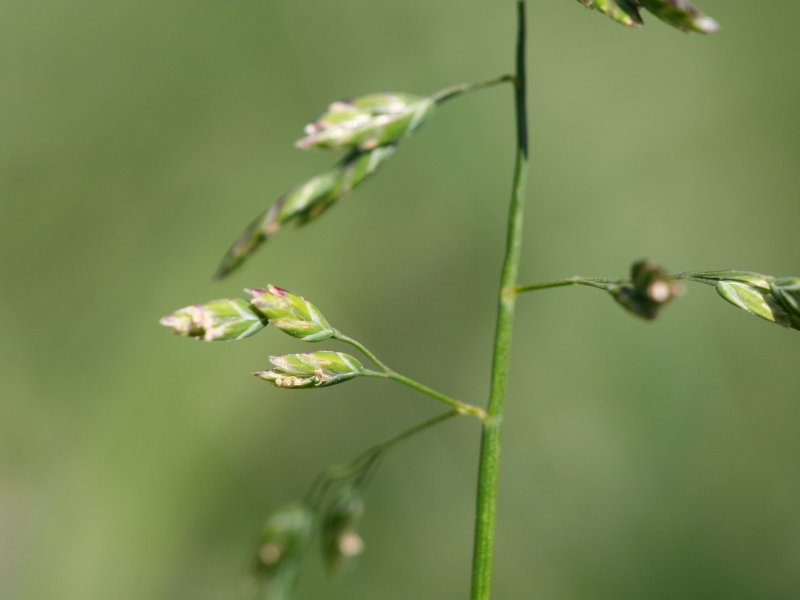
The scientific name of the Tussac Grass is Poa flabellata. It is a species of flowering plant in the family Poaceae (turf), order Poales.
- Scientific name
- Poa flabellata (Lam.) Raspail
- Common name
- Tussac Grass
- Genus
- Poa
- Family
- Poaceae (Turf)
- Order
- Poales
- Class
- Liliopsida
- Recorded in
- 8 countries
- Name status
- accepted in the Catalogue of Life

Overview
Tussac grass is native to Patagonia, the Falkland Islands, South Georgia and other islands in the South Atlantic. It grows in dense clumps that usually reach approximately 2 metres in height, with some clumps growing considerably taller.
Written 26 November 2026 from the sources listed below. Each statement was checked against the passage it cites; statements that could not be supported were removed.
Appearance
Tussac grass grows in dense clumps. It usually reaches approximately 2 metres in height, although some clumps grow considerably taller.[1][2]
Habitat
Tussac grass is a dominant component of much of the landscape where it grows. Plant communities dominated by the species are widely used by birds and mammals.[3][4]
Breeding colonies of southern fur seals, elephant seals, Magellanic penguins, macaroni penguins and albatrosses occur among tussac grass on South Georgia and elsewhere.[5][6][7][8][9]
On the Falkland Islands, the austral thrush is predominantly found in tussac grass habitat. The South Georgia pipit and austral thrush use its tussocks as nesting sites.[10][11][12]
Uses
Tussac grass was introduced to Shetland, Scotland, in 1844 for basket making. It may also have been introduced as a source of fodder.[13][14][15]
Diet
Tussac grass was a principal food source for introduced reindeer on South Georgia.[16]
Conservation
Introduced reindeer caused considerable environmental damage in areas of South Georgia where they fed on tussac grass. The reindeer were eradicated in 2015.[17][18]
In some places, introduced annual meadow-grass eventually replaced tussac grass following environmental damage caused by reindeer.[18][19]
Classification of the Tussac Grass
| Kingdom | Plantae |
|---|---|
| Subkingdom | Pteridobiotina |
| Phylum | Tracheophyta |
| Class | Liliopsida |
| Order | Poales |
| Family | Poaceae (Turf) |
| Genus | Poa (Bluegrass) |
| Species | Poa flabellata (Lam.) Raspail |
Where the Tussac Grass is found
Checklists and occurrence records place Poa flabellata in 8 countries across Africa, Antarctica, Europe and South America. GBIF holds 515 georeferenced records of it.
Countries where it is native or its origin is not stated
- Antarctica 4
- Argentina 54
- Chile 17
- Falkland Islands 201
- Saint Helena 18
- South Georgia and the South Sandwich Islands 184
Countries where it has been introduced
Regions and cities with the most records
- Grytviken, South Georgia and the South Sandwich Islands 109
- Stanley, Falkland Islands 67
- Tierra del Fuego, Argentina 18
- Scotland, United Kingdom 8
- Tristan da Cunha, Saint Helena 5
2 more countries have a few records outside this range
These countries hold a few records of Poa flabellata but lie outside the range the checklists give for it. Such records are often zoo or garden specimens, museum material or vagrants, so the species is not counted as occurring there.
A number beside a place is its count of GBIF occurrence records. A place without a number comes from a checklist alone. Records show where a species has been observed or collected, which can include escapes and vagrants.
Common names
English
- Tussac Grass
- Tussac-Grass
- Tussock Grass
Names in 1 other language
- Welsh
- Gwennwell Twmpathog, Gweunwellt Twmpathog
Synonyms
13 other scientific names have been used for this species and are now treated as synonyms of Poa flabellata.
- Dactylis caespitosa G.Forst.
- Dactylis caespitosa J.R.Forst.
- Festuca flabellata Lam.
- Festuca urvilleana Steud.
- Parodiochloa flabellata (Lam.) C.E.Hubb.
- Poa controversa var. minor Steud.
- Poa flabellata (Lam.) Hook.fil.
- Poa forsteri Steud.
- Sesleria americana Nees ex Steud.
- Festuca antarctica Spreng. ambiguous synonym
- Festuca caespitosa (J.R.Forst.) Roem. & Schult. ambiguous synonym
- Poa caespitosa (J.R.Forst.) Speg. ambiguous synonym
- Poa controversa Steud. ambiguous synonym
Related species
-
 Kentucky BluegrassPoa pratensis
-
 Annual BluegrassPoa annua
-
 Rough BluegrassPoa trivialis
-
 Common Tussock-grassPoa labillardierei
-
 Bulbous BluegrassPoa bulbosa
-
 Alpine Meadow GrassPoa alpina
-
 Sandberg BluegrassPoa secunda
-
 Snow GrassPoa sieberiana
Compare
Questions and answers
What is the scientific name of the Tussac Grass?
The scientific name of the Tussac Grass is Poa flabellata. Written with its author, the full name is Poa flabellata (Lam.) Raspail.
Which family does the Tussac Grass belong to?
Poa flabellata belongs to the family Poaceae, in the order Poales and the class Liliopsida.
Where is the Tussac Grass found?
Checklists and occurrence records place Poa flabellata in 8 countries, including Falkland Islands, South Georgia and the South Sandwich Islands, Argentina, Saint Helena, Chile and Antarctica.
What other names does the Tussac Grass have?
Poa flabellata is also known in English as Tussac-Grass and Tussock Grass.
What is a grass tussock?
A tussock is a dense clump of grass. Tussac grass grows in dense clumps, usually reaching approximately 2 metres in height, although some clumps grow considerably taller.[1][2]
What is coastal tussock grass?
Tussac grass is a species native to Patagonia, the Falkland Islands, South Georgia and other islands in the South Atlantic.[20]
Sources
Passages the profile rests on
- The species grows in dense clumps. Source passage: “It grows in dense clumps, usually about 2 metres (6 ft 7 in) high” — English Wikipedia
- The species usually reaches approximately 2 metres in height, although some clumps grow considerably taller. Source passage: “usually about 2 metres (6 ft 7 in) high (although they can be much taller)” — English Wikipedia
- The species is a dominant component of much of the landscape where it grows. Source passage: “and is a dominant feature of much of the landscape.” — English Wikipedia
- Plant communities dominated by this species are widely used by birds and mammals. Source passage: “The plant community dominated by P. flabellata is widely used by birds and mammals.” — English Wikipedia
- Breeding colonies of southern fur seals occur among this species on South Georgia and elsewhere. Source passage: “Breeding colonies of southern fur seal, elephant seal, Magellanic penguin, macaroni penguin, and albatrosses are all found amongst tussac grass on South Georgia and elsewhere.” — English Wikipedia
- Breeding colonies of elephant seals occur among this species on South Georgia and elsewhere. Source passage: “Breeding colonies of southern fur seal, elephant seal, Magellanic penguin, macaroni penguin, and albatrosses are all found amongst tussac grass on South Georgia and elsewhere.” — English Wikipedia
- Breeding colonies of Magellanic penguins occur among this species on South Georgia and elsewhere. Source passage: “Breeding colonies of southern fur seal, elephant seal, Magellanic penguin, macaroni penguin, and albatrosses are all found amongst tussac grass on South Georgia and elsewhere.” — English Wikipedia
- Breeding colonies of macaroni penguins occur among this species on South Georgia and elsewhere. Source passage: “Breeding colonies of southern fur seal, elephant seal, Magellanic penguin, macaroni penguin, and albatrosses are all found amongst tussac grass on South Georgia and elsewhere.” — English Wikipedia
- Albatross breeding colonies occur among this species on South Georgia and elsewhere. Source passage: “Breeding colonies of southern fur seal, elephant seal, Magellanic penguin, macaroni penguin, and albatrosses are all found amongst tussac grass on South Georgia and elsewhere.” — English Wikipedia
- The austral thrush is predominantly found in this species' habitat on the Falkland Islands. Source passage: “The austral thrush is predominantly found in this habitat on the Falkland Islands” — English Wikipedia
- The South Georgia pipit uses the species' tussocks as nesting sites. Source passage: “The South Georgia pipit also uses the tussocks for nesting.” — English Wikipedia
- The austral thrush uses the species' tussocks as nesting sites. Source passage: “with tussocks being used as nesting sites.” — English Wikipedia
- The species was introduced to Shetland, Scotland, in 1844. Source passage: “It was introduced to Shetland, Scotland for basket making in 1844” — English Wikipedia
- The species was introduced to Shetland for basket making. Source passage: “It was introduced to Shetland, Scotland for basket making in 1844” — English Wikipedia
- The species may have been introduced to Shetland as a source of fodder. Source passage: “and possibly as a source of fodder because of its ability to grow in hostile conditions..” — English Wikipedia
- The species was a principal food source for introduced reindeer on South Georgia. Source passage: “On South Georgia, it was a principal food of the introduced reindeer” — English Wikipedia
- Introduced reindeer that fed on the species on South Georgia were eradicated in 2015. Source passage: “which was eradicated in 2015” — English Wikipedia
- Introduced reindeer caused considerable environmental damage in areas where they fed on the species. Source passage: “which had caused considerable environmental damage, including erosion” — English Wikipedia
- In some places, introduced annual meadow-grass eventually replaced this species following environmental damage caused by reindeer. Source passage: “eventual replacement of tussac grass in places by the introduced annual meadow-grass.” — English Wikipedia
- The species is native to Patagonia, the Falkland Islands, South Georgia and other islands in the South Atlantic. Source passage: “native to Patagonia, the Falkland Islands, South Georgia and other islands in the South Atlantic.” — English Wikipedia
Data
- Catalogue of Life, 2026-10-16 XR cc by
- Global Biodiversity Information Facility CC BY 4.0
- Wikidata CC0
- GeoNames CC BY 4.0
- Wikimedia Commons per image; credit shown with each image
- Within the Catalogue of Life, this name comes from The World Checklist of Vascular Plants (WCVP) cc by
References
- Ann. Sci. Observ. 2: 76, 78 (1829) where the name was published
This species in other databases
Page built on 27 November 2026. See how the catalog is made and all sources and licences.
Cite this page
ScientificNames.org. (2026). Poa flabellata (Tussac Grass). Retrieved November 27, 2026, from https://scientificnames.org/species/poa-flabellata
“Poa flabellata (Tussac Grass).” ScientificNames.org, 2026, scientificnames.org/species/poa-flabellata. Accessed 27 Nov. 2026.
ScientificNames.org. “Poa flabellata (Tussac Grass).” Accessed November 27, 2026. https://scientificnames.org/species/poa-flabellata.
@misc{scientificnames_poa_flabellata_tussac_grass,
  author = {{ScientificNames.org}},
  title = {Poa flabellata (Tussac Grass)},
  year = {2026},
  url = {https://scientificnames.org/species/poa-flabellata},
  note = {Accessed 2026-11-27}
}