Species · Flowering plants
Kentucky Bluegrass Poa pratensis
The scientific name of the Kentucky Bluegrass is Poa pratensis. It is a species of flowering plant in the family Poaceae (turf), order Poales.
- Scientific name
- Poa pratensis L.
- Common name
- Kentucky Bluegrass
- Genus
- Poa
- Family
- Poaceae (Turf)
- Order
- Poales
- Class
- Liliopsida
- Red List category
- LC Least Concern
- Recorded in
- 101 countries
- Name status
- accepted in the Catalogue of Life

Overview
Poa pratensis is native to practically all of Europe and the mountains of Algeria, Morocco, and Tunisia, and is widely distributed across North America. It has narrowly linear leaves with boat-shaped tips and a conical inflorescence measuring 5–20 centimetres in length.
Written 26 November 2026 from the sources listed below. Each statement was checked against the passage it cites; statements that could not be supported were removed.
Appearance
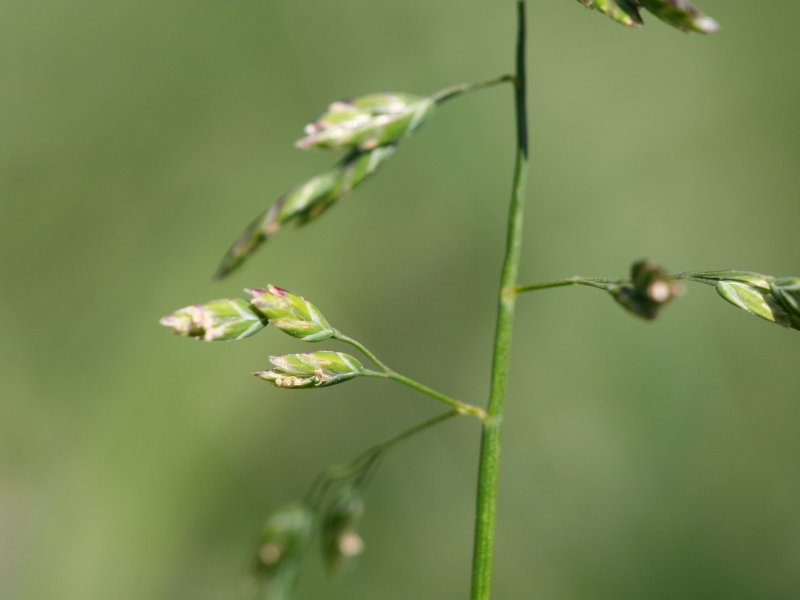
Kentucky bluegrass has narrowly linear leaves with boat-shaped tips. The leaves are smooth or slightly roughened, with a prominent mid-vein in their blades.[1][2][3]
The plant has a conical inflorescence measuring 5–20 centimetres in length, with 3 to 5 branches in its basal whorls. Its oval spikelets contain 2 to 5 florets and are purplish-green or grey.[4][5][6][7]
The ligule is extremely short and square-ended. The plant is dark green or blue and has a creeping rootstock with runners called rhizomes.[8][9][10]
The leaves spread near the base to form close mats. The plant reaches 30–70 centimetres in height.[11][12]
The leaves can reach 20 centimetres in length and are 3–5 millimetres wide. The ligule measures 1–2 millimetres in length, and the spikelets measure 3–6 millimetres in length.[13][14][15][16]
Reproduction and life cycle
Kentucky bluegrass flowers from May through July. It can spread through underground runners called rhizomes.[17][18]
Diet
The meadow brown butterfly and gatekeeper butterfly use Kentucky bluegrass as a food plant for their caterpillars.[19][20]
The common sun beetle feeds on the developing seeds. The grassbug Myrmus miriformis feeds on the young blades and developing seeds.[21][22]
The club-horned grasshopper feeds on the plant's blades, seeds, and glumes.[23]
Uses
Kentucky bluegrass is widely used as a lawn grass in North America and is used to establish lawns in parks and gardens. It provides a valuable pasture plant in its native range.[24][25][26]
Classification of the Kentucky Bluegrass
| Kingdom | Plantae |
|---|---|
| Subkingdom | Pteridobiotina |
| Phylum | Tracheophyta |
| Class | Liliopsida |
| Order | Poales |
| Family | Poaceae (Turf) |
| Genus | Poa (Bluegrass) |
| Species | Poa pratensis L. |
Where the Kentucky Bluegrass is found
Checklists and occurrence records place Poa pratensis in 101 countries across Africa, Antarctica, Asia, Europe, North America, Oceania and South America. GBIF holds 910,742 georeferenced records of it.
Countries where it is native or its origin is not stated
- Afghanistan 50
- Aland Islands 1,141
- Albania 6
- Andorra 51
- Armenia 33
- Austria 7,886
- Azerbaijan 14
- Belarus 167
- Belgium 23,206
- Bhutan 7
- Bulgaria 67
- China 1,403
- Croatia 35
- Cyprus 8
- Czechia 8,460
- Denmark 87,690
- Estonia 2,895
- Faroe Islands 69
- Finland 24,593
- France 161,686
- Georgia 21
- Germany 42,243
- Greece 255
- Greenland 1,480
- Guernsey 5
- Hungary 119
- Iceland 2,477
- India 164
- Indonesia 3
- Iran 59
- Iraq 6
- Ireland 573
- Isle of Man 2,863
- Italy 893
- Kazakhstan 169
- Kyrgyzstan 130
- Latvia 185
- Liechtenstein 33
- Lithuania 127
- Luxembourg 5,827
- Moldova 4
- Mongolia 213
- Myanmar
- Nepal 45
- North Korea 46
- Norway 16,920
- Pakistan 180
- Palestinian Territory 4
- Philippines 7
- Poland 40,014
- Romania 52
- Russia 8,245
- Saint Pierre and Miquelon 10
- Serbia 4
- Slovakia 14,720
- Slovenia 251
- South Korea 1,855
- Svalbard and Jan Mayen 100
- Sweden 42,420
- Switzerland 33,635
- Syria 3
- Tajikistan 133
- The Netherlands 110,157
- Turkey 135
- Turkmenistan 4
- Ukraine 2,825
- United Kingdom 219,380
- Uzbekistan 25
- Yemen
Countries where it has been introduced
- Algeria 7
- Argentina 318
- Australia 1,635
- Bermuda 3
- Bolivia 29
- Brazil 19
- Canada 5,512
- Chile 205
- Costa Rica 19
- Dominican Republic 2
- Ecuador 31
- Falkland Islands 21
- French Southern Territories 37
- Haiti 19
- Jamaica 1
- Japan 2,477
- Lesotho 15
- Mexico 201
- Morocco 10
- New Zealand 1,143
- Peru 13
- Portugal 144
- Puerto Rico
- Reunion 13
- Saint Helena 35
- South Africa 112
- South Georgia and the South Sandwich Islands 57
- Spain 7,619
- Sri Lanka 3
- Taiwan 3
- United States 22,544
- Uruguay 9
Regions and cities with the most records
- England, United Kingdom 154,686
- Auvergne-Rhône-Alpes, France 40,751
- Scotland, United Kingdom 36,159
- Central Jutland, Denmark 25,195
- Bourgogne-Franche-Comté, France 21,072
- Bavaria, Germany 18,287
- Centre-Val de Loire, France 17,273
- South Denmark, Denmark 15,953
- Île-de-France, France 15,737
- Benthuizen, The Netherlands 14,331
- Leiderdorp, The Netherlands 14,295
- Zealand, Denmark 13,806
- Leiden, The Netherlands 13,766
- North Rhine-Westphalia, Germany 13,670
- Zoetermeer, The Netherlands 13,351
- Voorschoten, The Netherlands 13,199
- Oegstgeest, The Netherlands 13,132
- Sassenheim, The Netherlands 13,029
- Gelderland, The Netherlands 12,784
- Grand Est, France 12,647
- Wassenaar, The Netherlands 12,592
- Noordwijk-Binnen, The Netherlands 12,258
- Katwijk aan Zee, The Netherlands 12,071
- Wales, United Kingdom 11,499
- Pijnacker, The Netherlands 11,490
- Voorburg, The Netherlands 11,217
- Alphen aan den Rijn, The Netherlands 11,185
- Nootdorp, The Netherlands 11,152
- Lisse, The Netherlands 10,813
- Provence-Alpes-Côte d'Azur, France 10,751
- Ypenburg, The Netherlands 10,749
- Hauts-de-France, France 10,559
- The Hague, The Netherlands 10,310
- Rijswijk, The Netherlands 10,027
- Scheveningen, The Netherlands 10,024
- Delft, The Netherlands 9,974
3 more countries have a few records outside this range
These countries hold a few records of Poa pratensis but lie outside the range the checklists give for it. Such records are often zoo or garden specimens, museum material or vagrants, so the species is not counted as occurring there.
A number beside a place is its count of GBIF occurrence records. A place without a number comes from a checklist alone. Records show where a species has been observed or collected, which can include escapes and vagrants.
Common names
English
- Kentucky Bluegrass
- English Meadow Grass
- Meadow Grass
- Smooth Meadow Grass
- Smooth Meadow-Grass
- Smooth Stalked Meadow Grass
- Speargrass
- Wintergrass
- Blue Grass
- Common Meadow-grass
Names in 33 other languages
- Arabic
- حشيشة المروج, حشيشة كنتاكي, قبأ المروج, كلئية مرجية
- Belarusian
- Метлюжок лугавы
- Bulgarian
- Ливадна ливадина
- Chinese
- cao di zao shu he, 草地早熟禾
- Czech
- lipnice luční
- Danish
- Eng-rapgræs
- Dutch
- Veldbeemdgras
- Estonian
- aasnurmikas
- Faroese
- eingjarhúsagras
- Finnish
- niittynurmikka
- French
- foin à vaches, pâturin des prés
- German
- Gewöhnliches Wiesen-Rispengras, Wiesen-Rispengras, Wiesenrispengras
- Hebrew
- סיסנית האחו
- Hungarian
- réti perje
- Icelandic
- Vallarsveifgras
- Italian
- Fienarola dei prati, erba fienarola
- Japanese
- nagahagusa, ナガハグサ
- Korean
- wangpoapul, 왕포아풀
- Lithuanian
- Pievinė miglė
- Northern Sami
- gieddesuoidni
- Norwegian Bokmål
- engrapp
- Polish
- Wiechlina łąkowa
- Portuguese
- capim-do-campo
- Russian
- mjatlik lugovoj, Мятлик луговой
- Slovak
- lipnica lúčna
- Slovenian
- travniška latovka
- Spanish
- Grama de Prados, Poa Común, Zacate Poa, Zacate azul de Kentucky
- Swedish
- ängsgröe
- Turkish
- Çayır Salkımotu
- Ukrainian
- Тонконіг лучний
- Welsh
- Gwellt y Gweunydd, Gweunwellt, Gweunwellt Llyfn
- chm
- ваштыраш шуды
- nav
- Tsétahtł’oh
Synonyms
9 other scientific names have been used for this species and are now treated as synonyms of Poa pratensis.
- Paneion pratense (L.) Lunell
- Poa anceps Hegetschw.
- Poa angustifolia subsp. pratensis (L.) K.Richt.
- Poa angustifolia var. pratensis (L.) Simonk.
- Poa bourgaei E.Fourn.
- Poa pratensis subsp. eu-pratensis Hiitonen
- Poa pratensis subsp. vulgaris Gaudin
- Poa pratensis var. major Roth
- Poa pratensis var. pratensis
Subspecies and varieties
- Poa pratensis subsp. dolichophylla subspecies
- Poa pratensis subsp. jordanii subspecies
- Poa pratensis subsp. oligantha subspecies
- Poa pratensis subsp. pratensis (Kentucky Bluegrass) subspecies
- Poa pratensis subsp. turfosa subspecies
Related species
-
 Annual BluegrassPoa annua
-
 Rough BluegrassPoa trivialis
-
 Common Tussock-grassPoa labillardierei
-
 Bulbous PoaPoa bulbosa
-
 BluegrassPoa alpina
-
 Tussac GrassPoa flabellata
-
 Big BluegrassPoa secunda
-
 Snow GrassPoa sieberiana
Compare
Questions and answers
What is the scientific name of the Kentucky Bluegrass?
The scientific name of the Kentucky Bluegrass is Poa pratensis. Written with its author, the full name is Poa pratensis L..
Which family does the Kentucky Bluegrass belong to?
Poa pratensis belongs to the family Poaceae, in the order Poales and the class Liliopsida.
Where is the Kentucky Bluegrass found?
Checklists and occurrence records place Poa pratensis in 101 countries, including United Kingdom, France, The Netherlands, Denmark, Sweden and Germany.
What is the conservation status of the Kentucky Bluegrass?
The IUCN Red List category recorded for Poa pratensis is Least Concern (LC).
What other names does the Kentucky Bluegrass have?
Poa pratensis is also known in English as English Meadow Grass, Meadow Grass, Smooth Meadow Grass, Smooth Meadow-Grass, Smooth Stalked Meadow Grass and Speargrass.
What is the common name for Poa pratensis?
Kentucky bluegrass is a common name for Poa pratensis.[27]
Why is Poa pratensis called bluegrass?
The common name Kentucky bluegrass refers to the blue colour of the flower heads when the plant reaches its natural height.[27]
What is meadow-grass good for?
Kentucky bluegrass is widely used as a lawn grass in North America, establishes lawns in parks and gardens, and provides a valuable pasture plant in its native range.[24][25][26]
What eats Kentucky bluegrass?
Caterpillars of the meadow brown butterfly and gatekeeper butterfly feed on Kentucky bluegrass. The common sun beetle feeds on its developing seeds, Myrmus miriformis feeds on its young blades and developing seeds, and the club-horned grasshopper feeds on its blades, seeds, and glumes.[19][20][21][22][23]
Sources
Passages the profile rests on
- The plant has narrowly linear leaves with boat-shaped tips. Source passage: “The leaves have boat-shaped tips, narrowly linear” — English Wikipedia
- The leaves are smooth or slightly roughened. Source passage: “smooth or slightly roughened” — English Wikipedia
- The plant has a prominent mid-vein in its leaf blades. Source passage: “Poa pratensis has a fairly prominent mid-vein (center of the blade).” — English Wikipedia
- The plant has a conical inflorescence measuring 5–20 centimetres in length. Source passage: “The conical panicle is 5–20 centimetres (2–8 in) long” — English Wikipedia
- The inflorescence has 3 to 5 branches in its basal whorls. Source passage: “with 3 to 5 branches in the basal whorls” — English Wikipedia
- The spikelets are oval and contain 2 to 5 florets. Source passage: “the oval spikelets are 3–6 millimetres (0.12–0.24 in) long with 2 to 5 florets” — English Wikipedia
- The spikelets are purplish-green or grey. Source passage: “and are purplish-green or grey.” — English Wikipedia
- The ligule is extremely short and has a square-ended shape. Source passage: “The ligule is extremely short and square-ended” — English Wikipedia
- The plant is dark green or blue in colour. Source passage: “The Kentucky bluegrass is a dark green/blue” — English Wikipedia
- The plant has a creeping rootstock with runners called rhizomes. Source passage: “The rootstock is creeping, with runners (rhizomes).” — English Wikipedia
- The leaves spread near the base to form close mats. Source passage: “The broad, blunt leaves tend to spread at the base, forming close mats.” — English Wikipedia
- The species is described as a herbaceous perennial reaching 30–70 centimetres in height. Source passage: “Poa pratensis is a herbaceous perennial plant 30–70 centimetres (12–28 in) tall.” — English Wikipedia
- Its leaves can reach 20 centimetres in length. Source passage: “up to 20 centimetres (8 in) long” — English Wikipedia
- Its leaves are 3–5 millimetres wide. Source passage: “3–5 millimetres (0.12–0.20 in) broad” — English Wikipedia
- Its ligule measures 1–2 millimetres in length. Source passage: “with a rounded to truncate ligule 1–2 millimetres (0.039–0.079 in) long.” — English Wikipedia
- Its spikelets measure 3–6 millimetres in length. Source passage: “the oval spikelets are 3–6 millimetres (0.12–0.24 in) long” — English Wikipedia
- The species flowers from May through July. Source passage: “They are in flower from May to July” — English Wikipedia
- The species can spread through underground runners called rhizomes. Source passage: “The rootstock is creeping, with runners (rhizomes).” — English Wikipedia
- The species is a food plant for caterpillars of the meadow brown butterfly. Source passage: “among the food plants of the caterpillars of the meadow brown (Maniola jurtina)” — English Wikipedia
- The species is a food plant for caterpillars of the gatekeeper butterfly. Source passage: “gatekeeper (Pyronia tithonus)” — English Wikipedia
- The common sun beetle feeds on the developing seeds of the species. Source passage: “the common sun beetle (Amara aenea) (adults feed on the developing seeds)” — English Wikipedia
- The grassbug Myrmus miriformis feeds on the plant's young blades and developing seeds. Source passage: “the grassbug Myrmus miriformis (feeds on young blades and developing seeds)” — English Wikipedia
- The club-horned grasshopper feeds on the plant's blades, seeds, and glumes. Source passage: “the club-horned grasshopper (Aeropedellus clavatus) (feeds on the blades, seeds, and glumes).” — English Wikipedia
- The species is widely used as a lawn grass in North America. Source passage: “It is a very popular lawn grass in North America” — English Wikipedia
- The species is used to establish lawns in parks and gardens. Source passage: “It is also used for making lawns in parks and gardens” — English Wikipedia
- The species provides a valuable pasture plant in its native range. Source passage: “In its native range, Poa pratensis forms a valuable pasture plant” — English Wikipedia
- The common name Kentucky bluegrass refers to the blue colour of the flower heads when the plant reaches its natural height. Source passage: “The name Kentucky bluegrass derives from its flower heads, which are blue when the plant is allowed to grow to its natural height of 60 to 90 cm (2 to 3 feet).” — English Wikipedia
Data
- Catalogue of Life, 2026-10-16 XR cc by
- Global Biodiversity Information Facility CC BY 4.0
- Wikidata CC0
- GeoNames CC BY 4.0
- Wikimedia Commons per image; credit shown with each image
- Within the Catalogue of Life, this name comes from The World Checklist of Vascular Plants (WCVP) cc by
References
- Sp. Pl. 1: 67. 1753 [1 May 1753] Link where the name was published
This species in other databases
Page built on 26 November 2026. See how the catalog is made and all sources and licences.
Cite this page
ScientificNames.org. (2026). Poa pratensis (Kentucky Bluegrass). Retrieved November 26, 2026, from https://scientificnames.org/species/poa-pratensis
“Poa pratensis (Kentucky Bluegrass).” ScientificNames.org, 2026, scientificnames.org/species/poa-pratensis. Accessed 26 Nov. 2026.
ScientificNames.org. “Poa pratensis (Kentucky Bluegrass).” Accessed November 26, 2026. https://scientificnames.org/species/poa-pratensis.
@misc{scientificnames_poa_pratensis_kentucky_bluegrass,
  author = {{ScientificNames.org}},
  title = {Poa pratensis (Kentucky Bluegrass)},
  year = {2026},
  url = {https://scientificnames.org/species/poa-pratensis},
  note = {Accessed 2026-11-26}
}