Species · Flowering plants
Common Tussock-grass Poa labillardierei
The scientific name of the Common Tussock-grass is Poa labillardierei. It is a species of flowering plant in the family Poaceae (turf), order Poales.
- Scientific name
- Poa labillardierei Steud.
- Common name
- Common Tussock-grass
- Genus
- Poa
- Family
- Poaceae (Turf)
- Order
- Poales
- Class
- Liliopsida
- Recorded in
- 2 countries
- Name status
- accepted in the Catalogue of Life

Overview
Poa labillardierei is endemic to Australia, where it occurs in southern and eastern Australia and Tasmania. It forms dense, coarse tufts with long, greyish-green or blue-green leaves and flower heads that extend above the foliage.
Written 26 November 2026 from the sources listed below. Each statement was checked against the passage it cites; statements that could not be supported were removed.
Appearance
Common tussock-grass forms dense, coarse tufts and can reach 120 cm in height. Its leaves are mostly located at the base of the plant and are very long, with leaf blades reaching 80 cm in length and 3.5 mm in width.[1][2][3][4]
Its foliage is greyish-green or blue-green. The leaf blades are flat or rolled inward, moderately rigid and rough to the touch.[5][6]
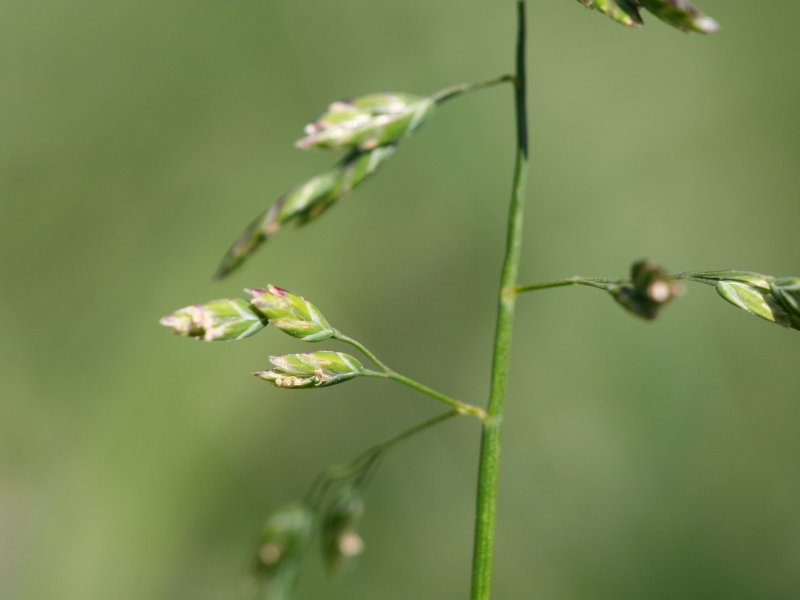
Its flower heads have erect or loosely spreading branches and form delicate plumes extending above the foliage. The inflorescences measure 10–25 cm in length.[7][8][9]
Its spikelets are strongly compressed from the sides and typically contain three to four flowers, although they can contain up to eight. Its lemmas are usually hairy, with abundant long hairs forming a web.[10][11][12]
Habitat
Common tussock-grass commonly grows in open forest and grassy woodland communities. It grows in moist areas on low slopes and valley floors that are frequently wet, as well as on river flats and open sheltered slopes.[13][14][15][16]
It occurs in the Victorian Volcanic Plains and Gippsland Plains Grassy Woodland. It can grow in clay loam, heavy clay, loam, sandy loam and sandy clay loam soils.[17][18]
Reproduction and life cycle
Common tussock-grass flowers from spring through summer. It can reproduce through seed germination or division.[19][20]
Its seeds germinate readily when sown in prepared soil during autumn and winter. Seedlings require moist soil to establish successfully.[21][22]
Its seeds can germinate in frost and tolerate temperatures between 0 and -5 °C.[23]
Behaviour
Common tussock-grass tolerates frost and has a fast growth rate. Established plants require very little maintenance and no irrigation, and have a shallow root system.[24][25][26][27]
It regenerates well after burning when fires are not very hot for prolonged periods. Its ability to regenerate after fire and outcompete other species contributes to its dominance in some grasslands.[28][29]
Rabbits and kangaroos can damage the grass through grazing.[30]
Diet
Common tussock-grass is not considered palatable to grazing animals.[31]
Conservation
Common tussock-grass can form the dominant ground layer in grasslands of southeastern Australia. Its ability to regenerate after fire and outcompete other species contributes to its dominance in some grasslands.[32][29]
It provides habitat for invertebrates with high abundance and species richness, and for reptiles including tussock skinks and blue tongue lizards. It also serves as a host plant for butterfly caterpillars.[33][34][35]
Uses
Its long leaves and stems are used to make string for basket making.[36]
Classification of the Common Tussock-grass
| Kingdom | Plantae |
|---|---|
| Subkingdom | Pteridobiotina |
| Phylum | Tracheophyta |
| Class | Liliopsida |
| Order | Poales |
| Family | Poaceae (Turf) |
| Genus | Poa (Bluegrass) |
| Species | Poa labillardierei Steud. |
Where the Common Tussock-grass is found
Checklists and occurrence records place Poa labillardierei in 2 countries across Oceania. GBIF holds 13,548 georeferenced records of it.
Countries where it is native or its origin is not stated
Countries where it has been introduced
Regions and cities with the most records
- Victoria, Australia 9,618
- Tasmania, Australia 2,467
- Balwyn North, Australia 686
- New South Wales, Australia 653
- Melbourne, Australia 587
- St Albans, Australia 525
- Burwood, Australia 495
- Ballarat, Australia 383
- Australian Capital Territory, Australia 343
- Frankston East, Australia 280
- Wallan, Australia 267
- Canberra, Australia 217
- Bacchus Marsh, Australia 196
- Torquay, Australia 187
- Hobart, Australia 184
- Geelong, Australia 175
- Tuggeranong, Australia 170
- Shepparton, Australia 92
- Launceston, Australia 77
- Traralgon, Australia 75
- Queensland, Australia 61
- South Australia, Australia 53
- Armidale, Australia 33
- Bairnsdale, Australia 29
- Adelaide, Australia 23
- Echuca, Australia 23
- Canterbury, New Zealand 22
- Wodonga, Australia 21
- Christchurch, New Zealand 19
- Wangaratta, Australia 19
- Warrnambool, Australia 19
- Devonport, Australia 18
- Parramatta, Australia 18
- Horsham, Australia 17
- Wollongong, Australia 15
- Batemans Bay, Australia 12
1 more country has a few records outside this range
These countries hold a few records of Poa labillardierei but lie outside the range the checklists give for it. Such records are often zoo or garden specimens, museum material or vagrants, so the species is not counted as occurring there.
A number beside a place is its count of GBIF occurrence records. A place without a number comes from a checklist alone. Records show where a species has been observed or collected, which can include escapes and vagrants.
Common names
English
- Common Tussock-grass
- Common Tussock Grass
- River Tussock
- River Tussock Grass
Names in 1 other language
- Chinese
- 澳洲早熟禾
Synonyms
2 other scientific names have been used for this species and are now treated as synonyms of Poa labillardierei.
- Poa labillardierei var. acris Vickery
- Poa billardierei Benth. ambiguous synonym
Related species
-
 Kentucky BluegrassPoa pratensis
-
 Annual BluegrassPoa annua
-
 Rough BluegrassPoa trivialis
-
 Bulbous BluegrassPoa bulbosa
-
 Alpine Meadow GrassPoa alpina
-
 Tussac GrassPoa flabellata
-
 Sandberg BluegrassPoa secunda
-
 Snow GrassPoa sieberiana
Compare
Questions and answers
What is the scientific name of the Common Tussock-grass?
The scientific name of the Common Tussock-grass is Poa labillardierei. Written with its author, the full name is Poa labillardierei Steud..
Which family does the Common Tussock-grass belong to?
Poa labillardierei belongs to the family Poaceae, in the order Poales and the class Liliopsida.
Where is the Common Tussock-grass found?
Checklists and occurrence records place Poa labillardierei in 2 countries, including Australia.
What other names does the Common Tussock-grass have?
Poa labillardierei is also known in English as Common Tussock Grass, River Tussock and River Tussock Grass.
Where does tussock grass grow?
Common tussock-grass grows in open forest and grassy woodland communities, moist areas on low slopes and frequently wet valley floors, river flats and open sheltered slopes. It occurs in the Victorian Volcanic Plains and Gippsland Plains Grassy Woodland.[13][14][15][16][18]
How can I grow poa labillardierei?
Common tussock-grass can be propagated through seed germination or division. Seeds germinate readily in prepared soil during autumn and winter, and seedlings require moist soil to establish successfully. Established plants require very little maintenance and no irrigation.[20][21][22][26]
Sources
Passages the profile rests on
- Poa labillardierei forms dense, coarse tufts of grass. Source passage: “Poa labillardierei is a dense coarsely tufted grasses” — English Wikipedia
- The grass can reach a height of 120 cm. Source passage: “can reach a height of 120 cm.” — English Wikipedia
- Its leaves are mostly located at the base of the plant and are very long. Source passage: “Leaves mostly basal, very long;” — English Wikipedia
- Its leaf blades can reach 80 cm in length and 3.5 mm in width. Source passage: “blade to 80 cm long, flat or inrolled, to 3.5 mm wide” — English Wikipedia
- Its leaf blades are flat or rolled inward, moderately rigid and rough to the touch. Source passage: “flat or inrolled, to 3.5 mm wide, scabrous, moderately rigid” — English Wikipedia
- Its foliage is greyish-green or blue-green. Source passage: “The greyish-green or blue-green leaves are long and slender” — anbg.gov.au
- Its flower heads have erect or loosely spreading branches. Source passage: “with erect or erectly and loosely spreading branches.” — English Wikipedia
- Its inflorescences measure 10–25 cm in length. Source passage: “Inflorescences are 10–25 cm long” — English Wikipedia
- Its flower heads form delicate plumes extending above the foliage. Source passage: “The flower heads are like delicate plumes that extend above the highly ornamental foliage” — anbg.gov.au
- Its spikelets typically contain three to four flowers, although they can contain up to eight. Source passage: “Spikelets 3–4(–8)-flowered” — English Wikipedia
- Its spikelets are strongly compressed from the sides. Source passage: “strongly laterally compressed.” — English Wikipedia
- Its lemmas are usually hairy, with abundant long hairs forming a web. Source passage: “usually hairy, web usually copious, consisting of long hairs;” — English Wikipedia
- The species commonly grows in open forest communities. Source passage: “most commonly growing in open forest communities” — English Wikipedia
- It commonly occurs in grassy woodland communities. Source passage: “grassy woodland communities” — English Wikipedia
- It grows in moist areas on low slopes and valley floors that are frequently wet. Source passage: “in moister areas on low slopes and valley floors that are frequently wet.” — English Wikipedia
- The species also grows on river flats and extends onto open sheltered slopes. Source passage: “They also grow on river flats and can extend up open sheltered slopes.” — English Wikipedia
- The species can grow in clay loam, heavy clay, loam, sandy loam and sandy clay loam soils. Source passage: “It can grow in clay loam, heavy clay, loam, sandy loam and sandy clay loam” — anbg.gov.au
- The species occurs in the Victorian Volcanic Plains and Gippsland Plains Grassy Woodland. Source passage: “Examples include in the Victorian Volcanic Plains, and Gippsland Plains Grassy Woodland.” — English Wikipedia
- The species flowers from spring through summer. Source passage: “Poa labillardierei flowers in spring to summer.” — English Wikipedia
- The species can reproduce through seed germination or division. Source passage: “germinates from seed or division.” — English Wikipedia
- Its seeds germinate readily when sown in prepared soil during autumn and winter. Source passage: “germinates readily from seed, into prepared soil in autumn and winter.” — anbg.gov.au
- Seedlings require moist soil to establish successfully. Source passage: “needs moist soil to establish.” — anbg.gov.au
- Its seeds can germinate in frost and tolerate temperatures between 0 and -5 °C. Source passage: “The seeds can germinate in frost and can tolerate a temperature in the 0 to -5 °C range.” — anbg.gov.au
- The species tolerates frost. Source passage: “This plant is additionally frost tolerant.” — English Wikipedia
- The species has a fast growth rate. Source passage: “Due to its fast growth rate and shallow root system plants establishes quickly.” — anbg.gov.au
- Established plants require very little maintenance and no irrigation. Source passage: “Once established, it needs very low maintenance and no irrigation.” — anbg.gov.au
- The species has a shallow root system. Source passage: “and shallow root system plants establishes quickly.” — anbg.gov.au
- It regenerates well after burning when fires are not very hot for prolonged periods. Source passage: “Poa labillardierei regenerates well after burning but the fire should not be very hot for a long time.” — anbg.gov.au
- Its ability to regenerate after fire and outcompete other species contributes to its dominance in some grasslands. Source passage: “due to its ability to regenerate well after fire and outcompete other species.” — English Wikipedia
- Rabbits and kangaroos can damage the grass through grazing. Source passage: “it can be damaged by grazing animals such as rabbits and kangaroos.” — anbg.gov.au
- The species is not considered palatable to grazing animals. Source passage: “While it is not considered palatable” — anbg.gov.au
- The species can form the dominant ground layer in grasslands of southeastern Australia. Source passage: “can form the dominant ground layer in grasslands of South-East Australia.” — English Wikipedia
- The species provides habitat for invertebrates with high abundance and species richness. Source passage: “provides excellent habitat for invertebrates, both in abundance and species richness.” — English Wikipedia
- The grass provides habitat for reptiles including tussock skinks and blue tongue lizards. Source passage: “Reptiles also rely on habitat provided by common tussock grass, including the tussock skink, and blue tongue lizard.” — English Wikipedia
- The species serves as a host plant for butterfly caterpillars. Source passage: “Butterfly (caterpillar) host” — melbourne.vic.gov.au
- Its long leaves and stems are used to make string for basket making. Source passage: “The long leaves and stems of Poa labillardierei are used as string for basket making.” — English Wikipedia
- The species is endemic to Australia. Source passage: “is endemic to Australia.” — English Wikipedia
- Its Australian distribution includes southern and eastern Australia and Tasmania. Source passage: “can be found in southern and eastern Australia including Tasmania” — anbg.gov.au
Data
- Catalogue of Life, 2026-10-16 XR cc by
- Global Biodiversity Information Facility CC BY 4.0
- Wikidata CC0
- GeoNames CC BY 4.0
- Wikimedia Commons per image; credit shown with each image
- Within the Catalogue of Life, this name comes from The World Checklist of Vascular Plants (WCVP) cc by
References
- Syn. Pl. Glumac. 1: 262 (1854) where the name was published
This species in other databases
- Catalogue of Life 4KM46
- Wikidata Q13943002
- iNaturalist 323470
- World Flora Online wfo-0000892722
- GRIN 468887
Page built on 29 November 2026. See how the catalog is made and all sources and licences.
Cite this page
ScientificNames.org. (2026). Poa labillardierei (Common Tussock-grass). Retrieved November 29, 2026, from https://scientificnames.org/species/poa-labillardierei
“Poa labillardierei (Common Tussock-grass).” ScientificNames.org, 2026, scientificnames.org/species/poa-labillardierei. Accessed 29 Nov. 2026.
ScientificNames.org. “Poa labillardierei (Common Tussock-grass).” Accessed November 29, 2026. https://scientificnames.org/species/poa-labillardierei.
@misc{scientificnames_poa_labillardierei_common_tussock_grass,
  author = {{ScientificNames.org}},
  title = {Poa labillardierei (Common Tussock-grass)},
  year = {2026},
  url = {https://scientificnames.org/species/poa-labillardierei},
  note = {Accessed 2026-11-29}
}