Species · Insects
Florida Harvester Ant Pogonomyrmex badius
The scientific name of the Florida Harvester Ant is Pogonomyrmex badius. It is a species of insect in the family Formicidae (ant), order Hymenoptera. The name dates from 1802.
- Scientific name
- Pogonomyrmex badius (Latreille, 1802)
- Common name
- Florida Harvester Ant
- Genus
- Pogonomyrmex
- Family
- Formicidae (Ant)
- Order
- Hymenoptera
- Class
- Insecta
- Recorded in
- 1 country
- Name status
- accepted in the Catalogue of Life

Overview
Pogonomyrmex badius occurs throughout most of Florida and is associated with Florida scrub and similar habitats within the Atlantic coastal plain. It is the only North American Pogonomyrmex known to be polymorphic.
Written 26 November 2026 from the sources listed below. Each statement was checked against the passage it cites; statements that could not be supported were removed.
Appearance
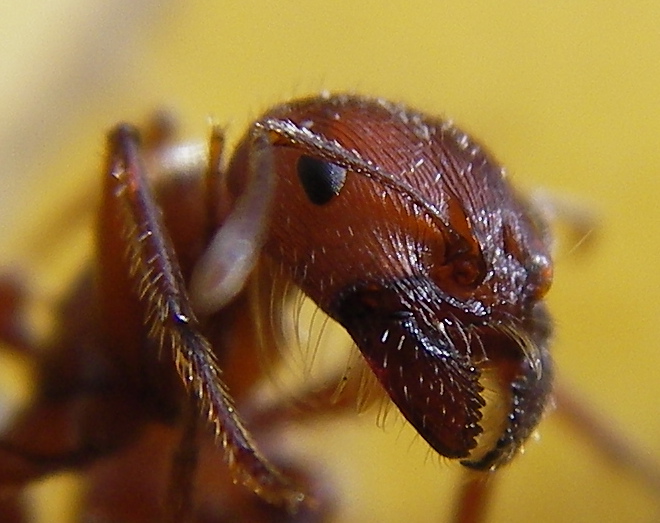
Worker ants are polymorphic. Queens, major workers, and intermediate workers have disproportionately large heads, while minor workers have a narrower appearance when viewed from the front.[1][2]
The species normally lacks epinotal spines on its propodeum, although these structures occasionally occur.[3]
Worker ants range from 6.35 mm for the smallest workers to 9.52 mm for the largest major workers. Queens measure approximately 10–12 mm in length.[4][5]
Habitat
Colonies primarily nest in well-drained sandy soils in xeric shrublands, grasslands, woodlands, and intact coastal dunes. Nesting sites are preferably open sandy areas with sparse vegetation and full sun exposure.[6][7]
Mature colonies construct nests that are usually 2.5–3.0 meters deep. Seeds are stored in underground granaries approximately 40–100 cm below the surface.[8][9]
The surface mound is flat, lacks surrounding vegetation, and contains detritus and charred plant material.[10]
Diet
The Florida harvester ant primarily consumes seeds and insects. Workers also regularly capture arthropod prey and show a stronger preference for protein-rich food than for seeds.[11][12]
Commonly collected grass seeds include those of Paspalum setaceum, Dicanthelium commutatum, and Croton michauxii. Workers collect seeds of various sizes but primarily open small seeds for consumption.[13][14]
Workers cannot crack open seeds wider than approximately 1–1.4 mm. Large seeds constitute at least 70% of the weight of stored seeds.[15][16]
Major workers increase the rate at which small and medium seeds are opened without expanding the range of seed sizes that can be opened.[17]
Behaviour
The Florida harvester ant is highly active during daylight hours and is adapted to hot and dry habitats in the southeastern United States.[18][19]
Mature colonies typically relocate their nests once annually, moving approximately 4–10 meters along an established foraging trail.[20]
Workers organize their activities according to age, with younger workers occupying deeper nest chambers and older workers moving toward the surface. Older workers undertake nest maintenance, nest defense, and food foraging.[21][22]
The species is relatively docile and generally stings only when physically trapped or forced to defend itself. Workers can leave their barbed stingers and venom sacs embedded in the skin of a target.[23][24]
Reproduction and life cycle
Colonies begin sexual reproduction when their worker population reaches approximately 700 individuals or more. Winged reproductive ants begin to be produced around spring.[25][26]
Nuptial flights are most frequently observed between May and June, with additional flights occurring in July. They occur on calm, sunny, humid mornings after heavy rainfall.[27][28]
Males fly from other nests to mate with females on the surface of their natal nest rather than mating in flight. Female reproductive ants mate with multiple males during successive mating flights over several days.[29][30]
Newly mated queens establish colonies after flying or walking away from their parent nest. Founding queens are fully claustral and rely on stored fat and wing muscles rather than leaving the nest to forage.[31][32]
Founding queens may temporarily cooperate in groups, although mature wild colonies have not been observed to maintain multiple queens.[33]
Classification of the Florida Harvester Ant
| Kingdom | Animalia |
|---|---|
| Phylum | Arthropoda |
| Subphylum | Hexapoda |
| Class | Insecta (Insect) |
| Order | Hymenoptera (Ants) |
| Suborder | Apocrita (Ants) |
| Infraorder | Aculeata |
| Superfamily | Formicoidea |
| Family | Formicidae (Ant) |
| Subfamily | Myrmicinae |
| Tribe | Pogonomyrmecini |
| Genus | Pogonomyrmex (Harvester Ants) |
| Species | Pogonomyrmex badius (Latreille, 1802) |
Where the Florida Harvester Ant is found
Checklists and occurrence records place Pogonomyrmex badius in 1 country. GBIF holds 6,222 georeferenced records of it.
Countries
Regions and cities with the most records
- Florida, United States 4,384
- Winter Springs, United States 895
- Oviedo, United States 883
- Casselberry, United States 877
- Alafaya, United States 875
- Winter Park, United States 850
- Altamonte Springs, United States 829
- Maitland, United States 829
- Orlando, United States 765
- Georgia, United States 564
- South Carolina, United States 267
- Mississippi, United States 252
- North Carolina, United States 230
- Gainesville, United States 202
- Greater Northdale, United States 198
- Lutz, United States 186
- Northdale, United States 178
- Citrus Park, United States 174
- Alabama, United States 173
- Lake Magdalene, United States 167
- Carrollwood Village, United States 160
- Westchase, United States 158
- Egypt Lake-Leto, United States 157
- Town 'n' Country, United States 156
- Carrollwood, United States 155
- Land O' Lakes, United States 155
- Keystone, United States 152
- Sanford, United States 151
- East Lake, United States 148
- DeBary, United States 147
- Tarpon Springs, United States 143
- Deltona, United States 140
- Myrtle Grove, United States 140
- West Pensacola, United States 139
- Bellview, United States 135
- Holiday, United States 133
A number beside a place is its count of GBIF occurrence records. A place without a number comes from a checklist alone. Records show where a species has been observed or collected, which can include escapes and vagrants.
Common names
English
- Florida Harvester Ant
Names in 2 other languages
- Dutch
- Florida-oogstmier
- Russian
- Флоридский муравей-жнец
Synonyms
7 other scientific names have been used for this species and are now treated as synonyms of Pogonomyrmex badius.
- Atta crudelis Smith, 1858
- Myrmica brevipennis Smith, 1858
- Myrmica transversa Smith, 1858
- Pogonomyrmex brevipennis (Smith, 1858)
- Pogonomyrmex crudelis (Smith, 1858)
- Pogonomyrmex transversa (Smith, 1858)
- Formica badia Latreille, 1802 ambiguous synonym
Related species
-
 Maricopa Harvester AntPogonomyrmex maricopa
-
 Red Harvester AntPogonomyrmex barbatus
-
 Western Harvester AntPogonomyrmex occidentalis
-
 California Harvester AntPogonomyrmex californicus
-
 Rough Harvester AntPogonomyrmex rugosus
-
 Comanche Harvester AntPogonomyrmex comanche
-
 Bicolored Harvester AntPogonomyrmex bicolor
-
 Pogonomyrmex anergismus
Compare
Questions and answers
What is the scientific name of the Florida Harvester Ant?
The scientific name of the Florida Harvester Ant is Pogonomyrmex badius. Written with its author, the full name is Pogonomyrmex badius (Latreille, 1802).
Which family does the Florida Harvester Ant belong to?
Pogonomyrmex badius belongs to the family Formicidae, in the order Hymenoptera and the class Insecta.
Where is the Florida Harvester Ant found?
Checklists and occurrence records place Pogonomyrmex badius in 1 country: United States.
What happens if a harvester ant bites you?
The species generally stings only when physically trapped or forced to defend itself. Workers can leave their barbed stingers and venom sacs embedded in the skin of a target.[23][24]
What food do harvester ants eat?
The Florida harvester ant primarily consumes seeds and insects. It also regularly captures arthropod prey and shows a stronger preference for protein-rich food than for seeds.[11][12]
Are harvester ants native to Florida?
The Florida harvester ant occurs throughout most of Florida and is associated with Florida scrub and similar habitats within the Atlantic coastal plain.[34][35]
Sources
Passages the profile rests on
- Worker ants are polymorphic, with queens, major workers, and intermediate workers having disproportionately large heads. Source passage: “Both queens, majors and intermediates have disproportionately large heads” — English Wikipedia
- Minor workers have a narrower appearance when viewed from the front. Source passage: “minors have a more narrow complexion when viewed at the front.” — English Wikipedia
- The species normally lacks epinotal spines on its propodeum, although these structures occasionally occur. Source passage: “Under normal circumstances this species lacks epinotal spines which sit parallel on the propodeum though these spines may occasionally be present.” — English Wikipedia
- Worker ants range from 6.35 mm for the smallest workers to 9.52 mm for the largest major workers. Source passage: “ranging from 6.35 mm for the smallest workers to 9.52 mm for the largest majors” — English Wikipedia
- Queens measure approximately 10–12 mm in length. Source passage: “the queen (10 - 12 mm) in size.” — English Wikipedia
- Colonies primarily nest in well-drained sandy soils in xeric shrublands, grasslands, woodlands, and intact coastal dunes. Source passage: “Colonies are near exclusively found nesting within well drained sandy soils in xeric shrublands, grasslands, woodlands, and intact coastal dunes.” — English Wikipedia
- Nesting sites are preferably open sandy areas with sparse vegetation and full sun exposure. Source passage: “Open sandy ground with sparse vegetation exposed to full sun is preferred as nesting sites.” — English Wikipedia
- Mature colonies construct nests that are usually 2.5–3.0 meters deep. Source passage: “The nests of mature colonies are very deep, usually 2.5 to 3.0 meters deep” — English Wikipedia
- Seeds are stored in underground granaries approximately 40–100 cm below the surface. Source passage: “seeds being stored about 40 - 100 cm below ground in large flat granaries.” — English Wikipedia
- The surface mound is flat, lacks surrounding vegetation, and contains detritus and charred plant material. Source passage: “the flat mound is free of peripheral vegetation and is decorated with detritus and charred plant matter” — English Wikipedia
- The species primarily consumes seeds and insects. Source passage: “The diet consists mainly of seeds and insects.” — English Wikipedia
- The ants regularly capture arthropod prey and show a stronger preference for protein-rich food than for seeds. Source passage: “Arthropod prey is regularly taken, with the ants having a stronger affinity for protein food items over the traditionally consumed seeds.” — English Wikipedia
- Commonly collected grass seeds include those of Paspalum setaceum, Dicanthelium commutatum, and Croton michauxii. Source passage: “Commonly harvested grass species includes those of Paspalum setaceum, Dicanthelium commutatum, Croton michauxii” — English Wikipedia
- Workers collect seeds of various sizes but primarily open small seeds for consumption. Source passage: “foragers collect a range of seed sizes but only open small seeds” — pmc.ncbi.nlm.nih.gov
- Workers cannot crack open seeds wider than approximately 1–1.4 mm. Source passage: “any seeds wider than 1 - 1.4 mm cannot be cracked open by the workers.” — English Wikipedia
- Large seeds constitute at least 70% of the weight of stored seeds. Source passage: “large seeds accumulate, forming 70% or more of the weight of seed stores.” — pmc.ncbi.nlm.nih.gov
- Major workers increase the rate at which small and medium seeds are opened without expanding the range of seed sizes that can be opened. Source passage: “Major workers increase the rates at which small and medium seeds are opened, but do not increase the size range of opened seeds.” — pmc.ncbi.nlm.nih.gov
- The species is highly active during daylight hours. Source passage: “The Florida Harvester ant is a highly active diurnal species” — English Wikipedia
- The species is adapted to hot and dry habitats in the southeastern United States. Source passage: “well adapted to the hot and dry habitats of the southeastern United States.” — English Wikipedia
- Mature colonies typically relocate their nests once annually, moving approximately 4–10 meters along an established foraging trail. Source passage: “colonies on average relocating once per year at a distance of 4 - 10 meters along an established foraging trail.” — English Wikipedia
- Workers organize their activities according to age, with younger workers occupying deeper nest chambers and older workers moving toward the surface. Source passage: “The youngest workers, which care for the brood and queen, reside in the deepest portions of the nest and as they age move closer to the surface” — English Wikipedia
- Older workers undertake nest maintenance, nest defense, and food foraging. Source passage: “take up the typically more perilous activities of maintaining and defending the nest as well as foraging for food.” — English Wikipedia
- The species is relatively docile and generally stings only when physically trapped or forced to defend itself. Source passage: “P. badius is also a rather docile ant, being reluctant to sting unless forced to” — English Wikipedia
- Workers can leave their barbed stingers and venom sacs embedded in the skin of a target. Source passage: “the barbed stinger and venom sac is left embedded in the skin to continuously pump venom.” — English Wikipedia
- Colonies begin sexual reproduction when their worker population reaches approximately 700 individuals or more. Source passage: “Colonies become sexually mature when the population reaches a minimum of ~700 or more workers” — English Wikipedia
- Winged reproductive ants begin to be produced around spring. Source passage: “with the production of winged reproductives beginning around spring.” — English Wikipedia
- Nuptial flights are most frequently observed between May and June, with additional flights occurring in July. Source passage: “Nuptial flights are most frequently observed from May to June with late season flights occurring in July.” — English Wikipedia
- Nuptial flights occur on calm, sunny, humid mornings after heavy rainfall. Source passage: “Flights occur during calm, sunny and humid mornings following a day of heavy rains which leave the ground moist.” — English Wikipedia
- Males fly from other nests to mate with females on the surface of their natal nest rather than mating in flight. Source passage: “Female and male alates do not mate in the air, and instead males fly in from other nests to mate with females on the surface of their parent nest.” — English Wikipedia
- Female reproductive ants mate with multiple males during successive mating flights over several days. Source passage: “Female alates mate with multiple males over subsequent mating flights in the following days.” — English Wikipedia
- Newly mated queens establish colonies after flying or walking away from their parent nest. Source passage: “The newly mated queens will either fly off or walk some distance away from their parent nest to establish a new colony.” — English Wikipedia
- Founding queens are fully claustral and rely on stored fat and wing muscles rather than leaving the nest to forage. Source passage: “Queens are fully claustral and do not venture out to feed when founding, instead solely relying on their fat reserves and wing muscles to sustain themselves and their brood.” — English Wikipedia
- Founding queens may temporarily cooperate in groups, although mature wild colonies have not been observed to maintain multiple queens. Source passage: “Founding queens may temporarily work together in a phenomenon known as pleometrosis, but true polygyny has never been observed in mature colonies in the wild.” — English Wikipedia
- The species occurs throughout most of Florida. Source passage: “occurs throughout most of Florida” — ask.ifas.ufl.edu
- The species is associated with Florida scrub and similar habitats within the Atlantic coastal plain. Source passage: “commonly found in Florida scrub and other similar habitats within the Atlantic coastal plain.” — English Wikipedia
Data
- Catalogue of Life, 2026-10-16 XR cc by
- Global Biodiversity Information Facility CC BY 4.0
- Wikidata CC0
- GeoNames CC BY 4.0
- Wikimedia Commons per image; credit shown with each image
- iNaturalist per image; credit shown with each image
- Within the Catalogue of Life, this name comes from An Online Catalog of the Ants of the World cc by
References
- Latreille, P. A. (1802). Histoire naturelle des fourmis, et recueil de mémoires et d’observations sur les abeilles, les araignées, les faucheurs, et autres insectes (p. xvi + 445 pp.). Impr. Crapelet (chez T. Barrois), Paris. https://antcat.org/documents/7992/latreille_1802_hist-_nat-_des_fourmis.pdf Link where the name was published
This species in other databases
Page built on 26 November 2026. See how the catalog is made and all sources and licences.
Cite this page
ScientificNames.org. (2026). Pogonomyrmex badius (Florida Harvester Ant). Retrieved November 26, 2026, from https://scientificnames.org/species/pogonomyrmex-badius
“Pogonomyrmex badius (Florida Harvester Ant).” ScientificNames.org, 2026, scientificnames.org/species/pogonomyrmex-badius. Accessed 26 Nov. 2026.
ScientificNames.org. “Pogonomyrmex badius (Florida Harvester Ant).” Accessed November 26, 2026. https://scientificnames.org/species/pogonomyrmex-badius.
@misc{scientificnames_pogonomyrmex_badius_florida_harvester_ant,
  author = {{ScientificNames.org}},
  title = {Pogonomyrmex badius (Florida Harvester Ant)},
  year = {2026},
  url = {https://scientificnames.org/species/pogonomyrmex-badius},
  note = {Accessed 2026-11-26}
}