Species · Insects
Western Harvester Ant Pogonomyrmex occidentalis
The scientific name of the Western Harvester Ant is Pogonomyrmex occidentalis. It is a species of insect in the family Formicidae (ant), order Hymenoptera. The name dates from 1865.
- Scientific name
- Pogonomyrmex occidentalis (Cresson, 1865)
- Common name
- Western Harvester Ant
- Genus
- Pogonomyrmex
- Family
- Formicidae (Ant)
- Order
- Hymenoptera
- Class
- Insecta
- Recorded in
- 3 countries
- Name status
- accepted in the Catalogue of Life

Overview
Pogonomyrmex occidentalis inhabits deserts and arid grasslands in western North America at elevations of 1,900 metres or lower. Workers are usually dark red, and colonies construct irregularly conical gravel mounds that can exceed 89 cm in diameter.
Written 26 November 2026 from the sources listed below. Each statement was checked against the passage it cites; statements that could not be supported were removed.
Habitat
The western harvester ant inhabits deserts and arid grasslands in western North America. It occurs at elevations of 1,900 metres or lower.[1][2]
The species builds conspicuous mounds in grasslands and forest openings in Nebraska and Kansas. Nest mounds are often surrounded by areas without vegetation.[3][4]
Appearance
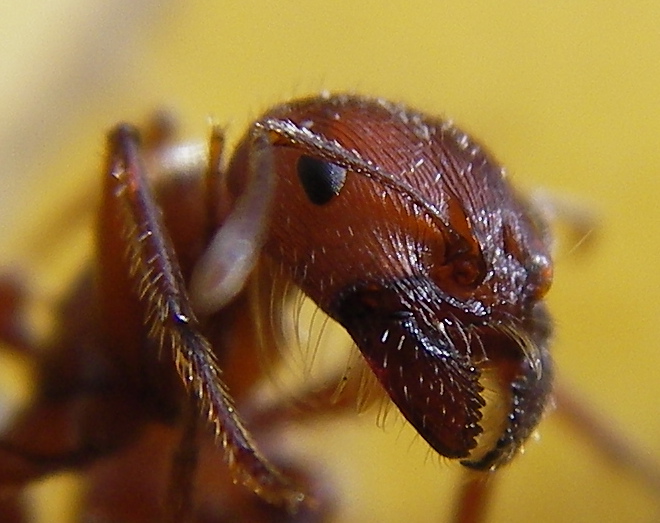
Workers are usually dark red. Workers in mature colonies average 6 mm in length, while the first workers produced by founding colonies are approximately 2 mm shorter than typical workers in established colonies.[5][6][7]
Colonies construct irregularly conical nest mounds consisting of gravel. A mound can exceed 89 cm in diameter, and the underground nest can reach 5 metres in depth.[8][9][10][11]
Diet
The western harvester ant is granivorous. Workers collect seeds and pollen directly from plants and gather fallen seeds, and they also collect newly dead insects as food.[12][13][14][15]
When given a choice, workers preferentially select seeds containing higher amounts of energy. They also prefer seed diversity or seeds that are new to their colony when alternatives are available.[16][17]
Behaviour
Workers generally forage between April and September. During summer, they generally forage between 5–11 am and 3–9 pm, while during cooler months they generally forage throughout the day.[18][19][20]
Workers usually specialize in collecting one kind of food item per day and change their specialization daily. They repeatedly forage in the same direction, sometimes across multiple days.[21][22]
Colonies recruit additional workers to forage at productive food sources. Workers defend their foraging territories against neighbouring colonies and are active when the surface temperature of their colony mound is between 25 and 53 °C.[23][24][25]
Workers usually move through different colony roles as they age. Workers live for an average of six months, and queens can live for up to 30 years.[26][27][28]
Mature colonies can contain as many as 20,000 workers and one queen. Many colonies survive for 20 years.[29][30]
Colonies store some collected seeds in underground chambers for use during winter. They stop producing brood before overwintering.[31][32]
Reproduction and life cycle
Individual queens establish new colonies without assistance from workers or other queens. Queens in some populations establish colonies through claustral founding, while queens in other populations use semi-claustral founding.[33][34]
Alates from different colonies are released synchronously and mate in swarms at hilltop leks. Queens mate with between two and eleven genetically distinct males, averaging 6.3 males, and female individuals always mate with multiple males.[35][36][37][38]
Queens that mate with more males establish colonies that grow faster. Before digging at their landing locations, queens select bare, bright areas for landing.[39][40]
Classification of the Western Harvester Ant
| Kingdom | Animalia |
|---|---|
| Phylum | Arthropoda |
| Subphylum | Hexapoda |
| Class | Insecta (Insect) |
| Order | Hymenoptera (Ants) |
| Suborder | Apocrita (Ants) |
| Infraorder | Aculeata |
| Superfamily | Formicoidea |
| Family | Formicidae (Ant) |
| Subfamily | Myrmicinae |
| Tribe | Pogonomyrmecini |
| Genus | Pogonomyrmex (Harvester Ants) |
| Species | Pogonomyrmex occidentalis (Cresson, 1865) |
Where the Western Harvester Ant is found
Checklists and occurrence records place Pogonomyrmex occidentalis in 3 countries. GBIF holds 7,386 georeferenced records of it.
Countries
Regions and cities with the most records
- Utah, United States 3,323
- Colorado, United States 1,383
- New Mexico, United States 734
- Arizona, United States 611
- South Salt Lake, United States 417
- Taylorsville, United States 403
- Kearns, United States 402
- Cottonwood Heights, United States 401
- Murray, United States 401
- Midvale, United States 400
- Millcreek, United States 398
- Holladay, United States 397
- West Valley City, United States 397
- Springville, United States 387
- Salt Lake City, United States 354
- East Millcreek, United States 344
- Bountiful, United States 343
- North Salt Lake, United States 343
- Centerville, United States 341
- Provo, United States 321
- American Fork, United States 314
- Pleasant Grove, United States 310
- Orem, United States 305
- Spanish Fork, United States 270
- Lafayette, United States 200
- Louisville, United States 195
- Denver, United States 186
- Broomfield, United States 184
- Erie, United States 182
- Thornton, United States 171
- Sherrelwood, United States 170
- Westminster, United States 170
- Wheat Ridge, United States 167
- West Jordan, United States 166
- Northglenn, United States 164
- Sandy, United States 163
A number beside a place is its count of GBIF occurrence records. A place without a number comes from a checklist alone. Records show where a species has been observed or collected, which can include escapes and vagrants.
Common names
English
- Western Harvester Ant
Names in 2 other languages
- Dutch
- Westerse oogstmier
- Spanish
- Hormiga cosechadora occidental
Synonyms
6 other scientific names have been used for this species and are now treated as synonyms of Pogonomyrmex occidentalis.
- Myrmica occidentalis Cresson, 1865
- Myrmica seminigra Cresson, 1865
- Pogonomyrmex occidentalis ruthveni Gaige, 1914
- Pogonomyrmex occidentalis utahensis Olsen, 1934
- Pogonomyrmex opaciceps Mayr, 1870
- Pogonomyrmex seminigra (Cresson, 1865)
Related species
-
 Maricopa Harvester AntPogonomyrmex maricopa
-
 Red Harvester AntPogonomyrmex barbatus
-
 Florida Harvester AntPogonomyrmex badius
-
 California Harvester AntPogonomyrmex californicus
-
 Rough Harvester AntPogonomyrmex rugosus
-
 Comanche Harvester AntPogonomyrmex comanche
-
 Bicolored Harvester AntPogonomyrmex bicolor
-
 Pogonomyrmex anergismus
Compare
Questions and answers
What is the scientific name of the Western Harvester Ant?
The scientific name of the Western Harvester Ant is Pogonomyrmex occidentalis. Written with its author, the full name is Pogonomyrmex occidentalis (Cresson, 1865).
Which family does the Western Harvester Ant belong to?
Pogonomyrmex occidentalis belongs to the family Formicidae, in the order Hymenoptera and the class Insecta.
Where is the Western Harvester Ant found?
Checklists and occurrence records place Pogonomyrmex occidentalis in 3 countries: United States, Mexico and Canada.
How venomous are harvester ants?
The western harvester ant has a painful, venomous sting.[41]
What do western harvester ants eat?
Western harvester ants consume seeds and pollen collected from plants. Workers also collect newly dead insects as food.[12][13][14]
Sources
Passages the profile rests on
- The species inhabits deserts and arid grasslands in western North America. Source passage: “inhabits the deserts and arid grasslands of the American West and Canada” — English Wikipedia
- The species occurs at elevations of 1,900 metres or lower. Source passage: “at or below 6,300 feet (1,900 m)” — English Wikipedia
- Nest mounds are often surrounded by areas without vegetation. Source passage: “The mounds of most colonies are surrounded by an area devoid of vegetation” — English Wikipedia
- The species builds conspicuous mounds in grasslands and forest openings in Nebraska and Kansas. Source passage: “build conspicuous mounds in grasslands and forest openings from Nebraska and Kansas” — digitalcommons.unl.edu
- Workers in this species are usually dark red. Source passage: “Workers' bodies are usually dark red” — English Wikipedia
- Workers in mature colonies average 6 mm in length. Source passage: “those in a mature colony are on average 6 mm long.” — English Wikipedia
- The first workers produced by founding colonies are approximately 2 mm shorter than typical workers in established colonies. Source passage: “They are 2 mm (33%) shorter than typical workers of established colonies.” — English Wikipedia
- The nest mound of a colony can exceed 89 cm in diameter. Source passage: “can be more than 89 centimetres (35 in) in diameter.” — English Wikipedia
- The underground nest can reach 5 metres in depth. Source passage: “A colony inhabits a nest that is up to 5 metres (16 ft) deep.” — English Wikipedia
- Colonies construct irregularly conical nest mounds. Source passage: “an irregularly conical nest mound” — English Wikipedia
- The nest mounds consist of gravel. Source passage: “its mounds of gravel” — English Wikipedia
- Workers collect seeds and pollen directly from plants and also gather fallen seeds. Source passage: “Workers harvest seeds and pollen directly from plants and gather fallen seeds.” — English Wikipedia
- The species consumes seeds and pollen collected from plants. Source passage: “Workers harvest seeds and pollen directly from plants” — English Wikipedia
- Workers also collect newly dead insects as food. Source passage: “Workers also gather newly dead insects.” — English Wikipedia
- The species is classified as granivorous. Source passage: “Western harvester ants, Pogonomyrmex occidentalis, are granivores” — digitalcommons.unl.edu
- Workers preferentially select seeds containing higher amounts of energy when given a choice. Source passage: “Given a choice, workers select seeds containing more energy.” — English Wikipedia
- Workers prefer seed diversity or seeds that are new to their colony when alternatives are available. Source passage: “Given a choice, workers select a diversity of seeds or seeds that are new to the colony.” — English Wikipedia
- Workers generally forage between April and September. Source passage: “Workers generally forage April–September.” — English Wikipedia
- During summer, workers generally forage between 5–11 am and 3–9 pm. Source passage: “only 5–11 am and 3–9 pm during the summer.” — English Wikipedia
- Workers generally forage throughout the day during cooler months. Source passage: “Workers generally forage throughout the day during cooler months” — English Wikipedia
- Workers usually specialize in collecting one kind of food item per day and change their specialization daily. Source passage: “Workers usually forage one kind of item each day, but change their specialty daily.” — English Wikipedia
- Workers repeatedly forage in the same direction, sometimes across multiple days. Source passage: “Workers usually forage in one direction over and over, even across days.” — English Wikipedia
- Colonies recruit additional workers to forage at productive food sources. Source passage: “Colonies recruit more workers (from the total worker pool) to forage at a good food source.” — English Wikipedia
- Workers defend their foraging territories against neighbouring colonies. Source passage: “Workers defend foraging territories against neighboring colonies.” — English Wikipedia
- Workers are active when the surface temperature of their colony mound is between 25 and 53 °C. Source passage: “In the field, workers are active when the temperature at the surface of the colony's mound is 25–53 °C (77–127 °F).” — English Wikipedia
- Workers usually move through different colony roles as they age. Source passage: “as it ages, it usually progresses through different roles within the colony.” — English Wikipedia
- Workers live for an average of six months. Source passage: “A worker lives for an average of six months” — English Wikipedia
- Queens can live for up to 30 years. Source passage: “A queen can live up to 30 years” — English Wikipedia
- Many colonies survive for 20 years. Source passage: “many colonies survive for 20 years.” — English Wikipedia
- Mature colonies can contain as many as 20,000 workers and one queen. Source passage: “Mature colonies consist of up to 20,000 workers and one queen.” — English Wikipedia
- Colonies store some collected seeds in underground chambers for use during winter. Source passage: “Some seeds are sometimes stored in chambers within the nest and are depleted during winter.” — English Wikipedia
- Colonies stop producing brood before overwintering. Source passage: “Colonies stop producing brood before they overwinter.” — English Wikipedia
- Individual queens establish new colonies without assistance from workers or other queens. Source passage: “Individual queens found colonies on their own, without workers or other queens.” — English Wikipedia
- Queens in some populations establish colonies through claustral founding, while queens in other populations use semi-claustral founding. Source passage: “Queens in some populations found colonies claustrally and in others, semi-claustrally.” — English Wikipedia
- Alates from different colonies are released synchronously. Source passage: “Colonies release alates synchronously.” — English Wikipedia
- Alates mate in swarms at hilltop leks. Source passage: “Alates mate in hilltop leks in swarms.” — English Wikipedia
- Queens mate with between two and eleven genetically distinct males, averaging 6.3 males. Source passage: “Gynes mate with 2–11 (an average of 6.3) genetically distinct males.” — English Wikipedia
- Female individuals always mate with multiple males. Source passage: “Females always mate with multiple males.” — English Wikipedia
- Queens that mate with more males establish colonies that grow faster. Source passage: “The colonies of queens that mate with more males grow faster.” — English Wikipedia
- Queens select bare, bright areas for landing before digging at their landing locations. Source passage: “Queens pick bare and bright areas to land and then dig where they land.” — English Wikipedia
- The species has a painful, venomous sting. Source passage: “They have a painful and venomous sting.” — English Wikipedia
Data
- Catalogue of Life, 2026-10-16 XR cc by
- Global Biodiversity Information Facility CC BY 4.0
- Wikidata CC0
- GeoNames CC BY 4.0
- Wikimedia Commons per image; credit shown with each image
- Within the Catalogue of Life, this name comes from An Online Catalog of the Ants of the World cc by
References
- Cresson, E. T. Sr. (1865). Catalogue of Hymenoptera in the collection of the Entomological Society of Philadelphia, from Colorado Territory. [concl.]. Proceedings of the Entomological Society of Philadelphia, 4, 426–488. https://antcat.org/documents/827/6249.pdf Link where the name was published
This species in other databases
Page built on 29 November 2026. See how the catalog is made and all sources and licences.
Cite this page
ScientificNames.org. (2026). Pogonomyrmex occidentalis (Western Harvester Ant). Retrieved November 29, 2026, from https://scientificnames.org/species/pogonomyrmex-occidentalis
“Pogonomyrmex occidentalis (Western Harvester Ant).” ScientificNames.org, 2026, scientificnames.org/species/pogonomyrmex-occidentalis. Accessed 29 Nov. 2026.
ScientificNames.org. “Pogonomyrmex occidentalis (Western Harvester Ant).” Accessed November 29, 2026. https://scientificnames.org/species/pogonomyrmex-occidentalis.
@misc{scientificnames_pogonomyrmex_occidentalis_western_harvester_ant,
  author = {{ScientificNames.org}},
  title = {Pogonomyrmex occidentalis (Western Harvester Ant)},
  year = {2026},
  url = {https://scientificnames.org/species/pogonomyrmex-occidentalis},
  note = {Accessed 2026-11-29}
}