Species · Fishes
Knife-back Seabream Polyamblyodon gibbosum
The scientific name of the Knife-back Seabream is Polyamblyodon gibbosum. It is a species of fish in the family Sparidae (porgies), order Perciformes. The name dates from 1914.
- Scientific name
- Polyamblyodon gibbosum (Pellegrin, 1914)
- Common name
- Knife-back Seabream
- Genus
- Polyamblyodon
- Family
- Sparidae (Porgies)
- Order
- Perciformes
- Class
- Teleostei
- Red List category
- LC Least Concern
- Environment
- marine
- Recorded in
- 3 countries
- Name status
- accepted in the Catalogue of Life
Overview
Polyamblyodon gibbosum inhabits offshore reefs at depths of 2–25 m in the southwestern Indian Ocean. It has a compressed, relatively deep body and a hump in front of the dorsal fin.
Written 27 November 2026 from the sources listed below. Each statement was checked against the passage it cites; statements that could not be supported were removed.
Appearance
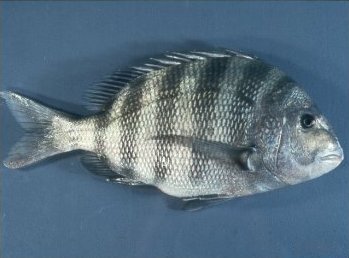
The head has a steep dorsal profile that becomes steeper with age. The profile is moderately concave between the upper lip and acute nape, then convex toward the dorsal fin origin.[1][2]
The upper body is grey-blue to dusky, with darker and conspicuous lateral-line scales, while the lower body is lighter. The rear margin of the gill cover is dark, and the fins are generally lighter except for the dusky tips of the pelvic, pectoral and caudal fins.[3][4]
The dorsal fin has 11 spines and 13 soft rays. The anal fin has 3 spines and 10 or 11 soft rays.[5][6]
The maximum published total length is 60 cm, while 35 cm is more typical.[7][8]
Habitat
The knife-back seabream inhabits offshore reefs at depths of 2–25 m.[9]
Diet
The knife-back seabream feeds on zooplankton.[10]
Behaviour
Individuals occur in shoals in the middle of the water column. They are often observed gathering near boats close to the water surface.[11][12]
Classification of the Knife-back Seabream
| Kingdom | Animalia |
|---|---|
| Phylum | Chordata |
| Subphylum | Vertebrata |
| Infraphylum | Gnathostomata |
| Parvphylum | Osteichthyes |
| Gigaclass | Actinopterygii |
| Superclass | Actinopteri |
| Class | Teleostei (Teleost) |
| Order | Perciformes |
| Suborder | Percoidei |
| Family | Sparidae (Porgies) |
| Genus | Polyamblyodon |
| Species | Polyamblyodon gibbosum (Pellegrin, 1914) |
Where the Knife-back Seabream is found
Checklists and occurrence records place Polyamblyodon gibbosum in 3 countries. GBIF holds 36 georeferenced records of it.
Countries
Regions and cities with the most records
- Scottburgh, South Africa 8
- eMkhomazi, South Africa 8
- eMuziwezinto, South Africa 8
- KwaZulu-Natal, South Africa 4
- Tôlanaro, Madagascar 3
A number beside a place is its count of GBIF occurrence records. A place without a number comes from a checklist alone. Records show where a species has been observed or collected, which can include escapes and vagrants.
Common names
English
- Knife-back Seabream
- Cristie
Names in 6 other languages
- Chinese
- 莫三比克鈍牙鯛, 駝背鈍牙鯛
- Czech
- pražman modrošedý
- French
- Sar Couteau
- Portuguese
- Pargo-de-dorso-afiado
- Russian
- Мозамбикский порги
- Spanish
- Sargo Navaja
Synonyms
2 other scientific names have been used for this species and are now treated as synonyms of Polyamblyodon gibbosum.
- Pachymetopon gibbosus Pellegrin, 1914
- Polyamblyodon cristiceps Smith, 1940
Related species
- German SeabreamPolyamblyodon germanum
-
 Gilt-head BreamSparus aurata
-
 BogueBoops boops
-
 SheepsheadArchosargus probatocephalus
-
 Red Sea BreamPagrus major
-
 Salema PorgySarpa salpa
-
 White Sea BreamDiplodus sargus
-
 Red PorgyPagrus pagrus
Compare
Questions and answers
What is the scientific name of the Knife-back Seabream?
The scientific name of the Knife-back Seabream is Polyamblyodon gibbosum. Written with its author, the full name is Polyamblyodon gibbosum (Pellegrin, 1914).
Which family does the Knife-back Seabream belong to?
Polyamblyodon gibbosum belongs to the family Sparidae, in the order Perciformes and the class Teleostei.
Where is the Knife-back Seabream found?
Checklists and occurrence records place Polyamblyodon gibbosum in 3 countries: South Africa, Mozambique and Madagascar.
What is the conservation status of the Knife-back Seabream?
The IUCN Red List category recorded for Polyamblyodon gibbosum is Least Concern (LC).
What other names does the Knife-back Seabream have?
Polyamblyodon gibbosum is also known in English as Cristie.
What do sea bream fish eat?
The knife-back seabream feeds on zooplankton.[10]
Sources
Passages the profile rests on
- Its head has a steep dorsal profile that becomes steeper with age. Source passage: “It has a steep dorsal profile to its head, growing steeper with age.” — English Wikipedia
- Its dorsal profile is moderately concave between the upper lip and acute nape, then convex toward the dorsal fin origin. Source passage: “It is moderately concave between the upper lip and the acute nape, and then it is convex to the origin of the dorsal fin origin.” — English Wikipedia
- The upper body is grey-blue to dusky, with darker and conspicuous lateral-line scales, while the lower body is lighter. Source passage: “The upper body is grey-blue to dusky with the lateral line scales being darker and very noticeable, the body is lighter in colour below the lateral line.” — English Wikipedia
- The rear margin of the gill cover is dark, and the fins are generally lighter except for the dusky tips of the pelvic, pectoral and caudal fins. Source passage: “The rear margin of the gill cover is darl with the fins being lighter in colour except that the tips of the pelvic fins, pectoral fins and caudal fin lobes are rather dusky.” — English Wikipedia
- Its dorsal fin has 11 spines and 13 soft rays. Source passage: “a dorsal fin which is supported by 11 spines and 13 soft rays” — English Wikipedia
- Its anal fin has 3 spines and 10 or 11 soft rays. Source passage: “there are 3 spines and 10 or 11 soft rays.” — English Wikipedia
- The maximum published total length is 60 cm. Source passage: “The maximum published total length of this species is 60 cm (24 in)” — English Wikipedia
- A total length of 35 cm is more typical for the species. Source passage: “although 35 cm (14 in) is more typical.” — English Wikipedia
- The species inhabits offshore reefs at depths of 2–25 m. Source passage: “This species is found at depths between 2 and 25 m (6 ft 7 in and 82 ft 0 in) over offshore reefs.” — English Wikipedia
- The species feeds on zooplankton. Source passage: “where it feeds on zooplankton.” — English Wikipedia
- Individuals occur in shoals in the middle of the water column. Source passage: “is found in shoals in the middle of the water column” — English Wikipedia
- Individuals are often observed gathering near boats close to the water surface. Source passage: “They are often seen gathering near boats close to the surface.” — English Wikipedia
- The species is endemic to the southwestern Indian Ocean. Source passage: “This species is endemic to the southwestern Indian Ocean.” — English Wikipedia
- Its documented distribution includes southern Madagascar. Source passage: “where it is found around southern Madagascar” — English Wikipedia
- Its documented distribution extends from Beira in Mozambique to Port Edward in KwaZulu-Natal. Source passage: “from Beira, Mozambique in Mozambique to Port Edward in KwaZulu-Natal.” — English Wikipedia
Data
- Catalogue of Life, 2026-10-16 XR cc by
- Global Biodiversity Information Facility CC BY 4.0
- Wikidata CC0
- GeoNames CC BY 4.0
- Within the Catalogue of Life, this name comes from World Register of Marine Species cc by
This species in other databases
- Catalogue of Life 4KZSK
- Wikidata Q2545257
- iNaturalist 1315966
- WoRMS urn:lsid:marinespecies.org:taxname:218612
- ITIS 647968
Page built on 28 November 2026. See how the catalog is made and all sources and licences.
Cite this page
ScientificNames.org. (2026). Polyamblyodon gibbosum (Knife-back Seabream). Retrieved November 28, 2026, from https://scientificnames.org/species/polyamblyodon-gibbosum
“Polyamblyodon gibbosum (Knife-back Seabream).” ScientificNames.org, 2026, scientificnames.org/species/polyamblyodon-gibbosum. Accessed 28 Nov. 2026.
ScientificNames.org. “Polyamblyodon gibbosum (Knife-back Seabream).” Accessed November 28, 2026. https://scientificnames.org/species/polyamblyodon-gibbosum.
@misc{scientificnames_polyamblyodon_gibbosum_knife_back_seabream,
  author = {{ScientificNames.org}},
  title = {Polyamblyodon gibbosum (Knife-back Seabream)},
  year = {2026},
  url = {https://scientificnames.org/species/polyamblyodon-gibbosum},
  note = {Accessed 2026-11-28}
}