Species · Flowering plants
Curly Pondweed Potamogeton crispus
The scientific name of the Curly Pondweed is Potamogeton crispus. It is a species of flowering plant in the family Potamogetonaceae (pondweed family), order Alismatales.
- Scientific name
- Potamogeton crispus L.
- Common name
- Curly Pondweed
- Genus
- Potamogeton
- Family
- Potamogetonaceae (Pondweed Family)
- Order
- Alismatales
- Class
- Liliopsida
- Red List category
- LC Least Concern
- Recorded in
- 92 countries
- Name status
- accepted in the Catalogue of Life

Overview
Curly pondweed is a rhizomatous perennial herb and submerged aquatic flowering plant in the family Potamogetonaceae, order Alismatales, and class Liliopsida. It grows in standing and slow-flowing freshwater, including ponds and ditches, and can occur at water depths reaching 4.5 metres.
Written 26 November 2026 from the sources listed below. Each statement was checked against the passage it cites; statements that could not be supported were removed.
Appearance
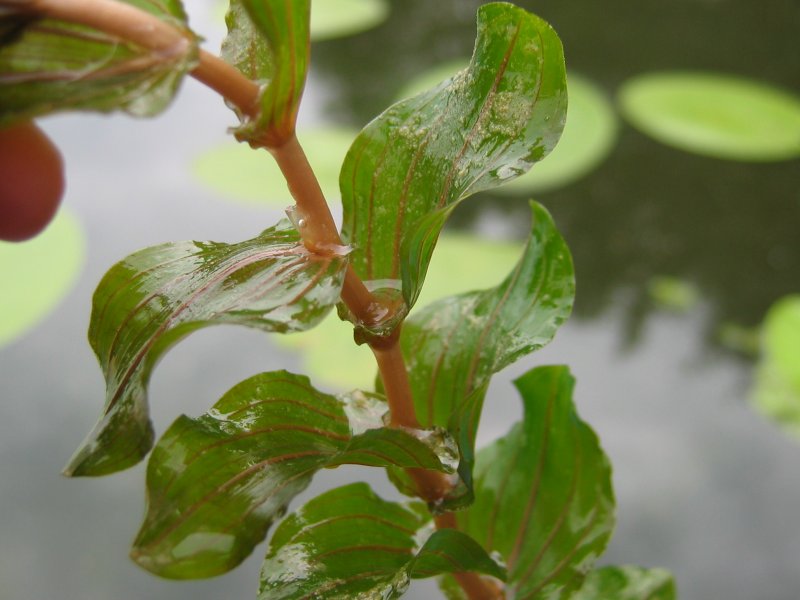
The leaves can be bright green or olive green, becoming fibrous and brownish later in the growing season. They measure 25–95 millimetres long and 5–12 millimetres wide.[1][2]
The branching stems can grow up to one meter long. Small flowers grow in dense terminal spikes that emerge above the water surface on curved stalks measuring 1–2 centimetres.[3][4][5][6]
The plant grows entirely underwater and does not produce floating leaves. Its leaves can reach 7.5 centimetres in length.[7][8]
Habitat
Curly pondweed is a lowland aquatic plant that grows in standing and slow-flowing freshwater, including small ponds and ditches. It requires fine substrates in standing or slow-flowing calcareous water.[9][10][11]
It prefers cooler, nutrient-rich, alkaline waters and can grow at depths reaching 4.5 metres. It also occurs in shallow water beds at depths of 30–60 centimetres.[12][13][14]
Behaviour
Curly pondweed tolerates significant nutrient pollution. It can survive beneath frozen waterways and resume vegetative growth before other aquatic plants, including active growth beneath 50 centimetres of ice and snow.[15][16][17]
Its greatest growth occurs in late spring, followed by breakdown and disappearance in early summer.[18]
Reproduction and life cycle
Curly pondweed reproduces through seeds and vegetative structures called turions. Its main reproductive methods are vegetative stem growth from rhizomes and production of turions rather than seeds.[19][20][21]
Turions develop in leaf axils and at stem tips. They consist of overlapping modified leaves that resemble small greenish-brown pinecones and are produced in large numbers by the beginning of summer.[22][23][24]
Turions have a germination rate of 60–80% and can remain viable in sediment for several years. They germinate in late summer to early fall when water temperatures cool.[25][26][27]
The species flowers from May through October. Its flowers may emerge above the water surface in spring.[28][29]
Conservation
Curly pondweed is considered invasive in much of North America. It forms dense mats that inhibit native plant growth and interfere with recreational activities.[30][31]
It can displace native aquatic plants and reduce biodiversity. Decomposition of its summer mats can release nutrients into the water and contribute to algal blooms.[32][33]
Decomposing plant material can reduce oxygen levels in water and potentially cause fish kills.[34]
Uses
Curly pondweed is sometimes cultivated as a pond plant and can make a good garden plant. Its growth during cooler seasons provides food and habitat for fish and wildlife.[35][36]
Classification of the Curly Pondweed
| Kingdom | Plantae |
|---|---|
| Subkingdom | Pteridobiotina |
| Phylum | Tracheophyta |
| Class | Liliopsida |
| Order | Alismatales |
| Family | Potamogetonaceae (Pondweed Family) |
| Genus | Potamogeton (Pondweed) |
| Species | Potamogeton crispus L. |
Where the Curly Pondweed is found
Checklists and occurrence records place Potamogeton crispus in 92 countries across Africa, Asia, Europe, North America, Oceania and South America. GBIF holds 119,602 georeferenced records of it.
Countries where it is native or its origin is not stated
- Afghanistan 7
- Aland Islands 75
- Albania 5
- Algeria 11
- Armenia 6
- Australia 1,129
- Austria 791
- Azerbaijan 12
- Bangladesh
- Belarus 86
- Belgium 4,062
- Bosnia and Herzegovina 4
- Botswana 1
- Bulgaria 24
- Cambodia
- China 770
- Croatia 61
- Czechia 1,155
- Denmark 2,130
- Egypt 60
- Estonia 134
- Eswatini 7
- Ethiopia 9
- Finland 373
- France 15,522
- Georgia 19
- Germany 11,230
- Greece 27
- Hungary 59
- India 109
- Indonesia
- Iran 13
- Iraq 29
- Ireland 480
- Isle of Man 65
- Israel 44
- Italy 397
- Japan 1,630
- Kazakhstan 59
- Kyrgyzstan
- Laos 4
- Latvia 28
- Libya
- Liechtenstein 23
- Lithuania 13
- Luxembourg 182
- Malawi 1
- Moldova 9
- Mongolia 1
- Montenegro 17
- Mozambique
- Myanmar 3
- Nepal 11
- North Korea 5
- North Macedonia 5
- Norway 301
- Pakistan 7
- Poland 1,145
- Portugal 206
- Romania 46
- Russia 1,547
- Serbia 8
- Slovakia 297
- Slovenia 38
- South Africa 144
- South Korea 769
- Spain 1,284
- Sudan 11
- Sweden 3,817
- Switzerland 2,533
- Syria 5
- Taiwan 327
- Tajikistan 6
- Thailand 3
- The Netherlands 11,257
- Turkey 32
- Turkmenistan 1
- Ukraine 845
- United Kingdom 33,193
- Uzbekistan 4
- Vietnam 1
- Zambia 2
- Zimbabwe 18
Countries where it has been introduced
- Argentina
- Canada 1,066
- Colombia 3
- Costa Rica 25
- Cuba
- Fiji 80
- Mexico 242
- New Zealand 1,746
- United States 17,696
Regions and cities with the most records
- England, United Kingdom 24,329
- New York, United States 6,653
- Scotland, United Kingdom 4,832
- Bavaria, Germany 4,096
- Auvergne-Rhône-Alpes, France 2,607
- Centre-Val de Loire, France 2,417
- Bourgogne-Franche-Comté, France 2,405
- Wisconsin, United States 2,016
- Wales, United Kingdom 1,723
- Gelderland, The Netherlands 1,597
- Grand Est, France 1,500
- Hauts-de-France, France 1,461
- Mecklenburg-Vorpommern, Germany 1,380
- Île-de-France, France 1,252
- Waddinxveen, The Netherlands 1,173
- Minnesota, United States 1,171
- Jamestown, United States 1,165
- Overijssel, The Netherlands 1,153
- Boskoop, The Netherlands 1,125
- Krimpen aan den IJssel, The Netherlands 1,122
- Benthuizen, The Netherlands 1,114
- Alblasserdam, The Netherlands 1,101
- Ridderkerk, The Netherlands 1,100
- Capelle aan den IJssel, The Netherlands 1,084
- North Rhine-Westphalia, Germany 1,081
- Alphen aan den Rijn, The Netherlands 1,078
- Northern Ireland, United Kingdom 1,076
- Barendrecht, The Netherlands 1,069
- Gouda, The Netherlands 1,049
- Hendrik-Ido-Ambacht, The Netherlands 1,041
- Rhoon, The Netherlands 1,025
- Rotterdam, The Netherlands 1,023
- Schiedam, The Netherlands 1,019
- Zoetermeer, The Netherlands 1,012
- Bergschenhoek, The Netherlands 1,011
- Papendrecht, The Netherlands 997
A number beside a place is its count of GBIF occurrence records. A place without a number comes from a checklist alone. Records show where a species has been observed or collected, which can include escapes and vagrants.
Common names
English
- Curly Pondweed
- Crisp-leaved Pondweed
- Crisped Pondweed
- Wavy-Leaved Pondweed
- Crispy-leaved Pondweed
- Curled Pondweed
- Curly-leaf Pondweed
- Curly-leaved Pondweed
- Curlyleaf Pondweed
Names in 33 other languages
- Afrikaans
- Fonteingras, krulblaarfonteinkruid
- Arabic
- Hamool, Horreish
- Catalan
- Llapó fullat
- Chinese
- 菹草, 蝦柳, 馬藻
- Czech
- rdest kadeřavý
- Danish
- Kruset vandaks
- Dutch
- Gekroesd fonteinkruid
- Estonian
- kähar penikeel
- Finnish
- poimuvita
- French
- potamot crispé, potamot crépu
- German
- Krauses Laichkraut
- Hebrew
- נהרונית מסולסלת
- Hungarian
- Bodros békaszőlő
- Italian
- Brasca increspata
- Japanese
- エビモ
- Korean
- 말즘
- Lithuanian
- Garbiniuotoji plūdė
- Norwegian Bokmål
- krustjernaks
- Norwegian Nynorsk
- krustjønnaks, krustjørnaks
- Persian
- بارهنگ آبی فردار
- Polish
- rdestnica kędzierzawa
- Portuguese
- Colher-de-folha-crespa, carvalhas, espiga-de-água-ondulada
- Russian
- Рдест курчавый
- Slovak
- červenavec kučeravý
- Slovenian
- kodravi dristavec
- Spanish
- Sierrita europea, rizos de agua
- Swedish
- krusnate
- Turkish
- Susümbülü
- Ukrainian
- Рдесник кучерявий
- Welsh
- Dyfrllys Crych, Dyfrllys Crychion, Dyfrllys Crychlyd, Dyfrllys Danhe
- Xhosa
- ikhubalo lomkhondo wempahla
- Zulu
- isaswane
- hsb
- Krjózkata dróstnica
Synonyms
39 other scientific names have been used for this species and are now treated as synonyms of Potamogeton crispus.
- Buccaferrea crispata Bubani
- Potamogeton austriacus Gand.
- Potamogeton concinnitus A.Benn.
- Potamogeton crenulatus D.Don
- Potamogeton crispatus Wallman ex Rchb.
- Potamogeton crispus f. angustifolius Fieber
- Potamogeton crispus f. gemmifer Rchb.
- Potamogeton crispus f. latifolius Fieber
- Potamogeton crispus f. longifolius Fieber
- Potamogeton crispus f. serrulatus (Opiz) Schrad. ex Rchb.
- Potamogeton crispus f. vulgaris Fieber
- Potamogeton crispus subsp. angustifolius Gaudin
- Potamogeton crispus var. acutifolius Fieber
- Potamogeton crispus var. alatus Zapał.
- Potamogeton crispus var. crispatus (Wallman) Rchb.
- Potamogeton crispus var. gemmifer Rchb.
- Potamogeton crispus var. gemmifer Hausm.
- Potamogeton crispus var. laevis Merino
- Potamogeton crispus var. macrorrhynchus (Gand.) Asch. & Graebn.
- Potamogeton crispus var. najadoides Graebn.
- Potamogeton crispus var. obtusifolius Fieber
- Potamogeton crispus var. phialiensis Post
- Potamogeton crispus var. planifolius Klett & Richt.
- Potamogeton crispus var. planifolius G.Mey.
- Potamogeton crispus var. serratus Gray
- Potamogeton crispus var. serrulatus Schrad. ex Rchb.
- Potamogeton crispus var. serrulatus (Schrad.) Asch.
- Potamogeton crispus var. sinuatus Fr.
- Potamogeton hohenackeri Gand.
- Potamogeton hungaricus Gand.
- Potamogeton lactucaceus Montandon
- Potamogeton leptophyllus Gand.
- Potamogeton macrorrhynchus Gand.
- Potamogeton notarisii Gand.
- Potamogeton pallidior Gand.
- Potamogeton rubricans Gand.
- Potamogeton rubrinaevus Gand.
- Potamogeton tuberosus Roxb.
- Potamogeton serrulatus Opiz ambiguous synonym
Related species
-
 Floating PondweedPotamogeton natans
-
 Clasping-leaf PondweedPotamogeton perfoliatus
-
 Small PondweedPotamogeton pusillus
-
 Shining PondweedPotamogeton lucens
-
 Longleaf PondweedPotamogeton nodosus
-
 Various-Leaved PondweedPotamogeton gramineus
-
 Bog PondweedPotamogeton polygonifolius
-
 Illinois PondweedPotamogeton illinoensis
Compare
Questions and answers
What is the scientific name of the Curly Pondweed?
The scientific name of the Curly Pondweed is Potamogeton crispus. Written with its author, the full name is Potamogeton crispus L..
Which family does the Curly Pondweed belong to?
Potamogeton crispus belongs to the family Potamogetonaceae, in the order Alismatales and the class Liliopsida.
Where is the Curly Pondweed found?
Checklists and occurrence records place Potamogeton crispus in 92 countries, including United Kingdom, France, The Netherlands, Germany, Belgium and Sweden.
What is the conservation status of the Curly Pondweed?
The IUCN Red List category recorded for Potamogeton crispus is Least Concern (LC).
What other names does the Curly Pondweed have?
Potamogeton crispus is also known in English as Crisp-leaved Pondweed, Crisped Pondweed, Wavy-Leaved Pondweed, Crispy-leaved Pondweed, Curled Pondweed and Curly-leaf Pondweed.
Is curlyleaf pondweed an invasive plant?
Yes. Curly pondweed is considered invasive in much of North America. It can form dense mats, displace native aquatic plants and reduce biodiversity.[30][31][32]
What does pondweed do?
Curly pondweed provides food and habitat for fish and wildlife during cooler seasons. It can also form dense mats that inhibit native plant growth, reduce biodiversity and interfere with recreational activities.[31][32][36]
Why is curly-leaf pondweed bad?
It can displace native aquatic plants, reduce biodiversity and form dense mats that interfere with recreational activities. Decomposition of its summer mats can contribute to algal blooms and reduce oxygen levels in water, potentially causing fish kills.[31][32][33][34]
Sources
Passages the profile rests on
- Its leaves can be bright green, olive green, or fibrous and brownish later in the growing season. Source passage: “The leaves may be bright green, olive green or (especially later in the season) fibrous and brownish” — English Wikipedia
- Its leaves measure 25–95 millimetres long and 5–12 millimetres wide. Source passage: “25–95 millimetres (1–3+3⁄4 in) long and 5–12 millimetres (3⁄16–15⁄32 in) wide.” — English Wikipedia
- Its flowers grow in short spikes that emerge above the water surface. Source passage: “The inflorescence is a short spike of flowers emerging above the water surface.” — English Wikipedia
- Its flowers are small and arranged in dense terminal spikes. Source passage: “The small flowers are arranged in a dense terminal spike” — extension.rutgers.edu
- Its branching stems can grow up to one meter long. Source passage: “stem up to a meter long.” — English Wikipedia
- Its flower spikes rise on curved stalks measuring 1–2 centimetres. Source passage: “on a curved 1–2 cm (1/3–3/4 in) stalk” — extension.rutgers.edu
- The plant grows entirely underwater and does not produce floating leaves. Source passage: “grows entirely as a submersed aquatic plant with no floating leaves.” — nas.er.usgs.gov
- Its leaves can reach 7.5 centimetres in length. Source passage: “up to 7½ cm (3 in) long.” — extension.rutgers.edu
- The species grows in standing and slow-flowing freshwater, including small ponds and ditches. Source passage: “growing in standing and slow-flowing water including small ponds and ditches.” — English Wikipedia
- It requires fine substrates in standing or slow-flowing calcareous water. Source passage: “requires fine substrates in standing or slow-flowing calcareous water.” — English Wikipedia
- It is a lowland aquatic plant. Source passage: “It is strictly a lowland plant” — English Wikipedia
- It prefers cooler, nutrient-rich, alkaline waters. Source passage: “Curly-leaf pondweed prefers cooler, nutrient rich, alkaline waters.” — extension.rutgers.edu
- It can grow in water depths reaching 4.5 metres. Source passage: “It can grow in depths up to 4.5 m (15 ft)” — extension.rutgers.edu
- It also occurs in shallow water beds at depths of 30–60 centimetres. Source passage: “but also occurs in shallow beds in 30–60 cm (1–2 ft) of water.” — extension.rutgers.edu
- The species tolerates significant nutrient pollution. Source passage: “it is tolerant of significant nutrient pollution” — English Wikipedia
- It can survive beneath frozen waterways and resume vegetative growth before other aquatic plants. Source passage: “It is also able to survive beneath the surface of frozen waterways and resume its rapid vegetative growth before other water plants can regrow.” — English Wikipedia
- It can grow actively beneath 50 centimetres of ice and snow. Source passage: “It's adapted to cold water and has been found actively growing under 50 cm (20 in) of ice and snow” — extension.rutgers.edu
- Its greatest growth occurs in late spring, followed by breakdown and disappearance in early summer. Source passage: “Plants reach their greatest growth in late spring, and then begin to breakdown and disappear in early summer.” — extension.rutgers.edu
- The species reproduces through seeds and vegetative structures called turions. Source passage: “Its production of both seed and turions makes it relatively resistant to disturbance” — English Wikipedia
- Its main reproductive methods are vegetative stem growth from rhizomes and production of turions rather than seeds. Source passage: “the main methods of spreading are not by seed, but by asexual stem growth from the perennial rhizomes and reproduction by vegetative structures called turions.” — extension.rutgers.edu
- The species is a rhizomatous perennial herb. Source passage: “Curly-leaf pondweed is a rhizomatous perennial herb” — English Wikipedia
- Turions develop in leaf axils and at stem tips. Source passage: “Turions occur in leaf axils and at stem tips.” — English Wikipedia
- Turions consist of overlapping modified leaves that resemble small greenish-brown pinecones. Source passage: “They are made up of several overlapping modified leaves resembling small greenish-brown pinecones” — extension.rutgers.edu
- Turions are produced in large numbers by the beginning of summer. Source passage: “and are produced in great numbers by the start of summer.” — extension.rutgers.edu
- Turions have a germination rate of 60–80%. Source passage: “Turions have a very high germination rate of 60–80%” — extension.rutgers.edu
- Turions can remain viable in sediment for several years. Source passage: “can remain viable in the sediment for several years.” — extension.rutgers.edu
- Turions germinate in late summer to early fall when water temperatures cool. Source passage: “where they remain dormant until cooling water temperature triggers their germination in the late summer to early fall.” — extension.rutgers.edu
- The species flowers from May through October. Source passage: “It flowers from May until October.” — English Wikipedia
- Its flowers may emerge above the water surface in spring. Source passage: “In spring, curly-leaf pondweed can produce flower spikes that rise above the surface.” — extension.rutgers.edu
- The species is considered invasive in much of North America. Source passage: “This pondweed is considered an invasive species in much of North America.” — English Wikipedia
- It forms dense mats that inhibit native plant growth and interfere with recreational activities. Source passage: “Forms dense mats that inhibit growth of native species and impede recreational activities” — invasivespeciesinfo.gov
- It can displace native aquatic plants and reduce biodiversity. Source passage: “tends to crowd out native submerged plants, reducing biodiversity” — extension.rutgers.edu
- Decomposition of its summer mats can release nutrients into the water and contribute to algal blooms. Source passage: “the dense mats decay releasing nutrients into the water column which contribute to algal blooms.” — extension.rutgers.edu
- Decomposing plant material can reduce oxygen levels in water and potentially cause fish kills. Source passage: “The decomposing plant material can also deplete oxygen levels in the water, causing anoxic conditions leading to possible fish kills.” — extension.rutgers.edu
- The species is sometimes cultivated as a pond plant and can make a good garden plant. Source passage: “Potamogeton crispus is sometimes cultivated as a pond plant, and generally makes a good garden plant.” — English Wikipedia
- Its growth during cooler seasons provides food and habitat for fish and wildlife. Source passage: “This provides a source of food and habitat during these times for fish and wildlife” — extension.rutgers.edu
Data
- Catalogue of Life, 2026-10-16 XR cc by
- Global Biodiversity Information Facility CC BY 4.0
- Wikidata CC0
- GeoNames CC BY 4.0
- Wikimedia Commons per image; credit shown with each image
- Within the Catalogue of Life, this name comes from The World Checklist of Vascular Plants (WCVP) cc by
References
- Sp. Pl.: 126 (1753) where the name was published
This species in other databases
- Catalogue of Life 4M3NH
- Wikidata Q157863
- iNaturalist 78707
- World Flora Online wfo-0000769780
- GRIN 400123
Page built on 29 November 2026. See how the catalog is made and all sources and licences.
Cite this page
ScientificNames.org. (2026). Potamogeton crispus (Curly Pondweed). Retrieved November 29, 2026, from https://scientificnames.org/species/potamogeton-crispus
“Potamogeton crispus (Curly Pondweed).” ScientificNames.org, 2026, scientificnames.org/species/potamogeton-crispus. Accessed 29 Nov. 2026.
ScientificNames.org. “Potamogeton crispus (Curly Pondweed).” Accessed November 29, 2026. https://scientificnames.org/species/potamogeton-crispus.
@misc{scientificnames_potamogeton_crispus_curly_pondweed,
  author = {{ScientificNames.org}},
  title = {Potamogeton crispus (Curly Pondweed)},
  year = {2026},
  url = {https://scientificnames.org/species/potamogeton-crispus},
  note = {Accessed 2026-11-29}
}