Species · Flowering plants
Floating Pondweed Potamogeton natans
The scientific name of the Floating Pondweed is Potamogeton natans. It is a species of flowering plant in the family Potamogetonaceae (pondweed family), order Alismatales.
- Scientific name
- Potamogeton natans L.
- Common name
- Floating Pondweed
- Genus
- Potamogeton
- Family
- Potamogetonaceae (Pondweed Family)
- Order
- Alismatales
- Class
- Liliopsida
- Red List category
- LC Least Concern
- Recorded in
- 69 countries
- Name status
- accepted in the Catalogue of Life

Overview
Potamogeton natans occurs in quiet or slow-flowing freshwater habitats. It produces two distinct leaf shapes, with floating leaves and grass-like submerged leaves.
Written 26 November 2026 from the sources listed below. Each statement was checked against the passage it cites; statements that could not be supported were removed.
Appearance
Floating pondweed produces floating and submerged leaves on the same plant. The floating leaves are ovate to oblong-ovate, almost always heart-shaped at their bases, dark green, leathery and opaque, with translucent longitudinal veins.[1][2][3]
The floating leaves measure 5–10 cm in length and have pointed tips and rounded bases. The stipules measure 4–17 cm in length.[4][5][6]
The submerged leaf-like structures are grass-like phyllodes, which are modified leaf stalks. The submerged leaves are grass-like in shape.[7][8]
The stems are cylindrical, simple or slightly forked, and have relatively few branches. They grow to 1–2 metres in length.[9][10][11]
The plant has a discoloured flexible joint just below the top of its long leaf stalk. Its rhizome is red-spotted.[12][13]
The flower spikes are dense and cylindrical, measuring 5–10 cm in length. The fruits are obovate and measure 4–5 mm in length.[14][15][16][17]
Habitat
Floating pondweed occurs in quiet or slow-flowing freshwater habitats. It is native to the Holarctic Kingdom.[18][19]
Reproduction and life cycle
Floating pondweed flowers from May through September.[20]
Classification of the Floating Pondweed
| Kingdom | Plantae |
|---|---|
| Subkingdom | Pteridobiotina |
| Phylum | Tracheophyta |
| Class | Liliopsida |
| Order | Alismatales |
| Family | Potamogetonaceae (Pondweed Family) |
| Genus | Potamogeton (Pondweed) |
| Species | Potamogeton natans L. |
Where the Floating Pondweed is found
Checklists and occurrence records place Potamogeton natans in 69 countries across Africa, Asia, Europe and North America. GBIF holds 234,912 georeferenced records of it.
Countries where it is native or its origin is not stated
- Afghanistan 7
- Aland Islands 118
- Albania 5
- Algeria 10
- Andorra 7
- Armenia 21
- Austria 1,201
- Belarus 124
- Belgium 7,050
- Bosnia and Herzegovina 9
- Bulgaria 3
- Canada 2,134
- China 183
- Croatia 23
- Czechia 1,896
- Denmark 21,587
- Estonia 1,153
- Faroe Islands 14
- Finland 9,855
- France 20,993
- Georgia 31
- Germany 18,572
- Greece 12
- Greenland 9
- Hungary 24
- Iceland 106
- India 39
- Iran 4
- Ireland 1,518
- Isle of Man 402
- Italy 360
- Japan 886
- Kazakhstan 59
- Kyrgyzstan 5
- Latvia 51
- Libya 1
- Liechtenstein 36
- Lithuania 126
- Luxembourg 461
- Mexico 26
- Mongolia
- Montenegro 37
- Morocco 20
- Myanmar
- Nepal 8
- North Korea 4
- Norway 5,945
- Pakistan 1
- Poland 2,381
- Portugal 194
- Romania 33
- Russia 4,303
- Serbia 3
- Slovakia 284
- Slovenia 42
- South Korea 82
- Spain 1,422
- Sweden 22,177
- Switzerland 4,186
- Taiwan 7
- Tajikistan
- The Netherlands 27,170
- Tunisia
- Turkey 42
- Ukraine 365
- United Kingdom 71,870
- Uzbekistan 2
- Yemen
Countries where it has been introduced
Regions and cities with the most records
- England, United Kingdom 41,441
- Scotland, United Kingdom 20,984
- Bavaria, Germany 9,301
- Central Jutland, Denmark 8,390
- Wales, United Kingdom 4,224
- South Denmark, Denmark 4,000
- Västra Götaland, Sweden 3,980
- Overijssel, The Netherlands 3,643
- Auvergne-Rhône-Alpes, France 3,615
- Bourgogne-Franche-Comté, France 3,547
- Zealand, Denmark 3,513
- Drenthe, The Netherlands 3,229
- Centre-Val de Loire, France 2,990
- Friesland, The Netherlands 2,970
- Maarssen, The Netherlands 2,967
- Woerden, The Netherlands 2,902
- Mijdrecht, The Netherlands 2,847
- De Meern, The Netherlands 2,818
- Île-de-France, France 2,718
- Skåne, Sweden 2,693
- Gouda, The Netherlands 2,669
- Alphen aan den Rijn, The Netherlands 2,659
- Capital Region, Denmark 2,649
- Waddinxveen, The Netherlands 2,627
- Leiderdorp, The Netherlands 2,617
- Gelderland, The Netherlands 2,583
- Boskoop, The Netherlands 2,581
- Benthuizen, The Netherlands 2,514
- Bodegraven, The Netherlands 2,423
- Steenwijk, The Netherlands 2,344
- Northern Ireland, United Kingdom 2,318
- IJsselstein, The Netherlands 2,285
- Uithoorn, The Netherlands 2,244
- Koersel, Belgium 2,199
- Nieuwegein, The Netherlands 2,185
- Meppel, The Netherlands 2,181
2 more countries have a few records outside this range
These countries hold a few records of Potamogeton natans but lie outside the range the checklists give for it. Such records are often zoo or garden specimens, museum material or vagrants, so the species is not counted as occurring there.
A number beside a place is its count of GBIF occurrence records. A place without a number comes from a checklist alone. Records show where a species has been observed or collected, which can include escapes and vagrants.
Common names
English
- Floating Pondweed
- Broad-Leaved Pondweed
- Broadleaf Pondweed
- Floating-leaf Pondweed
- Floating-leaved Pondweed
- Floatingleaf Pondweed
Names in 32 other languages
- Azerbaijani
- Üzən suçiçəyi
- Belarusian
- Урэчнік плывучы
- Chinese
- 浮叶眼子菜
- Croatian
- Plivajući mrijesnjak
- Czech
- rdest vzplývavý
- Danish
- Svømmende vandaks
- Dutch
- Drijvend fonteinkruid
- Estonian
- ujuv penikeel
- Faroese
- flottjarnaks
- Finnish
- uistinvita
- French
- potamot flottant, potamot flottat, potamot nageant
- German
- Schwimmendes Laichkraut
- Hungarian
- úszó békaszőlő
- Icelandic
- Blöðkunykra
- Italian
- Brasca comune, Lingua d'acqua comune
- Japanese
- オヒルムシロ
- Korean
- 큰가래
- Lithuanian
- Plūduriuojančioji plūdė
- Northern Sami
- cuopporássi, cuoppovihti, hávgarássi
- Norwegian
- Vanlig tjønnaks
- Norwegian Nynorsk
- tjernaks, tjønnaks, tjørnaks
- Polish
- Rdestnica pływająca
- Portuguese
- Colher-folha-de-acelga
- Russian
- Рдест плавающий
- Slovak
- červenavec plávajúci
- Slovenian
- plavajoči dristavec
- Spanish
- Espiga de agua
- Swedish
- gäddnate
- Turkish
- Suotu
- Ukrainian
- Рдесник плавучий
- Welsh
- Dyfrllys Llydanddail, Dyfrllys Nofiadwy, Tafod y Ci
- nuk
- muwach haʔumʔak
Synonyms
56 other scientific names have been used for this species and are now treated as synonyms of Potamogeton natans.
- Buccaferrea natans (L.) Bubani
- Potamogeton affinis Boenn. ex Cham. & Schlecht.
- Potamogeton besseri Steud.
- Potamogeton gramineus var. subnatans Wahlenb.
- Potamogeton hibernicus (Hagstr.) Druce
- Potamogeton kirkii Syme
- Potamogeton morongii A.Benn.
- Potamogeton natans f. angustifolius Regel
- Potamogeton natans f. fluviatilis (Fr.) Hagstr.
- Potamogeton natans f. lancifolius (Fieber) Rchb.
- Potamogeton natans f. ovalifolius (Fieber) M.Goldschm.
- Potamogeton natans f. ovalifolius (Fieber) Rchb.
- Potamogeton natans f. prolixus (W.D.J.Koch) Sagorski & Gus.Schneider
- Potamogeton natans f. rotundifolius (Bréb.) Hagstr.
- Potamogeton natans f. terrestris (Gray) Hagstr.
- Potamogeton natans f. vulgaris Rchb.
- Potamogeton natans subsp. ellipticus Gaudin
- Potamogeton natans subsp. explanatus (Mert. & W.D.J.Koch) K.Richt.
- Potamogeton natans subsp. kirkii (Syme) Nyman
- Potamogeton natans subsp. petiolaris (Nyman) Arcang.
- Potamogeton natans subsp. petiolatus (Wolfg.) K.Richt.
- Potamogeton natans subsp. vulgaris Schübl. & G.Martens
- Potamogeton natans subsp. vulgaris Gaudin
- Potamogeton natans var. acaulis Wahlb.
- Potamogeton natans var. angustifolius Wender.
- Potamogeton natans var. angustifolius G.Mey.
- Potamogeton natans var. explanatus Mert. & W.D.J.Koch
- Potamogeton natans var. fluviatilis Fr.
- Potamogeton natans var. intermedius Mert. & W.D.J.Koch
- Potamogeton natans var. lancifolius Fieber
- Potamogeton natans var. major W.D.J.Koch & Ziz
- Potamogeton natans var. media W.D.J.Koch & Ziz
- Potamogeton natans var. ovalifolius Fieber
- Potamogeton natans var. petiolaris Nyman
- Potamogeton natans var. petiolatus (Wolfg.) Nyman
- Potamogeton natans var. prolixus W.D.J.Koch
- Potamogeton natans var. pygmaeus Gaudin
- Potamogeton natans var. rotundifolius Bréb.
- Potamogeton natans var. subnatans Wahlenb.
- Potamogeton natans var. terrestris Gray
Showing 40 of 56.
Subspecies and varieties
Related species
-
 Curly PondweedPotamogeton crispus
-
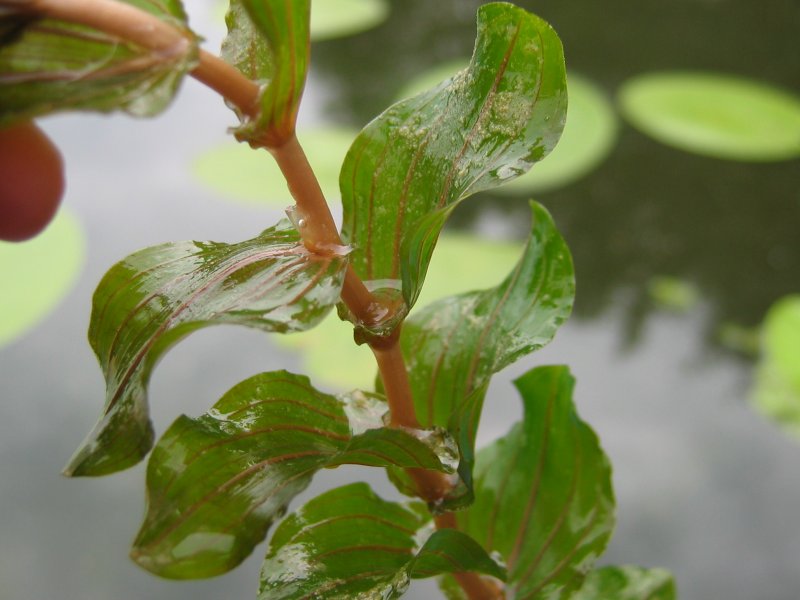 Clasping-leaf PondweedPotamogeton perfoliatus
-
 Small PondweedPotamogeton pusillus
-
 Shining PondweedPotamogeton lucens
-
 Longleaf PondweedPotamogeton nodosus
-
 Various-Leaved PondweedPotamogeton gramineus
-
 Bog PondweedPotamogeton polygonifolius
-
 Illinois PondweedPotamogeton illinoensis
Compare
Questions and answers
What is the scientific name of the Floating Pondweed?
The scientific name of the Floating Pondweed is Potamogeton natans. Written with its author, the full name is Potamogeton natans L..
Which family does the Floating Pondweed belong to?
Potamogeton natans belongs to the family Potamogetonaceae, in the order Alismatales and the class Liliopsida.
Where is the Floating Pondweed found?
Checklists and occurrence records place Potamogeton natans in 69 countries, including United Kingdom, The Netherlands, Sweden, Denmark, France and Germany.
What is the conservation status of the Floating Pondweed?
The IUCN Red List category recorded for Potamogeton natans is Least Concern (LC).
What other names does the Floating Pondweed have?
Potamogeton natans is also known in English as Broad-Leaved Pondweed, Broadleaf Pondweed, Floating-leaf Pondweed, Floating-leaved Pondweed and Floatingleaf Pondweed.
Is pondweed a floating plant?
Floating pondweed produces floating leaves as well as submerged leaves on the same plant.[1]
Is Potamogeton an aquatic plant?
Potamogeton natans occurs in quiet or slow-flowing freshwater habitats.[18]
Sources
Passages the profile rests on
- Potamogeton natans produces both floating and submerged leaves on the same plant. Source passage: “It produces both floating and submersed leaves on the same plant.” — English Wikipedia
- The floating leaves are ovate to oblong-ovate and almost always heart-shaped at their bases. Source passage: “The floating leaves are ovate to oblong-ovate and almost always cordate at the base.” — English Wikipedia
- The floating leaves are dark green, leathery, opaque, and have translucent longitudinal veins. Source passage: “They are dark green, leathery, opaque, with translucent longitudinal veins.” — English Wikipedia
- The floating leaves measure 5–10 cm in length. Source passage: “They are 5 to 10 cm long” — English Wikipedia
- The floating leaves have pointed tips and rounded bases. Source passage: “pointed at the tips, and rounded at the base.” — English Wikipedia
- The stipules measure 4–17 cm in length. Source passage: “The stipules are 4 to 17 cm long.” — English Wikipedia
- The submerged leaf-like structures are grass-like phyllodes that are modified leaf stalks. Source passage: “The submerged grass-like structures are called phyllodes, are actually modified leaf stalks.” — English Wikipedia
- The submerged leaves are grass-like in shape. Source passage: “submerged leaves are grass-like.” — fieldguide.mt.gov
- The stems are cylindrical and have relatively few branches. Source passage: “The stems are cylindrical, without many branches” — English Wikipedia
- The stems grow to 1–2 metres in length. Source passage: “grow from 1 to 2 metres.” — English Wikipedia
- The stem is simple or slightly forked. Source passage: “simple or slightly forking stem;” — ohiodnr.gov
- The species has a discoloured flexible joint just below the top of its long leaf stalk. Source passage: “a discoloured flexible joint just below the top of the long leaf stalk.” — English Wikipedia
- The rhizome is red-spotted. Source passage: “with red-spotted rhizome” — ohiodnr.gov
- The flower spikes are dense and cylindrical. Source passage: “The flower spikes are dense, and cylindrical.” — English Wikipedia
- The flower spikes measure 5–10 cm in length. Source passage: “They are 5 to 10 cm long” — English Wikipedia
- The fruits are obovate in shape. Source passage: “The fruits are 4 to 5 mm long and obovate.” — English Wikipedia
- The fruits measure 4–5 mm in length. Source passage: “The fruits are 4 to 5 mm long” — English Wikipedia
- Potamogeton natans occurs in quiet or slow-flowing freshwater habitats. Source passage: “native to quiet or slow-flowing freshwater habitats” — English Wikipedia
- Potamogeton natans is native to the Holarctic Kingdom. Source passage: “throughout the Holarctic Kingdom.” — English Wikipedia
- Potamogeton natans flowers from May through September. Source passage: “It flowers from May to September.” — English Wikipedia
Data
- Catalogue of Life, 2026-10-16 XR cc by
- Global Biodiversity Information Facility CC BY 4.0
- Wikidata CC0
- GeoNames CC BY 4.0
- Wikimedia Commons per image; credit shown with each image
- Within the Catalogue of Life, this name comes from The World Checklist of Vascular Plants (WCVP) cc by
References
- Sp. Pl.: 126 (1753) where the name was published
This species in other databases
- Catalogue of Life 4M3V8
- Wikidata Q370566
- iNaturalist 78712
- World Flora Online wfo-0000769905
- GRIN 406382
Page built on 29 November 2026. See how the catalog is made and all sources and licences.
Cite this page
ScientificNames.org. (2026). Potamogeton natans (Floating Pondweed). Retrieved November 29, 2026, from https://scientificnames.org/species/potamogeton-natans
“Potamogeton natans (Floating Pondweed).” ScientificNames.org, 2026, scientificnames.org/species/potamogeton-natans. Accessed 29 Nov. 2026.
ScientificNames.org. “Potamogeton natans (Floating Pondweed).” Accessed November 29, 2026. https://scientificnames.org/species/potamogeton-natans.
@misc{scientificnames_potamogeton_natans_floating_pondweed,
  author = {{ScientificNames.org}},
  title = {Potamogeton natans (Floating Pondweed)},
  year = {2026},
  url = {https://scientificnames.org/species/potamogeton-natans},
  note = {Accessed 2026-11-29}
}