Species · Flowering plants
Bog Pondweed Potamogeton polygonifolius
The scientific name of the Bog Pondweed is Potamogeton polygonifolius. It is a species of flowering plant in the family Potamogetonaceae (pondweed family), order Alismatales.
- Scientific name
- Potamogeton polygonifolius Pourr.
- Common name
- Bog Pondweed
- Genus
- Potamogeton
- Family
- Potamogetonaceae (Pondweed Family)
- Order
- Alismatales
- Class
- Liliopsida
- Red List category
- LC Least Concern
- Recorded in
- 31 countries
- Name status
- accepted in the Catalogue of Life

Overview
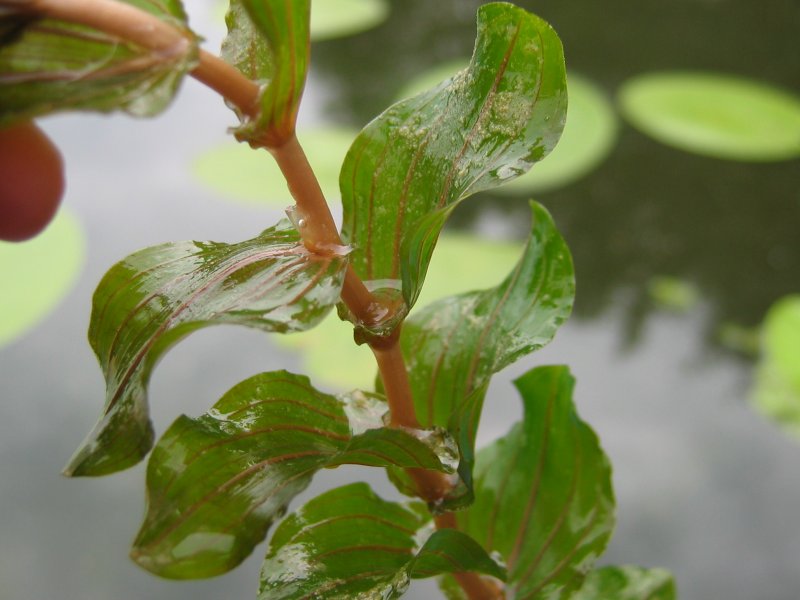
Bog Pondweed is a perennial flowering plant. It grows in shallow, nutrient-poor, usually acidic standing or running water, including bogs, fens and occasionally ditches. It has delicate, translucent submerged leaves and opaque floating leaves that are usually brownish or dark green, with a pink tint when young.
Written 26 November 2026 from the sources listed below. Each statement was checked against the passage it cites; statements that could not be supported were removed.
Appearance
Bog Pondweed has creeping rhizomes and cylindrical, unbranched stems. The stems can reach 0.7 m in length.[1][2][3]
Its submerged leaves are delicate, translucent, relatively long and narrow, measuring 60–160 mm long and 2.5–24 mm wide. Their petioles measure 14–80 mm, and they tend to decay early in the growing season, usually after floating leaves appear.[4][5][6][7][8]
The floating leaves are opaque and usually brownish or dark green, with a pink tint when young. Their secondary veins are inconspicuous.[9][10]
The inflorescences bear numerous small greenish flowers and can reach 42 mm in length. The fruits measure 1.9–2.6 mm long and 1.4–1.9 mm wide.[11][12][13]
Habitat
Bog Pondweed grows in shallow, nutrient-poor, usually acidic standing or running water. It occurs in bogs, fens and occasionally ditches, and can also grow as a terrestrial plant in seeps and wet moss.[14][15][16]
In Britain and Ireland, it occurs in wet or semi-wet oligotrophic and acidic habitats where water flow is not too rapid. Recorded habitats include lakes, slow-flowing rivers, ponds, ditches, seeps and Sphagnum moss communities.[17][18]
Bog Pondweed can also occur in calcareous habitats when nutrient levels are low.[19]
Conservation
Bog Pondweed has declined in lowland areas of southern and eastern England because of nutrient enrichment. It is considered endangered in Germany, Poland, Switzerland, the Czech Republic and Luxembourg, and is listed on the Red List in the Netherlands.[20][21][22]
In Central Europe, remaining populations are reported to be strong and reproducing freely. The species tolerates acidic conditions and has not been affected by widespread acidification of upland habitats in Britain.[23][24]
Uses
Bog Pondweed is not generally cultivated, although it is easy to grow. Its preference for shallow water makes it suitable for cultivation in garden ponds.[25][26]
Establishing Bog Pondweed may be difficult in areas with high-nutrient, hard water.[27]
Similar species
Potamogeton natans is the species most likely to be confused with Bog Pondweed because of their similar general growth forms. Bog Pondweed retains submerged leaves rather than having them reduced to strap-like phyllodes, and its floating leaves lack a discoloured mark at the base.[28][29][30]
The submerged leaves of Potamogeton alpinus can resemble those of Bog Pondweed, but those of Potamogeton alpinus are sessile.[31]
Classification of the Bog Pondweed
| Kingdom | Plantae |
|---|---|
| Subkingdom | Pteridobiotina |
| Phylum | Tracheophyta |
| Class | Liliopsida |
| Order | Alismatales |
| Family | Potamogetonaceae (Pondweed Family) |
| Genus | Potamogeton (Pondweed) |
| Species | Potamogeton polygonifolius Pourr. |
Where the Bog Pondweed is found
Checklists and occurrence records place Potamogeton polygonifolius in 31 countries across Africa, Asia, Europe and North America. GBIF holds 114,812 georeferenced records of it.
Countries where it is native or its origin is not stated
- Aland Islands 88
- Algeria 1
- Austria 10
- Belgium 5,586
- Bulgaria
- China 34
- Czechia 105
- Denmark 3,349
- Faroe Islands 116
- Finland 260
- France 15,976
- Germany 1,470
- Greece 3
- India 1
- Ireland 341
- Isle of Man 342
- Italy 68
- Japan 16
- Jersey 3
- Luxembourg 42
- Morocco 35
- Norway 2,589
- Poland 44
- Portugal 873
- Spain 1,055
- Sweden 6,848
- Switzerland 174
- The Netherlands 6,349
- Tunisia 3
- United Kingdom 68,956
Countries where it has been introduced
Regions and cities with the most records
- Scotland, United Kingdom 35,679
- England, United Kingdom 20,333
- Wales, United Kingdom 6,108
- Centre-Val de Loire, France 3,439
- Västra Götaland, Sweden 1,989
- Peer, Belgium 1,829
- Neerpelt, Belgium 1,725
- Lommel, Belgium 1,718
- Genk, Belgium 1,681
- Mol, Belgium 1,643
- Kasterlee, Belgium 1,622
- Beringen, Belgium 1,616
- Geel, Belgium 1,608
- Koersel, Belgium 1,598
- Northern Ireland, United Kingdom 1,538
- Turnhout, Belgium 1,536
- Zonhoven, Belgium 1,517
- Bodmin, United Kingdom 1,516
- Balen, Belgium 1,499
- Helchteren, Belgium 1,467
- Houthalen, Belgium 1,458
- Zolder, Belgium 1,417
- Heusden, Belgium 1,385
- Bergeijk, The Netherlands 1,365
- Diepenbeek, Belgium 1,362
- Eersel, The Netherlands 1,319
- Beerse, Belgium 1,250
- Bilzen, Belgium 1,245
- Gelderland, The Netherlands 1,217
- Mechelen-aan-de-Maas, Belgium 1,193
- Maasmechelen, Belgium 1,190
- Bourgogne-Franche-Comté, France 1,157
- Hasselt, Belgium 1,130
- Tessenderlo, Belgium 1,112
- Lille, Belgium 1,096
- Lanaken, Belgium 1,061
3 more countries have a few records outside this range
These countries hold a few records of Potamogeton polygonifolius but lie outside the range the checklists give for it. Such records are often zoo or garden specimens, museum material or vagrants, so the species is not counted as occurring there.
A number beside a place is its count of GBIF occurrence records. A place without a number comes from a checklist alone. Records show where a species has been observed or collected, which can include escapes and vagrants.
Common names
English
- Bog Pondweed
- Cinnamon-spot Pondweed
- Oblong-leaved Pondweed
Names in 11 other languages
- Danish
- Aflangbladet vandaks
- Dutch
- Duizendknoopfonteinkruid
- Finnish
- tatarvita
- French
- Potamot à feuilles de renouée, potamot oblong
- German
- Knöterich-Laichkraut
- Italian
- Brasca Poligonifolia
- Northern Sami
- rávevihti
- Norwegian Bokmål
- kysttjernaks
- Norwegian Nynorsk
- kysttjønnaks, kysttjørnaks
- Swedish
- bäcknate
- Welsh
- Dyfrllys y Gors
Synonyms
39 other scientific names have been used for this species and are now treated as synonyms of Potamogeton polygonifolius.
- Potamogeton anglicus Hagstr.
- Potamogeton cyprifolius Lowe ex Graebn.
- Potamogeton gramineus f. amphibius (Fr.) E.Baumann
- Potamogeton gramineus var. amphibius Fr.
- Potamogeton intermedius Cham. & Schltdl.
- Potamogeton microcarpus Boiss. & Reut.
- Potamogeton natans subsp. intermedius Gaudin
- Potamogeton natans subsp. polygonifolius (Pourr.) Bonnier & Layens
- Potamogeton natans var. oblongus (Viv.) Gaudin
- Potamogeton natans var. oblongus (Viv.) C.C.Gmel.
- Potamogeton natans var. parnassiifolius (Schrad. ex Mert. & W.D.J.Koch) Boenn.
- Potamogeton natans var. polygonifolius (Pourr.) Fiori & Paol.
- Potamogeton oblongus Viv.
- Potamogeton oblongus f. amphibius Fr.
- Potamogeton oblongus f. angustifolius Fr.
- Potamogeton oblongus f. cordifolius Cham. & Schltdl.
- Potamogeton oblongus f. lancifolius Cham. & Schltdl.
- Potamogeton oblongus var. cordifolius (Cham. & Schltdl.) Fieber
- Potamogeton oblongus var. lancifolius (Cham. & Schltdl.) Fieber
- Potamogeton oblongus var. ovato-oblongus Fieber
- Potamogeton parnassiifolius Schrad. ex Mert. & W.D.J.Koch
- Potamogeton polygonifolius cordifolius Asch. & Graebn.
- Potamogeton polygonifolius f. lancifolius Cham. & Schltdl.
- Potamogeton polygonifolius f. largior Tiselius
- Potamogeton polygonifolius f. norvegicus Hagstr.
- Potamogeton polygonifolius f. sphagnophilus Neuman
- Potamogeton polygonifolius lancifolius Asch. & Graebn.
- Potamogeton polygonifolius subsp. microcarpus (Boiss. & Reut.) Nyman
- Potamogeton polygonifolius subvar. largior Tiselius ex Graebn.
- Potamogeton polygonifolius subvar. terrestris Coss. & Germ.
- Potamogeton polygonifolius var. amphibius (Fr.) Graebn.
- Potamogeton polygonifolius var. amphibius (Fr.) Hagstr.
- Potamogeton polygonifolius var. ericetorum Syme
- Potamogeton polygonifolius var. microcarpus A.Benn.
- Potamogeton polygonifolius var. parnassiifolius (Schrad. ex Mert. & W.D.J.Koch) Nyman
- Potamogeton polygonifolius var. parnassiifolius (Schrad. ex Mert. & W.D.J.Koch) Gren. & Godr.
- Potamogeton polygonifolius var. terrestris (Coss. & Germ.) Rouy
- Potamogeton heterophyllus Biroli ambiguous synonym
- Potamogeton natans var. minor Mert. & W.D.J.Koch ambiguous synonym
Subspecies and varieties
Related species
-
 Curly PondweedPotamogeton crispus
-
 Floating PondweedPotamogeton natans
-
 Clasping-leaf PondweedPotamogeton perfoliatus
-
 Small PondweedPotamogeton pusillus
-
 Shining PondweedPotamogeton lucens
-
 Longleaf PondweedPotamogeton nodosus
-
 Various-Leaved PondweedPotamogeton gramineus
-
 Illinois PondweedPotamogeton illinoensis
Compare
Questions and answers
What is the scientific name of the Bog Pondweed?
The scientific name of the Bog Pondweed is Potamogeton polygonifolius. Written with its author, the full name is Potamogeton polygonifolius Pourr..
Which family does the Bog Pondweed belong to?
Potamogeton polygonifolius belongs to the family Potamogetonaceae, in the order Alismatales and the class Liliopsida.
Where is the Bog Pondweed found?
Checklists and occurrence records place Potamogeton polygonifolius in 31 countries, including United Kingdom, France, Sweden, The Netherlands, Belgium and Denmark.
What is the conservation status of the Bog Pondweed?
The IUCN Red List category recorded for Potamogeton polygonifolius is Least Concern (LC).
What other names does the Bog Pondweed have?
Potamogeton polygonifolius is also known in English as Cinnamon-spot Pondweed and Oblong-leaved Pondweed.
Sources
Passages the profile rests on
- The plant has creeping rhizomes. Source passage: “growing from creeping rhizomes.” — English Wikipedia
- Its stems are cylindrical and unbranched. Source passage: “terete and unbranched.” — English Wikipedia
- The stems can reach 0.7 m in length. Source passage: “The stems are up to 0.7 m long” — English Wikipedia
- Its submerged leaves are delicate and translucent. Source passage: “delicate and translucent” — English Wikipedia
- The submerged leaves are relatively long and narrow. Source passage: “long (60–160 mm) and fairly narrow (2.5–24 mm)” — English Wikipedia
- The submerged leaves have petioles measuring 14–80 mm. Source passage: “with long (14–80 mm) petioles” — English Wikipedia
- The submerged leaves tend to decay early in the growing season, usually after floating leaves appear. Source passage: “tending to decay rather early in the season, typically once the floating leaves appear.” — English Wikipedia
- The submerged leaves measure 60–160 mm long and 2.5–24 mm wide. Source passage: “long (60–160 mm) and fairly narrow (2.5–24 mm)” — English Wikipedia
- The floating leaves are opaque and usually brownish or dark green, with a pink tint when young. Source passage: “The floating leaves are opaque, 40–105 × 15–70 mm, usually brownish or dark green in colour with a pink tint when young” — English Wikipedia
- The floating leaves have inconspicuous secondary veins. Source passage: “with inconspicuous secondary veins.” — English Wikipedia
- The inflorescences bear numerous small greenish flowers. Source passage: “produce numerous small greenish flowers.” — English Wikipedia
- The inflorescences can reach 42 mm in length. Source passage: “The inflorescences are up to 42 mm long” — English Wikipedia
- The fruits measure 1.9–2.6 mm long and 1.4–1.9 mm wide. Source passage: “The fruits are 1.9–2.6 mm × 1.4–1.9 mm” — English Wikipedia
- The species grows in shallow, nutrient-poor, usually acidic standing or running water. Source passage: “shallow, nutrient-poor, usually acid standing or running water” — English Wikipedia
- It occurs in bogs, fens and occasionally ditches. Source passage: “bogs, fens and occasionally ditches.” — English Wikipedia
- The species occurs as terrestrial plants in seeps and wet moss as well as in aquatic environments. Source passage: “occurs both as terrestrial plants in seeps and wet moss, and as aquatic forms” — English Wikipedia
- In Britain and Ireland, it occurs in wet or semi-wet oligotrophic and acidic habitats where water flow is not too rapid. Source passage: “occurring in almost any wet or semi-wet oligotrophic and acidic habitat so long as flow is not too rapid.” — English Wikipedia
- Its recorded habitats in Britain and Ireland include lakes, slow-flowing rivers, ponds, ditches, seeps and Sphagnum moss communities. Source passage: “It may be found in lakes, slow-flowing rivers, ponds, ditches, seeps and among bog mosses (Sphagnum).” — English Wikipedia
- The species can also occur in calcareous habitats when nutrient levels are low. Source passage: “may also occur in calcareous but low-nutrient habitats.” — English Wikipedia
- The species has declined in southern and eastern England in lowland areas because of nutrient enrichment. Source passage: “has declined in southern and eastern England due to nutrient enrichment.” — English Wikipedia
- The species is considered endangered in Germany, Poland, Switzerland, the Czech Republic and Luxembourg. Source passage: “considered endangered in Germany, Poland, Switzerland, the Czech Republic. and Luxemburg.” — English Wikipedia
- The species is listed on the Red List in the Netherlands. Source passage: “Bog pondweed is also a Red List species in Holland.” — English Wikipedia
- In Central Europe, remaining populations are reported to be strong and reproducing freely. Source passage: “remaining populations in this area are still strong and reproduce freely.” — English Wikipedia
- The species tolerates acidic conditions and has not been affected by widespread acidification of upland habitats in Britain. Source passage: “has not been affected by the widespread acidification of upland habitats in Britain.” — English Wikipedia
- The species is not generally cultivated, although it is easy to grow. Source passage: “Bog pondweed is not in general cultivation, although it is easy to grow.” — English Wikipedia
- Its preference for shallow water makes it suitable for cultivation in garden ponds. Source passage: “Its preference for shallow water makes it very suitable for a garden pond” — English Wikipedia
- Establishing the species may be difficult in areas with high-nutrient, hard water. Source passage: “it would probably be difficult to establish in high nutrient, hard water areas.” — English Wikipedia
- Potamogeton natans is the species most likely to be confused with Potamogeton polygonifolius because of their similar general growth forms. Source passage: “most likely to be confused with P. natans which it resembles in general habit” — English Wikipedia
- Potamogeton polygonifolius can be distinguished from Potamogeton natans by retaining submerged leaves rather than having them reduced to strap-like phyllodes. Source passage: “the presence of submerged leaves (these are reduced to strap-like phyllodes in P. natans)” — English Wikipedia
- Potamogeton polygonifolius differs from Potamogeton natans in lacking a discoloured mark at the base of its floating leaves. Source passage: “the absence of a discoloured mark at the base of the floating leaves.” — English Wikipedia
- The submerged leaves of Potamogeton alpinus can resemble those of Potamogeton polygonifolius, but those of Potamogeton alpinus are sessile. Source passage: “The submerged leaves of P. alpinus can be similar, but these are sessile.” — English Wikipedia
Data
- Catalogue of Life, 2026-10-16 XR cc by
- Global Biodiversity Information Facility CC BY 4.0
- Wikidata CC0
- GeoNames CC BY 4.0
- Wikimedia Commons per image; credit shown with each image
- Within the Catalogue of Life, this name comes from The World Checklist of Vascular Plants (WCVP) cc by
References
- Hist. & Mém. Acad. Roy. Sci. Toulouse 3: 325 (1788) where the name was published
This species in other databases
Page built on 28 November 2026. See how the catalog is made and all sources and licences.
Cite this page
ScientificNames.org. (2026). Potamogeton polygonifolius (Bog Pondweed). Retrieved November 28, 2026, from https://scientificnames.org/species/potamogeton-polygonifolius
“Potamogeton polygonifolius (Bog Pondweed).” ScientificNames.org, 2026, scientificnames.org/species/potamogeton-polygonifolius. Accessed 28 Nov. 2026.
ScientificNames.org. “Potamogeton polygonifolius (Bog Pondweed).” Accessed November 28, 2026. https://scientificnames.org/species/potamogeton-polygonifolius.
@misc{scientificnames_potamogeton_polygonifolius_bog_pondweed,
  author = {{ScientificNames.org}},
  title = {Potamogeton polygonifolius (Bog Pondweed)},
  year = {2026},
  url = {https://scientificnames.org/species/potamogeton-polygonifolius},
  note = {Accessed 2026-11-28}
}