Species · Flowering plants
Clasping-leaf Pondweed Potamogeton perfoliatus
The scientific name of the Clasping-leaf Pondweed is Potamogeton perfoliatus. It is a species of flowering plant in the family Potamogetonaceae (pondweed family), order Alismatales.
- Scientific name
- Potamogeton perfoliatus L.
- Common name
- Clasping-leaf Pondweed
- Genus
- Potamogeton
- Family
- Potamogetonaceae (Pondweed Family)
- Order
- Alismatales
- Class
- Liliopsida
- Red List category
- LC Least Concern
- Recorded in
- 78 countries
- Name status
- accepted in the Catalogue of Life
Overview
Potamogeton perfoliatus grows in standing and flowing freshwater habitats, as well as brackish and estuarine waters.
Written 26 November 2026 from the sources listed below. Each statement was checked against the passage it cites; statements that could not be supported were removed.
Appearance
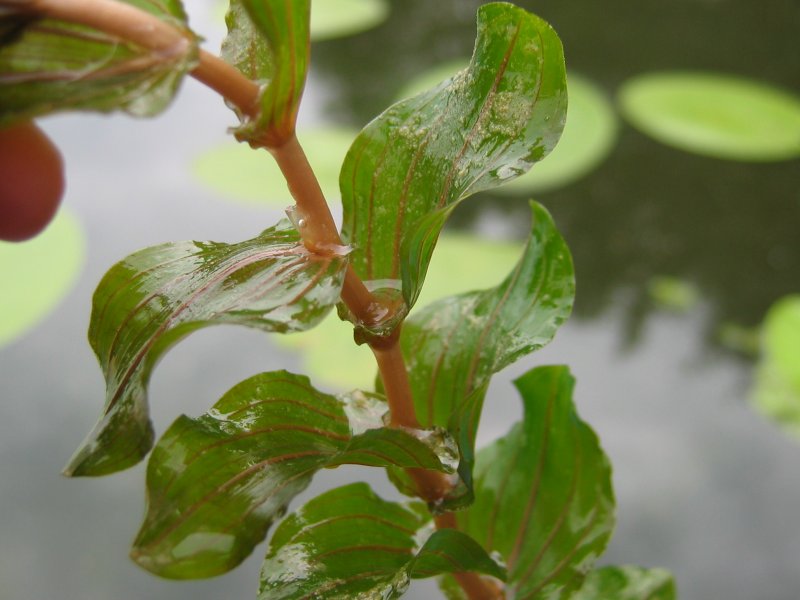
Its leaves can be bright green, dark green, yellowish, olive or brownish. The plant does not produce floating leaves, and its delicate stipules generally fall off shortly after the leaves unfurl.[1][2][3]
Its flowers are greenish-brown and arranged in whorls around spikes. Its fruits are olive green.[4][5]
Its round stems can reach 3 metres in length. Its submerged leaves measure 20–115 mm long and 7–42 mm wide, and its fruits measure approximately 4 mm across.[6][7][8]
Its stems range from 1 to 10 feet in length. Its leaves are 1–3 inches long and approximately one inch wide, and its flower spikes are approximately one inch long.[9][10][11]
Habitat
Clasping-leaf pondweed grows in both standing and flowing freshwater habitats. It occurs in lakes, rivers, streams, large ponds, canals, and larger drains and ditches.[12][13]
The species also grows in brackish and estuarine habitats, including Chesapeake Bay. It grows vigorously in fresh and brackish waters in Florida.[14][15]
It occurs in fast-moving and slow-moving waterways. Its most robust plants generally occur in water deeper than one metre.[16][17]
The species requires reasonably clear water and does not tolerate conditions that are too base-poor.[18]
Behaviour
Clasping-leaf pondweed does not tolerate drying out. Elevated salt concentrations negatively affect its growth and flowering.[19][20]
Reproduction and life cycle
The species produces flowers between June and September. Its flowers grow on spikes that can occur above or below the water surface.[21][22]
The species can reproduce through seeds, which typically germinate within approximately 10 days under suitable conditions. Seeds buried more than one centimetre deep generally fail to germinate or produce seedlings that die.[23][24][25]
The species is best propagated by dividing its rhizomes because it roots poorly from stem cuttings. It regularly hybridises with other Potamogeton species.[26][27]
The species is tetraploid, with a chromosome number of 2n=52.[28]
Conservation
The species is classified as Vulnerable in Spain and the Netherlands and Endangered in Flanders.[29]
Restoration efforts are underway for populations in Chesapeake Bay.[30]
Uses
Clasping-leaf pondweed can be cultivated in garden ponds and barrels.[31]
Similar species
Potamogeton praelongus is a species with which Potamogeton perfoliatus may be confused. Potamogeton richardsonii may be confused with this species in North America.[32][33]
Classification of the Clasping-leaf Pondweed
| Kingdom | Plantae |
|---|---|
| Subkingdom | Pteridobiotina |
| Phylum | Tracheophyta |
| Class | Liliopsida |
| Order | Alismatales |
| Family | Potamogetonaceae (Pondweed Family) |
| Genus | Potamogeton (Pondweed) |
| Species | Potamogeton perfoliatus L. |
Where the Clasping-leaf Pondweed is found
Checklists and occurrence records place Potamogeton perfoliatus in 78 countries across Africa, Asia, Europe, North America and Oceania. GBIF holds 151,787 georeferenced records of it.
Countries where it is native or its origin is not stated
- Afghanistan 42
- Aland Islands 402
- Albania 12
- Algeria 12
- Australia 303
- Austria 655
- Belarus 93
- Belgium 868
- Bosnia and Herzegovina 5
- Bulgaria 17
- Canada 1,153
- Chad
- China 350
- Croatia 20
- Cuba 1
- Cyprus
- Czechia 148
- Denmark 671
- Egypt 8
- Estonia 2,923
- Ethiopia
- Faroe Islands 14
- Finland 29,162
- France 8,738
- Georgia 9
- Germany 5,689
- Greece 16
- Greenland 6
- Guatemala 4
- Hungary 39
- Iceland 168
- India 60
- Indonesia 3
- Iran 9
- Iraq 16
- Ireland 1,897
- Isle of Man 8
- Israel 8
- Italy 289
- Japan 834
- Kazakhstan 128
- Kyrgyzstan 3
- Latvia 60
- Libya 2
- Lithuania 76
- Luxembourg 20
- Madagascar 3
- Mauritania
- Moldova 8
- Mongolia 39
- Montenegro 14
- Morocco
- Niger 7
- North Korea 3
- North Macedonia 23
- Norway 1,955
- Pakistan 23
- Poland 1,267
- Portugal 42
- Romania 31
- Russia 5,862
- Saint Pierre and Miquelon 8
- Slovakia 115
- Slovenia 8
- South Korea 7
- Spain 390
- Sudan 10
- Sweden 30,062
- Switzerland 9,702
- Syria 4
- Tajikistan 20
- The Netherlands 23,444
- Turkey 39
- Ukraine 557
- United Kingdom 21,180
- United States 2,007
- Uzbekistan 12
Countries where it has been introduced
Regions and cities with the most records
- England, United Kingdom 11,069
- Harderwijk, The Netherlands 10,095
- Nunspeet, The Netherlands 9,944
- Zeewolde, The Netherlands 9,495
- Putten, The Netherlands 8,688
- Scotland, United Kingdom 6,870
- Volendam, The Netherlands 6,581
- Elburg, The Netherlands 6,326
- Purmerend, The Netherlands 5,867
- Nijkerk, The Netherlands 5,759
- Dronten, The Netherlands 5,676
- Weesp, The Netherlands 5,043
- Almere Stad, The Netherlands 5,040
- Diemen, The Netherlands 4,937
- Amsterdam, The Netherlands 4,732
- Naarden, The Netherlands 4,278
- Zaandam, The Netherlands 4,054
- Zaanstad, The Netherlands 3,971
- Lelystad, The Netherlands 3,952
- Epe, The Netherlands 3,257
- Hoorn, The Netherlands 3,200
- Huizen, The Netherlands 3,021
- Kampen, The Netherlands 2,894
- Baar, Switzerland 2,669
- Horgen, Switzerland 2,655
- Zug, Switzerland 2,644
- Södermanland, Sweden 2,621
- Stockholm, Sweden 2,547
- Bussum, The Netherlands 2,510
- Cham, Switzerland 2,498
- Flevoland, The Netherlands 2,203
- Uster, Switzerland 2,199
- Adliswil, Switzerland 2,185
- Zwaag, The Netherlands 2,180
- Baarn, The Netherlands 2,123
- Zurich, Switzerland 1,983
1 more country has a few records outside this range
These countries hold a few records of Potamogeton perfoliatus but lie outside the range the checklists give for it. Such records are often zoo or garden specimens, museum material or vagrants, so the species is not counted as occurring there.
A number beside a place is its count of GBIF occurrence records. A place without a number comes from a checklist alone. Records show where a species has been observed or collected, which can include escapes and vagrants.
Common names
English
- Clasping-leaf Pondweed
- Clasped Pondweed
- Clasping-leaved Pondweed
- Perfoliate Pondweed
Names in 26 other languages
- Belarusian
- Урэчнік пранізаналісты
- Czech
- rdest prorostlý
- Danish
- Hjertebladet vandaks
- Dutch
- Doorgroeid fonteinkruid
- Estonian
- kaelus-penikeel
- Faroese
- hjartatjarnaks
- Finnish
- ahvenvita
- French
- potamot perfolié, potamot à feuilles perfoliées
- German
- Durchwachsenes Laichkraut
- Hebrew
- נהרונית לופתת
- Hungarian
- Hínáros békaszőlő
- Italian
- Brasca arrotondata
- Japanese
- hiroha-no-ebi-mo, ヒロハノエビモ
- Lithuanian
- Permautalapė plūdė
- Northern Sami
- vuoskkovihti
- Norwegian Bokmål
- hjertetjernaks, hjertetjønnaks
- Norwegian Nynorsk
- hjartetjernaks, hjartetjønnaks, hjartetjørnaks
- Polish
- Rdestnica przeszyta
- Portuguese
- Colher-de-folhas-raiadas, espiga-de-água-perfoliada
- Russian
- Рдест пронзённолистный
- Slovak
- červenavec prerastenolistý
- Slovenian
- preraslolistni dristavec
- Spanish
- Oreja de Liebre
- Swedish
- ålnate
- Ukrainian
- Рдесник пронизанолистий
- Welsh
- Dyfrllys Trydwll
Synonyms
43 other scientific names have been used for this species and are now treated as synonyms of Potamogeton perfoliatus.
- Buccaferrea amplexicaulis (Kar.) Bubani
- Peltopsis perfoliata (L.) Raf.
- Potamogeton alatofructus A.Benn.
- Potamogeton amplexicaulis Kar.
- Potamogeton bupleuroides Fernald
- Potamogeton fulvus Riddell
- Potamogeton juzepczukii P.I.Dorof. & Tzvelev
- Potamogeton loeselii Honck.
- Potamogeton perfoliatus f. acutifolius Hagstr.
- Potamogeton perfoliatus f. densifolius Tiselius
- Potamogeton perfoliatus f. exornatus Hagstr.
- Potamogeton perfoliatus f. imbecillus Tiselius
- Potamogeton perfoliatus f. lanceolatus (Blytt) Hagstr.
- Potamogeton perfoliatus f. longifolius Tiselius
- Potamogeton perfoliatus f. ovatolanceolatus Rchb.
- Potamogeton perfoliatus f. ovatus Rchb.
- Potamogeton perfoliatus f. prolixus Hagstr.
- Potamogeton perfoliatus f. rotundifolius (Wallr.) Rchb.
- Potamogeton perfoliatus f. simplex Tiselius ex Hagstr.
- Potamogeton perfoliatus subsp. bupleuroides (Fernald) R.T.Clausen
- Potamogeton perfoliatus subsp. bupleuroides (Fernald) Hultén
- Potamogeton perfoliatus subsp. loeselii (Roem. & Schult.) Schübl. & G.Martens
- Potamogeton perfoliatus subsp. perfoliatus
- Potamogeton perfoliatus var. bupleuroides (Fernald) Farw.
- Potamogeton perfoliatus var. densifolius G.Mey.
- Potamogeton perfoliatus var. gracilis Jess.
- Potamogeton perfoliatus var. lacustris Wallman
- Potamogeton perfoliatus var. lancifolius Wimm. & Grab.
- Potamogeton perfoliatus var. loeselii (Honck.) Gaudin
- Potamogeton perfoliatus var. macrophyllus Blytt
- Potamogeton perfoliatus var. mandschuriensis A.Benn.
- Potamogeton perfoliatus var. minor F.M.Bailey
- Potamogeton perfoliatus var. muelleri A.Benn.
- Potamogeton perfoliatus var. ovalifolius Wimm. & Grab.
- Potamogeton perfoliatus var. ovatifolius Wallr.
- Potamogeton perfoliatus var. ovatolanceolatus (Rchb.) Blytt
- Potamogeton perfoliatus var. ovatus M.Loehr
- Potamogeton perfoliatus var. perfoliatus
- Potamogeton perfoliatus var. rotundifolius Wallr.
- Potamogeton perfoliatus var. typicus Ogden
Showing 40 of 43.
Related species
-
 Curly PondweedPotamogeton crispus
-
 Floating PondweedPotamogeton natans
-
 Small PondweedPotamogeton pusillus
-
 Shining PondweedPotamogeton lucens
-
 Longleaf PondweedPotamogeton nodosus
-
 Various-Leaved PondweedPotamogeton gramineus
-
 Bog PondweedPotamogeton polygonifolius
-
 Illinois PondweedPotamogeton illinoensis
Compare
Questions and answers
What is the scientific name of the Clasping-leaf Pondweed?
The scientific name of the Clasping-leaf Pondweed is Potamogeton perfoliatus. Written with its author, the full name is Potamogeton perfoliatus L..
Which family does the Clasping-leaf Pondweed belong to?
Potamogeton perfoliatus belongs to the family Potamogetonaceae, in the order Alismatales and the class Liliopsida.
Where is the Clasping-leaf Pondweed found?
Checklists and occurrence records place Potamogeton perfoliatus in 78 countries, including Sweden, Finland, The Netherlands, United Kingdom, Switzerland and France.
What is the conservation status of the Clasping-leaf Pondweed?
The IUCN Red List category recorded for Potamogeton perfoliatus is Least Concern (LC).
What other names does the Clasping-leaf Pondweed have?
Potamogeton perfoliatus is also known in English as Clasped Pondweed, Clasping-leaved Pondweed and Perfoliate Pondweed.
Sources
Passages the profile rests on
- Its leaves can be bright green, dark green, yellowish, olive or brownish. Source passage: “They vary considerably in colour and may be bright green, dark green, yellowish, olive or brownish.” — English Wikipedia
- The species does not produce floating leaves. Source passage: “There are no floating leaves.” — English Wikipedia
- Its stipules are delicate and generally fall off shortly after the leaves unfurl. Source passage: “The stipules are rather delicate and usually fall off quite soon after the new leaf has unfurled.” — English Wikipedia
- Its fruits are olive green. Source passage: “Fruits are 4 mm across, olive green in colour.” — English Wikipedia
- Its flowers are greenish-brown and arranged in whorls around spikes. Source passage: “The flowers are greenish-brown and arranged in whorls around the spike.” — plant-directory.ifas.ufl.edu
- Its round stems can reach 3 metres in length. Source passage: “intermittently producing round stems up to 3 m long.” — English Wikipedia
- Its submerged leaves measure 20–115 mm long and 7–42 mm wide. Source passage: “20–115 mm long and 7–42 mm wide” — English Wikipedia
- Its fruits measure approximately 4 mm across. Source passage: “Fruits are 4 mm across” — English Wikipedia
- Its stems range from 1 to 10 feet in length. Source passage: “Stems are from 1 to 10 feet long.” — plant-directory.ifas.ufl.edu
- Its leaves are 1–3 inches long and approximately one inch wide. Source passage: “They are 1 to 3 inches long and an inch or so wide.” — plant-directory.ifas.ufl.edu
- Its flower spikes are approximately one inch long. Source passage: “The flowers are on spikes that are about an inch long.” — plant-directory.ifas.ufl.edu
- The species grows in both standing and flowing freshwater habitats. Source passage: “occurring in both standing and flowing freshwater habitats.” — English Wikipedia
- It occurs in lakes, rivers, streams, large ponds, canals, and larger drains and ditches. Source passage: “including lakes, rivers and streams, large ponds, canals and larger drains and ditches.” — English Wikipedia
- It can grow in brackish and estuarine habitats, including Chesapeake Bay. Source passage: “It may also grow in brackish or estuarine habitats, notably in Chesapeake Bay.” — English Wikipedia
- It grows vigorously in fresh and brackish waters in Florida. Source passage: “It grows vigorously in fresh and brackish waters of Florida.” — plant-directory.ifas.ufl.edu
- The species occurs in fast-moving and slow-moving waterways. Source passage: “It may be found in fast- or slow-moving waterways.” — plant-directory.ifas.ufl.edu
- Its most robust plants generally occur in water deeper than one metre. Source passage: “the most robust plants tend to occur in >1 m water depth.” — English Wikipedia
- The species requires reasonably clear water and does not tolerate conditions that are too base-poor. Source passage: “provided that the water remains reasonably clear and is not too base-poor” — English Wikipedia
- The species does not tolerate drying out. Source passage: “It does not tolerate drying out” — English Wikipedia
- Elevated salt concentrations negatively affect its growth and flowering. Source passage: “elevated salt concentrations have a negative effect on both growth and flowering.” — English Wikipedia
- The species produces flowers between June and September. Source passage: “The insignificant flowers are produced between June and September.” — English Wikipedia
- Its flowers grow on spikes that can occur above or below the water surface. Source passage: “The spikes may be found above or below the water surface.” — plant-directory.ifas.ufl.edu
- The species can reproduce through seeds. Source passage: “P. perfoliatus may also be established from seed” — English Wikipedia
- Its seeds typically germinate within approximately 10 days under suitable conditions. Source passage: “The seed typically germinates within about 10 days.” — English Wikipedia
- Seeds buried more than one centimetre deep generally fail to germinate or produce seedlings that die. Source passage: “seed buried more than 1 cm deep either does not germinate or the seedlings die.” — English Wikipedia
- The species is best propagated by dividing its rhizomes because it roots poorly from stem cuttings. Source passage: “it roots poorly from stem cuttings and is best propagated by division of the rhizomes.” — English Wikipedia
- The species regularly hybridises with other Potamogeton species. Source passage: “perfoliate pondweed regularly hybridises with other Potamogeton species” — English Wikipedia
- The species is tetraploid, with a chromosome number of 2n=52. Source passage: “perfoliate pondweed is tetraploid, with 2n=52.” — English Wikipedia
- The species is classified as Vulnerable in Spain and the Netherlands and Endangered in Flanders. Source passage: “it is listed as Vulnerable in Spain and the Netherlands and Endangered in Flanders.” — English Wikipedia
- Restoration efforts are underway for populations in Chesapeake Bay. Source passage: “There are ongoing efforts to restore populations in Chesapeake Bay” — English Wikipedia
- The species can be cultivated in garden ponds and barrels. Source passage: “It is easy to grow in a garden pond or even in a barrel” — English Wikipedia
- Potamogeton praelongus is a species with which Potamogeton perfoliatus may be confused. Source passage: “except perhaps P. praelongus.” — English Wikipedia
- Potamogeton richardsonii may be confused with this species in North America. Source passage: “In North America it could be confused with P. richardsonii” — English Wikipedia
Data
- Catalogue of Life, 2026-10-16 XR cc by
- Global Biodiversity Information Facility CC BY 4.0
- Wikidata CC0
- GeoNames CC BY 4.0
- Wikimedia Commons per image; credit shown with each image
- Within the Catalogue of Life, this name comes from The World Checklist of Vascular Plants (WCVP) cc by
References
- Sp. Pl.: 126 (1753) where the name was published
This species in other databases
- Catalogue of Life 4M3WT
- Wikidata Q158534
- iNaturalist 167328
- World Flora Online wfo-0000769945
- GRIN 417554
Page built on 29 November 2026. See how the catalog is made and all sources and licences.
Cite this page
ScientificNames.org. (2026). Potamogeton perfoliatus (Clasping-leaf Pondweed). Retrieved November 29, 2026, from https://scientificnames.org/species/potamogeton-perfoliatus
“Potamogeton perfoliatus (Clasping-leaf Pondweed).” ScientificNames.org, 2026, scientificnames.org/species/potamogeton-perfoliatus. Accessed 29 Nov. 2026.
ScientificNames.org. “Potamogeton perfoliatus (Clasping-leaf Pondweed).” Accessed November 29, 2026. https://scientificnames.org/species/potamogeton-perfoliatus.
@misc{scientificnames_potamogeton_perfoliatus_clasping_leaf_pondweed,
  author = {{ScientificNames.org}},
  title = {Potamogeton perfoliatus (Clasping-leaf Pondweed)},
  year = {2026},
  url = {https://scientificnames.org/species/potamogeton-perfoliatus},
  note = {Accessed 2026-11-29}
}