Species · Fishes
Panga Pterogymnus laniarius
The scientific name of the Panga is Pterogymnus laniarius. It is a species of fish in the family Sparidae (porgies), order Perciformes. The name dates from 1830.
- Scientific name
- Pterogymnus laniarius (Valenciennes, 1830)
- Common name
- Panga
- Genus
- Pterogymnus
- Family
- Sparidae (Porgies)
- Order
- Perciformes
- Class
- Teleostei
- Red List category
- LC Least Concern
- Environment
- marine
- Recorded in
- 2 countries
- Name status
- accepted in the Catalogue of Life

Overview
Pterogymnus laniarius occurs predominantly on deep reefs and also over mud and sand substrates at depths reaching 120 m. It has a red or pink compressed body, a large eye and two rows of molar-like teeth on its lower jaw.
Written 26 November 2026 from the sources listed below. Each statement was checked against the passage it cites; statements that could not be supported were removed.
Appearance
The Panga has a compressed, ovoid body with a body depth 2.3 to 2.5 times its standard length. Its body is red or pink, with a lighter underside and five or six indistinct bluish horizontal lines below the lateral line.[1][2]
It has a large eye and a smoothly convex dorsal head profile. Its lower jaw bears two rows of molar-like teeth.[3][4]
The dorsal fin has 12 spines and 10 soft rays, while the anal fin has three spines and eight soft rays. The soft-rayed portions of both fins lack scales.[5][6][7]
The maximum total length is 45 cm, although 27 cm is more typical.[8][9]
Habitat
The Panga occurs predominantly on deep reefs with low topographic relief and complex topography, as well as on deep, low-profile and high-profile reefs.[10][11]
It also occurs over mud and sand substrates at depths reaching 120 m.[12][13]
Diet
Adult Panga feed primarily on benthic invertebrates, particularly crabs. Polychaetes, brittle stars and fishes are less important prey items.[14][15]
Juvenile individuals feed largely on mysids.[16]
Behaviour
The Panga is predatory.[17]
Reproduction and life cycle
The Panga has gonads containing both male and female reproductive tissue and is a late gonochorist. Sexual maturity is attained at approximately four or five years of age.[18][19][20]
Spawning occurs mainly at the Agulhas Bank and takes place throughout the year.[21][22]
Conservation
FishBase reports a moderate to high vulnerability score of 47 out of 100 and also reports a score of 53 out of 100. The estimated minimum population doubling time is between 4.5 and 14 years.[23][24][25]
Uses
The Panga is commercially important in South African offshore line fisheries. It contributed 16.5% of total landings in the southern Eastern Cape offshore commercial line fishery between 1985 and 2007.[26][27]
It contributed 63% of landings in the South African demersal inshore trawl fishery between 1992 and 1995, and 11% of landings in the southern Eastern Cape and Western Cape demersal deep-sea trawl fishery.[28][29]
Classification of the Panga
| Kingdom | Animalia |
|---|---|
| Phylum | Chordata |
| Subphylum | Vertebrata |
| Infraphylum | Gnathostomata |
| Parvphylum | Osteichthyes |
| Gigaclass | Actinopterygii |
| Superclass | Actinopteri |
| Class | Teleostei (Teleost) |
| Order | Perciformes |
| Suborder | Percoidei |
| Family | Sparidae (Porgies) |
| Genus | Pterogymnus |
| Species | Pterogymnus laniarius (Valenciennes, 1830) |
Where the Panga is found
Checklists and occurrence records place Pterogymnus laniarius in 2 countries. GBIF holds 2,048 georeferenced records of it.
Countries
Regions and cities with the most records
- Mossel Bay, South Africa 197
- Muizenberg, South Africa 83
- Groot-Brakrivier, South Africa 70
- Retreat, South Africa 58
- Plettenberg Bay, South Africa 40
- Gqeberha, South Africa 34
- Gansbaai, South Africa 19
- Hermanus, South Africa 15
- Jeffreys Bay, South Africa 12
- Lüderitz, Namibia 9
- Saldanha, South Africa 9
- Eastern Cape, South Africa 8
- Port Shepstone, South Africa 8
- Vredenburg, South Africa 8
- Durban, South Africa 7
- Margate, South Africa 6
- Scottburgh, South Africa 6
- Western Cape, South Africa 6
- eMuziwezinto, South Africa 6
- East London, South Africa 5
- Ga-Malakhe, South Africa 5
- Northern Cape, South Africa 5
- Port Alfred, South Africa 5
- Humansdorp, South Africa 4
- Kruisfontein, South Africa 4
- Somerset West, South Africa 4
- eMkhomazi, South Africa 4
- eSikhaleni, South Africa 4
- Ballitoville, South Africa 3
- Gonubie, South Africa 3
- Kimberley, South Africa 3
- Knysna, South Africa 3
- KwaZulu-Natal, South Africa 3
A number beside a place is its count of GBIF occurrence records. A place without a number comes from a checklist alone. Records show where a species has been observed or collected, which can include escapes and vagrants.
Common names
English
- Panga
- Panga Seabream
Names in 7 other languages
- Chinese
- 紅裸翼鯛
- Czech
- pražman namibský
- Danish
- Panga-havrude
- French
- Spare Panga
- Polish
- pangafer
- Russian
- Радужный карась
- Spanish
- Sargo Panga
Synonyms
2 other scientific names have been used for this species and are now treated as synonyms of Pterogymnus laniarius.
- Chrysophrys laniarius (Valenciennes, 1830)
- Pagrus laniarius Valenciennes, 1830
Related species
-
 Gilt-head BreamSparus aurata
-
 BogueBoops boops
-
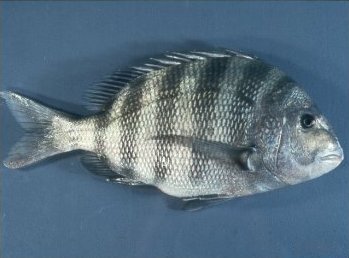 SheepsheadArchosargus probatocephalus
-
 Red Sea BreamPagrus major
-
 Salema PorgySarpa salpa
-
 White Sea BreamDiplodus sargus
-
 Red PorgyPagrus pagrus
-
 Common DentexDentex dentex
Compare
Questions and answers
What is the scientific name of the Panga?
The scientific name of the Panga is Pterogymnus laniarius. Written with its author, the full name is Pterogymnus laniarius (Valenciennes, 1830).
Which family does the Panga belong to?
Pterogymnus laniarius belongs to the family Sparidae, in the order Perciformes and the class Teleostei.
Where is the Panga found?
Checklists and occurrence records place Pterogymnus laniarius in 2 countries: South Africa and Namibia.
What is the conservation status of the Panga?
The IUCN Red List category recorded for Pterogymnus laniarius is Least Concern (LC).
What other names does the Panga have?
Pterogymnus laniarius is also known in English as Panga Seabream.
What kind of fish is panga?
Panga is a fish in the family Sparidae, order Perciformes and class Teleostei. It is the only member of the genus Pterogymnus.[30]
Sources
Passages the profile rests on
- The species has a compressed, ovoid body with a body depth 2.3 to 2.5 times its standard length. Source passage: “The compressed body is ovoid in shape with a depth that fits into its standard length 2.3 to 2.5 times.” — English Wikipedia
- Its body is red or pink, with a lighter underside and five or six indistinct bluish horizontal lines below the lateral line. Source passage: “The overall colour of the body is red or pink, lighter in colour on the lower body, with 5 or 6 indistinct bluish, horizontal lines underneath the lateral line.” — English Wikipedia
- The species has a large eye and a smoothly convex dorsal head profile. Source passage: “The dorsal profile of the head is smoothly convex and the eye is large” — English Wikipedia
- Its lower jaw bears two rows of molar-like teeth. Source passage: “The lower jaw has 2 rows of molar-like teeth.” — English Wikipedia
- Its dorsal fin has 12 spines and 10 soft rays. Source passage: “The dorsal fin has 12 spines and 10 soft rays” — English Wikipedia
- Its anal fin has three spines and eight soft rays. Source passage: “the anal fin has 3 spines and 8 soft rays.” — English Wikipedia
- The soft-rayed portions of its dorsal and anal fins lack scales. Source passage: “but no scales on the soft rayed part of these fins.” — English Wikipedia
- The species reaches a maximum total length of 45 cm. Source passage: “This species has a maximum total length of 45 cm (18 in)” — English Wikipedia
- A total length of 27 cm is more typical for this species. Source passage: “although 27 cm (11 in) is more typical.” — English Wikipedia
- The species occurs predominantly on deep, low-profile and high-profile reefs. Source passage: “found predominantly on deep, low, and high profile reefs” — speciesstatus.sanbi.org
- The species is found mostly on deep reefs with low topographic relief and complex topography. Source passage: “found mostly on deep, low. topographically complex reefs” — English Wikipedia
- The species also occurs over mud and sand substrates at depths reaching 120 m. Source passage: “to a lesser extent over mud and sand down to 120 m” — speciesstatus.sanbi.org
- The species occurs over mud and sand at depths reaching 120 m. Source passage: “and sometimes over areas of mud and sand as deep as 120 m (390 ft).” — English Wikipedia
- Adult individuals feed primarily on benthic invertebrates, particularly crabs. Source passage: “the adults feed on benthic invertebrates, mainly crabs” — English Wikipedia
- Polychaetes, brittle stars and fishes are less important prey items for adults. Source passage: “with polychaetes, brittle stars and fishes less important as prey.” — English Wikipedia
- Juvenile individuals feed largely on mysids. Source passage: “The juveniles feed largely on mysids.” — English Wikipedia
- The species is predatory. Source passage: “The panga is a predatory species” — English Wikipedia
- The species has gonads containing both male and female reproductive tissue. Source passage: “the gonads contain both male and female reproductive tissue” — English Wikipedia
- The species is a late gonochorist. Source passage: “but is a late gonochorist” — English Wikipedia
- Sexual maturity is attained at approximately four or five years of age. Source passage: “sexual maturity is attained at around 4 or 5 years old.” — English Wikipedia
- Spawning occurs mainly at the Agulhas Bank. Source passage: “They spawn mainly at the Agulhas Bank” — English Wikipedia
- Spawning takes place throughout the year. Source passage: “spawning occurs throughout the year.” — English Wikipedia
- FishBase reports a moderate to high vulnerability score of 47 out of 100. Source passage: “Moderate to high vulnerability (47 of 100).” — fishbase.se
- FishBase also reports a moderate to high vulnerability score of 53 out of 100. Source passage: “Moderate to high vulnerability (53 of 100).” — fishbase.se
- The estimated minimum population doubling time is between 4.5 and 14 years. Source passage: “Low, minimum population doubling time 4.5 - 14 years” — fishbase.se
- The species is commercially important in South African offshore line fisheries. Source passage: “The panga is an important species for the offshore commercial line fishery” — English Wikipedia
- The species contributed 16.5% of total landings in the southern Eastern Cape offshore commercial line fishery between 1985 and 2007. Source passage: “where it made up 16.5% of the total landings from 1985 to 2007.” — English Wikipedia
- The species contributed 63% of landings in the South African demersal inshore trawl fishery between 1992 and 1995. Source passage: “where it made up 63% of the landings between 1992 and 1995” — English Wikipedia
- The species contributed 11% of landings in the southern Eastern Cape and Western Cape demersal deep-sea trawl fishery. Source passage: “and 11% of the landing from the demersal deep sea trawl fishery in the southern Eastern Cape and Western Cape.” — English Wikipedia
- The species is the only member of the genus Pterogymnus. Source passage: “It is the only species in the monospecific genus Pterogymnus.” — English Wikipedia
Data
- Catalogue of Life, 2026-10-16 XR cc by
- Global Biodiversity Information Facility CC BY 4.0
- Wikidata CC0
- GeoNames CC BY 4.0
- Wikimedia Commons per image; credit shown with each image
- iNaturalist per image; credit shown with each image
- Within the Catalogue of Life, this name comes from World Register of Marine Species cc by
References
- Cuvier and Valenciennes, 1830 where the name was published
This species in other databases
- Catalogue of Life 6WKMD
- Wikidata Q784460
- iNaturalist 446437
- WoRMS urn:lsid:marinespecies.org:taxname:218619
- ITIS 647974
Page built on 26 November 2026. See how the catalog is made and all sources and licences.
Cite this page
ScientificNames.org. (2026). Pterogymnus laniarius (Panga). Retrieved November 26, 2026, from https://scientificnames.org/species/pterogymnus-laniarius
“Pterogymnus laniarius (Panga).” ScientificNames.org, 2026, scientificnames.org/species/pterogymnus-laniarius. Accessed 26 Nov. 2026.
ScientificNames.org. “Pterogymnus laniarius (Panga).” Accessed November 26, 2026. https://scientificnames.org/species/pterogymnus-laniarius.
@misc{scientificnames_pterogymnus_laniarius_panga,
  author = {{ScientificNames.org}},
  title = {Pterogymnus laniarius (Panga)},
  year = {2026},
  url = {https://scientificnames.org/species/pterogymnus-laniarius},
  note = {Accessed 2026-11-26}
}