Species · Flowering plants
Canary Islands Elder Sambucus palmensis
The scientific name of the Canary Islands Elder is Sambucus palmensis. It is a species of flowering plant in the family Viburnaceae (elder family), order Dipsacales.
- Scientific name
- Sambucus palmensis Link
- Common name
- Canary Islands Elder
- Genus
- Sambucus
- Family
- Viburnaceae (Elder Family)
- Order
- Dipsacales
- Class
- Magnoliopsida
- Recorded in
- 1 country
- Name status
- accepted in the Catalogue of Life

Overview
The Canary Islands elder is a shrub or small tree. It occurs in laurel forest. It is endemic to the Canary Islands.
Written 27 November 2026 from the sources listed below. Each statement was checked against the passage it cites; statements that could not be supported were removed.
Appearance
The Canary Islands elder is a shrub or small tree that can grow up to 6 metres tall.[1][2]
The species produces blackish berries.[3]
Habitat
The Canary Islands elder occurs in laurel forest.[4]
Conservation
The Canary Islands elder is classified as critically endangered. It is described as globally endangered according to the IUCN Red List.[5][6]
Classification of the Canary Islands Elder
| Kingdom | Plantae |
|---|---|
| Subkingdom | Pteridobiotina |
| Phylum | Tracheophyta |
| Class | Magnoliopsida |
| Order | Dipsacales |
| Family | Viburnaceae (Elder Family) |
| Subfamily | Adoxoideae |
| Tribe | Sambuceae |
| Genus | Sambucus (Elder) |
| Species | Sambucus palmensis Link |
Where the Canary Islands Elder is found
Checklists and occurrence records place Sambucus palmensis in 1 country. GBIF holds 249 georeferenced records of it.
Countries
Regions and cities with the most records
- Canary Islands, Spain 156
- Los Llanos de Aridane, Spain 46
- Santa Cruz de la Palma, Spain 46
- La Laguna, Spain 42
- Santa Cruz de Tenerife, Spain 40
- Tacoronte, Spain 38
- Candelaria, Spain 32
- La Orotava, Spain 30
- Puerto de la Cruz, Spain 28
- Güimar, Spain 23
- Los Realejos, Spain 19
- Realejo Alto, Spain 19
- Icod de los Vinos, Spain 18
- Arucas, Spain 12
- Las Palmas de Gran Canaria, Spain 12
- Santa Brígida, Spain 12
- Guía de Isora, Spain 11
- Santa Lucía, Spain 11
- Telde, Spain 11
- Gáldar, Spain 10
- San Bartolomé de Tirajana, Spain 10
- Alcorcón, Spain 8
- Arganda, Spain 8
- Boadilla del Monte, Spain 8
- Chamartín, Spain 8
- Ciudad Lineal, Spain 8
- Coslada, Spain 8
- Fuenlabrada, Spain 8
- Getafe, Spain 8
- Humanes de Madrid, Spain 8
- Leganés, Spain 8
- Madrid, Spain 8
- Madrid, Spain 8
- Mejorada del Campo, Spain 8
- Móstoles, Spain 8
- Parla, Spain 8
Range as the checklists state it
Canary Isl. (Gran Canaria, Tenerife, La Gomera, La Palma)
A number beside a place is its count of GBIF occurrence records. A place without a number comes from a checklist alone. Records show where a species has been observed or collected, which can include escapes and vagrants.
Common names
English
- Canary Islands Elder
Names in 5 other languages
- Catalan
- sabuquero
- Chinese
- 加納利接骨木
- Finnish
- kanarianmustaselja
- German
- Kanarischer Holunder
- Spanish
- Sauco, saúco canario
Synonyms
One other scientific name has been used for this species and is now treated as a synonym of Sambucus palmensis.
- Sambucus nigra subsp. palmensis (Link) Bolli
Related species
-
 ElderSambucus nigra
-
 American ElderberrySambucus canadensis
-
 Red ElderberrySambucus racemosa
-
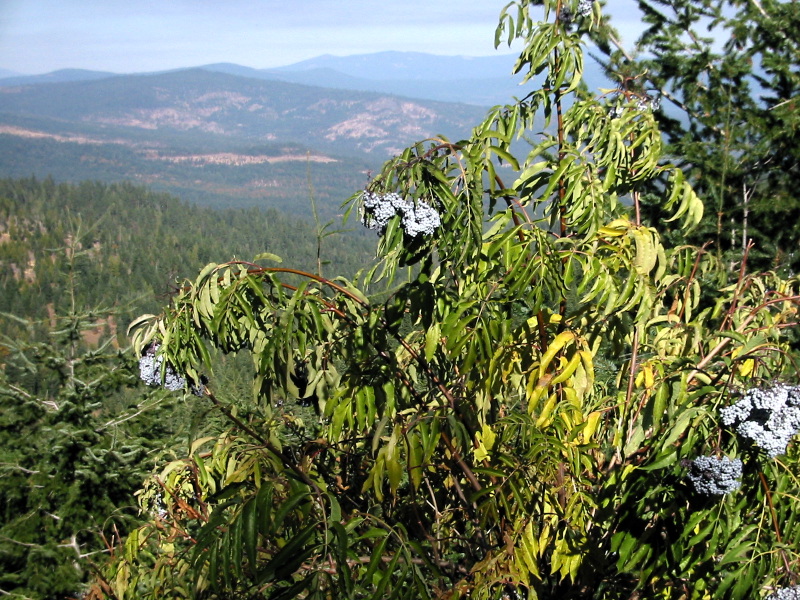 Blue ElderberrySambucus cerulea
-
 Dwarf ElderSambucus ebulus
-
 Blue ElderberrySambucus mexicana
-
 Chinese ElderSambucus javanica
-
 Native ElderSambucus australasica
Compare
Questions and answers
What is the scientific name of the Canary Islands Elder?
The scientific name of the Canary Islands Elder is Sambucus palmensis. Written with its author, the full name is Sambucus palmensis Link.
Which family does the Canary Islands Elder belong to?
Sambucus palmensis belongs to the family Viburnaceae, in the order Dipsacales and the class Magnoliopsida.
Where is the Canary Islands Elder found?
Checklists and occurrence records place Sambucus palmensis in 1 country: Spain.
Sources
Passages the profile rests on
- Sambucus palmensis is a shrub or small tree. Source passage: “Sambucus palmensis is a species of shrub or small tree in the family Viburnaceae.” — English Wikipedia
- The species can grow up to 6 metres tall. Source passage: “It can reach 6 m tall” — English Wikipedia
- The species produces blackish berries. Source passage: “yields blackish berries.” — English Wikipedia
- The species occurs in laurel forest. Source passage: “is present in the laurel forest.” — English Wikipedia
- The species is classified as critically endangered. Source passage: “Sambucus palmensis is a critically endangered endemic to the Canary Islands.” — science.gov
- The species is described as globally endangered according to the IUCN Red List. Source passage: “"Endangered" Globally (Source: IUCN Red List)” — inaturalist.org
Data
- Catalogue of Life, 2026-10-16 XR cc by
- Global Biodiversity Information Facility CC BY 4.0
- Wikidata CC0
- GeoNames CC BY 4.0
- Wikimedia Commons per image; credit shown with each image
- Within the Catalogue of Life, this name comes from Synonymic Checklists of the Vascular Plants of the World cc by
References
- Link. Phys. Beschr. Canar. Ins. [Buch] 151 (1825). where the name was published
This species in other databases
- Catalogue of Life 79HWW
- Wikidata Q6118045
- iNaturalist 765396
- World Flora Online wfo-0000439339
- GRIN 316140
Page built on 29 November 2026. See how the catalog is made and all sources and licences.
Cite this page
ScientificNames.org. (2026). Sambucus palmensis (Canary Islands Elder). Retrieved November 29, 2026, from https://scientificnames.org/species/sambucus-palmensis
“Sambucus palmensis (Canary Islands Elder).” ScientificNames.org, 2026, scientificnames.org/species/sambucus-palmensis. Accessed 29 Nov. 2026.
ScientificNames.org. “Sambucus palmensis (Canary Islands Elder).” Accessed November 29, 2026. https://scientificnames.org/species/sambucus-palmensis.
@misc{scientificnames_sambucus_palmensis_canary_islands_elder,
  author = {{ScientificNames.org}},
  title = {Sambucus palmensis (Canary Islands Elder)},
  year = {2026},
  url = {https://scientificnames.org/species/sambucus-palmensis},
  note = {Accessed 2026-11-29}
}