Species · Flowering plants
Earleaf Greenbrier Smilax auriculata
The scientific name of the Earleaf Greenbrier is Smilax auriculata. It is a species of flowering plant in the family Smilacaceae (greenbriars), order Liliales.
- Scientific name
- Smilax auriculata Walter
- Common name
- Earleaf Greenbrier
- Genus
- Smilax
- Family
- Smilacaceae (Greenbriars)
- Order
- Liliales
- Class
- Liliopsida
- Recorded in
- 3 countries
- Name status
- accepted in the Catalogue of Life

Overview
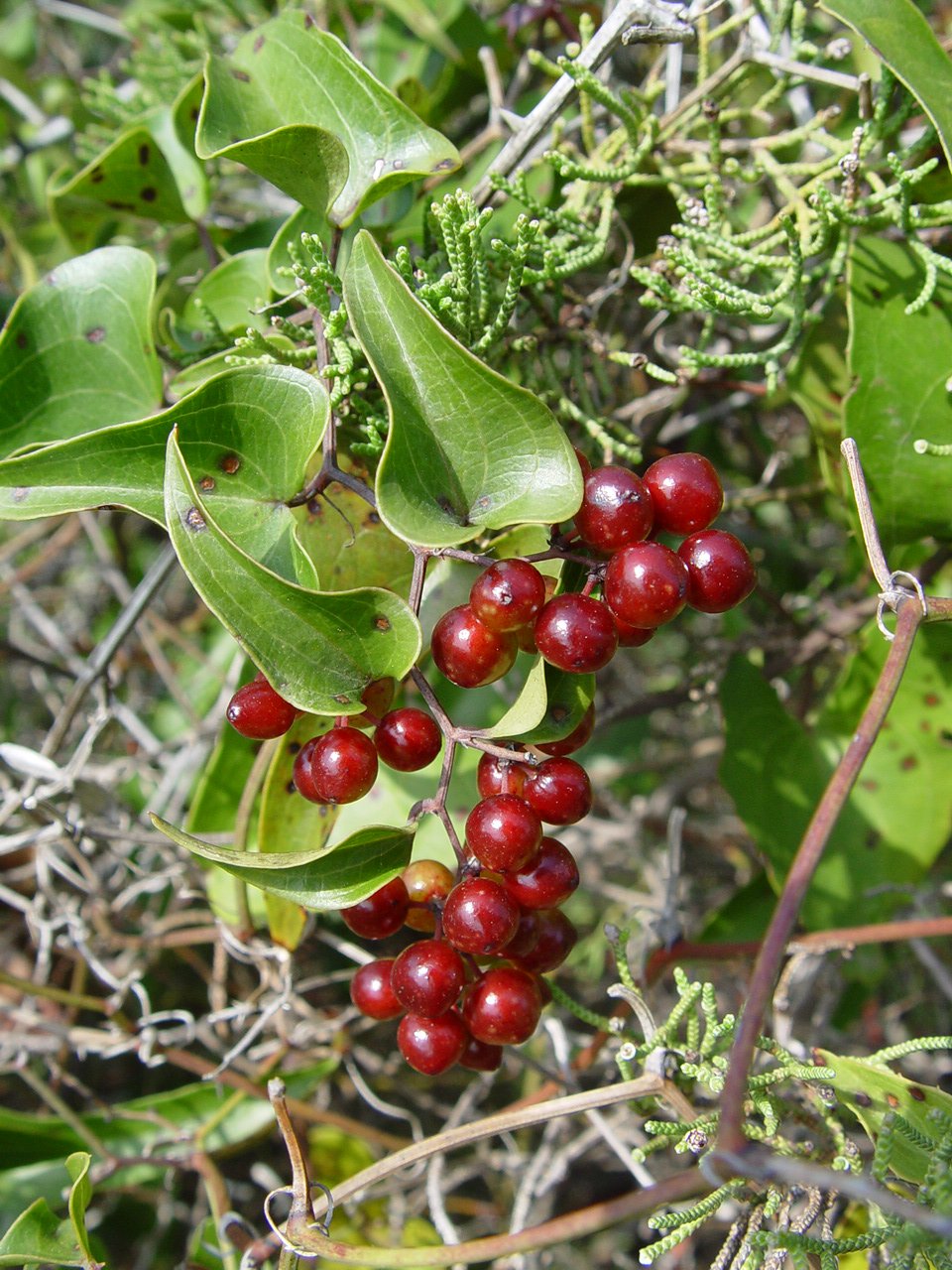
Smilax auriculata is native to the Bahamas, the Turks and Caicos Islands, and the southeastern United States, and has been reported in Florida, Georgia, North Carolina, South Carolina, Alabama, Mississippi, and Louisiana. It has climbing stems with zigzag branching, evergreen leaves, and dark purple, nearly black berries.
Written 26 November 2026 from the sources listed below. Each statement was checked against the passage it cites; statements that could not be supported were removed.
Appearance
The plant produces underground rhizomes and sometimes tubers. Its climbing stems have zigzag branching and can reach approximately 9 metres in height.[1][2][3]
The stems bear flattened, rigid prickles approximately 4 millimetres long. The leaves are evergreen and narrowly ovate, growing up to 8.5 centimetres long.[4][5][6]
The berries are dark purple and nearly black. They measure approximately 6 millimetres in diameter.[7][8]
Habitat
Earleaf Greenbrier grows on coastal sand dunes and in sunlit locations in sandy woodlands. It occurs at elevations below 100 metres.[9][10][11]
Reproduction and life cycle
The flowers are arranged in umbels. Each umbel contains three to eight flowers.[12]
Similar species
Despite its common name wild-bamboo, Earleaf Greenbrier is not closely related to bamboo.[13]
Classification of the Earleaf Greenbrier
| Kingdom | Plantae |
|---|---|
| Subkingdom | Pteridobiotina |
| Phylum | Tracheophyta |
| Class | Liliopsida |
| Order | Liliales |
| Family | Smilacaceae (Greenbriars) |
| Genus | Smilax (Greenbriar) |
| Species | Smilax auriculata Walter |
Where the Earleaf Greenbrier is found
Checklists and occurrence records place Smilax auriculata in 3 countries across North America. GBIF holds 8,260 georeferenced records of it.
Countries
Regions and cities with the most records
- Florida, United States 5,104
- Palm Beach Gardens, United States 395
- Jupiter, United States 369
- North Carolina, United States 351
- Riviera Beach, United States 321
- West Palm Beach, United States 272
- Alabama, United States 251
- Mississippi, United States 227
- Coconut Creek, United States 217
- Deerfield Beach, United States 217
- Pompano Beach, United States 217
- Kendall, United States 216
- Gainesville, United States 215
- Cutler, United States 211
- Sandalfoot Cove, United States 211
- Boynton Beach, United States 210
- South Carolina, United States 209
- Parkland, United States 208
- Boca Del Mar, United States 205
- Boca Raton, United States 203
- Glenvar Heights, United States 193
- Palmetto Bay, United States 193
- Pinecrest, United States 193
- Sunset, United States 192
- Georgia, United States 191
- Margate, United States 188
- Westchester, United States 188
- Coconut Grove, United States 187
- Coral Gables, United States 187
- Coral Terrace, United States 187
- Delray Beach, United States 186
- Kendale Lakes, United States 185
- South Miami Heights, United States 184
- Cutler Bay, United States 183
- Cutler Ridge, United States 183
- The Crossings, United States 183
A number beside a place is its count of GBIF occurrence records. A place without a number comes from a checklist alone. Records show where a species has been observed or collected, which can include escapes and vagrants.
Common names
English
- Earleaf Greenbrier
- Wild Bamboo
Names in 1 other language
- Chinese
- 耳葉菝葜
Synonyms
3 other scientific names have been used for this species and are now treated as synonyms of Smilax auriculata.
- Smilax beyrichii Kunth
- Smilax lata Small
- Smilax ovata Elliott ambiguous synonym
Related species
-
 Common GreenbrierSmilax rotundifolia
-
 Common SmilaxSmilax aspera
-
 CatbrierSmilax bona-nox
-
 Carrion-flowerSmilax herbacea
-
 ChinarootSmilax china
-
 Cat GreenbrierSmilax glauca
-
 Chinese SmilaxSmilax glabra
-
 Bristly GreenbrierSmilax tamnoides
Compare
Questions and answers
What is the scientific name of the Earleaf Greenbrier?
The scientific name of the Earleaf Greenbrier is Smilax auriculata. Written with its author, the full name is Smilax auriculata Walter.
Which family does the Earleaf Greenbrier belong to?
Smilax auriculata belongs to the family Smilacaceae, in the order Liliales and the class Liliopsida.
Where is the Earleaf Greenbrier found?
Checklists and occurrence records place Smilax auriculata in 3 countries: United States, Bahamas and Turks and Caicos Islands.
What other names does the Earleaf Greenbrier have?
Smilax auriculata is also known in English as Wild Bamboo.
Where does Smilax grow?
Earleaf Greenbrier is native to the Bahamas, the Turks and Caicos Islands, and the southeastern United States. It has been reported in Florida, Georgia, North Carolina, South Carolina, Alabama, Mississippi, and Louisiana. It grows on coastal sand dunes and in sunlit locations in sandy woodlands, at elevations below 100 metres.[14][15][9][10][11]
Sources
Passages the profile rests on
- The plant produces underground rhizomes and sometimes tubers. Source passage: “producing underground rhizomes and sometimes tubers.” — English Wikipedia
- The plant has climbing stems with zigzag branching. Source passage: “Plants are climbers with zigzag branching” — English Wikipedia
- The climbing stems can reach approximately 9 metres in height. Source passage: “sometimes reaching a height of 9 m (30 feet).” — English Wikipedia
- The stems bear flattened, rigid prickles approximately 4 millimetres long. Source passage: “Prickles on the stem are flattened and rigid, about 4 mm (0.16 inches) long.” — English Wikipedia
- The leaves are evergreen and narrowly ovate. Source passage: “Leaves are evergreen, narrowly ovate” — English Wikipedia
- The leaves can grow up to 8.5 centimetres long. Source passage: “up to 8.5 cm (3.4 inches) long.” — English Wikipedia
- The berries are dark purple and nearly black. Source passage: “Berries are dark purple, almost black” — English Wikipedia
- The berries measure approximately 6 millimetres in diameter. Source passage: “about 6 mm (0.24 inches) in diameter.” — English Wikipedia
- The species grows on coastal sand dunes. Source passage: “It grows on coastal sand dunes” — English Wikipedia
- The species inhabits sunlit locations in sandy woodlands. Source passage: “in sun-lit locations in sandy woodlands” — English Wikipedia
- The species occurs at elevations below 100 metres. Source passage: “at elevations of less than 100 m (333 feet).” — English Wikipedia
- The flowers are arranged in umbels containing three to eight flowers. Source passage: “borne in umbels of 3–8 flowers.” — English Wikipedia
- Despite its common name wild-bamboo, Smilax auriculata is not closely related to bamboo. Source passage: “despite the fact that it is not closely related to bamboo.” — English Wikipedia
- Smilax auriculata is native to the Bahamas, the Turks and Caicos Islands, and the southeastern United States. Source passage: “native to the Bahamas, the Turks and Caicos Islands, and the southeastern United States.” — English Wikipedia
- The species has been reported in Florida, Georgia, North Carolina, South Carolina, Alabama, Mississippi, and Louisiana. Source passage: “It is reported from Florida, Georgia, North and South Carolina, Alabama, Mississippi, and Louisiana.” — English Wikipedia
Data
- Catalogue of Life, 2026-10-16 XR cc by
- Global Biodiversity Information Facility CC BY 4.0
- Wikidata CC0
- GeoNames CC BY 4.0
- Wikimedia Commons per image; credit shown with each image
- Within the Catalogue of Life, this name comes from The World Checklist of Vascular Plants (WCVP) cc by
References
- Fl. Carol.: 245 (1788) where the name was published
This species in other databases
- Catalogue of Life 4XWBT
- Wikidata Q15491068
- iNaturalist 127910
- World Flora Online wfo-0000740762
- GRIN 457016
Page built on 29 November 2026. See how the catalog is made and all sources and licences.
Cite this page
ScientificNames.org. (2026). Smilax auriculata (Earleaf Greenbrier). Retrieved November 29, 2026, from https://scientificnames.org/species/smilax-auriculata
“Smilax auriculata (Earleaf Greenbrier).” ScientificNames.org, 2026, scientificnames.org/species/smilax-auriculata. Accessed 29 Nov. 2026.
ScientificNames.org. “Smilax auriculata (Earleaf Greenbrier).” Accessed November 29, 2026. https://scientificnames.org/species/smilax-auriculata.
@misc{scientificnames_smilax_auriculata_earleaf_greenbrier,
  author = {{ScientificNames.org}},
  title = {Smilax auriculata (Earleaf Greenbrier)},
  year = {2026},
  url = {https://scientificnames.org/species/smilax-auriculata},
  note = {Accessed 2026-11-29}
}