Species · Flowering plants
Huger's Carrionflower Smilax hugeri
The scientific name of the Huger's Carrionflower is Smilax hugeri. It is a species of flowering plant in the family Smilacaceae (greenbriars), order Liliales.
- Scientific name
- Smilax hugeri (Small) J.B.Norton ex Pennell
- Common name
- Huger's Carrionflower
- Genus
- Smilax
- Family
- Smilacaceae (Greenbriars)
- Order
- Liliales
- Class
- Liliopsida
- Recorded in
- 1 country
- Name status
- accepted in the Catalogue of Life

Overview
Smilax hugeri is native to the southeastern United States and occurs in Mississippi, Alabama, Georgia, Florida, Tennessee, North Carolina, and South Carolina. The plant grows upright without spines, can reach 5 metres in height, and produces small green flowers and round, wax-covered berries.
Written 27 November 2026 from the sources listed below. Each statement was checked against the passage it cites; statements that could not be supported were removed.
Appearance
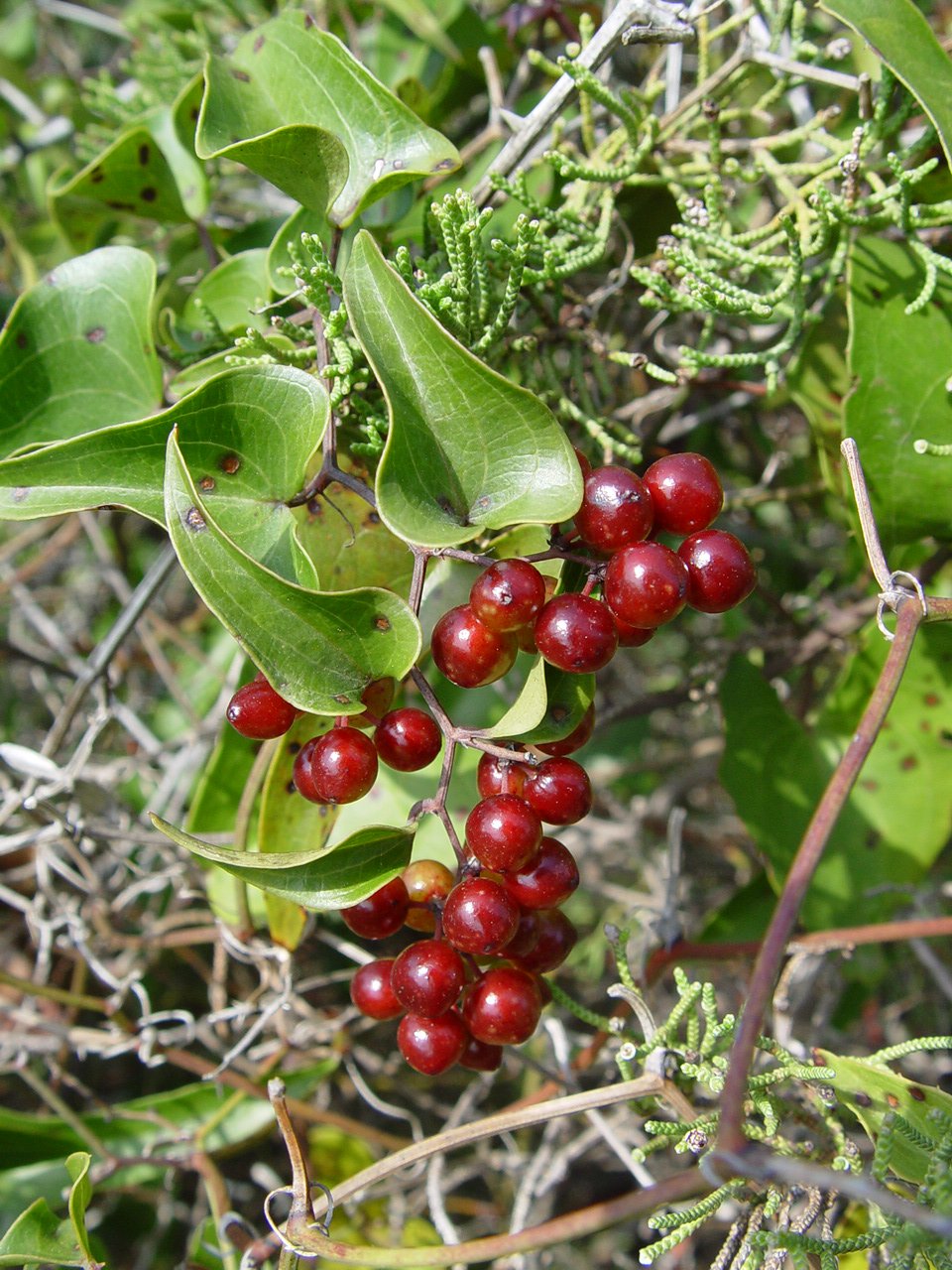
Huger's Carrionflower grows upright and lacks spines. It can reach a height of 5 metres.[1][2]
Its flowers are small and green.[3]
The plant produces round berries covered with wax.[4]
Habitat
Huger's Carrionflower is associated with Southern Piedmont mesic forests. Its naturally limited habitat is a characteristic of the species.[5][6]
Classification of the Huger's Carrionflower
| Kingdom | Plantae |
|---|---|
| Subkingdom | Pteridobiotina |
| Phylum | Tracheophyta |
| Class | Liliopsida |
| Order | Liliales |
| Family | Smilacaceae (Greenbriars) |
| Genus | Smilax (Greenbriar) |
| Species | Smilax hugeri (Small) J.B.Norton ex Pennell |
Where the Huger's Carrionflower is found
Checklists and occurrence records place Smilax hugeri in 1 country across North America. GBIF holds 589 georeferenced records of it.
Countries
Regions and cities with the most records
- Georgia, United States 75
- North Carolina, United States 50
- Alabama, United States 49
- Tennessee, United States 36
- Belvedere Park, United States 35
- Candler-McAfee, United States 35
- Decatur, United States 35
- North Decatur, United States 35
- North Druid Hills, United States 35
- Brookhaven, United States 34
- Redan, United States 33
- Atlanta, United States 32
- Chamblee, United States 31
- Stonecrest, United States 31
- Tucker, United States 31
- East Point, United States 29
- Forest Park, United States 29
- Dunwoody, United States 28
- Sandy Springs, United States 28
- South Carolina, United States 20
- Norcross, United States 16
- Florida, United States 13
- Knoxville, United States 12
- Farragut, United States 10
- Mooresville, United States 10
- Statesville, United States 10
- Smyrna, United States 7
- Athens, United States 6
- Huntsville, United States 6
- Kentucky, United States 6
- Marietta, United States 6
- Peachtree Corners, United States 6
- Riverdale, United States 6
- Stockbridge, United States 6
- Conyers, United States 5
- Kennesaw, United States 5
A number beside a place is its count of GBIF occurrence records. A place without a number comes from a checklist alone. Records show where a species has been observed or collected, which can include escapes and vagrants.
Common names
English
- Huger's Carrionflower
Names in 1 other language
- Chinese
- 修格菝葜
Synonyms
3 other scientific names have been used for this species and are now treated as synonyms of Smilax hugeri.
- Nemexia elliptica Raf.
- Nemexia hugeri Small
- Smilax ecirrhata var. hugeri (Small) H.E.Ahles
Related species
-
 Common GreenbrierSmilax rotundifolia
-
 Common SmilaxSmilax aspera
-
 CatbrierSmilax bona-nox
-
 Carrion-flowerSmilax herbacea
-
 ChinarootSmilax china
-
 Cat GreenbrierSmilax glauca
-
 Chinese SmilaxSmilax glabra
-
 Bristly GreenbrierSmilax tamnoides
Compare
Questions and answers
What is the scientific name of the Huger's Carrionflower?
The scientific name of the Huger's Carrionflower is Smilax hugeri. Written with its author, the full name is Smilax hugeri (Small) J.B.Norton ex Pennell.
Which family does the Huger's Carrionflower belong to?
Smilax hugeri belongs to the family Smilacaceae, in the order Liliales and the class Liliopsida.
Where is the Huger's Carrionflower found?
Checklists and occurrence records place Smilax hugeri in 1 country: United States.
Sources
Passages the profile rests on
- The plant grows upright and lacks spines. Source passage: “erect herb up to 5 m (15 feet) tall, without spines.” — English Wikipedia
- The plant can reach a height of 5 metres. Source passage: “erect herb up to 5 m (15 feet) tall” — English Wikipedia
- The flowers are small and green. Source passage: “Flowers are small and green” — English Wikipedia
- The plant produces round berries covered with wax. Source passage: “berries round and covered with wax.” — English Wikipedia
- The species is associated with Southern Piedmont mesic forests. Source passage: “Southern Piedmont mesic forests (G3G4)” — fs.usda.gov
- The species is identified as having naturally limited habitat. Source passage: “limited habitat naturally limited habitat.” — fs.usda.gov
Data
- Catalogue of Life, 2026-10-16 XR cc by
- Global Biodiversity Information Facility CC BY 4.0
- Wikidata CC0
- GeoNames CC BY 4.0
- Wikimedia Commons per image; credit shown with each image
- Within the Catalogue of Life, this name comes from The World Checklist of Vascular Plants (WCVP) cc by
References
- Bull. Torrey Bot. Club 43: 420 (1916) where the name was published
This species in other databases
Page built on 28 November 2026. See how the catalog is made and all sources and licences.
Cite this page
ScientificNames.org. (2026). Smilax hugeri (Huger's Carrionflower). Retrieved November 28, 2026, from https://scientificnames.org/species/smilax-hugeri
“Smilax hugeri (Huger's Carrionflower).” ScientificNames.org, 2026, scientificnames.org/species/smilax-hugeri. Accessed 28 Nov. 2026.
ScientificNames.org. “Smilax hugeri (Huger's Carrionflower).” Accessed November 28, 2026. https://scientificnames.org/species/smilax-hugeri.
@misc{scientificnames_smilax_hugeri_hugers_carrionflower,
  author = {{ScientificNames.org}},
  title = {Smilax hugeri (Huger's Carrionflower)},
  year = {2026},
  url = {https://scientificnames.org/species/smilax-hugeri},
  note = {Accessed 2026-11-28}
}