Species · Flowering plants
False Chinaroot Smilax pseudochina
The scientific name of the False Chinaroot is Smilax pseudochina. It is a species of flowering plant in the family Smilacaceae (greenbriars), order Liliales.
- Scientific name
- Smilax pseudochina L.
- Common name
- False Chinaroot
- Genus
- Smilax
- Family
- Smilacaceae (Greenbriars)
- Order
- Liliales
- Class
- Liliopsida
- Recorded in
- 3 countries
- Name status
- accepted in the Catalogue of Life

Overview
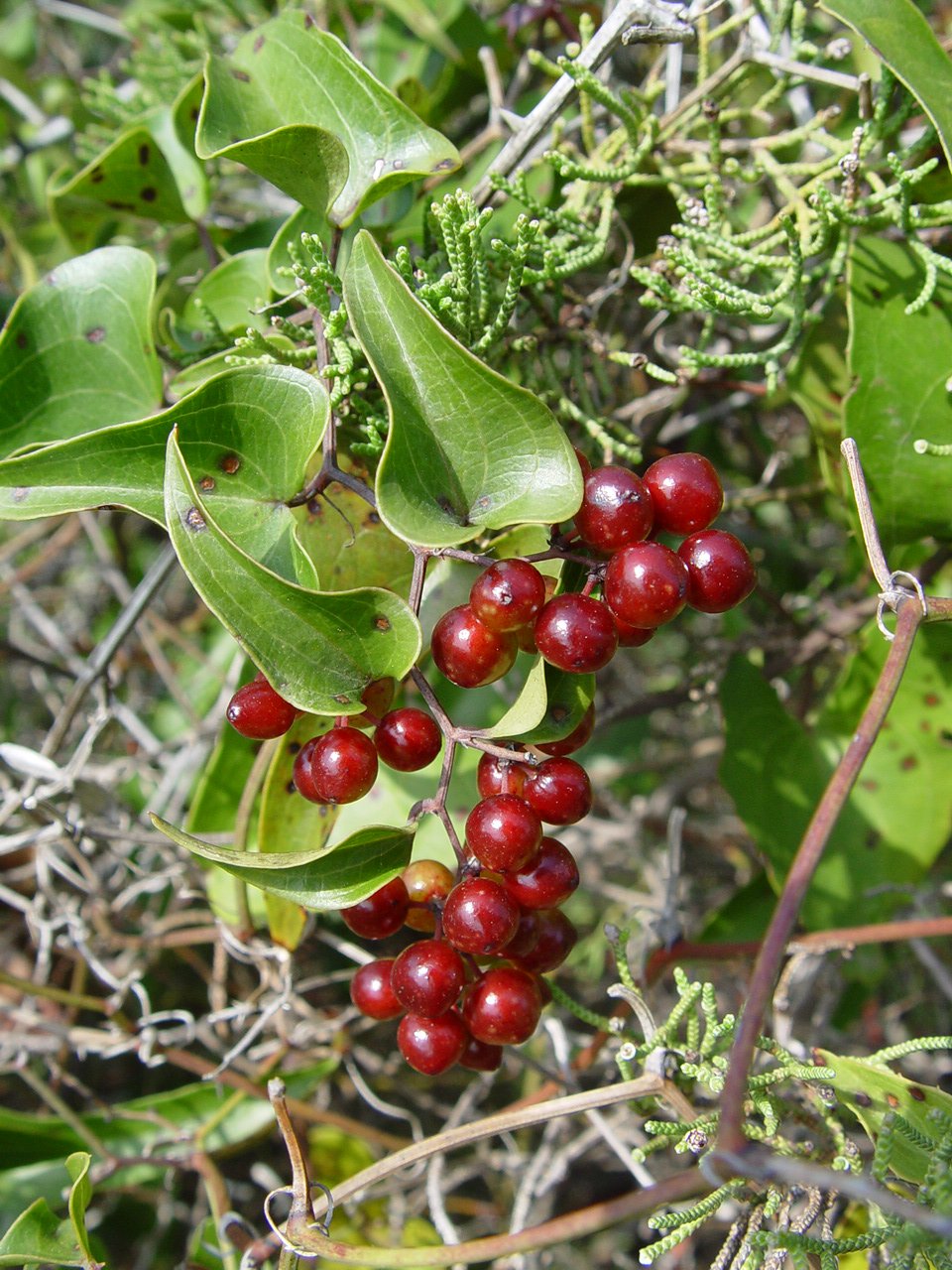
False chinaroot is a perennial climbing herbaceous vine. It occurs in bogs, marshes, wet and dry woods, and dry to damp sandy thickets, along the Atlantic Coast of the United States from Long Island, New York, south to Georgia. It has thornless stems with numerous climbing tendrils, greenish flowers with six tepals, and round blue or black berries with a waxy coating.
Written 27 November 2026 from the sources listed below. Each statement was checked against the passage it cites; statements that could not be supported were removed.
Appearance
False chinaroot is a climbing herbaceous vine that can grow up to 2 meters tall. Its stems are thornless and bear numerous tendrils that help it climb by twisting around objects.[1][2][3][4]
The leaves are hairless, triangular to oval, and measure 5–12 cm long and 2–5 cm wide. Their bases may be almost arrowhead-shaped, and their margins are often straight or nearly concave.[5][6][7][8]
The flowers are greenish and have six tepals. The berries are round, blue or black, and covered with a waxy coating.[9][10]
Habitat
False chinaroot grows in habitats ranging from bogs and marshes to wet and dry woods. It also occurs in dry to damp sandy thickets.[11][12]
Reproduction and life cycle
False chinaroot has separate male and female flowers on different plants. The flowers open in June.[13][14]
The berries mature in September and are borne in long umbels arising axially from the upper leaves.[15][16]
Conservation
False chinaroot is listed as extirpated in Pennsylvania and endangered in New York. It is listed as threatened in Maryland.[17][18][19]
Uses
The Cherokee people made fritters using the plant's fresh, macerated tuberous roots. The roots were ground and soaked in water before the water was decanted.[20][21]
The dried root mash was mixed with fine corn meal to prepare a dough-like batter. The batter was deep-fried in animal fat.[22][23]
Classification of the False Chinaroot
| Kingdom | Plantae |
|---|---|
| Subkingdom | Pteridobiotina |
| Phylum | Tracheophyta |
| Class | Liliopsida |
| Order | Liliales |
| Family | Smilacaceae (Greenbriars) |
| Genus | Smilax (Greenbriar) |
| Species | Smilax pseudochina L. |
Where the False Chinaroot is found
Checklists and occurrence records place Smilax pseudochina in 3 countries across Asia and North America. GBIF holds 633 georeferenced records of it.
Countries
Regions and cities with the most records
- Virginia, United States 49
- Bellmore, United States 36
- Bethpage, United States 36
- Copiague, United States 36
- East Massapequa, United States 36
- East Meadow, United States 36
- Freeport, United States 36
- Hempstead, United States 36
- Hicksville, United States 36
- Levittown, United States 36
- Massapequa, United States 36
- Massapequa Park, United States 36
- Merrick, United States 36
- North Amityville, United States 36
- North Bellmore, United States 36
- North Massapequa, United States 36
- Plainview, United States 36
- Roosevelt, United States 36
- Seaford, United States 36
- Uniondale, United States 36
- Wantagh, United States 36
- Westbury, United States 35
- Baldwin, United States 34
- Chillum, United States 34
- College Park, United States 34
- East Riverdale, United States 34
- Garden City, United States 34
- Hyattsville, United States 34
- Landover, United States 34
- Langley Park, United States 34
- Lanham-Seabrook, United States 34
- Lindenhurst, United States 34
- New York, United States 34
- Rockville Centre, United States 34
- Takoma Park, United States 34
- Adelphi, United States 33
A number beside a place is its count of GBIF occurrence records. A place without a number comes from a checklist alone. Records show where a species has been observed or collected, which can include escapes and vagrants.
Common names
English
- False Chinaroot
Synonyms
9 other scientific names have been used for this species and are now treated as synonyms of Smilax pseudochina.
- Coprosmanthus tamnifolius (Michx.) Kunth
- Nemexia leptanthera (Pennell) Small
- Nemexia tamnifolia (Michx.) Small
- Smilax farinosa Raf.
- Smilax leptanthera Pennell
- Smilax tamnifolia Michx.
- Smilax hederifolia Mill. ambiguous synonym
- Smilax inermis Walter ambiguous synonym
- Smilax pandurata Raf. ambiguous synonym
Related species
-
 Common GreenbrierSmilax rotundifolia
-
 Common SmilaxSmilax aspera
-
 CatbrierSmilax bona-nox
-
 Carrion-flowerSmilax herbacea
-
 ChinarootSmilax china
-
 Cat GreenbrierSmilax glauca
-
 Chinese SmilaxSmilax glabra
-
 Bristly GreenbrierSmilax tamnoides
Compare
Questions and answers
What is the scientific name of the False Chinaroot?
The scientific name of the False Chinaroot is Smilax pseudochina. Written with its author, the full name is Smilax pseudochina L..
Which family does the False Chinaroot belong to?
Smilax pseudochina belongs to the family Smilacaceae, in the order Liliales and the class Liliopsida.
Where is the False Chinaroot found?
Checklists and occurrence records place Smilax pseudochina in 3 countries: United States, Jamaica and Bangladesh.
Sources
Passages the profile rests on
- Smilax pseudochina is a climbing herbaceous vine. Source passage: “Smilax pseudochina is a climbing herbaceous vine” — English Wikipedia
- The stems are thornless. Source passage: “the thornless stems only live one year” — English Wikipedia
- The stems bear numerous tendrils that help the plant climb by twisting around objects. Source passage: “The stems have numerous tendrils which twist around objects and help the plant climb.” — English Wikipedia
- The vine can grow up to 2 meters tall. Source passage: “grows up to 2 meters (7 feet) tall” — English Wikipedia
- The leaves are hairless and range from triangular to oval in shape. Source passage: “The leaves are glabrous and triangular to oval (ovate) shaped” — English Wikipedia
- The leaves may have bases that are almost arrowhead-shaped. Source passage: “may almost be hastate at the base” — English Wikipedia
- The leaf margins are often straight or nearly concave. Source passage: “The leaf edges are often straight or almost concave” — English Wikipedia
- The leaves measure 5–12 cm long and 2–5 cm wide. Source passage: “range from 5–12 cm long to 2–5 cm wide.” — English Wikipedia
- The flowers are greenish and have six tepals. Source passage: “The flowers are dioecious and greenish with 6 tepals.” — English Wikipedia
- The berries are round and blue or black, with a waxy coating. Source passage: “The berries are round, blue or black with a waxy coat” — English Wikipedia
- The species occurs in habitats ranging from bogs and marshes to wet and dry woods. Source passage: “ranging from bogs, marshes, wet woods to dry woods” — English Wikipedia
- The species also grows in dry to damp sandy thickets. Source passage: “and dry to damp sandy thickets” — English Wikipedia
- The species has separate male and female flowers on different plants. Source passage: “The flowers are dioecious” — English Wikipedia
- The flowers open in June. Source passage: “The flowers open in June” — English Wikipedia
- The berries mature in September. Source passage: “the berries mature in September.” — English Wikipedia
- The berries are borne in long umbels arising axially from the upper leaves. Source passage: “borne on long umbels axially from the upper leaves” — English Wikipedia
- The species is listed as extirpated in Pennsylvania. Source passage: “listed as extirpated in Pennsylvania” — English Wikipedia
- The species is listed as endangered in New York. Source passage: “endangered in New York” — English Wikipedia
- The species is listed as threatened in Maryland. Source passage: “threatened in Maryland.” — English Wikipedia
- The Cherokee people made fritters using the plant's fresh, macerated tuberous roots. Source passage: “The Cherokees of North America would make fritters from the plant's fresh, macerated tuberous roots.” — English Wikipedia
- The roots were ground and soaked in water before the water was decanted. Source passage: “After the roots had been ground and soaked in water, the water was decanted” — English Wikipedia
- The dried root mash was mixed with fine corn meal to prepare a dough-like batter. Source passage: “the root mash, after leaving it out to dry, was mixed with fine corn meal, made into a dough-like batter” — English Wikipedia
- The fritter batter was deep-fried in animal fat. Source passage: “then deep-fried in animal fat.” — English Wikipedia
Data
- Catalogue of Life, 2026-10-16 XR cc by
- Global Biodiversity Information Facility CC BY 4.0
- Wikidata CC0
- GeoNames CC BY 4.0
- Wikimedia Commons per image; credit shown with each image
- Within the Catalogue of Life, this name comes from The World Checklist of Vascular Plants (WCVP) cc by
References
- Sp. Pl.: 1031 (1753) where the name was published
This species in other databases
Page built on 28 November 2026. See how the catalog is made and all sources and licences.
Cite this page
ScientificNames.org. (2026). Smilax pseudochina (False Chinaroot). Retrieved November 28, 2026, from https://scientificnames.org/species/smilax-pseudochina
“Smilax pseudochina (False Chinaroot).” ScientificNames.org, 2026, scientificnames.org/species/smilax-pseudochina. Accessed 28 Nov. 2026.
ScientificNames.org. “Smilax pseudochina (False Chinaroot).” Accessed November 28, 2026. https://scientificnames.org/species/smilax-pseudochina.
@misc{scientificnames_smilax_pseudochina_false_chinaroot,
  author = {{ScientificNames.org}},
  title = {Smilax pseudochina (False Chinaroot)},
  year = {2026},
  url = {https://scientificnames.org/species/smilax-pseudochina},
  note = {Accessed 2026-11-28}
}