Species · Fishes
Musselcracker Sparodon durbanensis
The scientific name of the Musselcracker is Sparodon durbanensis. It is a species of fish in the family Sparidae (porgies), order Perciformes. The name dates from 1861.
- Scientific name
- Sparodon durbanensis (Castelnau, 1861)
- Common name
- Musselcracker
- Genus
- Sparodon
- Family
- Sparidae (Porgies)
- Order
- Perciformes
- Class
- Teleostei
- Red List category
- NT Near Threatened
- Environment
- marine
- Recorded in
- 2 countries
- Name status
- accepted in the Catalogue of Life
Overview
Sparodon durbanensis occurs in the south-east Atlantic Ocean and is primarily distributed in southern Africa. It has an elongated oval body, large teeth, strongly developed jaws and a silver or gray body with darker fins and a white belly.
Written 27 November 2026 from the sources listed below. Each statement was checked against the passage it cites; statements that could not be supported were removed.
Appearance
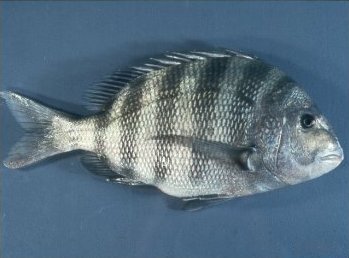
Musselcracker has a silver or gray head and body, darker fins and a white belly. Its body has an elongated oval shape, with large teeth and strongly developed jaws.[1][2][3]
The lateral line has between 58 and 61 scales. The dorsal fin has 11 spines and either 11 or 12 soft rays, while the anal fin has three spines and ten soft rays.[4][5][6]
The maximum reported length is 120 centimetres, and the species can weigh approximately 22 kilograms.[7][8]
Habitat
Musselcracker inhabits shallow coastal tropical waters at depths of up to 80 metres. Juveniles primarily inhabit shallow reefs at depths not exceeding 12 metres.[9][10]
Diet
Musselcracker feeds on sea urchins, crustaceans, gastropods and bristle worms. It has also been recorded consuming green algae belonging to Chlorophyta.[11][12]
Behaviour
Some adult individuals are thought to migrate seasonally in a northeasterly direction.[13]
Reproduction and life cycle
Young individuals typically spawn between August and January. The species reaches 50% maturity at approximately five and a half years of age.[14][15]
The estimated generation time is 13 years. The species can live for approximately 31 years.[16][17]
Conservation
Musselcracker is classified as Near Threatened by the IUCN, and its population is currently declining. A conservation measure limits catches to two fish per person per day.[18][19][20]
Uses
Musselcracker is edible and serves as an important food source in southern Africa.[21]
Classification of the Musselcracker
| Kingdom | Animalia |
|---|---|
| Phylum | Chordata |
| Subphylum | Vertebrata |
| Infraphylum | Gnathostomata |
| Parvphylum | Osteichthyes |
| Gigaclass | Actinopterygii |
| Superclass | Actinopteri |
| Class | Teleostei (Teleost) |
| Order | Perciformes |
| Suborder | Percoidei |
| Family | Sparidae (Porgies) |
| Genus | Sparodon |
| Species | Sparodon durbanensis (Castelnau, 1861) |
Where the Musselcracker is found
Checklists and occurrence records place Sparodon durbanensis in 2 countries. GBIF holds 444 georeferenced records of it.
Countries
Regions and cities with the most records
- Eastern Cape, South Africa 71
- Western Cape, South Africa 58
- Plettenberg Bay, South Africa 41
- Muizenberg, South Africa 21
- Retreat, South Africa 18
- Durban, South Africa 17
- Gqeberha, South Africa 16
- Pinetown, South Africa 11
- Scottburgh, South Africa 11
- eMuziwezinto, South Africa 11
- Port Alfred, South Africa 10
- Knysna, South Africa 9
- Lüderitz, Namibia 9
- eMkhomazi, South Africa 9
- Gansbaai, South Africa 8
- Groot-Brakrivier, South Africa 8
- Port Shepstone, South Africa 8
- East London, South Africa 7
- Mossel Bay, South Africa 7
- George, South Africa 6
- KwaZulu-Natal, South Africa 6
- Margate, South Africa 6
- Ga-Malakhe, South Africa 5
- Humansdorp, South Africa 5
- Jeffreys Bay, South Africa 5
- Motherwell, South Africa 5
- Gonubie, South Africa 4
- Grabouw, South Africa 4
- Hermanus, South Africa 4
- Mdantsane, South Africa 4
- Ballitoville, South Africa 3
- Despatch, South Africa 3
- Kruisfontein, South Africa 3
- eSikhaleni, South Africa 3
A number beside a place is its count of GBIF occurrence records. A place without a number comes from a checklist alone. Records show where a species has been observed or collected, which can include escapes and vagrants.
Common names
English
- Musselcracker
- Silver Steenbras
- White Musselcracker
- Musselcracker Seabream
Names in 8 other languages
- Afrikaans
- Biskop, Cracker, Sandbloue
- Chinese
- 桔尾石齒鯛
- Czech
- zubatec durbanský
- Danish
- Sølvstenbrasen
- French
- Spare Broyeuse
- Portuguese
- Dourada-quebradora
- Russian
- Серебристый спарус
- Spanish
- Sargo Berberecho
Synonyms
One other scientific name has been used for this species and is now treated as a synonym of Sparodon durbanensis.
- Sargus durbanensis Castelnau, 1861
Related species
-
 Gilt-head BreamSparus aurata
-
 BogueBoops boops
-
 SheepsheadArchosargus probatocephalus
-
 Red Sea BreamPagrus major
-
 Salema PorgySarpa salpa
-
 White Sea BreamDiplodus sargus
-
 Red PorgyPagrus pagrus
-
 Common DentexDentex dentex
Compare
Questions and answers
What is the scientific name of the Musselcracker?
The scientific name of the Musselcracker is Sparodon durbanensis. Written with its author, the full name is Sparodon durbanensis (Castelnau, 1861).
Which family does the Musselcracker belong to?
Sparodon durbanensis belongs to the family Sparidae, in the order Perciformes and the class Teleostei.
Where is the Musselcracker found?
Checklists and occurrence records place Sparodon durbanensis in 2 countries: South Africa and Namibia.
What is the conservation status of the Musselcracker?
The IUCN Red List category recorded for Sparodon durbanensis is Near Threatened (NT).
What other names does the Musselcracker have?
Sparodon durbanensis is also known in English as Silver Steenbras, White Musselcracker and Musselcracker Seabream.
Sources
Passages the profile rests on
- The species has a silver or gray head and body, darker fins, and a white belly. Source passage: “Its head and body are colored silver or gray. It has darker colored fins and a white belly.” — English Wikipedia
- The species has large teeth and strongly developed jaws. Source passage: “It has large teeth and has strongly developed jaws” — English Wikipedia
- Its body has an elongated oval shape. Source passage: “The shape of the body is an elongated oval” — English Wikipedia
- The lateral line has between 58 and 61 scales. Source passage: “The lateral line contains between 58 and 61 scales.” — English Wikipedia
- The dorsal fin has 11 spines and either 11 or 12 soft rays. Source passage: “The dorsal fin is supported by 11 spines and 11 or 12 soft rays” — English Wikipedia
- The anal fin has three spines and ten soft rays. Source passage: “the anal fin has 3 spines and 10 soft rays.” — English Wikipedia
- The species can reach a maximum reported length of 120 centimetres. Source passage: “S. durbanensis can grow up to a length of 120 centimetres (47 in),” — English Wikipedia
- The species can weigh approximately 22 kilograms. Source passage: “a weight of around 22 kilograms (50 lb).” — English Wikipedia
- Juveniles primarily inhabit shallow reefs at depths not exceeding 12 metres. Source passage: “S. durbanensis mostly stays in shallow reefs as a juvenile, in depths no greater than 12 metres (40 ft).” — English Wikipedia
- The species inhabits shallow coastal tropical waters at depths of up to 80 metres. Source passage: “It lives in shallow coastal tropical waters, in depths of up to 80 metres (260 ft).” — English Wikipedia
- The species feeds on sea urchins, crustaceans, gastropods, and bristle worms. Source passage: “S. durbanensis eats a variety of invertebrates commonly known as shellfish, including sea urchins, crustaceans, gastropods, and bristle worms.” — English Wikipedia
- The species has also been recorded consuming green algae belonging to Chlorophyta. Source passage: “In addition to this, it has also been known to eat Eukaryotes in the Chlorophyta division, a group of green algae.” — English Wikipedia
- Some adult individuals are thought to migrate seasonally in a northeasterly direction. Source passage: “Some adult specimens are thought to migrate northeasterly seasonally.” — English Wikipedia
- Young individuals typically spawn between August and January. Source passage: “Young typically spawn from August to January.” — English Wikipedia
- The species reaches 50% maturity at approximately five and a half years of age. Source passage: “The species reaches 50% maturity when it is around 5+1⁄2 years old.” — English Wikipedia
- The estimated generation time of the species is 13 years. Source passage: “The average length of time between two generations, called the generation time, is 13 years for the species.” — English Wikipedia
- The species can live for approximately 31 years. Source passage: “They can live to be around 31 years old.” — English Wikipedia
- The population of the species is currently declining. Source passage: “The population of S. durbanensis is currently declining.” — English Wikipedia
- The species is classified as Near Threatened by the IUCN. Source passage: “It is listed as "Near Threatened" by IUCN.” — English Wikipedia
- A conservation measure limits catches to two fish per person per day. Source passage: “most notability one which limits people to two fish per day.” — English Wikipedia
- The species is edible and serves as an important food source in southern Africa. Source passage: “The fish is edible and is an important food source in southern Africa.” — English Wikipedia
Data
- Catalogue of Life, 2026-10-16 XR cc by
- Global Biodiversity Information Facility CC BY 4.0
- Wikidata CC0
- GeoNames CC BY 4.0
- Within the Catalogue of Life, this name comes from World Register of Marine Species cc by
This species in other databases
- Catalogue of Life 6YVH2
- Wikidata Q2489891
- iNaturalist 360950
- WoRMS urn:lsid:marinespecies.org:taxname:218627
- ITIS 647982
Page built on 29 November 2026. See how the catalog is made and all sources and licences.
Cite this page
ScientificNames.org. (2026). Sparodon durbanensis (Musselcracker). Retrieved November 29, 2026, from https://scientificnames.org/species/sparodon-durbanensis
“Sparodon durbanensis (Musselcracker).” ScientificNames.org, 2026, scientificnames.org/species/sparodon-durbanensis. Accessed 29 Nov. 2026.
ScientificNames.org. “Sparodon durbanensis (Musselcracker).” Accessed November 29, 2026. https://scientificnames.org/species/sparodon-durbanensis.
@misc{scientificnames_sparodon_durbanensis_musselcracker,
  author = {{ScientificNames.org}},
  title = {Sparodon durbanensis (Musselcracker)},
  year = {2026},
  url = {https://scientificnames.org/species/sparodon-durbanensis},
  note = {Accessed 2026-11-29}
}