Species · Reptiles
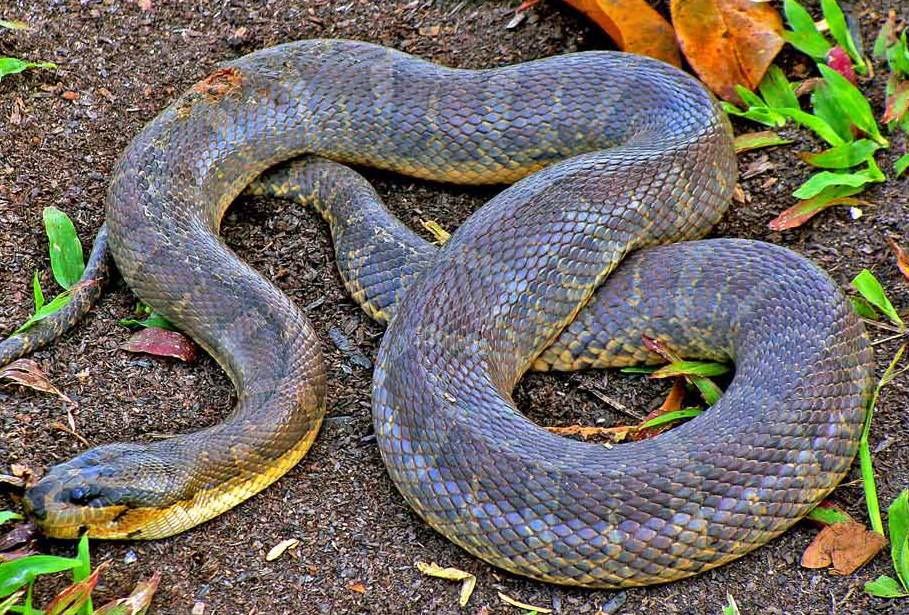
Bocourt's Mud Snake Subsessor bocourti
The scientific name of the Bocourt's Mud Snake is Subsessor bocourti. It is a species of reptile in the family Homalopsidae (mud snakes), order Squamata. The name dates from 1865.
- Scientific name
- Subsessor bocourti (Jan, 1865)
- Common name
- Bocourt's Mud Snake
- Genus
- Subsessor
- Family
- Homalopsidae (Mud Snakes)
- Order
- Squamata
- Class
- Reptilia
- Red List category
- LC Least Concern
- Recorded in
- 5 countries
- Name status
- accepted in the Catalogue of Life

Overview
Subsessor bocourti occurs in Mainland Southeast Asia. It is a robust-bodied snake that can exceed 1 metre (3.3 feet) in length.
Written 28 November 2026 from the sources listed below. Each statement was checked against the passage it cites; statements that could not be supported were removed.
Appearance
Bocourt's Mud Snake is a robust-bodied snake. It can exceed 1 metre (3.3 feet) in length.[1][2]
Habitat
Bocourt's Mud Snake inhabits a variety of stagnant freshwater environments.[3]
Diet
Bocourt's Mud Snake feeds on frogs, fish and crustaceans.[4]
Reproduction and life cycle
Bocourt's Mud Snake gives birth to live young rather than laying eggs. It produces an average of three to eight fully formed offspring per birth.[5][6]
Uses
Bocourt's Mud Snake is widely captured for its skin. It is sometimes consumed as food.[7][8]
Classification of the Bocourt's Mud Snake
| Kingdom | Animalia |
|---|---|
| Phylum | Chordata |
| Subphylum | Vertebrata |
| Infraphylum | Gnathostomata |
| Parvphylum | Osteichthyes |
| Megaclass | Tetrapoda |
| Class | Reptilia (Reptile) |
| Order | Squamata (Snakes) |
| Suborder | Serpentes (Snakes) |
| Infraorder | Alethinophidia |
| Family | Homalopsidae (Mud Snakes) |
| Genus | Subsessor |
| Species | Subsessor bocourti (Jan, 1865) |
Where the Bocourt's Mud Snake is found
Checklists and occurrence records place Subsessor bocourti in 5 countries across Asia. GBIF holds 154 georeferenced records of it.
Countries
Regions and cities with the most records
Range as the checklists state it
West Malaysia, Cambodia, Thailand, Vietnam, China ?
A number beside a place is its count of GBIF occurrence records. A place without a number comes from a checklist alone. Records show where a species has been observed or collected, which can include escapes and vagrants.
Common names
English
- Bocourt's Mud Snake
- Bocourt's Water Snake
- Bocourt’s Mud Snake
Names in 4 other languages
- Chinese
- 腹斑水蛇
- German
- Bacourts Wassertrugnatter, Bocourts Wassertrugnatter
- Spanish
- Serpiente Acuática de Bocourt
- Thai
- งูไซ
Synonyms
8 other scientific names have been used for this species and are now treated as synonyms of Subsessor bocourti.
- Enhydris bocourti (Jan, 1865)
- Enhydris bocourti (Jan, 1965)
- Enhydris bocourti Smith, 1943:388
- Hypsirhina bocourti Jan, 1865
- Hypsirhina bocourti Jan, 1965
- Hypsirhina bocourti soctrangensis Bourret, 1936
- Hypsirhina gigantea Werner, 1923
- Hypsirhina multilineata Tirant, 1885
Related species
-
 Tentacled SnakeErpeton tentaculatum
-
 South Asian BockadamCerberus rynchops
-
 Puff-faced Water SnakeHomalopsis buccata
-
 Boie’s Mud SnakeHypsiscopus plumbeus
-
 Rainbow Water SnakeEnhydris enhydris
-
 White-bellied Mangrove SnakeFordonia leucobalia
- Kapuas Mud SnakeHomalophis gyii
-
 Cat-eyed Water SnakeGerarda prevostiana
Compare
Questions and answers
What is the scientific name of the Bocourt's Mud Snake?
The scientific name of the Bocourt's Mud Snake is Subsessor bocourti. Written with its author, the full name is Subsessor bocourti (Jan, 1865).
Which family does the Bocourt's Mud Snake belong to?
Subsessor bocourti belongs to the family Homalopsidae, in the order Squamata and the class Reptilia.
Where is the Bocourt's Mud Snake found?
Checklists and occurrence records place Subsessor bocourti in 5 countries: Thailand, Vietnam, Cambodia, Malaysia and China.
What is the conservation status of the Bocourt's Mud Snake?
The IUCN Red List category recorded for Subsessor bocourti is Least Concern (LC).
What other names does the Bocourt's Mud Snake have?
Subsessor bocourti is also known in English as Bocourt's Water Snake and Bocourt’s Mud Snake.
What does a mud snake eat?
Bocourt's Mud Snake feeds on frogs, fish and crustaceans.[4]
Sources
Passages the profile rests on
- Subsessor bocourti is a robust-bodied snake. Source passage: “A robust snake, S. bocourti can surpass 1 m (3.3 ft) in length.” — English Wikipedia
- Subsessor bocourti can exceed 1 metre (3.3 feet) in length. Source passage: “A robust snake, S. bocourti can surpass 1 m (3.3 ft) in length.” — English Wikipedia
- Subsessor bocourti inhabits a variety of stagnant freshwater environments. Source passage: “S. bocourti is found in a wide range of stagnant fresh water habitats in Mainland Southeast Asia.” — English Wikipedia
- Subsessor bocourti feeds on frogs, fish and crustaceans. Source passage: “S. bocourti feeds on frogs, fishes, and crustaceans.” — English Wikipedia
- Subsessor bocourti gives birth to live young rather than laying eggs. Source passage: “S. bocourti is a live bearing species, giving birth to, on average, 3–8 fully formed neonate snakes.” — English Wikipedia
- Subsessor bocourti produces an average of three to eight fully formed offspring per birth. Source passage: “S. bocourti is a live bearing species, giving birth to, on average, 3–8 fully formed neonate snakes.” — English Wikipedia
- Subsessor bocourti is widely captured for its skin. Source passage: “Bocourt's water snake is widely caught for its skin and sometimes also eaten.” — English Wikipedia
- Subsessor bocourti is sometimes consumed as food. Source passage: “Bocourt's water snake is widely caught for its skin and sometimes also eaten.” — English Wikipedia
- Subsessor bocourti occurs in Mainland Southeast Asia. Source passage: “S. bocourti is found in a wide range of stagnant fresh water habitats in Mainland Southeast Asia.” — English Wikipedia
- Records of Subsessor bocourti from China are considered questionable. Source passage: “Records from China are questionable.” — English Wikipedia
Data
- Catalogue of Life, 2026-10-16 XR cc by
- Global Biodiversity Information Facility CC BY 4.0
- Wikidata CC0
- GeoNames CC BY 4.0
- Wikimedia Commons per image; credit shown with each image
- Within the Catalogue of Life, this name comes from The Reptile Database cc by
References
- Jan, G. (1865). Enumerazione sistematica degli ofidi appartenenti ai gruppo Potamophilidae. Archive per La Zoologia, l’Anatomia et La Fisiologia 3 (2): 201-265.
- Tirant. (1885). Notes sur les Reptiles et les Batraciens de la Cochinchine et du Cambodge. Imprim. Gouvern., Saigon, 104 Pp.
- Boulenger, G. A. (1896). Catalogue of the snakes in the British Museum, Vol. 3. London (Taylor & Francis), Xiv + 727 Pp.
- Werner, F. (1923). Neue Schlangen des naturhistorischen Museums in Wien. Ann. Naturh. Mus. Wien 36: 160-166.
- Smith, M. A. (1928). The status of some recently described genera and species of snakes. Ann. Mag. Nat. Hist. (10) 1: 494-496.
- Smith, M. A. (1943). The Fauna of British India, Ceylon and Burma, Including the Whole of the Indo-Chinese Sub-Region. Reptilia and Amphibia. 3 (Serpentes). Taylor and Francis, London. 583 Pp.
- Tweedie, M. W. F. (1950). Notes on Malayan reptiles, No.2. Bull. Raffles Mus. No 23: 191-199.
- Taylor, E. H. (1965). The serpents of Thailand and adjacent waters. Univ. Kansas Sci. Bull. 45 (9): 609-1096.
- Saint Girons, & Hubert. (1972). Notes sur l’Ecologie des Serpents du Cambodge. Zoologische Mededelingen 47: 65-87.
- Mehrtens, J. M. (1987). Living snakes of the world in color. Sterling Publ. Co., Hic., New York, NY: 480 Pp.
- Manthey, U., & Grossmann, W. (1997). Amphibien & Reptilien Südostasiens. Natur Und Tier Verlag (Münster), 512 Pp. (ISBN 3-931587-12-6).
- LI, J. (1998). Enhydris bocourti (Jan) - A snake record new to China. Sichuan Journal of Zoology 17 (2): Inside Back Cover and Back Cover.
- Cox, Merel J.; Van Dijk, Peter Paul; Jarujin Nabhitabhata & Thirakhupt,Kumthorn. (1998). A Photographic Guide to Snakes and Other Reptiles of Peninsular Malaysia, Singapore and Thailand. Ralph Curtis Publishing, 144 Pp.
- Stuart, B.L.; Smith, J.; Davey, K.; Din, P. & Platt, S.G. (2000). Homalopsine watersnakes. The harvest and trade from Tonle Sap, Cambodia. Traffic Bull. 18 (3): 115-124.
- ZHOU Fang, & YU Li-jiang. (2002). SNAKES ALONG THE BOUNDRY AREA BETWEEN SOUTHWEST GUANGXI,CHINA AND VIETNAM. Sichuan Journal of Zoology.
- Karns, D.R.; Murphy, J.C.; Voris, H.K. & Suddeth, J.S. (2005). Comparison of Semi-aquatic Snake Communities Associated with the Khorat Basin, Thailand. The Natural History Journal of Chulalongkorn University 5(2): 73-90.
- Zhao, E. M. (2006). The snakes of China [in Chinese]. Hefei, China, Anhui Sience & Technology Publ. House, Vol. I, 372 Pp., Vol. II (Color Plates), 280 Pp.
- Voris, H. K. (2006). Assessment of Biodiversity among Southeast Asian Amphibians and Reptiles. The Natural History Journal of Chulalongkorn University 6(1): 1-10.
- Stuart, B. L., & Emmett, D. A. (2006). A Collection of Amphibians and Reptiles from the Cardamom Mountains, Southwestern Cambodia. Fieldiana Zool. N.S. (109): 1-27.
- Murphy, John C. (2007). Homalopsid Snakes: Evolution in the Mud. Krieger Publishing, Malabar, Florida, 249 Pp.
- Grismer, L. L., Neang, T., Chav, T., & Grismer, J. L. (2008). Checklist of the amphibians and reptiles of the Cardamom region of Southwestern Cambodia. Cambodian Journal of Natural History 2008(1): 12–28.
- Nguyen, S.V., Ho, C.T. and Nguyen, T.Q. (2009). Herpetofauna of Vietnam. Chimaira, Frankfurt, 768 Pp.
- Geissler, Peter, Truong Quang Nguyen, Nikolay A. Poyarkov & Wolfgang Böhme. (2011). New records of snakes from Cat Tien National Park, Dong Nai and Lam Dong provinces, southern Vietnam. Bonn Zoological Bulletin 60 (1): 9-16.
- Beolens, B., & Michael Watkins, a. M. G. (2011). The Eponym Dictionary of Reptiles. Johns Hopkins University Press, Baltimore, USA.
- HARTMANN, Timo; Flora IHLOW, Sarah EDWARDS, SOVATH Sothanin, Markus HANDSCHUH and Wolfgang BÖHME. (2013). A Preliminary Annotated Checklist of the Amphibians and Reptiles of the Kulen Promtep Wildlife Sanctuary in Northern Cambodia. Asian Herpetological Research 4 (1): 36–55.
This species in other databases
Page built on 28 November 2026. See how the catalog is made and all sources and licences.
Cite this page
ScientificNames.org. (2026). Subsessor bocourti (Bocourt's Mud Snake). Retrieved November 28, 2026, from https://scientificnames.org/species/subsessor-bocourti
“Subsessor bocourti (Bocourt's Mud Snake).” ScientificNames.org, 2026, scientificnames.org/species/subsessor-bocourti. Accessed 28 Nov. 2026.
ScientificNames.org. “Subsessor bocourti (Bocourt's Mud Snake).” Accessed November 28, 2026. https://scientificnames.org/species/subsessor-bocourti.
@misc{scientificnames_subsessor_bocourti_bocourts_mud_snake,
  author = {{ScientificNames.org}},
  title = {Subsessor bocourti (Bocourt's Mud Snake)},
  year = {2026},
  url = {https://scientificnames.org/species/subsessor-bocourti},
  note = {Accessed 2026-11-28}
}