Species · Reptiles
Aquatic Garter Snake Thamnophis atratus
The scientific name of the Aquatic Garter Snake is Thamnophis atratus. It is a species of reptile in the family Colubridae (colubrid), order Squamata. The name dates from 1860.
- Scientific name
- Thamnophis atratus Kennicott, 1860
- Common name
- Aquatic Garter Snake
- Genus
- Thamnophis
- Family
- Colubridae (Colubrid)
- Order
- Squamata
- Class
- Reptilia
- Red List category
- LC Least Concern
- Recorded in
- 1 country
- Name status
- accepted in the Catalogue of Life

Overview
Thamnophis atratus sometimes flicks its tongue above the water to imitate an insect and attract small fish while hunting in streams.
Written 26 November 2026 from the sources listed below. Each statement was checked against the passage it cites; statements that could not be supported were removed.
Appearance
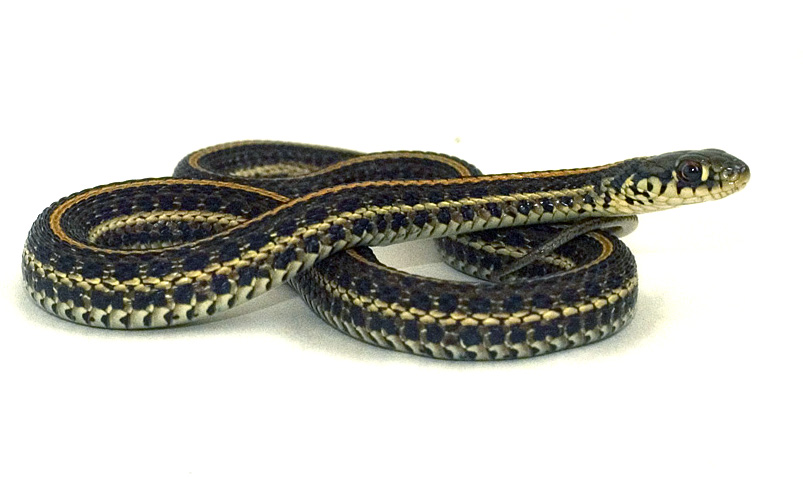
Adults can reach lengths of 18–40 inches (46–102 cm). Dorsal coloration ranges from pale gray with darker lateral blotches to dark brown or nearly black.[1][2]
A yellow stripe along the back may be absent, indistinct, or restricted to the neck. The throat and underside are whitish to yellow.[3][4]
One color morph has a blue-gray background, a faint olive dorsal stripe, and white lateral dots. Another has a yellow dorsal stripe and black spots along its sides.[5][6]
Habitat
The species commonly occurs along the edges of bushlands near ponds, marshes, streams, and lakes. It also occurs along the edges of woodlands, grasslands, and forests near freshwater habitats.[7][8]
Individuals kept alone at the study site showed a complete preference for aquatic or near-aquatic habitats. At study locations where common garter snakes were absent, aquatic garter snakes were found at the water's edge.[9][10]
When sharing habitat with the common garter snake, aquatic garter snakes occupy areas farther from water.[11]
Diet
At the Santa Lucia Preserve, amphibians are a primary food source for the species.[12]
Behaviour
When threatened, the snake seeks shelter in a nearby water source.[13]
While hunting in streams, the snake sometimes flicks its tongue above the water to imitate an insect and attract small fish.[14]
Common garter snakes can displace aquatic garter snakes from aquatic habitats through repeated biting and other aggressive displays.[15]
Reproduction and life cycle
The species gives birth to live young. Broods contain three to twelve young.[16][17]
Classification of the Aquatic Garter Snake
| Kingdom | Animalia |
|---|---|
| Phylum | Chordata |
| Subphylum | Vertebrata |
| Infraphylum | Gnathostomata |
| Parvphylum | Osteichthyes |
| Megaclass | Tetrapoda |
| Class | Reptilia (Reptile) |
| Order | Squamata (Snakes) |
| Suborder | Serpentes (Snakes) |
| Infraorder | Alethinophidia |
| Family | Colubridae (Colubrid) |
| Subfamily | Natricinae |
| Genus | Thamnophis (Garter Snake) |
| Species | Thamnophis atratus Kennicott, 1860 |
Where the Aquatic Garter Snake is found
Checklists and occurrence records place Thamnophis atratus in 1 country across North America. GBIF holds 7,407 georeferenced records of it.
Countries
Regions and cities with the most records
- California, United States 5,969
- Santa Cruz, United States 885
- Los Altos, United States 411
- Oregon, United States 397
- Saratoga, United States 396
- Mountain View, United States 394
- Los Gatos, United States 388
- Menlo Park, United States 347
- Cupertino, United States 344
- Redwood City, United States 342
- Live Oak, United States 340
- Palo Alto, United States 326
- San Carlos, United States 323
- Sunnyvale, United States 313
- Belmont, United States 308
- Daly City, United States 305
- Bayview-Hunters Point, United States 299
- East Palo Alto, United States 296
- San Mateo, United States 288
- Millbrae, United States 286
- Campbell, United States 281
- Burlingame, United States 279
- Foster City, United States 279
- San Francisco, United States 278
- San Rafael, United States 262
- Santa Clara, United States 239
- San Bruno, United States 233
- San Jose, United States 232
- Novato, United States 230
- Pacifica, United States 228
- Richmond, United States 227
- Danville, United States 226
- Oakland, United States 226
- Berkeley, United States 222
- Walnut Creek, United States 222
- Albany, United States 220
Range as the checklists state it
USA (coastal C California, SW Oregon)
A number beside a place is its count of GBIF occurrence records. A place without a number comes from a checklist alone. Records show where a species has been observed or collected, which can include escapes and vagrants.
Common names
English
- Aquatic Garter Snake
- Pacific Coast Aquatic Garter Snake
- Santa Cruz Garter Snake
- Western Aquatic Garter Snake
Names in 3 other languages
- French
- Couleuvre rayée aquatique
- German
- Santa-Cruz-Strumpfbandnatter
- Portuguese
- Cobra-liga-aquática
Synonyms
6 other scientific names have been used for this species and are now treated as synonyms of Thamnophis atratus.
- Eutaenia atrata Kennicott ex Cooper, 1860
- Eutaenia infernalis vidua Cope, 1892
- Thamnophis atratus aquaticus Fox, 1951
- Thamnophis elegans aquaticus Fox, 1951
- Thamnophis elegans atratus (Kennicott in Cooper, 1860)
- Thamnophis ordinoides hydrophila Fitch, 1936
Subspecies and varieties
- Thamnophis atratus atratus (Santa Cruz Gartersnake) subspecies
- Thamnophis atratus hydrophilus (Oregon Garter Snake) subspecies
- Thamnophis atratus zaxanthus (Diablo Range Gartersnake) subspecies
Related species
-
 Common Garter SnakeThamnophis sirtalis
-
 Common Ribbon SnakeThamnophis saurita
-
 Checkered Garter SnakeThamnophis marcianus
-
 Plains Garter SnakeThamnophis radix
-
 Western Ribbon SnakeThamnophis proximus
-
 Western Terrestrial Garter SnakeThamnophis elegans
-
 Giant Garter SnakeThamnophis gigas
-
 Mexican Garter SnakeThamnophis eques
Compare
Questions and answers
What is the scientific name of the Aquatic Garter Snake?
The scientific name of the Aquatic Garter Snake is Thamnophis atratus. Written with its author, the full name is Thamnophis atratus Kennicott, 1860.
Which family does the Aquatic Garter Snake belong to?
Thamnophis atratus belongs to the family Colubridae, in the order Squamata and the class Reptilia.
Where is the Aquatic Garter Snake found?
Checklists and occurrence records place Thamnophis atratus in 1 country: United States.
What is the conservation status of the Aquatic Garter Snake?
The IUCN Red List category recorded for Thamnophis atratus is Least Concern (LC).
What other names does the Aquatic Garter Snake have?
Thamnophis atratus is also known in English as Pacific Coast Aquatic Garter Snake, Santa Cruz Garter Snake and Western Aquatic Garter Snake.
Sources
Passages the profile rests on
- Adults can reach lengths of 18–40 inches (46–102 cm). Source passage: “The aquatic garter snake grows up to 18–40 inches (46–102 cm) long.” — English Wikipedia
- The dorsal coloration ranges from pale gray with darker lateral blotches to dark brown or nearly black. Source passage: “pale gray with alternating rows of darker blotches on the sides, dark brown with borders that are less distinct, or nearly all black.” — English Wikipedia
- A yellow stripe along the back may be absent, indistinct, or restricted to the neck. Source passage: “A long yellow stripe running down the back may be present or absent, only confined to the neck, or just very indistinct.” — English Wikipedia
- The throat and underside are whitish to yellow. Source passage: “The throat and underside of the snake are whitish to yellow.” — English Wikipedia
- One color morph has a blue-gray background, a faint olive dorsal stripe, and white lateral dots. Source passage: “One color morph of the aquatic garter snake has a blue-gray background color with a faint olive-colored dorsal stripe and white dots along its sides.” — English Wikipedia
- Another color morph has a yellow dorsal stripe and black spots along its sides. Source passage: “Another color morph has a yellow dorsal stripe with black spots along its sides.” — English Wikipedia
- The species commonly occurs along the edges of bushlands near ponds, marshes, streams, and lakes. Source passage: “It can most commonly be found on the edges of bushlands, woodlands, grasslands, and forests near ponds, marshes, streams and lakes.” — English Wikipedia
- The species also occurs along the edges of woodlands, grasslands, and forests near freshwater habitats. Source passage: “woodlands, grasslands, and forests near ponds, marshes, streams and lakes.” — English Wikipedia
- Individuals kept alone at the study site showed a complete preference for aquatic or near-aquatic habitats. Source passage: “when individuals from either species are alone, a 100% preference for aquatic or near aquatic habitat is observed.” — pmc.ncbi.nlm.nih.gov
- At study locations where common garter snakes were absent, aquatic garter snakes were found at the water's edge. Source passage: “T. atratus were found at the water's edge only at ponds without T. sirtalis” — pmc.ncbi.nlm.nih.gov
- When sharing habitat with the common garter snake, aquatic garter snakes occupy areas farther from water. Source passage: “In contrast, when these species are together, T. sirtalis occupy the aquatic habitat and T. atratus occupy an area far removed from water.” — pmc.ncbi.nlm.nih.gov
- At the Santa Lucia Preserve, amphibians are a primary food source for the species. Source passage: “the common garter snake (Thamnophis sirtalis) and the aquatic garter snake (Thamnophis atratus) show a strong preference for amphibians as their primary food source at the Santa Lucia Preserve (SLP), Monterey County, California.” — pmc.ncbi.nlm.nih.gov
- When threatened, the snake seeks shelter in a nearby water source. Source passage: “When feeling threatened, this snake will seek shelter in a nearby water source.” — English Wikipedia
- While hunting in streams, the snake sometimes flicks its tongue above the water to imitate an insect and attract small fish. Source passage: “Occasionally, while the snake is hunting for food in a stream, it will flick its tongue above the water to mimic an insect that a small fish would usually eat, thus luring the prey into its mouth.” — English Wikipedia
- Common garter snakes can displace aquatic garter snakes from aquatic habitats through repeated biting and other aggressive displays. Source passage: “Thamnophis sirtalis often physically force T. atratus from the aquatic habitat through repeated biting and other displays of aggression.” — pmc.ncbi.nlm.nih.gov
- The species gives birth to live young. Source passage: “The aquatic garter snake bears live young.” — English Wikipedia
- Broods contain three to twelve young. Source passage: “Broods consist of three to 12 young.” — English Wikipedia
Data
- Catalogue of Life, 2026-10-16 XR cc by
- Global Biodiversity Information Facility CC BY 4.0
- Wikidata CC0
- GeoNames CC BY 4.0
- Wikimedia Commons per image; credit shown with each image
- Within the Catalogue of Life, this name comes from The Reptile Database cc by
References
- Cooper, 1860 where the name was published
- Kennicott, R. (1860). Zoological report. No. 4. Report upon the reptiles collected on the survey. In: Stevens, I.I. (Ed.), Reports of Explorations and Surveys, to Ascertain the Most Practicable and Economical Route for a Railroad from the Mississippi River to the Pacific Ocean, Made under the Direction of the Secretary of War, in 1853-5. Route near the Forty-Seventh and Forty-Ninth Parallels. 12(2), 292–306, Pls. 12–16, 19–22, 29, 31.
- Cope, E. D. (1900). The crocodilians, lizards and snakes of North America. Ann. Rep. U.S. Natl. Mus. 1898: 153-1270.
- Fitch, H. S. (1936). Amphibians and reptiles of the Rouge River Basin, Oregon. American Midland Naturalist 17: 634-652.
- Fitch, H. C. (1940). A biogeographical study of the ordinoides artenkreis of garter snakes (genus Thamnophis). Univ. California Publ. Zool. 44: 1-150.
- Fox, W. (1951). Relationships among the garter snakes of the Thamnophis elegans rassenkreis. Univ. California Publ. Zool. 50: 485-530.
- Rossman, D. A. (1979). Morphological evidence for taxonomic partitioning of the Thamnophis elegans complex (Serpentes: Colubridae). Occ. Pap. Mus. Zool. Louisiana State Univ. (55): 1-12.
- Stebbins, R. C. (1985). A Field Guide to Western Reptiles and Amphibians, 2nd ed. Houghton Mifflin, Boston.
- Rossman, D. A., & Stewart, G. R. (1987). Taxonomic reevaluation of Thamnophis couchii (Serpentes: Colubridae). Occ. Pap. Mus. Zool. Louisiana Sata Univ. (63): 1-25.
- Rossman, Douglas A.; Ford, Neil B. & Seigel, Richard A. (1996). The Garter Snakes: Evolution and Ecology. University of Oklahoma Press, Norman, OK, Xx + 332 + Pp.
- Boundy, J. (1999). Systematics of the garter snake Thamnophis atratus at the southern end of its range. Proc. Cal. Acad. Sci. 51 (6): 311-336.
- Hallmen, M., & Chlebowy, J. (2001). Strumpfbandnattern. Natur Und Tier Verlag (Münster), 192 Pp.
- Bourguignon, T. (2002). Strumpfbandnattern: Herkunft - Pflege - Arten. E. Ulmer Verlag, 125 Pp.
- Queiroz, Alan de; Robin Lawson and Julio A. Lemos-Espinal. (2002). Phylogenetic Relationships of North American Garter Snakes (Thamnophis) Based on Four Mitochondrial Genes: How Much DNA Sequence Is Enough? Molecular Phylogenetics and Evolution 22: 315-329.
- Rodríguez-Robles, Javier A., Good, David A., Wake, David B. (2003). Brief History of Herpetology in the Museum of Vertebrate Zoology, University of California, Berkeley, with a List of Type Specimens of Recent Amphibians and Reptiles. UC Publications in Zoology, 119 Pp.
- Bruchmann, H. (2006). Freilandbeobachtungen an Strumpfbandnattern in Nordamerika. Draco 6 (25): 86-93.
- Grübner, D. (2006). Die seltener beobachteten Strumpfbandnattern. Draco 6 (25): 66-76.
- Bol, S. (2007). Verzorging en kweek van de Santa Cruz kousebandslang, Thamnophis atratus atratus. Lacerta 65 (5): 200-217.
- Fontenot Jr, Clifford L. (2008). Variation in pupil diameter in North American Gartersnakes (Thamnophis) is regulated by immersion in water, not by light intensity. Vision Research 48: 1663–1669.
- Welsh, H.H., Jr., C.A. Wheeler & A.J. Lind. (2010). Spatial Ecology of the Oregon Gartersnake, Thamnophis atratus hydrophilus, in a Free-Flowing Stream Environment. Copeia 2010 (1): 75-85.
- Parker, Michael S. and Emma Rose Parker. (2011). Thamnophis atratus hydrophilus (Oregon gartersnake) diet. Herpetological Review 42 (3): 445.
- Preston, Daniel L. and Pieter T. J. Johnson. (2012). Importance of Native Amphibians in the Diet and Distribution of the Aquatic Gartersnake (Thamnophis atratus) in the San Francisco Bay Area of California. Journal of Herpetology 46 (2): 221-227.
- Crother, B. I. (ed.). (2012). Standard Common and Current Scientific Names for North American Amphibians, Turtles, Reptiles, and Crocodilians, Seventh Edition. Herpetological Circular 39: 1-92.
- Sleijpen, & Fons. (2013). Picture: Thamnophis atratus atratus, adult, female. Litteratura Serpentium 33 (4): 330.
- Allen, W. L., R. Baddeley, N. E. Scott-Samuel, and I. C. Cuthill. (2013). The evolution and function of pattern diversity in snakes. Behav. Ecol. 24:1237– 1250.
This species in other databases
Page built on 28 November 2026. See how the catalog is made and all sources and licences.
Cite this page
ScientificNames.org. (2026). Thamnophis atratus (Aquatic Garter Snake). Retrieved November 28, 2026, from https://scientificnames.org/species/thamnophis-atratus
“Thamnophis atratus (Aquatic Garter Snake).” ScientificNames.org, 2026, scientificnames.org/species/thamnophis-atratus. Accessed 28 Nov. 2026.
ScientificNames.org. “Thamnophis atratus (Aquatic Garter Snake).” Accessed November 28, 2026. https://scientificnames.org/species/thamnophis-atratus.
@misc{scientificnames_thamnophis_atratus_aquatic_garter_snake,
  author = {{ScientificNames.org}},
  title = {Thamnophis atratus (Aquatic Garter Snake)},
  year = {2026},
  url = {https://scientificnames.org/species/thamnophis-atratus},
  note = {Accessed 2026-11-28}
}