Species · Reptiles
Southern Durango Spotted Garter Snake Thamnophis nigronuchalis
The scientific name of the Southern Durango Spotted Garter Snake is Thamnophis nigronuchalis. It is a species of reptile in the family Colubridae (colubrid), order Squamata. The name dates from 1957.
- Scientific name
- Thamnophis nigronuchalis Thompson, 1957
- Common name
- Southern Durango Spotted Garter Snake
- Genus
- Thamnophis
- Family
- Colubridae (Colubrid)
- Order
- Squamata
- Class
- Reptilia
- Red List category
- DD Data Deficient
- Recorded in
- 1 country
- Name status
- accepted in the Catalogue of Life
Overview
Thamnophis nigronuchalis is endemic to the Mexican state of Durango, where it inhabits wet meadows and riparian areas at elevations between 8,500 and 9,000 feet. It is distinguished by a black neck blotch and rufous-colored dorsal spots outlined in black, arranged in five to ten rows.
Written 27 November 2026 from the sources listed below. Each statement was checked against the passage it cites; statements that could not be supported were removed.
Appearance
The Southern Durango Spotted Garter Snake has a heavy-bodied, medium-sized build and an oval-shaped head. It has two supralabial scales and two preocular scales.[1][2][3]
A distinct black blotch marks the dorsal surface of its neck. Its dorsal pattern consists of rufous-colored spots outlined in black, arranged in five to ten rows, and it lacks dorsal and lateral stripes.[4][5][6]
The species has between 149 and 165 ventral scales. These scales are heavily pigmented and often form an irregular black stripe.[7][8]
Habitat
The species inhabits wet meadows and riparian areas at elevations between 8,500 and 9,000 feet. Its habitat appears restricted to high-elevation drainage basins of the Sierra Madre Occidental.[9][10][11]
Diet
The Southern Durango Spotted Garter Snake has been documented eating earthworms and amphibians. Its documented amphibian prey includes Rana pipiens and species of the genus Hyla.[12][13][14][15]
Uses
The specific name nigronuchalis refers to the Latin words nigro, meaning black, and nuchal, meaning of the nape. The scientific name refers to the species' characteristic black neck patch.[16][17]
Classification of the Southern Durango Spotted Garter Snake
| Kingdom | Animalia |
|---|---|
| Phylum | Chordata |
| Subphylum | Vertebrata |
| Infraphylum | Gnathostomata |
| Parvphylum | Osteichthyes |
| Megaclass | Tetrapoda |
| Class | Reptilia (Reptile) |
| Order | Squamata (Snakes) |
| Suborder | Serpentes (Snakes) |
| Infraorder | Alethinophidia |
| Family | Colubridae (Colubrid) |
| Subfamily | Natricinae |
| Genus | Thamnophis (Garter Snake) |
| Species | Thamnophis nigronuchalis Thompson, 1957 |
Where the Southern Durango Spotted Garter Snake is found
Checklists and occurrence records place Thamnophis nigronuchalis in 1 country across North America. GBIF holds 96 georeferenced records of it.
Countries
Regions and cities with the most records
Range as the checklists state it
Mexico (SW Durango, Nayarit)
A number beside a place is its count of GBIF occurrence records. A place without a number comes from a checklist alone. Records show where a species has been observed or collected, which can include escapes and vagrants.
Common names
English
- Southern Durango Spotted Garter Snake
Names in 4 other languages
- Chinese
- 杜蘭戈帶蛇
- German
- Durango-Strumpfbandnatter, Südliche Durango-Strumpfbandnatter
- Portuguese
- Cobra-liga-pintada-do-sul
- Spanish
- Jarretera Manchada de Durango, culebra de agua de cabeza angosta de Durango
Related species
-
 Common Garter SnakeThamnophis sirtalis
-
 Common Ribbon SnakeThamnophis saurita
-
 Checkered Garter SnakeThamnophis marcianus
-
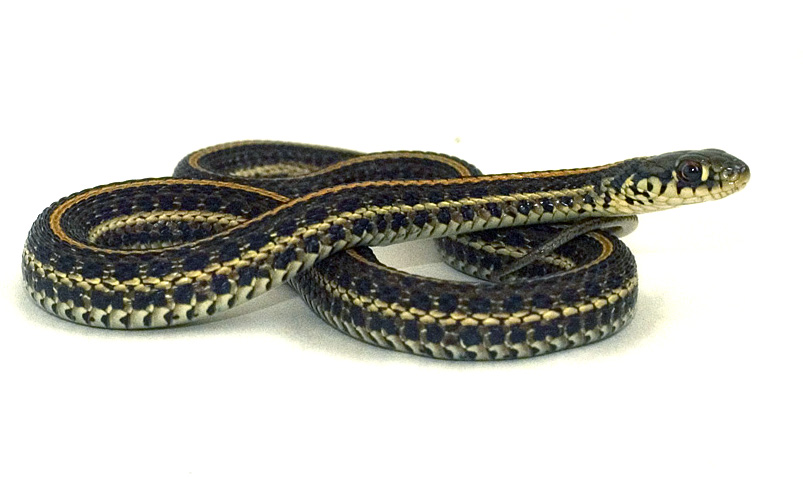 Plains Garter SnakeThamnophis radix
-
 Western Ribbon SnakeThamnophis proximus
-
 Western Terrestrial Garter SnakeThamnophis elegans
-
 Giant Garter SnakeThamnophis gigas
-
 Mexican Garter SnakeThamnophis eques
Compare
- Southern Durango Spotted Garter Snake vs Common Garter Snake
- Southern Durango Spotted Garter Snake vs Common Ribbon Snake
- Southern Durango Spotted Garter Snake vs Checkered Garter Snake
- Southern Durango Spotted Garter Snake vs Plains Garter Snake
- Southern Durango Spotted Garter Snake vs Western Ribbon Snake
Questions and answers
What is the scientific name of the Southern Durango Spotted Garter Snake?
The scientific name of the Southern Durango Spotted Garter Snake is Thamnophis nigronuchalis. Written with its author, the full name is Thamnophis nigronuchalis Thompson, 1957.
Which family does the Southern Durango Spotted Garter Snake belong to?
Thamnophis nigronuchalis belongs to the family Colubridae, in the order Squamata and the class Reptilia.
Where is the Southern Durango Spotted Garter Snake found?
Checklists and occurrence records place Thamnophis nigronuchalis in 1 country: Mexico.
What is the conservation status of the Southern Durango Spotted Garter Snake?
The IUCN Red List category recorded for Thamnophis nigronuchalis is Data Deficient (DD).
What is the diet of a garter snake?
The Southern Durango Spotted Garter Snake has been documented eating earthworms and amphibians, including Rana pipiens and species of the genus Hyla.[12][13][14][15]
Sources
Passages the profile rests on
- The species has a heavy-bodied, medium-sized build. Source passage: “This is a heavy-bodied, medium sized garter snake.” — English Wikipedia
- The snake has an oval-shaped head. Source passage: “It has an oval-shaped head” — English Wikipedia
- The species has two supralabial scales and two preocular scales. Source passage: “two supralabial scales, two preocular scales” — English Wikipedia
- The snake has a distinct black blotch on the dorsal surface of its neck. Source passage: “a distinct black blotch on the dorsal surface of its neck.” — English Wikipedia
- Its dorsal pattern features rufous-colored spots outlined in black, arranged in five to ten rows. Source passage: “The dorsal pattern consists of rufous-colored spots outlined in black in 5-10 rows” — English Wikipedia
- The species lacks dorsal and lateral stripes. Source passage: “with no dorsal or lateral stripes.” — English Wikipedia
- The species has between 149 and 165 ventral scales. Source passage: “It has 149-165 ventral” — English Wikipedia
- Its ventral scales are heavily pigmented and often form an irregular black stripe. Source passage: “Ventral scales are heavily pigmented, often forming an irregular black stripe.” — English Wikipedia
- The species inhabits wet meadows and riparian areas. Source passage: “where it is found in wet meadows and riparian areas” — English Wikipedia
- The species occurs at elevations between 8,500 and 9,000 feet. Source passage: “at altitudes of 8500–9000 feet.” — English Wikipedia
- Its habitat appears restricted to high-elevation drainage basins of the Sierra Madre Occidental. Source passage: “It appears to be restricted to high elevation drainage basins of the Sierra Madre Occidental.” — English Wikipedia
- The species has been documented eating earthworms. Source passage: “This species has been documented to eat earthworms and amphibians” — English Wikipedia
- The species has been documented eating amphibians. Source passage: “This species has been documented to eat earthworms and amphibians” — English Wikipedia
- Its documented amphibian prey includes the species Rana pipiens. Source passage: “including Rana pipiens and Hyla species.” — English Wikipedia
- Its documented amphibian prey includes species of the genus Hyla. Source passage: “including Rana pipiens and Hyla species.” — English Wikipedia
- The specific name nigronuchalis refers to the Latin words nigro, meaning black, and nuchal, meaning of the nape. Source passage: “The specific name nigronuchalis references the Latin word nigro meaning black, and nuchal meaning of the nape” — English Wikipedia
- The species' scientific name refers to its characteristic black neck patch. Source passage: “and is derived from the black neck patch characteristic of the species.” — English Wikipedia
Data
- Catalogue of Life, 2026-10-16 XR cc by
- Global Biodiversity Information Facility CC BY 4.0
- Wikidata CC0
- GeoNames CC BY 4.0
- Within the Catalogue of Life, this name comes from The Reptile Database cc by
References
- A new Mexican Gartersnake (Genus Thamnophis) with notes on related forms. (1957). Occasional Papers of the Museum of Zoology University of Michigan Ann Arbor, 584, 1–10. https://bionames.org/references/727cdc79cfaf8e3efed31428cd073d9e Link where the name was published
- Thompson, Fred G. (1957). A new Mexican gartersnake (Genus Thamnophis) with notes on related forms. Occasional Papers of the Museum of Zoology, University of Michigan (584): 1-10.
- Webb, R. G. (1984). Herpetogeography in the Mazatlán-Durango Region of the Sierra Madre Occidental, Mexico. Vetrebrate Ecology and Systematics - A Ribute to Henry S. Fitch; Museum of Natural History, University of Kansas, Lawrence, Pp. 217-241.
- Tanner, Wilmer W. (1985). Snakes of Western Chihuahua. Great Basin Naturalist 45 (4): 615-676.
- de Queiroz, K., & LAWSON, R. (1994). Phylogenetic relationships of the garter snakes based on DNA sequence and allozyme vatiation. Biol. J. Linnean Soc. 53: 209-229.
- Rossman, Douglas A.; Ford, Neil B. & Seigel, Richard A. (1996). The Garter Snakes: Evolution and Ecology. University of Oklahoma Press, Norman, OK, Xx + 332 + Pp.
- Valdez-Lares, R.; R. Muñiz-Martínez; E.Gadsden; G. Aguirre-León; G. Castañeda-Gaytán; R. Gonzalez-Trápaga. (2013). Checklist of amphibians and reptiles of the state of Durango, México. Check List 9 (4):714-724.
- Wallach, Van; Kenneth L. Williams, Jeff Boundy. (2014). Snakes of the World: A Catalogue of Living and Extinct Species. [type catalogue]. Taylor and Francis, CRC Press, 1237 Pp.
- Woolrich-Piña, Guillermo A, Paulino Ponce-Campos, Jesús Loc-Barragán, Juan Pablo Ramírez-Silva, Vicente Mata-Silva, Jerry D. Johnson, Elí García-Padilla and Larry David Wilson. (2016). The herpetofauna of Nayarit, Mexico: composition, distribution, and conservation status. Mesoamerican Herpetology 3 (2): 376-448.
- Heimes, P. (2016). Snakes of Mexico. Chimaira, Frankfurt, 572 Pp.
- Lemos-Espinal JA, Smith GR, Gadsden-Esparza H, Valdez-Lares R, & Woolrich-Piña GA. (2018). Amphibians and reptiles of the state of Durango, Mexico, with comparisons with adjoining states. ZooKeys 748: 65-87.
- Burbrink FT, Futterman I. (2019). Female‐ biased gape and body-size dimorphism in the New World watersnakes (tribe: Thamnophiini) oppose predictions from Rensch’s rule. Ecol Evol. 00:1–10.
- HALLAS, JOSHUA M.; THOMAS L. PARCHMAN & CHRIS R. FELDMAN. (2021). Phylogenomic analyses resolve relationships among garter snakes (Thamnophis: Natricinae: Colubridae) and elucidate biogeographic history and morphological evolution. Molecular Phylogenetics and Evolution 107374. [2022 in Print].
- Loc-Barragán JA, Smith GR, Woolrich-Piña GA, & Lemos-Espinal JA. (2024). An updated checklist of the amphibians and reptiles of Nayarit, Mexico with conservation status and comparison with adjoining States. Herpetozoa 37: 25-42.
- Heptinstall, Tucker C.; Ramses A. Rosales-Garcia, Rhett M. Rautsaw, Erich P. Hofmann, Alan De Queiroz, Luis Canseco-Márquez & Christopher L. Parkinson. (2024). Size Doesn’t Matter: Body Size is Not Linked to Diet Specialization in Garter Snakes (Squamata: Natricidae: Thamnophis). Journal of Herpetology 58 (2): 122-134.
This species in other databases
Page built on 28 November 2026. See how the catalog is made and all sources and licences.
Cite this page
ScientificNames.org. (2026). Thamnophis nigronuchalis (Southern Durango Spotted Garter Snake). Retrieved November 28, 2026, from https://scientificnames.org/species/thamnophis-nigronuchalis
“Thamnophis nigronuchalis (Southern Durango Spotted Garter Snake).” ScientificNames.org, 2026, scientificnames.org/species/thamnophis-nigronuchalis. Accessed 28 Nov. 2026.
ScientificNames.org. “Thamnophis nigronuchalis (Southern Durango Spotted Garter Snake).” Accessed November 28, 2026. https://scientificnames.org/species/thamnophis-nigronuchalis.
@misc{scientificnames_thamnophis_nigronuchalis_southern_durango_spotted_garter_snake,
  author = {{ScientificNames.org}},
  title = {Thamnophis nigronuchalis (Southern Durango Spotted Garter Snake)},
  year = {2026},
  url = {https://scientificnames.org/species/thamnophis-nigronuchalis},
  note = {Accessed 2026-11-28}
}