Species · Reptiles
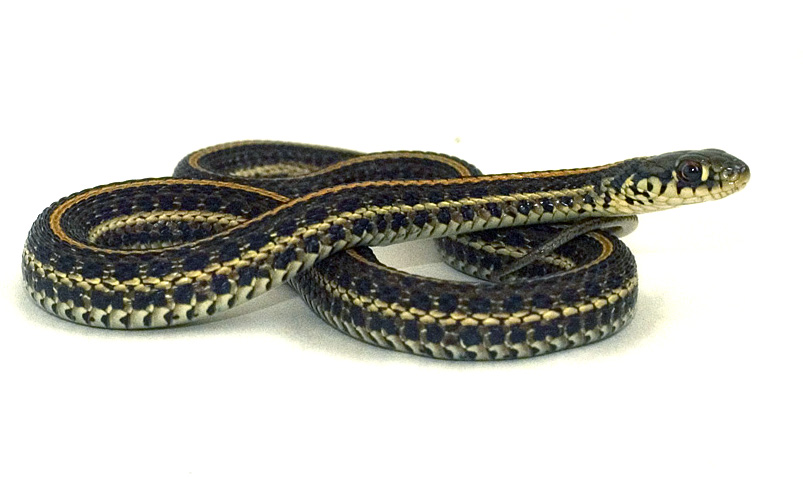
Longtail Alpine Garter Snake Thamnophis scalaris
The scientific name of the Longtail Alpine Garter Snake is Thamnophis scalaris. It is a species of reptile in the family Colubridae (colubrid), order Squamata. The name dates from 1861.
- Scientific name
- Thamnophis scalaris Cope, 1861
- Common name
- Longtail Alpine Garter Snake
- Genus
- Thamnophis
- Family
- Colubridae (Colubrid)
- Order
- Squamata
- Class
- Reptilia
- Red List category
- LC Least Concern
- Recorded in
- 1 country
- Name status
- accepted in the Catalogue of Life

Overview
Adult individuals show population-related and sex-related differences in body condition, while juveniles show similar body condition across populations.
Written 27 November 2026 from the sources listed below. Each statement was checked against the passage it cites; statements that could not be supported were removed.
Appearance
The species is identified as a longtail alpine garter snake.[1]
Behaviour
Body condition varies among local populations. Adult individuals exhibit differences in body condition between populations and between sexes.[2][3][4]
Juvenile individuals exhibit similar body condition across populations.[5]
Classification of the Longtail Alpine Garter Snake
| Kingdom | Animalia |
|---|---|
| Phylum | Chordata |
| Subphylum | Vertebrata |
| Infraphylum | Gnathostomata |
| Parvphylum | Osteichthyes |
| Megaclass | Tetrapoda |
| Class | Reptilia (Reptile) |
| Order | Squamata (Snakes) |
| Suborder | Serpentes (Snakes) |
| Infraorder | Alethinophidia |
| Family | Colubridae (Colubrid) |
| Subfamily | Natricinae |
| Genus | Thamnophis (Garter Snake) |
| Species | Thamnophis scalaris Cope, 1861 |
Where the Longtail Alpine Garter Snake is found
Checklists and occurrence records place Thamnophis scalaris in 1 country. GBIF holds 1,227 georeferenced records of it.
Countries
Regions and cities with the most records
- México, Mexico 353
- San Miguel Ajusco, Mexico 179
- Xalatlaco, Mexico 179
- Magdalena Contreras, Mexico 163
- San Miguel Topilejo, Mexico 162
- Tlalpan, Mexico 157
- Huixquilucan, Mexico 153
- Delegación Cuajimalpa de Morelos, Mexico 152
- Veracruz, Mexico 148
- Jesús del Monte, Mexico 142
- Coyoacán, Mexico 141
- Ocoyoacac, Mexico 132
- Xochimilco, Mexico 132
- San Pedro Totoltepec, Mexico 115
- Capulhuac de Mirafuentes, Mexico 110
- San Pablo Oztotepec, Mexico 107
- San Mateo Otzacatipan, Mexico 105
- San José Guadalupe Otzacatipan, Mexico 102
- San Jorge Pueblo Nuevo, Mexico 101
- San Andrés Cuexcontitlán, Mexico 100
- San Mateo Atenco, Mexico 97
- Lerma de Villada, Mexico 96
- Metepec, Mexico 96
- San Salvador Tizatlalli, Mexico 95
- Xonacatlán, Mexico 93
- Toluca, Mexico 88
- Puebla, Mexico 87
- San Pablo Autopan, Mexico 81
- San Francisco Tlalcilalcalpan, Mexico 80
- Benito Juarez, Mexico 79
- San Miguel Zinacantepec, Mexico 78
- Perote, Mexico 77
- San Antonio Acahualco, Mexico 75
- Santiago Tlacotepec, Mexico 71
- San Rafael, Mexico 65
- Banderilla, Mexico 57
Range as the checklists state it
Mexico (Distrito Federal, Guanajuato, Jalisco, Mexc. Michoacán, Oaxaca, Querétaro, Tamaulipas, San Luis Potosí, Veracruz, Morelos, Hidalgo, Puebla).
A number beside a place is its count of GBIF occurrence records. A place without a number comes from a checklist alone. Records show where a species has been observed or collected, which can include escapes and vagrants.
Common names
English
- Longtail Alpine Garter Snake
Names in 4 other languages
- Chinese
- 長尾帶蛇
- German
- Treppen-Strumpfbandnatter
- Portuguese
- Cobra-liga-de-cauda-longa
- Spanish
- Culebra de agua nómada cola corta alpestre, Culebra-listonada de montaña-cola larga, Jarretera Alpina Cola-larga, culebra listonada de montaña cola larga
Related species
-
 Common Garter SnakeThamnophis sirtalis
-
 Common Ribbon SnakeThamnophis saurita
-
 Checkered Garter SnakeThamnophis marcianus
-
 Plains Garter SnakeThamnophis radix
-
 Western Ribbon SnakeThamnophis proximus
-
 Western Terrestrial Garter SnakeThamnophis elegans
-
 Giant Garter SnakeThamnophis gigas
-
 Mexican Garter SnakeThamnophis eques
Compare
Questions and answers
What is the scientific name of the Longtail Alpine Garter Snake?
The scientific name of the Longtail Alpine Garter Snake is Thamnophis scalaris. Written with its author, the full name is Thamnophis scalaris Cope, 1861.
Which family does the Longtail Alpine Garter Snake belong to?
Thamnophis scalaris belongs to the family Colubridae, in the order Squamata and the class Reptilia.
Where is the Longtail Alpine Garter Snake found?
Checklists and occurrence records place Thamnophis scalaris in 1 country: Mexico.
What is the conservation status of the Longtail Alpine Garter Snake?
The IUCN Red List category recorded for Thamnophis scalaris is Least Concern (LC).
Sources
Passages the profile rests on
- The species is identified as a longtail alpine garter snake. Source passage: “Longtail Alpine garter snake (T. scalaris)” — pmc.ncbi.nlm.nih.gov
- Body condition varies among local populations of this species. Source passage: “Each garter snake species shows locations with good and poor body condition” — pmc.ncbi.nlm.nih.gov
- Adult individuals exhibit differences in body condition between populations. Source passage: “adults show varying body condition between populations” — pmc.ncbi.nlm.nih.gov
- Adult individuals exhibit sex-related differences in body condition. Source passage: “adults also show sex differences in body condition.” — pmc.ncbi.nlm.nih.gov
- Juvenile individuals exhibit similar body condition across populations. Source passage: “juvenile snakes show similar body condition between populations” — pmc.ncbi.nlm.nih.gov
Data
- Catalogue of Life, 2026-10-16 XR cc by
- Global Biodiversity Information Facility CC BY 4.0
- Wikidata CC0
- GeoNames CC BY 4.0
- Wikimedia Commons per image; credit shown with each image
- Within the Catalogue of Life, this name comes from The Reptile Database cc by
References
- Cope, E. D. (1861). Descriptions of reptiles from tropical America and Asia. Proc. Acad. Nat. Sci. Philadelphia 1860: 368-374.
- Boulenger, G. A. (1893). Catalogue of the snakes in the British Museum (Nat. Hist.) I. London (Taylor & Francis), 448 Pp.
- Cope, E. D. (1900). The crocodilians, lizards and snakes of North America. Ann. Rep. U.S. Natl. Mus. 1898: 153-1270.
- Smith, Hobart M. (1942). The synonymy of the garter snakes (Thamnophis), with notes on Mexican and Central American species. Zoologica, Scientific Contributions of the New York Zoological Society 27 (3 and 4): 97-123.
- Smith, Hobart M. & Taylor, Edward H. (1945). An annotated checklist and key to the snakes of Mexico. Bull. US Natl. Mus. (187): Iv + 1-239.
- Smith, Hobart M.; Nixon, C. William; Smith, Philip W. (1950). Mexican and Central American garter snakes (Thamnophis) in the British Museum (Natural History). Zool. J. Linnean Soc. 41 (282): 571-584. Link
- Davis, William B.; Smith, Hobart M. (1953). Snakes of the Mexican state of Morelos. Herpetologica 8: 133-149.
- Castro-Franco, Rubén, & María Guasalupe Bustos-Zagal. (1994). List of reptiles of Morelos, Mexico, and their distribution in relation to vegetation types. Southwestern Naturalist 39 (2): 171-175.
- Rossman, Douglas A.; Ford, Neil B. & Seigel, Richard A. (1996). The Garter Snakes: Evolution and Ecology. University of Oklahoma Press, Norman, OK, Xx + 332 + Pp.
- Rossman, D. A., & Gongora, G. L. (1997). Variation in the mexican garter snake Thamnophis scalaris COPE and the taxonomic status of T. scaliger (JAN). Occ. Pap. Mus. Nat. Sci., Louisiana State Univ., 74: 1-14.
- Hallmen, M., & Chlebowy, J. (2001). Strumpfbandnattern. Natur Und Tier Verlag (Münster), 192 Pp.
- Queiroz, Alan de; Robin Lawson and Julio A. Lemos-Espinal. (2002). Phylogenetic Relationships of North American Garter Snakes (Thamnophis) Based on Four Mitochondrial Genes: How Much DNA Sequence Is Enough? Molecular Phylogenetics and Evolution 22: 315-329.
- Casas-Andreu, G., F.R. Méndez-De la Cruz and X. Aguilar-Miguel. (2004). Anfibios y Reptiles; pp. 375–390, in A.J.M. García-Mendoza, J. Ordoñez and M. Briones-Salas (ed.). Biodiversidad de Oaxaca. Instituto de Biología, UNAM-Fondo Oaxaqueño Para La Conservación de La Naturaleza-World Wildlife Fund, México, D. F.
- Hallmen, M., & Grübner, D. (2006). Überblick über die Gattung Thamnophis. Draco 6 (25): 6-24.
- Liner, Ernest A. (2007). A CHECKLIST OF THE AMPHIBIANS AND REPTILES OF MEXICO. Louisiana State University Occasional Papers of the Museum of Natural Science 80: 1-60.
- Dixon, James R. and Julio A. Lemos-Espinal. (2010). Amphibians and reptiles of the state of Queretaro, Mexico. Tlalnepantla UNAM, 428 Pp.
- Lemos-Espinal, Julio A. and James R. Dixon. (2013). Amphibians and Reptiles of San Luis Potosí. Eagle Mountain Publishing, Xii + 300 Pp.
- Wallach, Van; Kenneth L. Williams, Jeff Boundy. (2014). Snakes of the World: A Catalogue of Living and Extinct Species. [type catalogue]. Taylor and Francis, CRC Press, 1237 Pp.
- Leyte-Manrique, Adrian; Efrén M. Hernández Navarro y Luis A. Escobedo-Morales. (2015). Herpetofauna de Guanajuato: Un análisis histórico y contemporáneo de su conocimiento. Revista Mexicana de Herpetología 1(1): 1–14.
- Lemos-Espinal, Julio A., Geoffrey R. Smith. (2015). Amphibians and reptiles of the state of Hidalgo, Mexico. Check List 11 (3): 1642.
- Mata-Silva, Vicente, Jerry D. Johnson, Larry David Wilson and Elí García-Padilla. (2015). The herpetofauna of Oaxaca, Mexico: composition, physiographic distribution, and conservation status. Mesoamerican Herpetology 2 (1): 6–62.
- Olvera, Cristian Raùl Olvera and Leonardo Fernández Badillo. (2016). Geographic Distribution: Thamnophis scalaris (Long-tailed Alpine Gartersnake). Herpetological Review 47 (1): 85.
- Heimes, P. (2016). Snakes of Mexico. Chimaira, Frankfurt, 572 Pp.
- Mundo-Hernandez, Victor; Hublester Dominguez-Vega, Yuriana Gomez-Ortiz, Tamara Rubio-Blanco, Leroy Soria-Diaz, Javier Manjarrez. (2017). Hibernation refuge of Thamnophis scalaris COPE, 1861, in Central Mexico. Herpetozoa 29 (3/4): 198 - 200.
- González Fernández A, Manjarrez J, García-Vázquez U, D’Addario M, Sunny A. (2017). Environmental niche modeling; present and future potential distribution of garter snakes species from the Trans-Mexican Volcanic Belt. PeerJ Preprints 5:E3476v1.
This species in other databases
Page built on 28 November 2026. See how the catalog is made and all sources and licences.
Cite this page
ScientificNames.org. (2026). Thamnophis scalaris (Longtail Alpine Garter Snake). Retrieved November 28, 2026, from https://scientificnames.org/species/thamnophis-scalaris
“Thamnophis scalaris (Longtail Alpine Garter Snake).” ScientificNames.org, 2026, scientificnames.org/species/thamnophis-scalaris. Accessed 28 Nov. 2026.
ScientificNames.org. “Thamnophis scalaris (Longtail Alpine Garter Snake).” Accessed November 28, 2026. https://scientificnames.org/species/thamnophis-scalaris.
@misc{scientificnames_thamnophis_scalaris_longtail_alpine_garter_snake,
  author = {{ScientificNames.org}},
  title = {Thamnophis scalaris (Longtail Alpine Garter Snake)},
  year = {2026},
  url = {https://scientificnames.org/species/thamnophis-scalaris},
  note = {Accessed 2026-11-28}
}