Species · Flowering plants
Small-leaf Elm Ulmus alata
The scientific name of the Small-leaf Elm is Ulmus alata. It is a species of flowering plant in the family Ulmaceae (elm family), order Rosales.
- Scientific name
- Ulmus alata Michx.
- Common name
- Small-leaf Elm
- Genus
- Ulmus
- Family
- Ulmaceae (Elm Family)
- Order
- Rosales
- Class
- Magnoliopsida
- Red List category
- LC Least Concern
- Recorded in
- 1 country
- Name status
- accepted in the Catalogue of Life

Overview
The species is native to woodlands of the southeastern and south-central United States. It is distinguished by a pair of broad, thin, corky wings along its branchlets and small, narrow leaves.
Written 26 November 2026 from the sources listed below. Each statement was checked against the passage it cites; statements that could not be supported were removed.
Appearance
Its leaves are oblong-lanceolate to narrowly elliptic, thin, and pointed, with serrate or doubly serrate margins. Their upper surfaces may be rough or smooth on older trees, and they turn bright yellow in autumn.[1][2][3]
The leaves are smaller and narrower than those of other elm species, measuring less than 6.5 centimetres long and less than 2 centimetres wide.[4][5]
The flowers are perfect, lack petals, and are borne on long pedicels. The reddish, narrowly elliptic samaras have two long incurving stigmas at their tips and measure less than 8 millimetres long.[6][7][8]
Habitat
The small-leaf elm occurs in woodlands of the southeastern and south-central United States. It tolerates a wide range of soil conditions and ponding.[9][10]
The species can invade old fields, forest clearings, and rangelands.[11]
Behaviour
The small-leaf elm is the least shade-tolerant of the North American elm species. It often has a very slow growth rate, with its trunk increasing in diameter by less than 5 millimetres annually.[12][13]
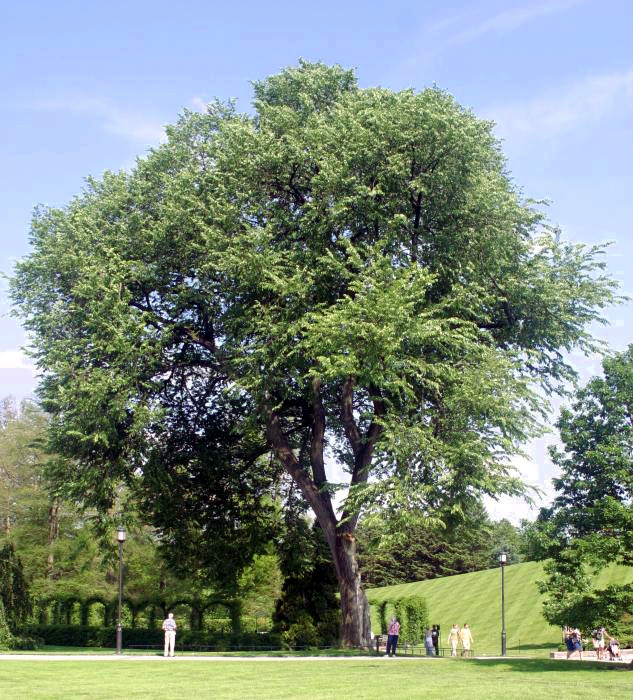
The tree generally reaches a maximum height and breadth of approximately 13 metres. Some specimens on fertile alluvial soils reach approximately twice the usual maximum height, while specimens on the silty uplands of the Mississippi Delta can reach 27 metres in height.[14][15][16]
Reproduction and life cycle
The flowers are wind-pollinated and appear in March and April before the leaves emerge. The samaras usually disperse before the end of April.[17][18][19]
Conservation
The small-leaf elm is very susceptible to Dutch elm disease and elm yellows, also known as elm phloem necrosis.[20][21]
Uses
The timber is used to manufacture high-quality hockey sticks because it resists splitting. However, the species has minimal commercial significance, partly because its trees are commonly small.[22][23][24]
The small-leaf elm provides wildlife with food, nesting resources, and habitat.[25]
Classification of the Small-leaf Elm
| Kingdom | Plantae |
|---|---|
| Subkingdom | Pteridobiotina |
| Phylum | Tracheophyta |
| Class | Magnoliopsida |
| Order | Rosales |
| Family | Ulmaceae (Elm Family) |
| Genus | Ulmus (Elm) |
| Species | Ulmus alata Michx. |
Where the Small-leaf Elm is found
Checklists and occurrence records place Ulmus alata in 1 country across North America. GBIF holds 10,522 georeferenced records of it.
Countries
Regions and cities with the most records
- Texas, United States 1,358
- Arkansas, United States 813
- North Carolina, United States 797
- Georgia, United States 653
- Alabama, United States 610
- Tennessee, United States 541
- Mississippi, United States 334
- Louisiana, United States 309
- South Carolina, United States 306
- Oklahoma, United States 278
- Illinois, United States 251
- Durham, United States 244
- Carrboro, United States 240
- Chapel Hill, United States 236
- Florida, United States 222
- Missouri, United States 194
- Kentucky, United States 178
- Belvedere Park, United States 162
- Candler-McAfee, United States 161
- College Station, United States 150
- Bryan, United States 143
- Virginia, United States 142
- Spring, United States 141
- Decatur, United States 137
- Redan, United States 136
- Stonecrest, United States 135
- Brookhaven, United States 132
- North Druid Hills, United States 130
- North Decatur, United States 127
- Chamblee, United States 125
- Morrisville, United States 111
- Tucker, United States 110
- Sandy Springs, United States 107
- Atlanta, United States 106
- The Woodlands, United States 106
- Shenandoah, United States 97
Range as the checklists state it
USA (Alabama, Arkansas, Florida, Georgia, Illinois, Indiana, Kansas, Kentucky, Louisiana, Maryland, Missouri, Mississippi, North Carolina, Oklahoma, South Carolina, Tennessee, Texas, Virginia)
A number beside a place is its count of GBIF occurrence records. A place without a number comes from a checklist alone. Records show where a species has been observed or collected, which can include escapes and vagrants.
Common names
English
- Small-leaf Elm
- Wahoo Elm
Names in 7 other languages
- Chinese
- 翅榆
- Czech
- jilm křídlatý
- French
- orme ailé
- German
- Geflügelte Ulme, Kleinblättrige Ulme
- Lithuanian
- Sparnuotoji vinkšna
- Portuguese
- Olmo-alado
- Russian
- Вяз крылатый
Synonyms
2 other scientific names have been used for this species and are now treated as synonyms of Ulmus alata.
- Ulmus americana var. alata (Michx.) Spach
- Ulmus pumila Walter ambiguous synonym
Related species
-
 White ElmUlmus americana
-
 Lacebark ElmUlmus parvifolia
- Red ElmUlmus rubra
-
 Wych ElmUlmus glabra
-
 Siberian ElmUlmus pumila
-
 Field ElmUlmus minor
-
 European White ElmUlmus laevis
-
 Red ElmUlmus crassifolia
Compare
Questions and answers
What is the scientific name of the Small-leaf Elm?
The scientific name of the Small-leaf Elm is Ulmus alata. Written with its author, the full name is Ulmus alata Michx..
Which family does the Small-leaf Elm belong to?
Ulmus alata belongs to the family Ulmaceae, in the order Rosales and the class Magnoliopsida.
Where is the Small-leaf Elm found?
Checklists and occurrence records place Ulmus alata in 1 country: United States.
What is the conservation status of the Small-leaf Elm?
The IUCN Red List category recorded for Ulmus alata is Least Concern (LC).
What other names does the Small-leaf Elm have?
Ulmus alata is also known in English as Wahoo Elm.
Is winged elm good for anything?
Its timber is used to manufacture hockey sticks because it resists splitting. The tree also provides wildlife with food, nesting resources, and habitat.[22][25]
What is the native range of the winged elm?
The small-leaf elm is native to the southeastern and south-central United States.[26]
Where is the elm tree native to?
The small-leaf elm is native to the southeastern and south-central United States.[26]
What are the pros and cons of a winged elm tree?
The tree tolerates a wide range of soil conditions and ponding, and provides wildlife with food, nesting resources, and habitat. Its growth is often very slow, it is the least shade-tolerant of the North American elm species, and it is very susceptible to Dutch elm disease and elm yellows.[10][12][13][20][21][25]
Sources
Passages the profile rests on
- Its leaves are oblong-lanceolate to narrowly elliptic, thin, and smooth on their upper surfaces, with serrate or doubly serrate margins. Source passage: “oblong-lanceolate to narrowly elliptic, thin in texture, and smooth above with serrate or doubly serrate margins.” — English Wikipedia
- The leaves turn bright yellow in autumn. Source passage: “The leaves turn bright yellow in Autumn.” — English Wikipedia
- The leaves are pointed and may be rough on their upper surfaces or smooth on older trees. Source passage: “Pointed leaves, rough above or smooth on older trees.” — warcapps.usgs.gov
- Its leaves are less than 6.5 centimetres long and less than 2 centimetres wide. Source passage: “less than 6.5 cm (2+1⁄2 in) long and less than 2.0 cm (3⁄4 in) broad” — English Wikipedia
- The leaves are smaller and narrower than those of other elm species. Source passage: “Leaves smaller and narrower than other elms.” — warcapps.usgs.gov
- The flowers are perfect, lack petals, and are borne on long pedicels. Source passage: “The wind-pollinated perfect apetalous flowers are borne on long pedicels” — English Wikipedia
- The species produces reddish, narrowly elliptic samaras with two long incurving stigmas at their tips. Source passage: “The reddish samaras are also relatively small, less than 8 mm (5⁄16 in) long, narrowly elliptic with two long incurving stigmas at the tip” — English Wikipedia
- Its samaras are less than 8 millimetres long. Source passage: “less than 8 mm (5⁄16 in) long” — English Wikipedia
- The species occurs in woodlands of the southeastern and south-central United States. Source passage: “endemic to the woodlands of the southeastern and south-central United States.” — English Wikipedia
- Ulmus alata tolerates a wide range of soil conditions and ponding. Source passage: “The species is tolerant of a wide range of soils, and of ponding” — English Wikipedia
- The species can invade old fields, forest clearings, and rangelands. Source passage: “readily invades old fields, forest clearings, and rangelands” — English Wikipedia
- Ulmus alata is the least shade-tolerant of the North American elm species. Source passage: “is the least shade-tolerant of the North American elms.” — English Wikipedia
- The tree often has a very slow growth rate, with its trunk increasing in diameter by less than 5 millimetres annually. Source passage: “The trunk increasing in diameter by less than 5 mm (3⁄16 in) per year.” — English Wikipedia
- Ulmus alata generally reaches a maximum height and breadth of approximately 13 metres. Source passage: “The tree generally grows to a maximum height and breadth of about 13 m × 13 m (43 ft × 43 ft)” — English Wikipedia
- Some specimens on fertile alluvial soils reach approximately twice the usual maximum height. Source passage: “on fertile alluvial soils such as those of the Mississippi River Delta, some specimens have reached double this height” — English Wikipedia
- Specimens on the silty uplands of the Mississippi Delta can reach 27 metres in height. Source passage: “On the silty uplands of the Mississippi Delta, Ulmus alata can attain 27 m (89 ft) in height” — English Wikipedia
- The flowers are wind-pollinated. Source passage: “The wind-pollinated perfect apetalous flowers” — English Wikipedia
- The flowers appear in March and April before the leaves emerge. Source passage: “in March and April before the leaves appear.” — English Wikipedia
- The samaras usually disperse before the end of April. Source passage: “usually disperse before the end of April.” — English Wikipedia
- Ulmus alata is very susceptible to Dutch elm disease. Source passage: “U. alata is very susceptible to Dutch elm disease” — English Wikipedia
- The species is very susceptible to elm yellows, also known as elm phloem necrosis. Source passage: “and elm yellows (Elm phloem necrosis).” — English Wikipedia
- The timber is used to manufacture high-quality hockey sticks because it resists splitting. Source passage: “owing to its resistance to splitting, it is used to make high-quality hockey sticks.” — English Wikipedia
- Ulmus alata has minimal commercial significance. Source passage: “Ulmus alata is of minimal commercial significance” — English Wikipedia
- The timber has limited usefulness partly because the trees are commonly small. Source passage: “of limited use because of the commonly small size of the trees.” — English Wikipedia
- Ulmus alata provides wildlife with food, nesting resources, and habitat. Source passage: “This elm is valuable to wildlife as a source of food, nesting and habitat.” — plants.ces.ncsu.edu
- The species is native to the southeastern and south-central United States. Source passage: “endemic to the woodlands of the southeastern and south-central United States.” — English Wikipedia
Data
- Catalogue of Life, 2026-10-16 XR cc by
- Global Biodiversity Information Facility CC BY 4.0
- Wikidata CC0
- GeoNames CC BY 4.0
- Wikimedia Commons per image; credit shown with each image
- Within the Catalogue of Life, this name comes from Synonymic Checklists of the Vascular Plants of the World cc by
References
- Michx. (1803). Fl. Bor.-Amer. [Hooker] 1: 173 (1803). where the name was published
This species in other databases
- Catalogue of Life 7DFYH
- Wikidata Q7879360
- iNaturalist 84292
- World Flora Online wfo-0001143138
- GRIN 40816
Page built on 28 November 2026. See how the catalog is made and all sources and licences.
Cite this page
ScientificNames.org. (2026). Ulmus alata (Small-leaf Elm). Retrieved November 28, 2026, from https://scientificnames.org/species/ulmus-alata
“Ulmus alata (Small-leaf Elm).” ScientificNames.org, 2026, scientificnames.org/species/ulmus-alata. Accessed 28 Nov. 2026.
ScientificNames.org. “Ulmus alata (Small-leaf Elm).” Accessed November 28, 2026. https://scientificnames.org/species/ulmus-alata.
@misc{scientificnames_ulmus_alata_small_leaf_elm,
  author = {{ScientificNames.org}},
  title = {Ulmus alata (Small-leaf Elm)},
  year = {2026},
  url = {https://scientificnames.org/species/ulmus-alata},
  note = {Accessed 2026-11-28}
}