Species · Flowering plants
Wych Elm Ulmus glabra
The scientific name of the Wych Elm is Ulmus glabra. It is a species of flowering plant in the family Ulmaceae (elm family), order Rosales.
- Scientific name
- Ulmus glabra Huds.
- Common name
- Wych Elm
- Genus
- Ulmus
- Family
- Ulmaceae (Elm Family)
- Order
- Rosales
- Class
- Magnoliopsida
- Red List category
- DD Data Deficient
- Recorded in
- 65 countries
- Name status
- accepted in the Catalogue of Life

Overview
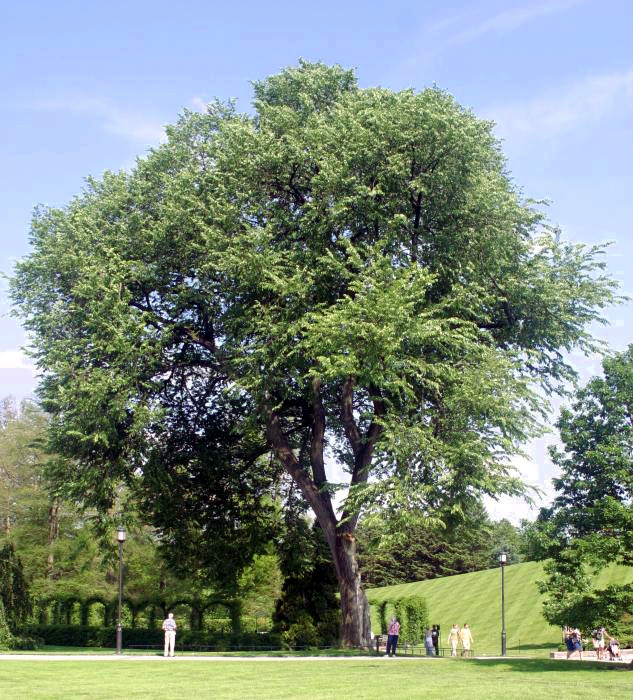
Wych elm (Ulmus glabra Huds.) is a large deciduous flowering tree in the family Ulmaceae, order Rosales and class Magnoliopsida. It is native to Europe, the Caucasus region and parts of Turkey, Syria and Iran, and has been introduced to other areas. It is distinguished by its usually obovate leaves with asymmetric bases, tough and supple young shoots, and small flowers that appear before the leaves.
Written 26 November 2026 from the sources listed below. Each statement was checked against the passage it cites; statements that could not be supported were removed.
Appearance
Wych elm is a large deciduous tree that can reach 40 metres in height. Its trunk can reach a diameter of 2 metres at breast height.[1][2][3]
The leaves measure 6–17 cm long and 3–12 cm wide. They are usually obovate, have an asymmetric base and have rough upper surfaces.[4][5][6]
The fruit is a winged samara measuring 20 mm long and 15 mm broad.[7]
Habitat
Wych elm is primarily associated with mountainous environments and grows at elevations reaching 1,500 metres. It prefers moist soils and high humidity.[8][9][10]
The species requires deep, rich soils of the type commonly found along river valleys. It is intolerant of acidic soils and flooding.[11][12]
Reproduction and life cycle
Natural reproduction occurs exclusively through seeds. The hermaphroditic flowers are produced in clusters of 10–20 and are pollinated by wind.[13][14][15]
The flowers appear before the leaves in early spring, and the fruits mature in late spring.[16][17]
Wych elm can be propagated from seeds or by layering stooled stock plants.[18]
Behaviour
Wych elm is moderately tolerant of shade. It is highly susceptible to Dutch elm disease and is less attractive to elm bark beetles than the field elm.[19][20][21]
Conservation
Wych elm has become uncommon across much of its former range. Natural regeneration is restricted because the species does not produce root suckers and its seedlings are often eaten by deer.[22][23]
Uses
Wych elm wood is valued by craftspeople for its colouring and distinctive grain. When worked, the wood can display an iridescent greenish sheen.[24][25]
Wych elm was widely planted in Edinburgh as a park and avenue tree during the 19th century.[26]
Similar species
Wych elm naturally hybridises with Ulmus minor.[27]
Classification of the Wych Elm
| Kingdom | Plantae |
|---|---|
| Subkingdom | Pteridobiotina |
| Phylum | Tracheophyta |
| Class | Magnoliopsida |
| Order | Rosales |
| Family | Ulmaceae (Elm Family) |
| Genus | Ulmus (Elm) |
| Species | Ulmus glabra Huds. |
Where the Wych Elm is found
Checklists and occurrence records place Ulmus glabra in 65 countries across Asia, Europe, North America and South America. GBIF holds 396,765 georeferenced records of it.
Countries where it is native or its origin is not stated
- Aland Islands 213
- Albania 5
- Andorra 13
- Armenia 39
- Austria 23,345
- Azerbaijan 18
- Belarus 160
- Belgium 3,331
- Bolivia 3
- Bosnia and Herzegovina 26
- Brazil 3
- Bulgaria 35
- China 6
- Croatia 33
- Cyprus
- Czechia 3,898
- Denmark 16,451
- Estonia 1,911
- Finland 3,409
- France 23,463
- Georgia 27
- Germany 29,316
- Greece 80
- Hungary 60
- India 4
- Iran 11
- Ireland 668
- Isle of Man 1,916
- Israel 6
- Italy 565
- Japan 8
- Kazakhstan 44
- Kosovo
- Kyrgyzstan 4
- Latvia 108
- Liechtenstein 22
- Lithuania 153
- Luxembourg 790
- Moldova 15
- Montenegro 9
- North Macedonia 1
- Norway 31,701
- Poland 6,465
- Romania 52
- Russia 7,242
- San Marino 1
- Serbia 28
- Slovakia 2,865
- Slovenia 264
- Spain 2,702
- Sweden 53,567
- Switzerland 15,339
- Syria 3
- The Netherlands 2,299
- Turkey 40
- Turkmenistan 3
- Ukraine 1,330
Countries where it has been introduced
- Canada 330
- Guernsey
- Jersey
- Portugal 128
- Tajikistan
- United Kingdom 161,613
- United States 603
- Uzbekistan 21
Regions and cities with the most records
- England, United Kingdom 115,406
- Scotland, United Kingdom 30,165
- Bavaria, Germany 19,964
- Upper Austria, Austria 19,220
- Wales, United Kingdom 9,735
- Östergötland, Sweden 9,360
- Västra Götaland, Sweden 9,171
- Auvergne-Rhône-Alpes, France 8,157
- Skåne, Sweden 6,427
- Møre og Romsdal, Norway 4,593
- Keynsham, United Kingdom 4,457
- Kingswood, United Kingdom 4,377
- Belper, United Kingdom 4,137
- South Denmark, Denmark 4,121
- Burngreave, United Kingdom 3,995
- Asker, Norway 3,983
- Staveley, United Kingdom 3,921
- Derby, United Kingdom 3,910
- Oslo, Norway 3,902
- Central Jutland, Denmark 3,879
- Rotherham, United Kingdom 3,872
- Ripley, United Kingdom 3,792
- Dinnington, United Kingdom 3,738
- Sheffield, United Kingdom 3,735
- Maltby, United Kingdom 3,724
- Heanor, United Kingdom 3,716
- Mangotsfield, United Kingdom 3,715
- Bath, United Kingdom 3,702
- Alfreton, United Kingdom 3,678
- Dronfield, United Kingdom 3,671
- Bristol, United Kingdom 3,657
- Rawmarsh, United Kingdom 3,647
- Sinfin, United Kingdom 3,630
- Uppsala, Sweden 3,606
- Chesterfield, United Kingdom 3,561
- Broxburn, United Kingdom 3,553
2 more countries have a few records outside this range
These countries hold a few records of Ulmus glabra but lie outside the range the checklists give for it. Such records are often zoo or garden specimens, museum material or vagrants, so the species is not counted as occurring there.
Range as the checklists state it
England (England, Wales, Isle of Man, Scotland, Outer Hebrides [I], Orkney Isl. [I], Shetland Isl. [I], Isles of Scilly); Ireland (Ireland, Northern Ireland); Denmark; Norway; Sweden; Finland; Netherlands; Belgium; Luxembourg; Germany (Brandenburg, Berlin, Baden-Württemberg, Bayern, Hessen, Hamburg, Mecklenburg-Vorpommern, Niedersachsen, Nordrhein-Westfalen, Rheinland-Pfalz, Schleswig-Holstein, Saarland, Sachsen, Sachsen-Anhalt, Thüringen); Switzerland; Liechtenstein; Austria; Poland; Czech Republic; Slovakia; Hungary; Portugal [I]; Spain; Andorra; France; Channel Isl. [I] (Alderney [I], Guernsey [I], Jersey [I], Sark [I]); Corsica; Italy; Sicily; San Marino; Slovenia; Croatia; Bosnia & Hercegovina; Montenegro; Serbia; Kosovo; North Macedonia; Albania; Romania; Bulgaria; European Turkey; Greece (scattered N- & C-Greece, Evvoia); Estonia; Latvia; Lithuania; Belarus; W-European Russia; C-European Russia; E-European Russia; Moldova; Ukraine; Crimea; Siberia (Siberian Urals); Uzbekistan [I]; Tajikistan [I]; Northern Caucasus; Georgia [Caucasus]; Armenia; Azerbaijan; Turkey (E-Anatolia, Inner Anatolia, N-Anatolia, NE-Anatolia, NW-Anatolia: Bithynia, S-Anatolia, SSW-Anatolia, W-Anatolia, WN-Anatolia); Iran (EC-Iran, N-Iran, Iranian Aserbaijan); Cyprus (N-Cyprus); Syria (coastal W-Syria); Canada [I] (New Brunswick [I], Nova Scotia [I], Ontario [I]); USA [I] (California [I], Connecticut [I], Iowa [I], Illinois [I], Kansas [I], Massachusetts [I], Maine [I], Michigan [I], Minnesota [I], Missouri [I], New York [I], Pennsylvania [I], Virginia [I], Vermont [I], West Virginia [I]); Bolivia [c]
A number beside a place is its count of GBIF occurrence records. A place without a number comes from a checklist alone. Records show where a species has been observed or collected, which can include escapes and vagrants.
Common names
English
- Wych Elm
- European Mountain Elm
- Scotch Elm
- Scottish Elm
- Broad-leaved Elm
- Broadleaf Elm
Names in 9 other languages
- Danish
- Skov-elm/storbladet elm
- Dutch
- Ruwe iep
- Finnish
- vuorijalava
- French
- orme blanc, orme de montagne, orme glabre, orme montagnard, orme rude
- German
- Berg-Ulme, Bergulme, Weißrüster
- Greek
- Βουνοφτελιά
- Northern Sami
- jálvi
- Swedish
- alm, skogsalm
- Welsh
- Glaswydd, Llwyfanen Lydanddail, Llwyfanen â Dail Llyfnion, Llwyfen, Llwyfen Lydanddail
Synonyms
109 other scientific names have been used for this species and are now treated as synonyms of Ulmus glabra.
- Ulmus adiantifolia Dippel
- Ulmus antarctica K.Koch
- Ulmus camperdowni (Bean) J.V.Armstr. & P.D.Sell
- Ulmus campestris subsp. glabra (Huds.) C.Hartm.
- Ulmus campestris subsp. montana (With.) Hartm.
- Ulmus campestris subsp. montana (With.) Bonnier & Layens
- Ulmus campestris var. campestris
- Ulmus campestris var. excelsa (Borkh.) Asch.
- Ulmus campestris var. latifolia Aiton
- Ulmus campestris var. montana (With.) Döll
- Ulmus campestris var. purpurea H.Vilm. ex Wesm.
- Ulmus campestris var. purpurea G.Kirchn.
- Ulmus campestris var. scabra (Mill.) M.Loehr
- Ulmus cebennensis Audib. ex Planch.
- Ulmus cinerea Planch.
- Ulmus communis Carrière
- Ulmus corylacea Dumort.
- Ulmus corylacea var. grandidentata Dumort.
- Ulmus elliptica K.Koch
- Ulmus excelsa Borkh.
- Ulmus exoniensis (K.Koch) K.Koch
- Ulmus expansa Rota
- Ulmus forficata C.Presl
- Ulmus gallica A.Chev.
- Ulmus gigantea K.Koch
- Ulmus glabra f. atropurpurea (Späth) Rehder
- Ulmus glabra f. camperdownii A.Henry ex Rehder
- Ulmus glabra f. cornuta (I.David) Rehder
- Ulmus glabra f. exoniensis (K.Koch) Rehder
- Ulmus glabra f. firma (Schneid.) Soó
- Ulmus glabra f. glabrata (Sonder) Soó
- Ulmus glabra f. horizontalis (G.Kirchn.) Geerinck
- Ulmus glabra f. lutescens (Dippel) Rehder
- Ulmus glabra f. macrophylla (Dippel) Soó
- Ulmus glabra f. monstrosa (C.K.Schneid.) Rehder
- Ulmus glabra f. nana (Dippel) Rehder
- Ulmus glabra f. nitida (Fr.) Rehder
- Ulmus glabra f. pendula (Loudon) Rehder
- Ulmus glabra f. purpurea (K.Koch) Rehder
- Ulmus glabra subsp. montana (Stokes) Hyl.
Showing 40 of 109.
Subspecies and varieties
- Ulmus glabra subsp. glabra subspecies
Related species
-
 White ElmUlmus americana
-
 Lacebark ElmUlmus parvifolia
- Red ElmUlmus rubra
-
 Siberian ElmUlmus pumila
-
 Field ElmUlmus minor
-
 European White ElmUlmus laevis
-
 Red ElmUlmus crassifolia
-
 Small-leaf ElmUlmus alata
Compare
Questions and answers
What is the scientific name of the Wych Elm?
The scientific name of the Wych Elm is Ulmus glabra. Written with its author, the full name is Ulmus glabra Huds..
Which family does the Wych Elm belong to?
Ulmus glabra belongs to the family Ulmaceae, in the order Rosales and the class Magnoliopsida.
Where is the Wych Elm found?
Checklists and occurrence records place Ulmus glabra in 65 countries, including Sweden, Norway, Germany, France, Austria and Denmark.
What is the conservation status of the Wych Elm?
The IUCN Red List category recorded for Ulmus glabra is Data Deficient (DD).
What other names does the Wych Elm have?
Ulmus glabra is also known in English as European Mountain Elm, Scotch Elm, Scottish Elm, Broad-leaved Elm and Broadleaf Elm.
Why is it called a Wych Elm?
The word 'wych' derives from the Old English word wice, meaning pliant or supple. The specific epithet glabra refers to the smooth bark of young trees.[28][29]
What is the difference between elm and wych elm?
Wych elm is the name used for the species Ulmus glabra. It has usually obovate leaves with asymmetric bases and tough, supple young shoots that lack corky ridges or wings.[5][30]
Sources
Passages the profile rests on
- Ulmus glabra is a large deciduous tree. Source passage: “A large deciduous tree” — English Wikipedia
- The tree can reach a height of 40 metres. Source passage: “The type sometimes reaches heights of 40 m (130 ft)” — English Wikipedia
- The trunk can reach a diameter of 2 metres at breast height. Source passage: “supported by a short bole up to 2 m (6.6 ft) diameter at breast height (DBH)” — English Wikipedia
- Its leaves measure 6–17 cm long and 3–12 cm wide. Source passage: “6–17 cm (2.4–6.7 in) long by 3–12 cm (1.2–4.7 in) broad” — English Wikipedia
- The leaves are usually obovate and have an asymmetric base. Source passage: “usually obovate with an asymmetric base” — English Wikipedia
- The upper surfaces of the leaves are rough. Source passage: “the upper surface is rough.” — English Wikipedia
- The fruit is a winged samara measuring 20 mm long and 15 mm broad. Source passage: “The fruit is a winged samara 20 mm long and 15 mm broad” — English Wikipedia
- The species is primarily associated with mountainous environments. Source passage: “it is essentially a montane species” — English Wikipedia
- The tree grows at elevations reaching 1,500 metres. Source passage: “growing at altitudes up to 1,500 m (5,000 ft)” — English Wikipedia
- The species prefers moist soils and high humidity. Source passage: “preferring sites with moist soils and high humidity.” — English Wikipedia
- Wych elm requires deep, rich soils of the type commonly found along river valleys. Source passage: “requires deep, rich soils as typically found along river valleys.” — English Wikipedia
- The species is intolerant of acidic soils and flooding. Source passage: “The species is intolerant of acid soils and flooding” — English Wikipedia
- Natural reproduction occurs exclusively through seeds. Source passage: “natural reproduction is by seed alone.” — English Wikipedia
- The hermaphroditic flowers are produced in clusters of 10–20. Source passage: “produced in clusters of 10–20” — English Wikipedia
- The flowers are pollinated by wind. Source passage: “being wind-pollinated” — English Wikipedia
- The flowers appear before the leaves in early spring. Source passage: “The perfect hermaphrodite flowers appear before the leaves in early spring” — English Wikipedia
- The fruits mature in late spring. Source passage: “maturing in late spring.” — English Wikipedia
- Wych elm can be propagated from seeds or by layering stooled stock plants. Source passage: “It is best propagated from seed or by layering stooled stock plants” — English Wikipedia
- The species is moderately tolerant of shade. Source passage: “The wych elm is moderately shade-tolerant” — English Wikipedia
- Wych elm is highly susceptible to Dutch elm disease. Source passage: “the species is highly susceptible to Dutch elm disease (DED)” — English Wikipedia
- The species is less attractive to elm bark beetles than the field elm. Source passage: “rendering the tree bark less attractive to the beetle than the field elm” — English Wikipedia
- Wych elm has become uncommon across much of its former range. Source passage: “the wych elm is now uncommon over much of its former range.” — English Wikipedia
- Natural regeneration is restricted because the species does not produce root suckers and seedlings are often eaten by deer. Source passage: “As wych elm does not sucker from the roots, and any seedlings are often consumed by uncontrolled deer populations, regeneration is very restricted” — English Wikipedia
- Wych elm wood is valued by craftspeople for its colouring and distinctive grain. Source passage: “Wych elm wood is prized by craftsmen for its colouring, its striking grain” — English Wikipedia
- The wood can display an iridescent greenish sheen when worked. Source passage: “when worked, its occasional iridescent greenish sheen or 'bloom'.” — English Wikipedia
- Wych elm was widely planted in Edinburgh as a park and avenue tree during the 19th century. Source passage: “Wych elm was widely planted in Edinburgh in the 19th century as a park and avenue tree” — English Wikipedia
- Ulmus glabra naturally hybridises with Ulmus minor. Source passage: “U. glabra hybridises naturally with U. minor” — English Wikipedia
- The word 'wych' derives from the Old English word wice, meaning pliant or supple. Source passage: “The word "wych" (also spelled "witch") comes from the Old English wice, meaning pliant or supple” — English Wikipedia
- The specific epithet glabra refers to the smooth bark of young trees. Source passage: “The specific name of wych elm, glabra, refers to the smooth bark of the young tree.” — kew.org
- The young shoots are tough and supple and lack corky ridges or wings. Source passage: “very tough, supple young shoots, which are always without the corky ridges or 'wings'” — English Wikipedia
Data
- Catalogue of Life, 2026-10-16 XR cc by
- Global Biodiversity Information Facility CC BY 4.0
- Wikidata CC0
- GeoNames CC BY 4.0
- Wikimedia Commons per image; credit shown with each image
- Within the Catalogue of Life, this name comes from Synonymic Checklists of the Vascular Plants of the World cc by
References
- Huds. Fl. Angl. [Hudson] 95 (1762). where the name was published
This species in other databases
Page built on 28 November 2026. See how the catalog is made and all sources and licences.
Cite this page
ScientificNames.org. (2026). Ulmus glabra (Wych Elm). Retrieved November 28, 2026, from https://scientificnames.org/species/ulmus-glabra
“Ulmus glabra (Wych Elm).” ScientificNames.org, 2026, scientificnames.org/species/ulmus-glabra. Accessed 28 Nov. 2026.
ScientificNames.org. “Ulmus glabra (Wych Elm).” Accessed November 28, 2026. https://scientificnames.org/species/ulmus-glabra.
@misc{scientificnames_ulmus_glabra_wych_elm,
  author = {{ScientificNames.org}},
  title = {Ulmus glabra (Wych Elm)},
  year = {2026},
  url = {https://scientificnames.org/species/ulmus-glabra},
  note = {Accessed 2026-11-28}
}