Species · Flowering plants
European White Elm Ulmus laevis
The scientific name of the European White Elm is Ulmus laevis. It is a species of flowering plant in the family Ulmaceae (elm family), order Rosales.
- Scientific name
- Ulmus laevis Pall.
- Common name
- European White Elm
- Genus
- Ulmus
- Family
- Ulmaceae (Elm Family)
- Order
- Rosales
- Class
- Magnoliopsida
- Red List category
- DD Data Deficient
- Recorded in
- 47 countries
- Name status
- accepted in the Catalogue of Life

Overview
Ulmus laevis is native to Europe, with a range extending from France northeast to southern Finland and east beyond the Urals into Kyrgyzstan and Kazakhstan. It is distinguished by its extensive shallow root system, markedly asymmetric leaf bases and long-stemmed flowers that appear before the leaves.
Written 26 November 2026 from the sources listed below. Each statement was checked against the passage it cites; statements that could not be supported were removed.
Appearance
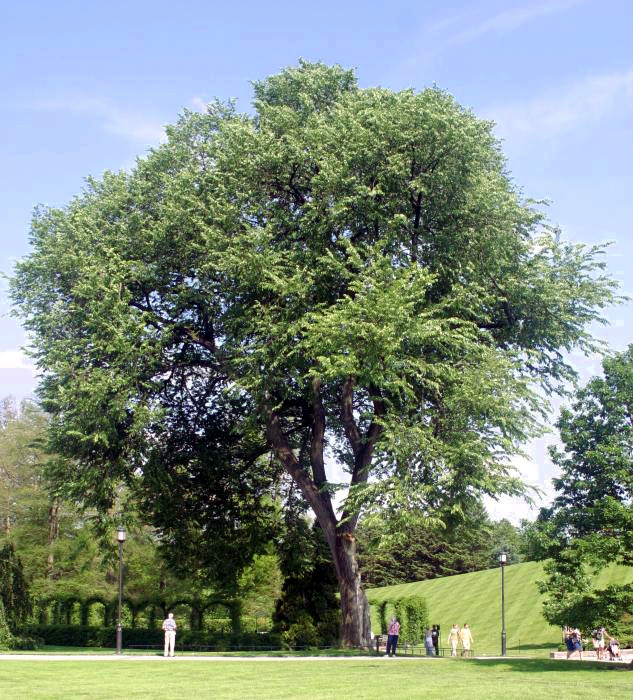
European White Elm is a deciduous tree with irregular branching and a loosely rounded crown. It typically grows to more than 30 metres in both height and crown breadth, while its trunk diameter at breast height is typically less than 2 metres.[1][2][3]
The tree develops an extensive shallow root system that eventually forms prominent buttresses around the trunk base.[4]
Its leaves are alternate, simple and ovate, with markedly asymmetric bases. They are less than 10 centimetres long and less than 7 centimetres wide, comparatively thin, often papery and translucent, and downy underneath.[5][6][7]
The leaf veins do not branch between the central vein and the leaf margin. The tree sheds its leaves earlier in autumn than other European elm species.[8][9]
Reproduction and life cycle
The cream-coloured flowers lack petals and are pollinated by wind. They appear before the leaves in early spring in clusters containing 15–30 flowers, with individual flowers measuring approximately 3–4 millimetres across.[10][11][12]
The flowers have long stems averaging approximately 20 millimetres. The species is protandrous, although self-pollination can occur at high levels.[13][14]
The fruit is a winged samara with a ciliate margin. Each fruit contains a single round seed measuring approximately 5 millimetres, and the seeds mature in late spring.[15][16][17]
Seeds from Serbian trees examined in one study had germination rates of 45–60%. The species can be propagated from seed sown on ordinary compost and kept well-watered, with germination possible within one week without additional heat.[18][19][20]
Softwood cuttings taken in June provide a reliable propagation method.[21]
Habitat
The species is endemic to alluvial forests and is commonly found along rivers including the Volga and Danube.[22][23]
It tolerates prolonged waterlogged and oxygen-deficient soil conditions and can withstand more than 100 consecutive days of flooding. It is rarely encountered at elevations above 400 metres.[24][25][26]
The species is intolerant of saline soil conditions and drought. Spanish populations prefer slightly acidic, siliceous soils.[27][28][29]
Conservation
The IUCN Red List classified Ulmus laevis as Data Deficient in its 2017 assessment. Habitat destruction and disturbance threaten the species in some countries, particularly Spain.[30][31]
Flood-control schemes threaten the species by disrupting the floods required for seed dispersal. Lowering groundwater levels through aquifer abstraction has also compromised tree development.[32][33]
The species has little innate genetic resistance to Dutch elm disease. A French study recorded losses of 28% from the disease over ten years.[34][35]
Uses
Young European white elms were traditionally cultivated in Finland as raw material for shaft bows. The species' leathery bark was traditionally used for making tough bindings.[36][37]
The tree has been used for amenity planting in towns and along roadsides because of its rapid growth and tolerance of soil compaction, air pollution and de-icing salts.[38]
Similar species
The American elm is the closest relative of European White Elm.[39]
Classification of the European White Elm
| Kingdom | Plantae |
|---|---|
| Subkingdom | Pteridobiotina |
| Phylum | Tracheophyta |
| Class | Magnoliopsida |
| Order | Rosales |
| Family | Ulmaceae (Elm Family) |
| Genus | Ulmus (Elm) |
| Species | Ulmus laevis Pall. |
Where the European White Elm is found
Checklists and occurrence records place Ulmus laevis in 47 countries across Asia and Europe. GBIF holds 42,582 georeferenced records of it.
Countries where it is native or its origin is not stated
- Albania
- Armenia 11
- Austria 953
- Belarus 104
- Belgium 692
- Bosnia and Herzegovina 5
- Bulgaria 5
- China 24
- Croatia 15
- Czechia 435
- Denmark 100
- Estonia 608
- Finland 1,430
- France 10,019
- Georgia 3
- Germany 5,906
- Greece 2
- Hungary 107
- Iran
- Italy 165
- Kazakhstan 116
- Kosovo
- Kyrgyzstan 10
- Latvia 53
- Lithuania 24
- Luxembourg 56
- Moldova 11
- Montenegro
- North Macedonia 1
- Norway 34
- Poland 3,082
- Portugal 6
- Romania 7
- Russia 10,533
- Serbia 4
- Slovakia 1,353
- Slovenia 43
- Sweden 1,638
- Switzerland 2,134
- The Netherlands 1,128
- Turkey 8
- Ukraine 1,417
- United Kingdom 128
Countries where it has been introduced
Regions and cities with the most records
- Grand Est, France 2,764
- Centre-Val de Loire, France 1,858
- Samara Oblast, Russia 1,851
- Bourgogne-Franche-Comté, France 1,730
- Bavaria, Germany 1,671
- Zhigulëvsk, Russia 1,660
- Auvergne-Rhône-Alpes, France 1,338
- Moscow Oblast, Russia 1,301
- Kalmar, Sweden 1,169
- Moscow, Russia 1,130
- Neuchâtel, Switzerland 909
- Fribourg, Switzerland 877
- Brandenburg, Germany 868
- Kalmar, Sweden 866
- Vostochnoe Degunino, Russia 856
- Fribourg, Switzerland 810
- Cherëmushki, Russia 804
- Reutov, Russia 765
- Obruchevo, Russia 745
- Mytishchi, Russia 719
- Khimki, Russia 603
- Korolev, Russia 601
- Balashikha, Russia 599
- Illkirch-Graffenstaden, France 571
- Dolgoprudnyy, Russia 553
- Yubileyny, Russia 544
- Vladimir Oblast, Russia 537
- Malacky, Slovakia 534
- Upper Austria, Austria 534
- Bratislava Region, Slovakia 533
- Krasnogorsk, Russia 526
- Île-de-France, France 522
- Lingolsheim, France 521
- Kotel’niki, Russia 493
- Lyubertsy, Russia 490
- Occitanie, France 490
2 more countries have a few records outside this range
These countries hold a few records of Ulmus laevis but lie outside the range the checklists give for it. Such records are often zoo or garden specimens, museum material or vagrants, so the species is not counted as occurring there.
Range as the checklists state it
S-Sweden (Øland); Denmark; Finland; Netherlands; Belgium; Luxembourg; Germany (Brandenburg, Berlin, Baden-Württemberg, Bayern, Hessen, Hamburg, Mecklenburg-Vorpommern, Niedersachsen, Nordrhein-Westfalen, Rheinland-Pfalz, Schleswig-Holstein, Saarland, Sachsen, Sachsen-Anhalt, Thüringen); Switzerland; Austria; Poland; Czech Republic; Slovakia; Hungary; Spain [I]; France; Corsica; Slovenia; Croatia; Bosnia & Hercegovina; Montenegro; Serbia; Kosovo; North Macedonia; Albania; Romania; Bulgaria; European Turkey; ?Greece; Estonia; Latvia; Lithuania; Belarus; European Russia; Moldova; Ukraine; Crimea; Crimea [c]; Siberia (W-Siberia, Siberian Urals, SW-Siberia, Altay [I], Baikal region [I]); Kazakhstan; Uzbekistan [I]; Tajikistan [I]; Northern Caucasus; Armenia [c]; Azerbaijan [I]; Turkey (N-Anatolia, NW-Anatolia: Bithynia); Iran (N-Iran)
A number beside a place is its count of GBIF occurrence records. A place without a number comes from a checklist alone. Records show where a species has been observed or collected, which can include escapes and vagrants.
Common names
English
- European White Elm
- European White-Elm
- Fluttering Elm
- Russian Elm
- Water Elm
Names in 24 other languages
- Belarusian
- Вяз гладкі
- Chinese
- 大葉榆, 歐洲白榆
- Czech
- jilm vaz
- Danish
- Skærm-elm, Skærmblomstret elm
- Dutch
- Fladderiep
- Estonian
- künnapuu
- Finnish
- kynäjalava
- French
- Orme blanc, orme diffus, orme lisse
- German
- Flatterrüster, Flatterulme, Weißrüster
- Hungarian
- Vénic-szil, vénic szil
- Italian
- Olmo bianco
- Japanese
- ヨーロッパホワイトエルム
- Latvian
- Parastā vīksna
- Lithuanian
- Paprastoji vinkšna
- Norwegian Bokmål
- vrangalm
- Polish
- Wiąz Szypułkowy
- Russian
- Вяз гладкий
- Slovak
- brest väzový
- Slovenian
- dolgopecljati brest, vez
- Spanish
- olmo temblón
- Swedish
- vitalm, vresalm
- Turkish
- Hercai Karaağaç
- Ukrainian
- В'яз гладкий
- Welsh
- Llwyfen Ewropeaidd
Synonyms
21 other scientific names have been used for this species and are now treated as synonyms of Ulmus laevis.
- Ulmus acuta Dumort.
- Ulmus campestris var. effusa (Willd.) Merrem
- Ulmus celtidea (Rogow.) Litv.
- Ulmus ciliata Ehrh.
- Ulmus communis var. ornata Carrière
- Ulmus effusa Willd.
- Ulmus effusa var. acuminata Roth
- Ulmus effusa var. inflexa Roth
- Ulmus effusa var. oblongata Roth
- Ulmus effusa var. rotundata Roth
- Ulmus laevis var. celtidea Rogow.
- Ulmus laevis var. parvifolia Jovan. & Radulović
- Ulmus oblongata (Hayne) Sloboda
- Ulmus octandra Schkuhr
- Ulmus pedunculata var. aequilateris Zapał.
- Ulmus pedunculata var. sandomiriensis Zapał.
- Ulmus rotundata (Hayne) Sloboda
- Ulmus simplicidens E.L.Wolf
- Ulmus alba Kit. ex Willd. ambiguous synonym
- Ulmus pedunculata Foug. ambiguous synonym
- Ulmus racemosa Borkh. ambiguous synonym
Related species
-
 White ElmUlmus americana
-
 Lacebark ElmUlmus parvifolia
- Red ElmUlmus rubra
-
 Wych ElmUlmus glabra
-
 Siberian ElmUlmus pumila
-
 Field ElmUlmus minor
-
 Red ElmUlmus crassifolia
-
 Small-leaf ElmUlmus alata
Compare
Questions and answers
What is the scientific name of the European White Elm?
The scientific name of the European White Elm is Ulmus laevis. Written with its author, the full name is Ulmus laevis Pall..
Which family does the European White Elm belong to?
Ulmus laevis belongs to the family Ulmaceae, in the order Rosales and the class Magnoliopsida.
Where is the European White Elm found?
Checklists and occurrence records place Ulmus laevis in 47 countries, including Russia, France, Germany, Poland, Switzerland and Sweden.
What is the conservation status of the European White Elm?
The IUCN Red List category recorded for Ulmus laevis is Data Deficient (DD).
What other names does the European White Elm have?
Ulmus laevis is also known in English as European White-Elm, Fluttering Elm, Russian Elm and Water Elm.
How can I identify a white elm tree?
European White Elm is a deciduous tree with irregular branching, a loosely rounded crown and prominent buttresses around the trunk base. Its alternate, simple, ovate leaves have markedly asymmetric bases and are often papery, translucent and downy underneath. Its flowers have long stems and appear before the leaves in early spring.[1][4][5][7][13][11]
Do elm trees bear fruit?
European White Elm produces winged samaras with ciliate margins. Each fruit contains a single round seed measuring approximately 5 millimetres.[15][16]
Where is the elm tree native to?
European White Elm is native to Europe, with its range extending from France northeast to southern Finland and east beyond the Urals into Kyrgyzstan and Kazakhstan. Its southeastern distribution includes Bulgaria and the Crimea, with disjunct populations in the Caucasus and Spain. The species is rare in the United Kingdom.[40][41][42][43][44]
Sources
Passages the profile rests on
- Ulmus laevis is a deciduous tree with an irregular branching structure and a loosely rounded crown. Source passage: “with a looser, untidy, branch structure and less neatly rounded crown.” — English Wikipedia
- The tree typically grows to more than 30 metres in both height and crown breadth. Source passage: “The tree typically reaches a height and breadth of > 30 m” — English Wikipedia
- Its trunk diameter at breast height is typically less than 2 metres. Source passage: “with a trunk < 2 m d.b.h.” — English Wikipedia
- The species develops an extensive shallow root system that eventually forms prominent buttresses around the trunk base. Source passage: “The extensive shallow root system ultimately forms distinctive high buttresses around the base of the trunk.” — English Wikipedia
- Its leaves are alternate, simple and ovate, with a markedly asymmetric base. Source passage: “The leaves are deciduous, alternate, simple ovate with a markedly asymmetric base” — English Wikipedia
- Its leaves are less than 10 centimetres long and less than 7 centimetres wide. Source passage: “< 10 cm long and < 7 cm broad” — English Wikipedia
- The leaves are comparatively thin, often papery, translucent and downy underneath. Source passage: “comparatively thin, often almost papery in texture and very translucent, smooth above with a downy underside.” — English Wikipedia
- The leaf veins do not branch between the central vein and the leaf margin. Source passage: “the leaf veins do not divide from the central vein to the leaf margin.” — English Wikipedia
- The species sheds its leaves earlier in autumn than other European elm species. Source passage: “The leaves are shed earlier in autumn than other species of European elm.” — English Wikipedia
- Its cream-coloured flowers lack petals and are pollinated by wind. Source passage: “the apetalous wind-pollinated flowers are distinctively cream-coloured” — English Wikipedia
- The flowers appear before the leaves in early spring in clusters containing 15–30 flowers. Source passage: “appearing before the leaves in early spring in clusters of 15-30” — English Wikipedia
- Individual flowers measure approximately 3–4 millimetres across. Source passage: “they are 3–4 mm across.” — English Wikipedia
- Its flowers have long stems averaging approximately 20 millimetres. Source passage: “its long flower stems, averaging 20 mm.” — English Wikipedia
- The species is protandrous, although self-pollination can occur at high levels. Source passage: “Although the species is protandrous, levels of self-pollination can be high” — English Wikipedia
- The fruit is a winged samara with a ciliate margin. Source passage: “The fruit is a winged samara < 15 mm long by 10 mm broad with a ciliate margin” — English Wikipedia
- Each fruit contains a single round seed measuring approximately 5 millimetres. Source passage: “the single round 5 mm seed maturing in late spring.” — English Wikipedia
- The seeds mature in late spring. Source passage: “seed maturing in late spring.” — English Wikipedia
- Seeds from Serbian trees examined in one study had germination rates of 45–60%. Source passage: “45–60% for Serbian trees examined by Stilinović.” — English Wikipedia
- The species can be propagated from seed sown on ordinary compost and kept well-watered. Source passage: “U. laevis is easily grown from seed sown on ordinary compost and kept well-watered.” — English Wikipedia
- Seed germination can occur within one week without additional heat. Source passage: “Germination should occur within one week even without heat” — English Wikipedia
- Softwood cuttings taken in June provide a reliable propagation method. Source passage: “Softwood cuttings taken in June is also a reliable method” — English Wikipedia
- The species is endemic to alluvial forests. Source passage: “Endemic to alluvial forest” — English Wikipedia
- It is commonly found along rivers including the Volga and Danube. Source passage: “Most commonly found along rivers such as the Volga and Danube” — English Wikipedia
- The species tolerates prolonged waterlogged and oxygen-deficient soil conditions. Source passage: “one of very few elms tolerant of prolonged waterlogged, anoxic ground conditions.” — English Wikipedia
- The species is rarely encountered at elevations above 400 metres. Source passage: “U. laevis is rarely encountered at elevations above 400 m.” — English Wikipedia
- The tree can withstand more than 100 consecutive days of flooding. Source passage: “able to withstand over 100 days of continual flooding” — English Wikipedia
- The species is intolerant of saline soil conditions. Source passage: “although it is intolerant of saline conditions” — English Wikipedia
- Spanish populations prefer slightly acidic, siliceous soils. Source passage: “Spanish trees were found to be calcifuge, preferring slightly acid, siliceous soils” — English Wikipedia
- The species is intolerant of drought conditions. Source passage: “and also drought-intolerant” — English Wikipedia
- The IUCN Red List classified Ulmus laevis as Data Deficient in its 2017 assessment. Source passage: “Ulmus laevis is listed as Data Deficient.” — iucnredlist.org
- Habitat destruction and disturbance threaten the species in some countries, particularly Spain. Source passage: “The species is threatened by habitat destruction and disturbance in some countries, notably Spain.” — English Wikipedia
- Flood-control schemes threaten the species by disrupting the floods required for seed dispersal. Source passage: “Flood control schemes are particularly harmful, as seed dispersion is reliant on floods” — English Wikipedia
- Lowering groundwater levels through aquifer abstraction has compromised tree development. Source passage: “abstraction from aquifers lowering ground water levels has compromised the development of the trees.” — English Wikipedia
- The species has little innate genetic resistance to Dutch elm disease. Source passage: “Like other European elms, natural populations of the European white elm have little innate resistance to Dutch elm disease.” — English Wikipedia
- A French study recorded losses of 28% from Dutch elm disease over ten years. Source passage: “In a study in France, losses to DED amounted to 28% over a 10 year period.” — English Wikipedia
- Young European white elms were traditionally cultivated in Finland as raw material for shaft bows. Source passage: “In Finland, young European white elm trees were traditionally grown for the raw material of shaft bows.” — English Wikipedia
- The species' leathery bark was traditionally used for making tough bindings. Source passage: “It's leathery bark was also used in tough bindings.” — English Wikipedia
- The tree has been used for amenity planting in towns and along roadsides because of its rapid growth and tolerance of soil compaction, air pollution and de-icing salts. Source passage: “owing to its rapid growth, tolerance of soil compaction, air pollution and de-icing salts, the tree has long been used for amenity planting in towns and along roadsides.” — English Wikipedia
- The American elm is the closest relative of Ulmus laevis. Source passage: “The tree is allogamous and is most closely related to the American elm U. americana.” — English Wikipedia
- The species is native to Europe, with its range extending from France northeast to southern Finland. Source passage: “native to Europe, from France northeast to southern Finland” — English Wikipedia
- Its native range extends east beyond the Urals into Kyrgyzstan and Kazakhstan. Source passage: “east beyond the Urals into Kyrgyzstan and Kazakhstan” — English Wikipedia
- Its southeastern distribution includes Bulgaria and the Crimea. Source passage: “and southeast to Bulgaria and the Crimea” — English Wikipedia
- Disjunct populations occur in the Caucasus and Spain. Source passage: “there are also disjunct populations in the Caucasus and Spain” — English Wikipedia
- The species is rare in the United Kingdom. Source passage: “U. laevis is rare in the UK” — English Wikipedia
Data
- Catalogue of Life, 2026-10-16 XR cc by
- Global Biodiversity Information Facility CC BY 4.0
- Wikidata CC0
- GeoNames CC BY 4.0
- Wikimedia Commons per image; credit shown with each image
- Within the Catalogue of Life, this name comes from Synonymic Checklists of the Vascular Plants of the World cc by
References
- Pall. (1784). Fl. Ross. [Pallas] 1(1): 75 (1784). where the name was published
This species in other databases
- Catalogue of Life 7DFN8
- Wikidata Q147492
- iNaturalist 450330
- World Flora Online wfo-0000416715
- GRIN 40842
Page built on 26 November 2026. See how the catalog is made and all sources and licences.
Cite this page
ScientificNames.org. (2026). Ulmus laevis (European White Elm). Retrieved November 26, 2026, from https://scientificnames.org/species/ulmus-laevis
“Ulmus laevis (European White Elm).” ScientificNames.org, 2026, scientificnames.org/species/ulmus-laevis. Accessed 26 Nov. 2026.
ScientificNames.org. “Ulmus laevis (European White Elm).” Accessed November 26, 2026. https://scientificnames.org/species/ulmus-laevis.
@misc{scientificnames_ulmus_laevis_european_white_elm,
  author = {{ScientificNames.org}},
  title = {Ulmus laevis (European White Elm)},
  year = {2026},
  url = {https://scientificnames.org/species/ulmus-laevis},
  note = {Accessed 2026-11-26}
}