Species · Flowering plants
Red Elm Ulmus rubra
The scientific name of the Red Elm is Ulmus rubra. It is a species of flowering plant in the family Ulmaceae (elm family), order Rosales.
- Scientific name
- Ulmus rubra Muhl.
- Common name
- Red Elm
- Genus
- Ulmus
- Family
- Ulmaceae (Elm Family)
- Order
- Rosales
- Class
- Magnoliopsida
- Red List category
- LC Least Concern
- Recorded in
- 2 countries
- Name status
- accepted in the Catalogue of Life
Overview
Ulmus rubra is native to eastern North America, with a range extending from southeastern North Dakota eastward to Maine and southern Quebec, south to northernmost Florida, and west to eastern Texas. It is distinguished by its reddish-brown heartwood, rough upper leaf surfaces, velvety lower leaf surfaces, and mucilaginous inner bark.
Written 26 November 2026 from the sources listed below. Each statement was checked against the passage it cites; statements that could not be supported were removed.
Appearance
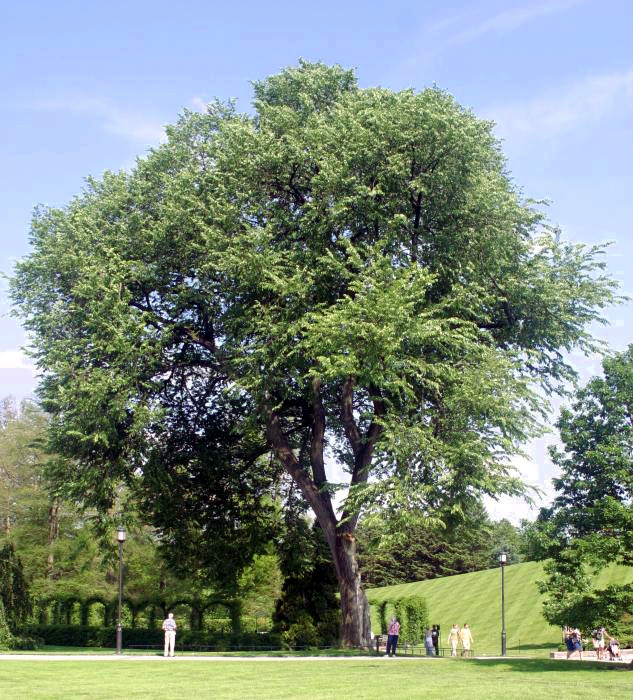
Red elm is a deciduous tree with a spreading crown of branches. Its heartwood is reddish-brown.[1][2]
Its leaves are broadly oblong to obovate, with rough upper surfaces, velvety lower surfaces, coarse double-serrated margins, pointed tips, and oblique bases. They measure 10–20 centimetres in length and have stalks measuring 6–12 millimetres.[3][4][5][6][7]
The leaves often emerge with a reddish tinge, become dark green in summer, and turn dull yellow in autumn.[8]
Habitat
Red elm thrives in moist upland habitats and can also grow in dry and intermediate soils.[9][10]
Behaviour
Red elm produces flowers in early spring before its leaves emerge. The flowers usually occur in compact clusters containing 10–20 flowers.[11][12]
Reproduction and life cycle
Red elm produces winged samara fruits containing a single seed. The seed is centrally positioned within each samara.[13][14]
Its flowers are pollinated by wind.[15]
Conservation
Red elm is reputedly less susceptible to Dutch elm disease than other American elm species. The elm leaf beetle severely damages the species.[16][17]
Uses
The mucilaginous inner bark of red elm can be eaten raw or boiled. Native Americans ate the inner bark, which can also be used to prepare tea.[18][19][20]
The inner bark is used in folk medicine to treat sore throats and gastrointestinal upset. It is also applied topically for skin rashes and irritation.[21][22]
The inner bark is commercially marketed in the United States as an over-the-counter demulcent. The leaves can be dried, ground into powder, and prepared as tea.[23][24]
The wood is used to manufacture wagon-wheel hubs because its interlocking grain provides high shock resistance. It is sometimes used to manufacture archery bows under the name red elm.[25][26]
Its fibrous inner bark can be processed into thread, twine, and rope. The wood can also be used to start fires through the bow-drill method.[27][28]
Similar species
Red elm closely resembles American elm but can be distinguished by its downy twigs, reddish hairy buds, and slimy red inner bark.[29]
Red elm is closely related to European wych elm, which has a similar flower structure but lacks hairs on the seed.[30]
Classification of the Red Elm
| Kingdom | Plantae |
|---|---|
| Subkingdom | Pteridobiotina |
| Phylum | Tracheophyta |
| Class | Magnoliopsida |
| Order | Rosales |
| Family | Ulmaceae (Elm Family) |
| Genus | Ulmus (Elm) |
| Species | Ulmus rubra Muhl. |
Where the Red Elm is found
Checklists and occurrence records place Ulmus rubra in 2 countries across North America. GBIF holds 11,883 georeferenced records of it.
Countries
Regions and cities with the most records
- Ontario, Canada 1,540
- Wisconsin, United States 566
- Pennsylvania, United States 511
- Texas, United States 452
- Quebec, Canada 422
- New York, United States 419
- Aylmer, Canada 389
- Ottawa, Canada 371
- Ottawa South, Canada 366
- Nepean, Canada 350
- Illinois, United States 328
- Bridlewood, Canada 320
- Kanata, Canada 319
- Gatineau, Canada 306
- Allen, United States 304
- Gloucester, Canada 299
- Vanier, Canada 296
- Minnesota, United States 259
- Frisco, United States 249
- McKinney, United States 246
- Plano, United States 245
- Ohio, United States 231
- Virginia, United States 215
- Stittsville, Canada 214
- Indiana, United States 204
- Prosper, United States 199
- Orléans, Canada 198
- Kansas, United States 182
- Missouri, United States 182
- The Colony, United States 173
- North Carolina, United States 168
- Michigan, United States 161
- Kentucky, United States 157
- Murphy, United States 157
- Richardson, United States 157
- The Trails of Frisco, United States 157
1 more country has a few records outside this range
These countries hold a few records of Ulmus rubra but lie outside the range the checklists give for it. Such records are often zoo or garden specimens, museum material or vagrants, so the species is not counted as occurring there.
Range as the checklists state it
Canada (New Brunswick, Ontario, Québec); USA (Alabama, Arkansas, Connecticut, District of Columbia, Delaware, Florida, Georgia, Iowa, Illinois, Indiana, Kansas, Kentucky, Louisiana, Massachusetts, Maryland, Maine, Michigan, Minnesota, Missouri, Mississippi, North Carolina, North Dakota, Nebraska, New Hampshire, New Jersey, New York, Ohio, Oklahoma, Pennsylvania, Rhode Island, South Carolina, South Dakota, Tennessee, Texas, Virginia, Vermont, Wisconsin, West Virginia)
A number beside a place is its count of GBIF occurrence records. A place without a number comes from a checklist alone. Records show where a species has been observed or collected, which can include escapes and vagrants.
Common names
English
- Red Elm
- Gray Elm
- Soft Elm
- Slippery Ellum
Names in 12 other languages
- Chinese
- 紅榆
- Czech
- jilm plavý
- Finnish
- punajalava
- French
- orme gras, orme rouge
- German
- Rot-Ulme, Rotulme
- Greek
- Κόκκινη φτελιά
- Slovak
- brest červený
- Swedish
- rödalm
- kio
- ch'iłjįį
- mia
- ašaahšikopa
- mus
- lopakv
- oji
- Ozhaashigob (Anib)
Synonyms
13 other scientific names have been used for this species and are now treated as synonyms of Ulmus rubra.
- Ulmus americana var. rubra (Muhl.) Aiton
- Ulmus crispa Willd.
- Ulmus dimidiata Raf.
- Ulmus fulva Michx.
- Ulmus glabra f. crispa (Willd.) Rehder
- Ulmus heyderi Späth
- Ulmus pendula Willd.
- Ulmus pinguis Raf.
- Ulmus pubescens Walter
- Ulmus rubra f. laevis F.Seym.
- Ulmus scabra subf. crispa (Willd.) Dippel
- Ulmus tridens Dippel
- Ulmus triserrata Dippel
Related species
-
 White ElmUlmus americana
-
 Lacebark ElmUlmus parvifolia
-
 Wych ElmUlmus glabra
-
 Siberian ElmUlmus pumila
-
 Field ElmUlmus minor
-
 European White ElmUlmus laevis
-
 Red ElmUlmus crassifolia
-
 Small-leaf ElmUlmus alata
Compare
Questions and answers
What is the scientific name of the Red Elm?
The scientific name of the Red Elm is Ulmus rubra. Written with its author, the full name is Ulmus rubra Muhl..
Which family does the Red Elm belong to?
Ulmus rubra belongs to the family Ulmaceae, in the order Rosales and the class Magnoliopsida.
Where is the Red Elm found?
Checklists and occurrence records place Ulmus rubra in 2 countries: United States and Canada.
What is the conservation status of the Red Elm?
The IUCN Red List category recorded for Ulmus rubra is Least Concern (LC).
What other names does the Red Elm have?
Ulmus rubra is also known in English as Gray Elm, Soft Elm and Slippery Ellum.
Sources
Passages the profile rests on
- Ulmus rubra is a deciduous tree with a spreading crown of branches. Source passage: “a medium-sized deciduous tree with a spreading head of branches” — English Wikipedia
- The heartwood of Ulmus rubra is reddish-brown. Source passage: “Its heartwood is reddish-brown.” — English Wikipedia
- Its leaves are broadly oblong to obovate in shape. Source passage: “The broad oblong to obovate leaves are 10–20 centimetres” — English Wikipedia
- Its leaves have rough upper surfaces and velvety lower surfaces. Source passage: “rough above but velvety below” — English Wikipedia
- Its leaves have coarse double-serrated margins, pointed tips, and oblique bases. Source passage: “with coarse double-serrate margins, acuminate apices and oblique bases” — English Wikipedia
- Its leaves measure 10–20 centimetres in length. Source passage: “leaves are 10–20 centimetres (4–8 inches) long” — English Wikipedia
- Its leaf stalks measure 6–12 millimetres in length. Source passage: “the petioles are 6–12 millimetres (1⁄4–15⁄32 in) long.” — English Wikipedia
- Its leaves often emerge with a reddish tinge, become dark green in summer, and turn dull yellow in autumn. Source passage: “The leaves are often tinged red on emergence, turning dark green by summer and a dull yellow in autumn.” — English Wikipedia
- Ulmus rubra thrives in moist upland habitats. Source passage: “where it thrives in moist uplands” — English Wikipedia
- The species can also grow in dry and intermediate soils. Source passage: “although it will also grow in dry, intermediate soils.” — English Wikipedia
- Ulmus rubra produces flowers before its leaves emerge in early spring. Source passage: “The perfect, apetalous, wind-pollinated flowers are produced before the leaves in early spring” — English Wikipedia
- Its flowers usually occur in compact clusters containing 10–20 flowers. Source passage: “usually in tight, short-stalked, clusters of 10–20.” — English Wikipedia
- The species produces winged samara fruits containing a single seed. Source passage: “The reddish-brown fruit is an oval winged samara” — English Wikipedia
- The seeds are centrally positioned within the samaras. Source passage: “the single, central seed” — English Wikipedia
- Its flowers are bisexual, lack petals, and are pollinated by wind. Source passage: “The perfect, apetalous, wind-pollinated flowers” — English Wikipedia
- Ulmus rubra is reputedly less susceptible to Dutch elm disease than other American elm species. Source passage: “The tree is reputedly less susceptible to Dutch elm disease than other species of American elms” — English Wikipedia
- The elm leaf beetle severely damages Ulmus rubra. Source passage: “but is severely damaged by the elm leaf beetle (Xanthogaleruca luteola).” — English Wikipedia
- The mucilaginous inner bark of Ulmus rubra can be eaten raw or boiled. Source passage: “The mucilaginous inner bark of the tree is edible raw or boiled” — English Wikipedia
- Native Americans ate the inner bark of Ulmus rubra. Source passage: “and was eaten by Native Americans.” — English Wikipedia
- The inner bark can be used to prepare tea. Source passage: “The bark can also be used to make tea.” — English Wikipedia
- The inner bark is used in folk medicine to treat sore throats and gastrointestinal upset. Source passage: “The inner bark is used orally in folk medicine to treat sore throat and gastrointestinal upset” — English Wikipedia
- The inner bark is applied topically in folk medicine for skin rashes and irritation. Source passage: “and topically for skin rash and irritation.” — English Wikipedia
- The inner bark is commercially marketed in the United States as an over-the-counter demulcent. Source passage: “is still marketed commercially for this purpose in the United States as an over-the-counter demulcent.” — English Wikipedia
- The leaves can be dried, ground into powder, and prepared as tea. Source passage: “The leaves may be dried and ground into a powder, then made into a tea.” — English Wikipedia
- The wood is used to manufacture wagon-wheel hubs because its interlocking grain provides high shock resistance. Source passage: “The wood is also used for the hubs of wagon wheels, as it is very shock resistant owing to the interlocking grain.” — English Wikipedia
- The wood is sometimes used to manufacture archery bows under the name red elm. Source passage: “The wood, as 'red elm', is sometimes used to make bows for archery.” — English Wikipedia
- Its fibrous inner bark can be processed into thread, twine, and rope. Source passage: “The tree's fibrous inner bark produces a strong and durable fiber that can be spun into thread, twine, or rope” — English Wikipedia
- The wood can be used to start fires through the bow-drill method. Source passage: “the wood is also excellent for starting fires with the bow-drill method” — English Wikipedia
- Ulmus rubra closely resembles American elm but can be distinguished by its downy twigs, reddish hairy buds, and slimy red inner bark. Source passage: “chiefly distinguished from American elm by its downy twigs, chestnut brown or reddish hairy buds, and slimy red inner bark.” — English Wikipedia
- Ulmus rubra is closely related to European wych elm, which has a similar flower structure but lacks hairs on the seed. Source passage: “which has a very similar flower structure but lacks the pubescence over the seed.” — English Wikipedia
Data
- Catalogue of Life, 2026-10-16 XR cc by
- Global Biodiversity Information Facility CC BY 4.0
- Wikidata CC0
- GeoNames CC BY 4.0
- Within the Catalogue of Life, this name comes from Synonymic Checklists of the Vascular Plants of the World cc by
References
- Muhl. (1793). Trans. Amer. Philos. Soc. 3: 165 (1793). where the name was published
This species in other databases
- Catalogue of Life 7DFPH
- Wikidata Q1534893
- iNaturalist 54860
- World Flora Online wfo-0000416800
- GRIN 40855
Page built on 27 November 2026. See how the catalog is made and all sources and licences.
Cite this page
ScientificNames.org. (2026). Ulmus rubra (Red Elm). Retrieved November 27, 2026, from https://scientificnames.org/species/ulmus-rubra
“Ulmus rubra (Red Elm).” ScientificNames.org, 2026, scientificnames.org/species/ulmus-rubra. Accessed 27 Nov. 2026.
ScientificNames.org. “Ulmus rubra (Red Elm).” Accessed November 27, 2026. https://scientificnames.org/species/ulmus-rubra.
@misc{scientificnames_ulmus_rubra_red_elm,
  author = {{ScientificNames.org}},
  title = {Ulmus rubra (Red Elm)},
  year = {2026},
  url = {https://scientificnames.org/species/ulmus-rubra},
  note = {Accessed 2026-11-27}
}