Species · Flowering plants
Harbin Elm Ulmus chenmoui
The scientific name of the Harbin Elm is Ulmus chenmoui. It is a species of flowering plant in the family Ulmaceae (elm family), order Rosales.
- Scientific name
- Ulmus chenmoui W.C.Cheng
- Common name
- Harbin Elm
- Genus
- Ulmus
- Family
- Ulmaceae (Elm Family)
- Order
- Rosales
- Class
- Magnoliopsida
- Red List category
- EN Endangered
- Recorded in
- 1 country
- Name status
- accepted in the Catalogue of Life

Overview
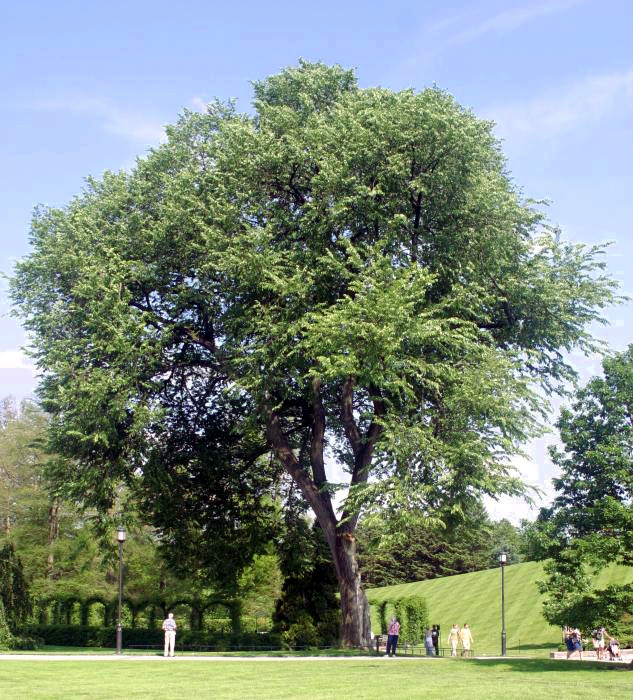
Harbin Elm is a small deciduous tree. It is native to the temperate provinces of Anhui and Jiangsu in eastern China. It has very high resistance to Dutch elm disease, and the elm leaf beetle does not feed on it.
Written 26 November 2026 from the sources listed below. Each statement was checked against the passage it cites; statements that could not be supported were removed.
Appearance
Harbin Elm is a small deciduous tree with a slender trunk. Its bark sheds in irregular flakes.[1][2][3]
Its leaves are obovate to oblong, with doubly serrated margins and caudate to acuminate apices. Leaves of specimens grown in the United States developed thick pubescence and a greyish appearance.[4][5][6]
The tree can reach a height of less than 20 metres, and its trunk diameter rarely exceeds 0.5 metres at breast height. Its leaves measure less than 18 centimetres in length.[7][8][9]
Its obovate samaras measure less than 25 millimetres long and 17 millimetres wide.[10][11]
Habitat
Harbin Elm occurs at elevations below 200 metres on Langya Shan and Baohua Shan.[12]
The species is native to the temperate provinces of Anhui and Jiangsu in eastern China.[13]
Behaviour
Harbin Elm is deciduous.[14]
Reproduction and life cycle
Harbin Elm produces perfect, apetalous flowers that are wind-pollinated. The flowers develop on second-year shoots in March.[15][16]
The species produces obovate samaras.[11]
Conservation
Harbin Elm has very high resistance to Dutch elm disease, comparable to that of Ulmus pumila. The elm leaf beetle does not feed on this species.[17][18][19]
The species has moderate susceptibility to elm yellows.[20]
Uses
Harbin Elm has been evaluated in cultivation at the Morton Arboretum in Illinois. It was also included in elm trials conducted by INRA in the Bois de Vincennes, Paris.[21][22]
The species was hybridized with the Dutch clone '405' to produce the cultivar 'Morfeo'. The hybrid cultivar was patented and released commercially in 2011, but was subsequently withdrawn because of its high susceptibility to elm yellows.[23][24][25]
The species was also hybridized with the Dutch hybrid cultivar 'Groeneveld' to produce the cultivar designation 'FL522'. The hybrid cultivar was never commercially released.[26][27]
Classification of the Harbin Elm
| Kingdom | Plantae |
|---|---|
| Subkingdom | Pteridobiotina |
| Phylum | Tracheophyta |
| Class | Magnoliopsida |
| Order | Rosales |
| Family | Ulmaceae (Elm Family) |
| Genus | Ulmus (Elm) |
| Species | Ulmus chenmoui W.C.Cheng |
Where the Harbin Elm is found
Checklists and occurrence records place Ulmus chenmoui in 1 country across Asia. GBIF holds 34 georeferenced records of it.
Countries
Regions and cities with the most records
1 more country has a few records outside this range
These countries hold a few records of Ulmus chenmoui but lie outside the range the checklists give for it. Such records are often zoo or garden specimens, museum material or vagrants, so the species is not counted as occurring there.
Range as the checklists state it
China (Anhui, Jiangsu)
A number beside a place is its count of GBIF occurrence records. A place without a number comes from a checklist alone. Records show where a species has been observed or collected, which can include escapes and vagrants.
Common names
English
- Harbin Elm
Names in 1 other language
- Chinese
- Langya Yu, ha er bin yu, 琅玡榆
Related species
-
 White ElmUlmus americana
-
 Lacebark ElmUlmus parvifolia
- Red ElmUlmus rubra
-
 Wych ElmUlmus glabra
-
 Siberian ElmUlmus pumila
-
 Field ElmUlmus minor
-
 European White ElmUlmus laevis
-
 Red ElmUlmus crassifolia
Compare
Questions and answers
What is the scientific name of the Harbin Elm?
The scientific name of the Harbin Elm is Ulmus chenmoui. Written with its author, the full name is Ulmus chenmoui W.C.Cheng.
Which family does the Harbin Elm belong to?
Ulmus chenmoui belongs to the family Ulmaceae, in the order Rosales and the class Magnoliopsida.
Where is the Harbin Elm found?
Checklists and occurrence records place Ulmus chenmoui in 1 country: China.
What is the conservation status of the Harbin Elm?
The IUCN Red List category recorded for Ulmus chenmoui is Endangered (EN).
Sources
Passages the profile rests on
- Ulmus chenmoui is a small deciduous tree. Source passage: “is a small deciduous tree” — English Wikipedia
- The species has a slender trunk. Source passage: “the slender trunk rarely exceeds 0.5 m d.b.h.” — English Wikipedia
- The bark sheds in irregular flakes. Source passage: “the bark exfoliates in irregular flakes.” — English Wikipedia
- Its leaves are obovate to oblong and have doubly serrated margins. Source passage: “large obovate to oblong leaves < 18 cm in length with doubly serrate margins” — English Wikipedia
- Its leaves have caudate to acuminate apices. Source passage: “caudate to acuminate apices.” — English Wikipedia
- Leaves of specimens grown in the United States developed thick pubescence and a greyish appearance. Source passage: “Leaves of specimens grown in the US developed a thick pubescence, giving them a greyish appearance” — English Wikipedia
- The tree can reach a height of less than 20 metres. Source passage: “the tree can grow to a height of < 20 m” — English Wikipedia
- The trunk diameter rarely exceeds 0.5 metres at breast height. Source passage: “the slender trunk rarely exceeds 0.5 m d.b.h.” — English Wikipedia
- The leaves measure less than 18 centimetres in length. Source passage: “leaves < 18 cm in length” — English Wikipedia
- The samaras measure less than 25 millimetres long and 17 millimetres wide. Source passage: “the samarae are obovate < 25 mm long by 17 mm wide” — English Wikipedia
- The species produces obovate samaras. Source passage: “the samarae are obovate” — English Wikipedia
- The species occurs at elevations below 200 metres on Langya Shan and Baohua Shan. Source passage: “where it is found at elevations below 200 m on the Langya Shan and Baohua Shan mountains.” — English Wikipedia
- Ulmus chenmoui is native to the temperate provinces of Anhui and Jiangsu in eastern China. Source passage: “from the more temperate provinces of Anhui and Jiangsu in eastern China” — English Wikipedia
- The species is deciduous. Source passage: “is a small deciduous tree” — English Wikipedia
- The species produces perfect, apetalous flowers that are wind-pollinated. Source passage: “The perfect wind-pollinated apetalous flowers” — English Wikipedia
- Flowers develop on second-year shoots in March. Source passage: “flowers are produced on second-year shoots in March” — English Wikipedia
- The species has very high resistance to Dutch elm disease. Source passage: “U. chenmoui has a very high resistance to Dutch elm disease” — English Wikipedia
- The species has resistance to Dutch elm disease comparable to that of Ulmus pumila. Source passage: “on a par with Ulmus pumila” — English Wikipedia
- The elm leaf beetle does not feed on this species. Source passage: “is eschewed by the elm leaf beetle Xanthogaleruca luteola” — English Wikipedia
- The species has moderate susceptibility to elm yellows. Source passage: “but has a moderate susceptibility to elm yellows.” — English Wikipedia
- The species has been evaluated in cultivation at the Morton Arboretum in Illinois. Source passage: “was under evaluation by Dr George Ware at the Morton Arboretum, Illinois, in 2009” — English Wikipedia
- The species was included in elm trials conducted by INRA in the Bois de Vincennes, Paris. Source passage: “It also featured in elm trials conducted by the Institut National de la Recherche Agronomique (INRA) on gravelly soils in the Bois de Vincennes, Paris” — English Wikipedia
- The species was hybridized with the Dutch clone '405' to produce the cultivar 'Morfeo'. Source passage: “U. chenmoui was hybridized with the Dutch clone '405' (U. × hollandica × U. minor) by the Istituto per la Protezione delle Piante (IPP), Florence, to create 'Morfeo'” — English Wikipedia
- The hybrid cultivar 'Morfeo' was patented and released commercially in 2011. Source passage: “a robust, fast-growing tree patented and released to commerce in 2011” — English Wikipedia
- The cultivar 'Morfeo' was subsequently withdrawn because of its high susceptibility to elm yellows. Source passage: “but later withdrawn owing to its high susceptibility to elm yellows.” — English Wikipedia
- The species was hybridized with the Dutch hybrid cultivar 'Groeneveld' to produce the cultivar designation 'FL522'. Source passage: “IPP also hybridized U. chenmoui with the early Dutch hybrid cultivar 'Groeneveld', identifying the new cultivar as 'FL522'” — English Wikipedia
- The hybrid cultivar 'FL522' was never commercially released. Source passage: “however this was never released to commerce.” — English Wikipedia
Data
- Catalogue of Life, 2026-10-16 XR cc by
- Global Biodiversity Information Facility CC BY 4.0
- Wikidata CC0
- GeoNames CC BY 4.0
- Wikimedia Commons per image; credit shown with each image
- Within the Catalogue of Life, this name comes from Synonymic Checklists of the Vascular Plants of the World cc by
References
- Cheng, W. C. (1958). J. Nanjing Forest. Coll. 1(1): 69 (1958). where the name was published
This species in other databases
- Catalogue of Life 7DFL4
- Wikidata Q2109862
- iNaturalist 444535
- World Flora Online wfo-0001244088
- GRIN 476142
Page built on 28 November 2026. See how the catalog is made and all sources and licences.
Cite this page
ScientificNames.org. (2026). Ulmus chenmoui (Harbin Elm). Retrieved November 28, 2026, from https://scientificnames.org/species/ulmus-chenmoui
“Ulmus chenmoui (Harbin Elm).” ScientificNames.org, 2026, scientificnames.org/species/ulmus-chenmoui. Accessed 28 Nov. 2026.
ScientificNames.org. “Ulmus chenmoui (Harbin Elm).” Accessed November 28, 2026. https://scientificnames.org/species/ulmus-chenmoui.
@misc{scientificnames_ulmus_chenmoui_harbin_elm,
  author = {{ScientificNames.org}},
  title = {Ulmus chenmoui (Harbin Elm)},
  year = {2026},
  url = {https://scientificnames.org/species/ulmus-chenmoui},
  note = {Accessed 2026-11-28}
}