Species · Flowering plants
Cork Elm Ulmus thomasii
The scientific name of the Cork Elm is Ulmus thomasii. It is a species of flowering plant in the family Ulmaceae (elm family), order Rosales.
- Scientific name
- Ulmus thomasii Sarg.
- Common name
- Cork Elm
- Genus
- Ulmus
- Family
- Ulmaceae (Elm Family)
- Order
- Rosales
- Class
- Magnoliopsida
- Red List category
- LC Least Concern
- Recorded in
- 2 countries
- Name status
- accepted in the Catalogue of Life

Overview
Cork elm (Ulmus thomasii Sarg.) is a deciduous flowering tree in the family Ulmaceae, order Rosales, class Magnoliopsida. It is native primarily to the Midwestern United States, with a range extending from southern Ontario and Quebec south to Tennessee, west to northeastern Kansas, and north to Minnesota. It is distinguished by the thick corky wings that develop on many older branches.
Written 26 November 2026 from the sources listed below. Each statement was checked against the passage it cites; statements that could not be supported were removed.
Appearance
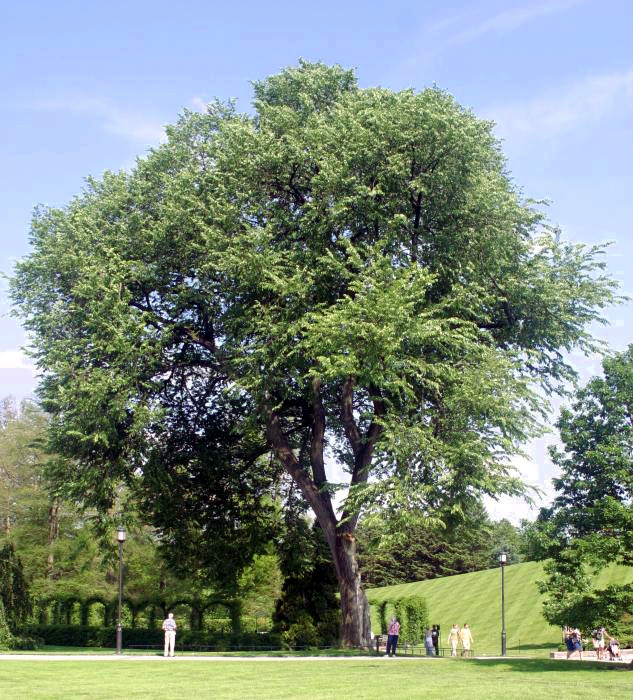
Cork elm is a deciduous tree with a typical height of 15–30 metres. Forest-grown trees have a cylindrical, upright crown with short branches, narrower than that of most other elms. The species is often monopodial, an unusual characteristic among North American elms.[1][2][3][4]
Its bark is grey-brown and deeply furrowed into scaly, flattened ridges. Many older branches develop three or four irregular, thick corky wings.[5][6]
The leaves are oval to obovate, with a rounded symmetrical base and an acuminate apex. They measure 5–10 centimetres in length and 2–5 centimetres in width; the upper surface is shiny dark green and turns bright yellow in autumn, while the underside is pubescent.[7][8][9]
The flowers are red-green and lack petals. They occur in racemes reaching up to 40 millimetres in length.[10][11]
The fruit is a broad ovate samara covered with fine hairs and notched at the tip. Samaras measure 13–25 millimetres in length.[12][13]
Habitat
Cork elm prefers moist but well-drained sandy loam, loam, or silt loam soils in association with other hardwood trees. It also grows on dry uplands, particularly rocky ridges and limestone bluffs.[14][15]
Behaviour
Cork elm has moderate tolerance of shade.[16]
Reproduction and life cycle
The flowers are pollinated by wind and generally appear from March to May, approximately two weeks before the leaves emerge. The species is protandrous, although self-pollination remains frequent.[17][18][19]
The fruits mature in May or June and form drooping clusters at the leaf bases.[20]
Conservation
Cork elm is very susceptible to Dutch elm disease.[21]
Uses
The wood is described as the hardest and heaviest among elm species. It is strong and capable of taking a high polish.[22][23]
The wood was historically used for boatbuilding, furniture, agricultural tools, and musical instruments.[24]
Cork elm has been planted as a street tree in Cheyenne, Wyoming. It is occasionally cultivated outside its native range as a specimen tree in botanical gardens and arboreta.[25][26]
Similar species
Cork elm has been experimentally crossed with Japanese elm (Ulmus davidiana var. japonica). Experimental crossings with Siberian elm (Ulmus pumila) produced seedlings that all perished.[27][28]
Classification of the Cork Elm
| Kingdom | Plantae |
|---|---|
| Subkingdom | Pteridobiotina |
| Phylum | Tracheophyta |
| Class | Magnoliopsida |
| Order | Rosales |
| Family | Ulmaceae (Elm Family) |
| Genus | Ulmus (Elm) |
| Species | Ulmus thomasii Sarg. |
Where the Cork Elm is found
Checklists and occurrence records place Ulmus thomasii in 2 countries across North America. GBIF holds 4,424 georeferenced records of it.
Countries
Regions and cities with the most records
- Ontario, Canada 1,998
- Aylmer, Canada 801
- Nepean, Canada 670
- Quebec, Canada 624
- Ottawa, Canada 611
- Ottawa South, Canada 603
- Gatineau, Canada 601
- Bridlewood, Canada 568
- Kanata, Canada 562
- Vanier, Canada 517
- Gloucester, Canada 480
- Stittsville, Canada 361
- Orléans, Canada 341
- Fallingbrook, Canada 194
- Wisconsin, United States 155
- Illinois, United States 138
- Minnesota, United States 124
- New York, United States 94
- Cornwall, Canada 87
- Laval, Canada 83
- Laval-des-Rapides, Canada 83
- Saint-Michel, Canada 78
- Val-des-Arbres, Canada 76
- Michigan, United States 73
- Cartierville, Canada 72
- Montréal-Nord, Canada 71
- Rosemont–La Petite-Patrie, Canada 71
- Saint-Vincent-de-Paul, Canada 71
- Villeray–Saint-Michel–Parc-Extension, Canada 71
- Le Plateau-Mont-Royal, Canada 66
- Terrebonne, Canada 65
- Mont-Royal, Canada 62
- Montréal, Canada 62
- Rivière-des-Prairies–Pointe-aux-Trembles, Canada 62
- Ville-Marie, Canada 62
- Boisbriand, Canada 61
Range as the checklists state it
Canada (Ontario, Québec); USA (Arkansas, Connecticut, Iowa, Illinois, Indiana, Kansas, Kentucky, Massachusetts, Maryland, Michigan, Minnesota, Missouri, North Dakota, Nebraska, New Hampshire, New Jersey, New York, Ohio, Pennsylvania, South Dakota, Tennessee, Vermont, Wisconsin, West Virginia)
A number beside a place is its count of GBIF occurrence records. A place without a number comes from a checklist alone. Records show where a species has been observed or collected, which can include escapes and vagrants.
Common names
English
- Cork Elm
Names in 7 other languages
- Chinese
- 岩榆
- Czech
- jilm Thomasův
- Finnish
- kivijalava
- French
- orme de Thomas, orme liège
- German
- Felsen-Ulme, Felsenulme
- Swedish
- klippalm
- oji
- aniibii-mitigwaabaak
Synonyms
One other scientific name has been used for this species and is now treated as a synonym of Ulmus thomasii.
- Ulmus racemosa D.Thomas ambiguous synonym
Related species
-
 White ElmUlmus americana
-
 Lacebark ElmUlmus parvifolia
- Red ElmUlmus rubra
-
 Wych ElmUlmus glabra
-
 Siberian ElmUlmus pumila
-
 Field ElmUlmus minor
-
 European White ElmUlmus laevis
-
 Red ElmUlmus crassifolia
Compare
Questions and answers
What is the scientific name of the Cork Elm?
The scientific name of the Cork Elm is Ulmus thomasii. Written with its author, the full name is Ulmus thomasii Sarg..
Which family does the Cork Elm belong to?
Ulmus thomasii belongs to the family Ulmaceae, in the order Rosales and the class Magnoliopsida.
Where is the Cork Elm found?
Checklists and occurrence records place Ulmus thomasii in 2 countries: Canada and United States.
What is the conservation status of the Cork Elm?
The IUCN Red List category recorded for Ulmus thomasii is Least Concern (LC).
Is elm the hardest wood?
Cork elm wood is described as the hardest and heaviest among elm species.[22]
Is elm coniferous or deciduous?
Cork elm is deciduous.[1]
Do elm trees bear fruit?
Cork elm produces broad ovate samaras covered with fine hairs and notched at the tip. The fruits mature in May or June and form drooping clusters at the leaf bases.[12][20]
Is Dutch elm still a problem?
Cork elm is very susceptible to Dutch elm disease.[21]
Sources
Passages the profile rests on
- Ulmus thomasii is a deciduous tree. Source passage: “Ulmus thomasii, the rock elm or cork elm (or orme liège in Québec), is a deciduous tree” — English Wikipedia
- Forest-grown trees have a cylindrical, upright crown with short branches that is narrower than that of most other elms. Source passage: “Where forest-grown, the crown is cylindrical and upright with short branches, and is narrower than most other elms.” — English Wikipedia
- The species is often monopodial, an unusual characteristic among North American elms. Source passage: “Rock elm is also unusual among North American elms in that it is often monopodial.” — English Wikipedia
- The tree typically reaches 15–30 metres in height. Source passage: “Ulmus thomasii grows as a tree from 15–30 m (50–100 ft) tall” — English Wikipedia
- Its bark is grey-brown and deeply furrowed into scaly, flattened ridges. Source passage: “The bark is grey-brown and deeply furrowed into scaly, flattened ridges.” — English Wikipedia
- Many older branches develop three or four irregular, thick corky wings. Source passage: “Many older branches have 3–4 irregular thick corky wings.” — English Wikipedia
- Its leaves are oval to obovate, with a rounded symmetrical base and an acuminate apex. Source passage: “oval to obovate with a round, symmetrical base and acuminate apex.” — English Wikipedia
- The upper leaf surface is shiny dark green and turns bright yellow in autumn, while the underside is pubescent. Source passage: “The leaf surface is shiny dark green, turning bright yellow in autumn; the underside is pubescent.” — English Wikipedia
- Its leaves measure 5–10 centimetres in length and 2–5 centimetres in width. Source passage: “The leaves are 5–10 cm (2–4 in) long and 2–5 cm (3⁄4–2 in) wide” — English Wikipedia
- Its flowers are red-green and lack petals. Source passage: “The perfect apetalous, wind-pollinated flowers are red-green” — English Wikipedia
- Its flowers occur in racemes reaching up to 40 millimetres in length. Source passage: “appear in racemes up to 40 mm (2 in) long” — English Wikipedia
- Its fruit is a broad ovate samara covered with fine hairs and notched at the tip. Source passage: “The fruit is a broad ovate samara 13–25 mm (1⁄2–31⁄32 in) long covered with fine hair, notched at the tip” — English Wikipedia
- Its samaras measure 13–25 millimetres in length. Source passage: “13–25 mm (1⁄2–31⁄32 in) long” — English Wikipedia
- The species prefers moist but well-drained sandy loam, loam, or silt loam soils in association with other hardwood trees. Source passage: “Its preferred habitat is moist but well-drained sandy loam, loam, or silt loam soil, mixed with other hardwoods.” — English Wikipedia
- The species also grows on dry uplands, particularly rocky ridges and limestone bluffs. Source passage: “However, it also grows on dry uplands, especially on rocky ridges and limestone bluffs.” — English Wikipedia
- Ulmus thomasii has moderate tolerance of shade. Source passage: “Ulmus thomasii is moderately shade-tolerant.” — English Wikipedia
- Its flowers are pollinated by wind. Source passage: “The perfect apetalous, wind-pollinated flowers are red-green” — English Wikipedia
- Its flowers generally appear from March to May, approximately two weeks before the leaves emerge. Source passage: “appear in racemes up to 40 mm (2 in) long two weeks before the leaves from March to May, depending on the tree's location.” — English Wikipedia
- The species is protandrous, although self-pollination remains frequent. Source passage: “Although U. thomasii is protandrous, levels of self-pollination remain high.” — English Wikipedia
- The fruits mature in May or June and form drooping clusters at the leaf bases. Source passage: “maturing during May or June to form drooping clusters at the leaf bases.” — English Wikipedia
- The species is very susceptible to Dutch elm disease. Source passage: “U. thomasii is very susceptible to Dutch elm disease.” — English Wikipedia
- Its wood is described as the hardest and heaviest among elm species. Source passage: “The wood of the rock elm is the hardest and heaviest of all elms” — English Wikipedia
- The wood is strong and capable of taking a high polish. Source passage: “It is also very strong and takes a high polish” — English Wikipedia
- The wood was historically used for boatbuilding, furniture, agricultural tools, and musical instruments. Source passage: “notably boatbuilding, furniture, agricultural tools, and musical instruments.” — English Wikipedia
- The species has been planted as a street tree in Cheyenne, Wyoming. Source passage: “It has, however, been planted as a street tree in Cheyenne, Wyoming” — English Wikipedia
- The species is occasionally cultivated outside its native range as a specimen tree in botanical gardens and arboreta. Source passage: “The species is occasionally grown beyond its native range as a specimen tree in botanical gardens and arboreta” — English Wikipedia
- Ulmus thomasii has been experimentally crossed with Japanese elm (Ulmus davidiana var. japonica). Source passage: “Ulmus thomasii was crossed experimentally with Japanese elm (U. davidiana var. japonica) at the Arnold Arboretum in Massachusetts” — English Wikipedia
- Experimental crossings with Siberian elm (Ulmus pumila) produced seedlings that all perished. Source passage: “Seedlings arising from crossings with Siberian elm (U. pumila) at the Lake States Forestry Experimental Station in the 1950s all perished” — English Wikipedia
Data
- Catalogue of Life, 2026-10-16 XR cc by
- Global Biodiversity Information Facility CC BY 4.0
- Wikidata CC0
- GeoNames CC BY 4.0
- Wikimedia Commons per image; credit shown with each image
- Within the Catalogue of Life, this name comes from Synonymic Checklists of the Vascular Plants of the World cc by
References
- Sarg. (1902). Silva [Sargent] 14: 102 (1902). where the name was published
This species in other databases
- Catalogue of Life 7DFNX
- Wikidata Q1147786
- iNaturalist 54861
- World Flora Online wfo-0000416829
- GRIN 101705
Page built on 26 November 2026. See how the catalog is made and all sources and licences.
Cite this page
ScientificNames.org. (2026). Ulmus thomasii (Cork Elm). Retrieved November 26, 2026, from https://scientificnames.org/species/ulmus-thomasii
“Ulmus thomasii (Cork Elm).” ScientificNames.org, 2026, scientificnames.org/species/ulmus-thomasii. Accessed 26 Nov. 2026.
ScientificNames.org. “Ulmus thomasii (Cork Elm).” Accessed November 26, 2026. https://scientificnames.org/species/ulmus-thomasii.
@misc{scientificnames_ulmus_thomasii_cork_elm,
  author = {{ScientificNames.org}},
  title = {Ulmus thomasii (Cork Elm)},
  year = {2026},
  url = {https://scientificnames.org/species/ulmus-thomasii},
  note = {Accessed 2026-11-26}
}