Species · Flowering plants
Thick Violet Viola crassa
The scientific name of the Thick Violet is Viola crassa. It is a species of flowering plant in the family Violaceae (violet family), order Malpighiales.
- Scientific name
- Viola crassa (Makino) Makino
- Common name
- Thick Violet
- Genus
- Viola
- Family
- Violaceae (Violet Family)
- Order
- Malpighiales
- Class
- Magnoliopsida
- Recorded in
- 3 countries
- Name status
- accepted in the Catalogue of Life
Overview
Viola crassa is a species of flowering plant in the family Violaceae. It is native to Japan, Kamchatka Krai, the Kuril Islands, and Sakhalin.
Classification of the Thick Violet
| Kingdom | Plantae |
|---|---|
| Subkingdom | Pteridobiotina |
| Phylum | Tracheophyta |
| Class | Magnoliopsida |
| Order | Malpighiales |
| Family | Violaceae (Violet Family) |
| Subfamily | Violoideae |
| Genus | Viola (Violets) |
| Species | Viola crassa (Makino) Makino |
Where the Thick Violet is found
Checklists and occurrence records place Viola crassa in 3 countries across Asia and North America. GBIF holds 329 georeferenced records of it.
Countries
Regions and cities with the most records
- Nagano, Japan 42
- Hokkaido, Japan 36
- Toyama, Japan 33
- Iwate, Japan 19
- British Columbia, Canada 16
- Takizawa, Japan 14
- Toyama, Japan 12
- Akita, Japan 11
- Imizu, Japan 10
- Takaoka, Japan 10
- Niigata, Japan 7
- Hokuto, Japan 6
- Chino, Japan 5
- Ina, Japan 5
- Azumino, Japan 4
- Morioka, Japan 3
1 more country has a few records outside this range
These countries hold a few records of Viola crassa but lie outside the range the checklists give for it. Such records are often zoo or garden specimens, museum material or vagrants, so the species is not counted as occurring there.
A number beside a place is its count of GBIF occurrence records. A place without a number comes from a checklist alone. Records show where a species has been observed or collected, which can include escapes and vagrants.
Common names
English
- Thick Violet
Names in 3 other languages
- Japanese
- ezo-takane-sumire, kumoma-sumire, takane-sumire, yatsugatake-ki-sumire, タカネスミレ(広義)
- Korean
- 구름제비꽃
- Russian
- Фиалка толстая
Subspecies and varieties
- Viola crassa subsp. alpicola subspecies
- Viola crassa subsp. avatschensis subspecies
- Viola crassa subsp. borealis subspecies
- Viola crassa subsp. crassa subspecies
- Viola crassa subsp. yatsugatakeana subspecies
Related species
-
 March VioletViola odorata
-
 PansyViola tricolor
-
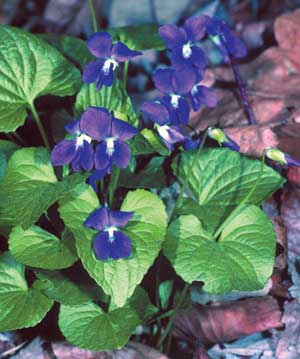 VioletViola sororia
-
 Creeping VioletViola hederacea
-
 Dog VioletViola riviniana
-
 ViolaViola cornuta
-
 Banks VioletViola banksii
-
 Manchuria VioletViola mandshurica
Compare
Questions and answers
What is the scientific name of the Thick Violet?
The scientific name of the Thick Violet is Viola crassa. Written with its author, the full name is Viola crassa (Makino) Makino.
Which family does the Thick Violet belong to?
Viola crassa belongs to the family Violaceae, in the order Malpighiales and the class Magnoliopsida.
Where is the Thick Violet found?
Checklists and occurrence records place Viola crassa in 3 countries: Japan, Canada and South Korea.
Sources
Data
- Catalogue of Life, 2026-10-16 XR cc by
- Global Biodiversity Information Facility CC BY 4.0
- Wikidata CC0
- English Wikipedia CC BY-SA 4.0
- GeoNames CC BY 4.0
- Within the Catalogue of Life, this name comes from Synonymic Checklists of the Vascular Plants of the World cc by
References
- (Makino) Makino. where the name was published
This species in other databases
- Catalogue of Life 5BGLL
- Wikidata Q11315941
- iNaturalist 907227
- World Flora Online wfo-0000426472-2026-06
- GRIN 429917
Page built on 25 November 2026. See how the catalog is made and all sources and licences.
Cite this page
ScientificNames.org. (2026). Viola crassa (Thick Violet). Retrieved November 25, 2026, from https://scientificnames.org/species/viola-crassa
“Viola crassa (Thick Violet).” ScientificNames.org, 2026, scientificnames.org/species/viola-crassa. Accessed 25 Nov. 2026.
ScientificNames.org. “Viola crassa (Thick Violet).” Accessed November 25, 2026. https://scientificnames.org/species/viola-crassa.
@misc{scientificnames_viola_crassa_thick_violet,
  author = {{ScientificNames.org}},
  title = {Viola crassa (Thick Violet)},
  year = {2026},
  url = {https://scientificnames.org/species/viola-crassa},
  note = {Accessed 2026-11-25}
}