Species · Flowering plants
Guadalupe Mountains Violet Viola guadalupensis
The scientific name of the Guadalupe Mountains Violet is Viola guadalupensis. It is a species of flowering plant in the family Violaceae (violet family), order Malpighiales.
- Scientific name
- Viola guadalupensis A.M.Powell & Wauer
- Common name
- Guadalupe Mountains Violet
- Genus
- Viola
- Family
- Violaceae (Violet Family)
- Order
- Malpighiales
- Class
- Magnoliopsida
- Recorded in
- 1 country
- Name status
- accepted in the Catalogue of Life

Overview
The Guadalupe Mountains Violet (Viola guadalupensis) is a perennial violet with yellow flowers. The species is endemic to the Guadalupe Mountains and is known only from Guadalupe Mountains National Park. It is the only yellow-flowered violet in its region.
Written 27 November 2026 from the sources listed below. Each statement was checked against the passage it cites; statements that could not be supported were removed.
Appearance
The Guadalupe Mountains Violet is a perennial violet with yellow flowers. It is the only yellow-flowered violet in its region.[1][2]
Habitat
The species grows on vertical limestone faces at high elevations. At its type locality, plants are rooted in small openings in northwest-facing, dolomitized limestone at approximately 2,600 metres above sea level.[3][4][5][6]
Two large Douglas firs shade plants at the type locality. The species occurs in association with rock spiraea, Guadalupe valerian, small rocklettuce, and Guadalupe leastdaisy.[7][8]
A second population was discovered in a steep slot-canyon drainage. The species is thought to have highly specific habitat requirements, and microclimate and substrate type may be critical factors.[9][10][11]
Behaviour
Plants in the second population grew mainly as individual plants rather than in mats.[12]
Reproduction and life cycle
Seeds collected from wild plants have been used by National Park Service cooperators to produce plants.[13]
Conservation
The Guadalupe Mountains Violet is classified as a National Park Service Species of Concern. Potential threats include genetic isolation, catastrophic fires, disease, and herbivory.[14][15][16][17][18]
Park conservation efforts include plans to introduce laboratory-germinated plants or seeds into suitable locations. The success of future transplants is intended to be monitored after suitable transplant techniques are established.[19][20]
Classification of the Guadalupe Mountains Violet
| Kingdom | Plantae |
|---|---|
| Subkingdom | Pteridobiotina |
| Phylum | Tracheophyta |
| Class | Magnoliopsida |
| Order | Malpighiales |
| Family | Violaceae (Violet Family) |
| Subfamily | Violoideae |
| Genus | Viola (Violets) |
| Species | Viola guadalupensis A.M.Powell & Wauer |
Where the Guadalupe Mountains Violet is found
Checklists and occurrence records place Viola guadalupensis in 1 country across North America. GBIF holds 3 georeferenced records of it.
Countries
Regions and cities with the most records
Range as the checklists state it
USA (New Mexico, Texas)
A number beside a place is its count of GBIF occurrence records. A place without a number comes from a checklist alone. Records show where a species has been observed or collected, which can include escapes and vagrants.
Common names
English
- Guadalupe Mountains Violet
Names in 1 other language
- Finnish
- guadaloupenorvokki
Related species
-
 Sweet VioletViola odorata
-
 Wild PansyViola tricolor
-
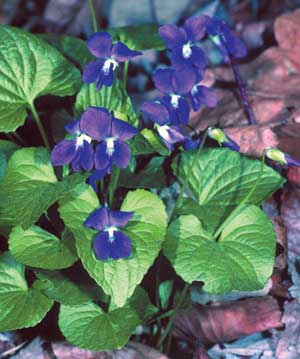 North American Common Blue VioletViola sororia
-
 Australian VioletViola hederacea
-
 Common Dog-VioletViola riviniana
-
 Horned PansyViola cornuta
-
 Native VioletViola banksii
-
 Manchurian VioletViola mandshurica
Compare
Questions and answers
What is the scientific name of the Guadalupe Mountains Violet?
The scientific name of the Guadalupe Mountains Violet is Viola guadalupensis. Written with its author, the full name is Viola guadalupensis A.M.Powell & Wauer.
Which family does the Guadalupe Mountains Violet belong to?
Viola guadalupensis belongs to the family Violaceae, in the order Malpighiales and the class Magnoliopsida.
Where is the Guadalupe Mountains Violet found?
Checklists and occurrence records place Viola guadalupensis in 1 country: United States.
Sources
Passages the profile rests on
- Viola guadalupensis is a perennial violet with yellow flowers. Source passage: “is a perennial yellow-flowered violet” — English Wikipedia
- The species is the only yellow-flowered violet in its region. Source passage: “It is the only yellow-flowered violet in the region.” — English Wikipedia
- The species grows on vertical limestone faces at high elevations. Source passage: “where it grows at high elevations on vertical limestone faces.” — English Wikipedia
- At its type locality, the species is rooted in small openings in rock faces. Source passage: “that are rooted in small openings of the rock face.” — English Wikipedia
- The limestone substrate at the type locality is dolomitized and faces northwest. Source passage: “The dolomitized, limestone rock on which the plants occur is northwest-facing” — English Wikipedia
- The type locality is approximately 2,600 metres above sea level. Source passage: “at approximately 2,600 m elevation.” — English Wikipedia
- Two large Douglas firs shade plants at the type locality. Source passage: “Two large Douglas firs (Pseudotsuga menziesii) shade the plants” — English Wikipedia
- The species occurs in association with rock spiraea, Guadalupe valerian, small rocklettuce, and Guadalupe leastdaisy. Source passage: “including rock spiraea (Petrophytum caespitosum), Guadalupe valerian (Valeriana texana), small rocklettuce (Pinaropappus parvus), and Guadalupe leastdaisy (Chaetopappa hersheyi).” — English Wikipedia
- A second population was discovered in a steep slot-canyon drainage. Source passage: “A second, isolated population was found in 2006 in a steep, slot-canyon drainage” — English Wikipedia
- The species is thought to have highly specific habitat requirements. Source passage: “The species is thought to have highly specific habitat requirements.” — nps.gov
- Microclimate and substrate type may be critical habitat factors, although this has not been confirmed. Source passage: “Microclimate and substrate type may be critical for this species, but this is not yet confirmed.” — English Wikipedia
- Plants in the second population grew mainly as individual plants rather than in mats. Source passage: “which grew mainly as individual plants rather than in mats.” — English Wikipedia
- Seeds collected from wild plants have been used by National Park Service cooperators to produce plants. Source passage: “park personnel collected seeds from the field and NPS cooperators produced plants from the seeds.” — nps.gov
- The species is classified as a National Park Service Species of Concern. Source passage: “The Guadalupe Mountains violet is currently considered a National Park Service Species of Concern.” — nps.gov
- Genetic isolation is considered a potential threat to the species. Source passage: “The plant is thought to be threatened by genetic isolation” — English Wikipedia
- The species is considered susceptible to catastrophic fires. Source passage: “susceptible to catastrophic fire” — English Wikipedia
- The species is considered susceptible to disease. Source passage: “susceptible to catastrophic fire, disease, and herbivory.” — English Wikipedia
- Herbivory is considered a potential threat to the species. Source passage: “susceptible to catastrophic fire, disease, and herbivory.” — nps.gov
- Park conservation efforts include plans to introduce laboratory-germinated plants or seeds into suitable locations. Source passage: “the park began efforts to introduce laboratory-germinated plants or seeds to suitable locations within the park.” — English Wikipedia
- The success of future transplants is intended to be monitored after suitable transplant techniques are established. Source passage: “Once appropriate transplant techniques are determined, seeds or plants will be transplanted in suitable sites and their success monitored.” — English Wikipedia
- The species is known only from Guadalupe Mountains National Park. Source passage: “The violet is known only from Guadalupe Mountains National Park” — English Wikipedia
Data
- Catalogue of Life, 2026-10-16 XR cc by
- Global Biodiversity Information Facility CC BY 4.0
- Wikidata CC0
- GeoNames CC BY 4.0
- Wikimedia Commons per image; credit shown with each image
- Within the Catalogue of Life, this name comes from Synonymic Checklists of the Vascular Plants of the World cc by
References
- Powell, A. M., & Wauer. (1990). Sida 14(1): 1 (1990). where the name was published
This species in other databases
- Catalogue of Life 7G3QB
- Wikidata Q17564918
- iNaturalist 170242
- World Flora Online wfo-0000423951
- GRIN 430874
Page built on 27 November 2026. See how the catalog is made and all sources and licences.
Cite this page
ScientificNames.org. (2026). Viola guadalupensis (Guadalupe Mountains Violet). Retrieved November 27, 2026, from https://scientificnames.org/species/viola-guadalupensis
“Viola guadalupensis (Guadalupe Mountains Violet).” ScientificNames.org, 2026, scientificnames.org/species/viola-guadalupensis. Accessed 27 Nov. 2026.
ScientificNames.org. “Viola guadalupensis (Guadalupe Mountains Violet).” Accessed November 27, 2026. https://scientificnames.org/species/viola-guadalupensis.
@misc{scientificnames_viola_guadalupensis_guadalupe_mountains_violet,
  author = {{ScientificNames.org}},
  title = {Viola guadalupensis (Guadalupe Mountains Violet)},
  year = {2026},
  url = {https://scientificnames.org/species/viola-guadalupensis},
  note = {Accessed 2026-11-27}
}