Species · Flowering plants
Early Dog-Violet Viola reichenbachiana
The scientific name of the Early Dog-Violet is Viola reichenbachiana. It is a species of flowering plant in the family Violaceae (violet family), order Malpighiales.
- Scientific name
- Viola reichenbachiana Jord. ex Boreau
- Common name
- Early Dog-Violet
- Genus
- Viola
- Family
- Violaceae (Violet Family)
- Order
- Malpighiales
- Class
- Magnoliopsida
- Recorded in
- 48 countries
- Name status
- accepted in the Catalogue of Life

Overview
Early Dog-Violet is a herbaceous perennial flowering plant in the family Violaceae, order Malpighiales and class Magnoliopsida. It grows in hardwood forests, other broad-leaved wooded areas and along road banks among rich vegetation. It is distinguished by its dull purple flowers with narrow, separated petals and occasional deep violet-blue spurs.
Written 26 November 2026 from the sources listed below. Each statement was checked against the passage it cites; statements that could not be supported were removed.
Appearance
Early Dog-Violet is a herbaceous perennial with simple leaves arranged alternately along its stems. The leaves have broad, heart-shaped blades with rounded, tooth-like ridges and may be hairless or slightly textured, with pointed or hooked tips.[1][2][3][4]
The upper leaves are generally smaller and darker than the lower leaves. Each leaf typically has four or five veins on either side of its midrib.[5][6]
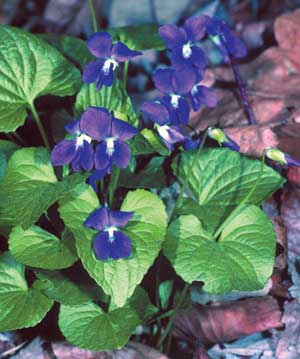
Its bisexual flowers contain both male and female reproductive structures. They have narrow, non-overlapping, dull purple petals and typically five pointed sepals, five stamens and one carpel.[7][8][9]
The flowers measure approximately 1.5–2 cm across and have a star-like appearance because of their separated petals. They may display deep violet-blue spurs.[10][11]
Its fruits usually have three lobes.[12]
The plant typically grows to a height of 5–15 cm and spreads 10–50 cm.[13][14]
Habitat
Early Dog-Violet typically grows along road banks and among other rich vegetation. Its natural habitats include hardwood forests and other broad-leaved wooded areas.[15][16]
The species grows successfully in maximum or partial sunlight. It thrives in fertile acidic-to-neutral soil that is damp but well-drained.[17][18]
Diet
Early Dog-Violet serves as a food source for fritillary butterfly larvae.[19]
Behaviour
Early Dog-Violet is pollinated by insects through self-pollination or cross-pollination.[20]
Reproduction and life cycle
Early Dog-Violet propagates rhizomatously through above-ground runners called stolons. Its seeds have thick cotyledons that nourish the developing embryo.[21][22]
Its flowers generally bloom from late February through May. Its fruits are generally produced between May and August.[23][24]
The species can hybridise with Viola riviniana to produce Viola × bavarica.[25]
Conservation
Early Dog-Violet is classified as H6 on the Royal Horticultural Society's hardiness scale. This classification indicates that it is hardy throughout the United Kingdom and northern Europe.[26][27]
Its reported minimum survival temperature is −20 °C.[28]
Uses
Early Dog-Violet is cultivated mainly for the aesthetic appeal of its distinctive flowers.[29]
Similar species
Viola riviniana is a species with which Early Dog-Violet can hybridise to produce Viola × bavarica.[25][30]
Classification of the Early Dog-Violet
| Kingdom | Plantae |
|---|---|
| Subkingdom | Pteridobiotina |
| Phylum | Tracheophyta |
| Class | Magnoliopsida |
| Order | Malpighiales |
| Family | Violaceae (Violet Family) |
| Subfamily | Violoideae |
| Genus | Viola (Violets) |
| Species | Viola reichenbachiana Jord. ex Boreau |
Where the Early Dog-Violet is found
Checklists and occurrence records place Viola reichenbachiana in 48 countries across Africa, Asia and Europe. GBIF holds 269,722 georeferenced records of it.
Countries where it is native or its origin is not stated
- Aland Islands 46
- Albania 7
- Algeria 6
- Austria 18,914
- Azerbaijan 2
- Belarus 47
- Belgium 4,358
- Bosnia and Herzegovina 17
- Bulgaria 31
- Croatia 177
- Czechia 7,198
- Denmark 3,995
- Estonia 59
- Finland 37
- France 90,263
- Georgia 36
- Germany 31,722
- Greece 103
- Hungary 237
- India 2
- Ireland 866
- Italy 1,323
- Kosovo 2
- Latvia 22
- Liechtenstein 30
- Lithuania 27
- Luxembourg 2,692
- Moldova 13
- Montenegro 22
- Morocco 18
- North Macedonia 4
- Norway 73
- Pakistan 1
- Poland 16,988
- Portugal 23
- Romania 88
- Russia 306
- Serbia 33
- Slovakia 6,677
- Slovenia 261
- Spain 3,959
- Sweden 3,490
- Switzerland 19,710
- The Netherlands 8,748
- Turkey 9
- Ukraine 610
- United Kingdom 46,470
Countries where it has been introduced
Regions and cities with the most records
- England, United Kingdom 42,113
- Auvergne-Rhône-Alpes, France 19,630
- Bavaria, Germany 19,341
- Bourgogne-Franche-Comté, France 17,105
- Upper Austria, Austria 14,769
- Grand Est, France 13,472
- Centre-Val de Loire, France 8,698
- Hauts-de-France, France 7,269
- Île-de-France, France 6,254
- Vaud, Switzerland 5,898
- Maastricht, The Netherlands 4,847
- Hoensbroek, The Netherlands 4,524
- Provence-Alpes-Côte d'Azur, France 4,292
- Visé, Belgium 4,064
- Lanaken, Belgium 3,930
- Riemst, Belgium 3,907
- Heerlen, The Netherlands 3,849
- Geleen, The Netherlands 3,524
- Limburg, The Netherlands 3,371
- Maasmechelen, Belgium 3,360
- Mechelen-aan-de-Maas, Belgium 3,312
- Occitanie, France 3,239
- Brunssum, The Netherlands 3,184
- Sittard, The Netherlands 2,774
- Kerkrade, The Netherlands 2,709
- Herzogenrath, Germany 2,542
- Salzburg, Austria 2,531
- Gilching, Germany 2,388
- Bilzen, Belgium 2,369
- Saint-Égrève, France 2,364
- Yverdon-les-Bains, Switzerland 2,357
- Wales, United Kingdom 2,331
- Bern, Switzerland 2,306
- Gauting, Germany 2,297
- Fontaine, France 2,270
- Grenoble, France 2,253
1 more country has a few records outside this range
These countries hold a few records of Viola reichenbachiana but lie outside the range the checklists give for it. Such records are often zoo or garden specimens, museum material or vagrants, so the species is not counted as occurring there.
Range as the checklists state it
England (England, Wales, S-Scotland, Isles of Scilly); Ireland (Ireland, Northern Ireland); Denmark; Sweden; Netherlands; Belgium; Luxembourg; Germany (Brandenburg, Berlin, Baden-Württemberg, Bayern, Hessen, Hamburg, Mecklenburg-Vorpommern, Niedersachsen, Nordrhein-Westfalen, Rheinland-Pfalz, Schleswig-Holstein, Saarland, Sachsen, Sachsen-Anhalt, Thüringen); Switzerland; Liechtenstein; Austria; Poland; Czech Republic; Slovakia; Hungary; Spain; France; Corsica; Sardinia; Italy; Sicily; San Marino [I]; Slovenia; Croatia; Bosnia & Hercegovina; Montenegro; Serbia; Kosovo; North Macedonia; Albania; Romania; Bulgaria; Greece (mountans of mainland, Thasos, Samothraki, Kerkyra, Evvoia); Crete; Estonia; Latvia; Lithuania; Belarus; C-European Russia; W-European Russia; Moldova; Ukraine; Crimea; Morocco; Algeria; Northern Caucasus; Georgia [Caucasus]; Azerbaijan; East Aegaean Isl. (Lesvos, Ikaria); Turkey (N-Anatolia, NE-Anatolia); Pakistan (Waziristan, Chitral, Swat, Hazara); NW-India (Jammu & Kashmir)
A number beside a place is its count of GBIF occurrence records. A place without a number comes from a checklist alone. Records show where a species has been observed or collected, which can include escapes and vagrants.
Common names
English
- Early Dog-Violet
- Wood Dog Violet
- Early Dog Violet
- European Early Dog-violet
Names in 27 other languages
- Catalan
- Violeta boscana
- Chinese
- 早花犬堇菜
- Croatian
- Reichenbachova ljubica
- Czech
- violka lesní
- Danish
- Skov-viol
- Dutch
- Donkersporig bosviooltje
- Esperanto
- Arbara violo
- Estonian
- metskannike
- Finnish
- pyökkiorvokki
- French
- Violette des bois
- German
- Artengruppe Wald-Veilchen, Wald-Veilchen
- Hungarian
- Erdei ibolya
- Irish
- Sailchuach luath
- Italian
- Viola silvestre
- Latvian
- meža vijolīte
- Lithuanian
- Miškinė našlaitė
- Norwegian Bokmål
- lundfiol
- Persian
- بنفشه زودرس سگی
- Polish
- Fiołek leśny
- Russian
- Фиалка Рейхенбаха
- Slovak
- fialka lesná
- Slovenian
- Gozdna vijolica
- Swedish
- lundviol
- Turkish
- Orman menekşesi, kayınmenekşesi
- Ukrainian
- Фіалка Рейхенбаха
- Welsh
- Fioled y Coed, Fioledau'r Coed, Gwiolydd, Gwiolydd y Goedwig, Millyn Glaswelw, Millyn y Goedwig
- csb
- Lesny proliszk
Synonyms
33 other scientific names have been used for this species and are now treated as synonyms of Viola reichenbachiana.
- Viola arenicola Chabert
- Viola bertotii Souché ex Corb.
- Viola canina subsp. silvatica (Fr.) Kirschl.
- Viola canina subsp. sylvestris Lam. ex Schübl. & G.Martens
- Viola canina var. degeneri Boenn.
- Viola canina var. reichenbachiana (Jord. ex Boreau) Baker
- Viola canina var. silvatica Fr.
- Viola canina var. tracheliifolia Wallr.
- Viola degeneri Schweigg. ex Mert. & W.D.J.Koch
- Viola formosa Vuk.
- Viola leucocentra Pinkw.
- Viola reichenbachiana
- Viola reichenbachiana var. leucantha (Beck) M.Porter, M.J.Y.Foley & L.Lewis
- Viola reichenbachiana var. punctata (Rouy & Foucaud) P.D.Sell
- Viola silvatica subsp. nemoralis (Jord.) Corb.
- Viola silvatica subsp. reichenbachiana (Jord. ex Boreau) Syme
- Viola silvatica subsp. sylvestris (Lam.) Semler
- Viola silvatica var. micrantha (Döll) T.Marsson
- Viola silvatica var. nemoralis Caldesi
- Viola silvatica var. reichenbachiana (Jord. ex Boreau) Crép.
- Viola silvatica var. reichenbachiana (Jord. ex Boreau) Nyman
- Viola sylvestris
- Viola sylvestris f. leucantha Beck
- Viola sylvestris f. pygmaea (Gaudin) Gams
- Viola sylvestris subsp. reichenbachiana (Jord. ex Boreau) Tourlet
- Viola sylvestris subvar. punctata Rouy & Foucaud
- Viola sylvestris var. barbata St.-Lag.
- Viola sylvestris var. micrantha Döll
- Viola vicina Martrin-Donos
- Viola vulgaris Rupr.
- Viola canina var. sylvestris Schltdl. ambiguous synonym
- Viola nemoralis Jord. ambiguous synonym
- Viola silvatica (Fr.) C.Hartm. ambiguous synonym
Related species
-
 Sweet VioletViola odorata
-
 Wild PansyViola tricolor
-
 North American Common Blue VioletViola sororia
-
 Australian VioletViola hederacea
-
 Common Dog-VioletViola riviniana
-
 Horned PansyViola cornuta
-
 Native VioletViola banksii
-
 Manchurian VioletViola mandshurica
Compare
Questions and answers
What is the scientific name of the Early Dog-Violet?
The scientific name of the Early Dog-Violet is Viola reichenbachiana. Written with its author, the full name is Viola reichenbachiana Jord. ex Boreau.
Which family does the Early Dog-Violet belong to?
Viola reichenbachiana belongs to the family Violaceae, in the order Malpighiales and the class Magnoliopsida.
Where is the Early Dog-Violet found?
Checklists and occurrence records place Viola reichenbachiana in 48 countries, including France, United Kingdom, Germany, Switzerland, Austria and Poland.
What other names does the Early Dog-Violet have?
Viola reichenbachiana is also known in English as Wood Dog Violet, Early Dog Violet and European Early Dog-violet.
Do wood violets spread?
Early Dog-Violet spreads 10–50 cm and propagates through above-ground runners called stolons.[14][21]
Do violas like sun or shade?
Early Dog-Violet grows successfully in maximum or partial sunlight.[17]
Sources
Passages the profile rests on
- Viola reichenbachiana is a herbaceous perennial with purple petals. Source passage: “It is a rhizomatous herbaceous perennial that is widely known for its purple petals” — English Wikipedia
- The plant has simple leaves arranged alternately along its stems. Source passage: “The leaf orientation is simple and grows alternately.” — English Wikipedia
- Its leaves have broad, heart-shaped blades with rounded, tooth-like ridges. Source passage: “The plant has wide, heart-shaped blades with rounded, tooth-like ridges.” — English Wikipedia
- Its leaves can be hairless or slightly textured, with pointed or hooked tips. Source passage: “The leaves may be hairless or very slightly textured, and their tips may be pointed or hooked.” — English Wikipedia
- The upper leaves are generally smaller and darker than the lower leaves. Source passage: “Its upper leaves tend to be smaller and darker in color.” — English Wikipedia
- Each leaf typically has four or five veins on either side of its midrib. Source passage: “Its leaf typically has 4 or 5 veins on either side of a main vein called the midrib.” — English Wikipedia
- Its flowers are bisexual and contain both male and female reproductive structures. Source passage: “The flower of Viola reichenbachiana is bisexual, containing both male and female reproductive structures.” — English Wikipedia
- Its flowers have narrow, non-overlapping petals that are characteristically dull purple. Source passage: “It has 3 or 5 narrow, non-overlapping petals that are a signature dull purple.” — English Wikipedia
- Its flowers typically have five pointed sepals, five stamens and one carpel. Source passage: “The flower typically has 5 small, pointed sepals, 5 stamens, and 1 carpel.” — English Wikipedia
- Its flowers measure approximately 1.5–2 cm across. Source passage: “These flowers can range from 1.5 to 2 cm across.” — English Wikipedia
- Its flowers have a star-like appearance because of their separated petals and may display deep violet-blue spurs. Source passage: “They can be recognized by their star-like appearance due to the separated petals or their deep violet-blue spurs.” — English Wikipedia
- Its fruits usually have three lobes. Source passage: “the fruits that develop around them usually have 3 lobes.” — English Wikipedia
- The plant typically grows to a height of 5–15 cm. Source passage: “Viola reichenbachiana grows to 5–15 cm (2.0–5.9 in) in height” — English Wikipedia
- The plant typically spreads 10–50 cm. Source passage: “and 10–50 cm (3.9–19.7 in) in spread.” — English Wikipedia
- The species typically grows along road banks and among other rich vegetation. Source passage: “typically resides along road banks or among other rich vegetation” — English Wikipedia
- Its natural habitats include hardwood forests and other broad-leaved wooded areas. Source passage: “Its natural habitats include hardwood forests or other wooded areas with broad leaves.” — English Wikipedia
- The species grows successfully in maximum or partial sunlight. Source passage: “It grows most successfully under maximum or partial sunlight” — English Wikipedia
- The species thrives in fertile acidic-to-neutral soil that is damp but well-drained. Source passage: “It thrives in acidic to neutral fertile soil that is damp but well-drained.” — English Wikipedia
- The species serves as a food source for fritillary butterfly larvae. Source passage: “and it is also the food source for fritillary butterfly larvae.” — English Wikipedia
- The species is pollinated by insects, through self-pollination or through cross-pollination. Source passage: “Pollination can occur via insects, self-pollination, or cross-pollination.” — English Wikipedia
- The plant propagates rhizomatously through above-ground runners called stolons. Source passage: “grow rhizomatously, meaning they propagate through above-ground runners known as stolons.” — English Wikipedia
- Its seeds have thick cotyledons that nourish the developing embryo. Source passage: “Its seeds have rather thick cotyledons to nourish the embryo” — English Wikipedia
- Its flowers generally bloom from late February through May. Source passage: “Its flowers typically bloom between late February and May” — English Wikipedia
- Its fruits are generally produced between May and August. Source passage: “and its fruits are produced from May to August.” — English Wikipedia
- The species can hybridise with Viola riviniana to produce Viola × bavarica. Source passage: “This species hybridises with Viola riviniana, the common dog-violet, to produce Viola × bavarica.” — English Wikipedia
- The species is classified as H6 on the Royal Horticultural Society's hardiness scale. Source passage: “The Royal Horticultural Society recognizes V. reichenbachiana as an H6 on the Hardiness Scale” — English Wikipedia
- Its H6 hardiness classification indicates that it is hardy throughout the United Kingdom and northern Europe. Source passage: “hardy in all of UK and northern Europe” — English Wikipedia
- Its reported minimum survival temperature is −20 °C. Source passage: “the minimum temperature at which it can survive is -20 degrees Celsius.” — English Wikipedia
- The species is cultivated mainly for the aesthetic appeal of its distinctive flowers. Source passage: “are grown mainly for the aesthetic of their distinct flowers.” — English Wikipedia
- Viola riviniana is a species with which Viola reichenbachiana hybridises. Source passage: “This species hybridises with Viola riviniana, the common dog-violet” — English Wikipedia
Data
- Catalogue of Life, 2026-10-16 XR cc by
- Global Biodiversity Information Facility CC BY 4.0
- Wikidata CC0
- GeoNames CC BY 4.0
- Wikimedia Commons per image; credit shown with each image
- Within the Catalogue of Life, this name comes from Synonymic Checklists of the Vascular Plants of the World cc by
References
- Jord. ex Boreau. (1857). Fl. Centre France [Boreau], éd. 3, 2: 78 (1857). where the name was published
This species in other databases
- Catalogue of Life 5BHG3
- Wikidata Q594058
- iNaturalist 147293
- World Flora Online wfo-0000423803
- GRIN 101118
Page built on 26 November 2026. See how the catalog is made and all sources and licences.
Cite this page
ScientificNames.org. (2026). Viola reichenbachiana (Early Dog-Violet). Retrieved November 26, 2026, from https://scientificnames.org/species/viola-reichenbachiana
“Viola reichenbachiana (Early Dog-Violet).” ScientificNames.org, 2026, scientificnames.org/species/viola-reichenbachiana. Accessed 26 Nov. 2026.
ScientificNames.org. “Viola reichenbachiana (Early Dog-Violet).” Accessed November 26, 2026. https://scientificnames.org/species/viola-reichenbachiana.
@misc{scientificnames_viola_reichenbachiana_early_dog_violet,
  author = {{ScientificNames.org}},
  title = {Viola reichenbachiana (Early Dog-Violet)},
  year = {2026},
  url = {https://scientificnames.org/species/viola-reichenbachiana},
  note = {Accessed 2026-11-26}
}