Species · Flowering plants
Selkirk's Violet Viola selkirkii
The scientific name of the Selkirk's Violet is Viola selkirkii. It is a species of flowering plant in the family Violaceae (violet family), order Malpighiales.
- Scientific name
- Viola selkirkii Pursh ex Goldie
- Common name
- Selkirk's Violet
- Genus
- Viola
- Family
- Violaceae (Violet Family)
- Order
- Malpighiales
- Class
- Magnoliopsida
- Recorded in
- 14 countries
- Name status
- accepted in the Catalogue of Life

Overview
Selkirk's violet is a perennial herb with rhizomes and hairy, heart-shaped leaves. It occupies moist, shady and cool habitats, including forests, moist woods and thickets. Its violet-colored, beardless flowers have spurs that can reach 7 millimeters in length.
Written 27 November 2026 from the sources listed below. Each statement was checked against the passage it cites; statements that could not be supported were removed.
Appearance
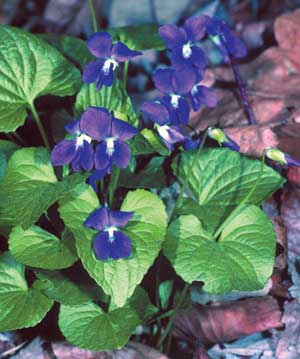
Selkirk's violet has hairy, heart-shaped leaves and violet-colored flowers that lack beards. Its flowers can reach 1.5 centimeters in width.[1][2][3]
Each flower has a spur that can reach 7 millimeters in length. The fruit capsules can reach 6 millimeters in width.[4][5]
Habitat
Selkirk's violet occupies moist, shady and cool habitats. In North America, it is mostly found in forests and also occurs in cold mountain forests, moist woods and thickets.[6][7][8]
It often grows on rotting wood and appears to favor calcareous substrates such as limestone.[9][10]
Reproduction and life cycle
Selkirk's violet flowers between April and July.[11]
The species forcefully ejects mature seeds from its fruit capsules. Ants collect the ejected seeds and contribute to their dispersal.[12][13]
Conservation
Although Selkirk's violet is not generally rare, it is considered imperiled in some regions, mainly near the periphery of its range.[14]
The species is considered imperiled in Colorado, Connecticut, Montana, Pennsylvania and South Dakota. Connecticut lists it as a special concern species.[15][16]
Similar species
Selkirk's violet may be confused with the hookedspur violet and the common blue violet. Its relatively large flower spur distinguishes it from some related violets.[17][18]
Classification of the Selkirk's Violet
| Kingdom | Plantae |
|---|---|
| Subkingdom | Pteridobiotina |
| Phylum | Tracheophyta |
| Class | Magnoliopsida |
| Order | Malpighiales |
| Family | Violaceae (Violet Family) |
| Subfamily | Violoideae |
| Genus | Viola (Violets) |
| Species | Viola selkirkii Pursh ex Goldie |
Where the Selkirk's Violet is found
Checklists and occurrence records place Viola selkirkii in 14 countries across Asia, Europe and North America. GBIF holds 13,532 georeferenced records of it.
Countries
- Canada 888
- China 335
- Estonia 22
- Finland 2,605
- Greenland 51
- Japan 1,272
- Kazakhstan 6
- Mongolia 2
- North Korea 48
- Norway 878
- Russia 3,253
- South Korea 1,057
- Sweden 1,755
- United States 1,360
Regions and cities with the most records
- Västernorrland, Sweden 777
- Sundsvall, Sweden 410
- Quebec, Canada 339
- Buryatiya Republic, Russia 305
- Irkutsk Oblast, Russia 281
- Hokkaido, Japan 246
- Kostroma Oblast, Russia 246
- Gangwon-do, South Korea 233
- Iwate, Japan 198
- Primorye, Russia 192
- Buskerud, Norway 182
- Sverdlovsk Oblast, Russia 171
- Dalarna, Sweden 167
- Moscow Oblast, Russia 150
- Lapland, Finland 142
- Ontario, Canada 128
- Norrbotten, Sweden 122
- Kangasala, Finland 117
- Usol’ye-Sibirskoye, Russia 116
- Vermont, United States 114
- Kamchatka, Russia 112
- Kuopio, Finland 109
- Sakhalin Oblast, Russia 109
- Siilinjärvi, Finland 107
- Valkeakoski, Finland 104
- Gävleborg, Sweden 101
- Jämtland, Sweden 101
- Hämeenlinna, Finland 99
- Novosibirsk Oblast, Russia 95
- Nagano, Japan 94
- Gyeongsangbuk-do, South Korea 86
- Vladimir Oblast, Russia 83
- Yekaterinburg, Russia 83
- Oslo, Norway 81
- Komi, Russia 80
- Tampere, Finland 80
Range as the checklists state it
Norway; Sweden; Finland; Estonia; C-European Russia; N-European Russia; Siberia (Altay, Buryatia, Chita, Irkutsk, Krasnoyarsk, Tuva, W-Siberia); Russian Far East (Upper Amur, Kamchatka, Khabarovsk, Kuril Isl., Magadan, Primorye, Sakhalin); Kazakhstan; Northern Caucasus; China (Anhui, Hebei, Heilongjiang, ?Henan, ?Hubei, Jilin, Liaoning, Nei Mongol, ?Shaanxi, Shandong, ?Shanxi, Sichuan); Mongolia; North Korea; South Korea; Japan (Hokkaido, Honshu, Shikoku); Alaska; Greenland; Canada (Alberta, British Columbia, Labrador, Manitoba, New Brunswick, Newfoundland, Nova Scotia, ?Northern Territories, ?Nunavut, Ontario, Québec, Saskatchewan, Yukon); USA (Colorado, Connecticut, Massachusetts, Maine, Michigan, Minnesota, Montana, New Hampshire, New Mexico, New York, Ohio, Pennsylvania, South Dakota, Vermont, Washington State, Wisconsin)
A number beside a place is its count of GBIF occurrence records. A place without a number comes from a checklist alone. Records show where a species has been observed or collected, which can include escapes and vagrants.
Common names
English
- Selkirk's Violet
- Great-spur Violet
- Great-spurred Violet
- Long-spurred Violet
Names in 6 other languages
- Finnish
- kaiheorvokki
- French
- violette de Selkirk
- Japanese
- miyama-sumire
- Northern Sami
- itkoviola
- Norwegian Bokmål
- dalfiol
- Swedish
- dalviol, skuggviol
Synonyms
23 other scientific names have been used for this species and are now treated as synonyms of Viola selkirkii.
- Viola borealis Weinm.
- Viola carnosula W.Becker
- Viola imberbis Ledeb.
- Viola kamtschatica Ging.
- Viola kamtschatica var. glabra Regel
- Viola kamtschatica var. kamtschatica
- Viola kamtschatica var. umbrosa (Fr.) Regel
- Viola salina Turcz.
- Viola selkirkii f. alba Tatew.
- Viola selkirkii f. albiflora (Nakai) F.Maek.
- Viola selkirkii f. subglabra (W.Becker) F.Maek.
- Viola selkirkii f. variegata (Nakai) F.Maek.
- Viola selkirkii var. albiflora Nakai
- Viola selkirkii var. angustistipulata W.Becker
- Viola selkirkii var. brevicalcarata (W.Becker) W.Becker
- Viola selkirkii var. glabrescens W.Becker & Hultén
- Viola selkirkii var. okudana Okuyama
- Viola selkirkii var. subbarbata W.Becker
- Viola selkirkii var. subglabra W.Becker
- Viola selkirkii var. variegata Nakai
- Viola erecta H.M.Myers ambiguous synonym
- Viola hirta var. umbrosa Wahlenb. ambiguous synonym
- Viola umbrosa (Wahlenb.) Fr. ambiguous synonym
Related species
-
 Sweet VioletViola odorata
-
 Wild PansyViola tricolor
-
 North American Common Blue VioletViola sororia
-
 Australian VioletViola hederacea
-
 Common Dog-VioletViola riviniana
-
 Horned PansyViola cornuta
-
 Native VioletViola banksii
-
 Manchurian VioletViola mandshurica
Compare
Questions and answers
What is the scientific name of the Selkirk's Violet?
The scientific name of the Selkirk's Violet is Viola selkirkii. Written with its author, the full name is Viola selkirkii Pursh ex Goldie.
Which family does the Selkirk's Violet belong to?
Viola selkirkii belongs to the family Violaceae, in the order Malpighiales and the class Magnoliopsida.
Where is the Selkirk's Violet found?
Checklists and occurrence records place Viola selkirkii in 14 countries, including Russia, Finland, Sweden, United States, Japan and South Korea.
What other names does the Selkirk's Violet have?
Viola selkirkii is also known in English as Great-spur Violet, Great-spurred Violet and Long-spurred Violet.
Sources
Passages the profile rests on
- Viola selkirkii is a perennial herb with rhizomes and hairy, heart-shaped leaves. Source passage: “This species is a rhizomatous perennial herb with hairy, heart-shaped leaves.” — English Wikipedia
- The flowers are violet-colored and lack beards. Source passage: “The flowers are up to 1.5 centimeters wide and are violet in color. They lack the beards that some other violets have.” — English Wikipedia
- The flowers can reach 1.5 centimeters in width. Source passage: “The flowers are up to 1.5 centimeters wide” — English Wikipedia
- Each flower has a spur that can reach 7 millimeters in length. Source passage: “Each flower has a spur up to 7 millimeters long.” — English Wikipedia
- The fruit capsules can reach 6 millimeters in width. Source passage: “The fruit is a capsule up to 6 millimeters wide.” — English Wikipedia
- The species occupies moist, shady and cool habitats. Source passage: “The plant occupies many types of moist, shady, cool habitat.” — English Wikipedia
- In North America, the species is mostly found in forests. Source passage: “In North America it is mostly found in forests.” — English Wikipedia
- The species occurs in cold mountain forests, moist woods and thickets. Source passage: “Habitat: Cold mountain forests; moist woods and thickets.” — cnhp.colostate.edu
- The species often grows on rotting wood. Source passage: “Like many other violets it often grows on rotting wood.” — English Wikipedia
- The species appears to favor calcareous substrates such as limestone. Source passage: “It also seems to favor calcareous substrates such as limestone.” — English Wikipedia
- The species flowers between April and July. Source passage: “Flowering occurs between April and July.” — English Wikipedia
- The species forcefully ejects mature seeds from its fruit capsules. Source passage: “this species forcefully ejects its mature seeds from the fruit capsules.” — English Wikipedia
- Ants collect the ejected seeds and contribute to their dispersal. Source passage: “Ants then pick up the seeds and aid in their dispersal.” — English Wikipedia
- Although the species is not generally rare, it is considered imperiled in some regions, mainly near the periphery of its range. Source passage: “While the plant is not rare in general, it is considered to be an imperiled species in some regions, mainly on the periphery of its range” — English Wikipedia
- The species is considered imperiled in Colorado, Connecticut, Montana, Pennsylvania and South Dakota. Source passage: “including the US states of Colorado, Connecticut (where it is listed as a special concern species) Montana, Pennsylvania, and South Dakota.” — English Wikipedia
- Connecticut lists the species as a special concern species. Source passage: “Connecticut (where it is listed as a special concern species)” — English Wikipedia
- The species may be confused with the hookedspur violet and the common blue violet. Source passage: “In some regions this violet may be confused with its relatives, the hookedspur violet (V. adunca) and the common blue violet (V. sororia).” — English Wikipedia
- The relatively large flower spur distinguishes this species from some related violets. Source passage: “Its relatively large spur is a good distinguishing characteristic.” — English Wikipedia
Data
- Catalogue of Life, 2026-10-16 XR cc by
- Global Biodiversity Information Facility CC BY 4.0
- Wikidata CC0
- GeoNames CC BY 4.0
- Wikimedia Commons per image; credit shown with each image
- Within the Catalogue of Life, this name comes from Synonymic Checklists of the Vascular Plants of the World cc by
References
- Pursh ex Goldie. (1822). Edinburgh Philos. J. 6: 324 (1822). where the name was published
This species in other databases
Page built on 27 November 2026. See how the catalog is made and all sources and licences.
Cite this page
ScientificNames.org. (2026). Viola selkirkii (Selkirk's Violet). Retrieved November 27, 2026, from https://scientificnames.org/species/viola-selkirkii
“Viola selkirkii (Selkirk's Violet).” ScientificNames.org, 2026, scientificnames.org/species/viola-selkirkii. Accessed 27 Nov. 2026.
ScientificNames.org. “Viola selkirkii (Selkirk's Violet).” Accessed November 27, 2026. https://scientificnames.org/species/viola-selkirkii.
@misc{scientificnames_viola_selkirkii_selkirks_violet,
  author = {{ScientificNames.org}},
  title = {Viola selkirkii (Selkirk's Violet)},
  year = {2026},
  url = {https://scientificnames.org/species/viola-selkirkii},
  note = {Accessed 2026-11-27}
}