Species · Flowering plants
Three-part Violet Viola tripartita
The scientific name of the Three-part Violet is Viola tripartita. It is a species of flowering plant in the family Violaceae (violet family), order Malpighiales.
- Scientific name
- Viola tripartita Elliott
- Common name
- Three-part Violet
- Genus
- Viola
- Family
- Violaceae (Violet Family)
- Order
- Malpighiales
- Class
- Magnoliopsida
- Recorded in
- 1 country
- Name status
- accepted in the Catalogue of Life

Overview
Viola tripartita is native to Eastern North America and occurs primarily in the Southern Appalachian Mountains. It produces yellow flowers in spring and has leaves wider than they are long, with wedge-shaped bases.
Written 27 November 2026 from the sources listed below. Each statement was checked against the passage it cites; statements that could not be supported were removed.
Appearance
The three-part violet produces yellow flowers in spring. Its leaves are wider than they are long and have wedge-shaped bases.[1][2]
Habitat
The three-part violet primarily inhabits rich, mesic forests growing over calcareous rocks.[3]
Classification of the Three-part Violet
| Kingdom | Plantae |
|---|---|
| Subkingdom | Pteridobiotina |
| Phylum | Tracheophyta |
| Class | Magnoliopsida |
| Order | Malpighiales |
| Family | Violaceae (Violet Family) |
| Subfamily | Violoideae |
| Genus | Viola (Violets) |
| Species | Viola tripartita Elliott |
Where the Three-part Violet is found
Checklists and occurrence records place Viola tripartita in 1 country across North America. GBIF holds 709 georeferenced records of it.
Countries
Regions and cities with the most records
- Georgia, United States 81
- South Carolina, United States 25
- Tennessee, United States 24
- Alabama, United States 19
- Athens, United States 19
- East Chattanooga, United States 14
- Chattanooga, United States 13
- East Ridge, United States 12
- North Carolina, United States 11
- Conyers, United States 10
- Redan, United States 10
- Chamblee, United States 9
- North Druid Hills, United States 9
- Stonecrest, United States 9
- Belvedere Park, United States 8
- Brookhaven, United States 8
- Candler-McAfee, United States 8
- Clemson, United States 8
- Decatur, United States 8
- East Brainerd, United States 8
- North Decatur, United States 8
- Tucker, United States 8
- Asheville, United States 7
- Norcross, United States 7
- Snellville, United States 7
- Anderson, United States 4
- Peachtree Corners, United States 4
- Smyrna, United States 4
- Atlanta, United States 3
- Dunwoody, United States 3
- Johnson City, United States 3
- Lawrenceville, United States 3
- Lithia Springs, United States 3
- Lost Mountain, United States 3
- Mableton, United States 3
- McDonough, United States 3
Range as the checklists state it
USA (Alabama, Florida, Georgia, Kentucky, Maryland, Mississippi, North Carolina, Ohio, Pennsylvania, South Carolina, Tennessee, West Virginia)
A number beside a place is its count of GBIF occurrence records. A place without a number comes from a checklist alone. Records show where a species has been observed or collected, which can include escapes and vagrants.
Common names
English
- Three-part Violet
- Three-part VViolet
- Three-parted Yellow Violet
Synonyms
3 other scientific names have been used for this species and are now treated as synonyms of Viola tripartita.
- Viola hastata var. tripartita (Elliott) A.Gray
- Viola tripartita f. tripartita
- Viola tripartita var. tripartita
Related species
-
 Sweet VioletViola odorata
-
 Wild PansyViola tricolor
-
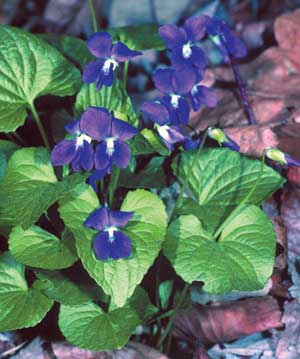 North American Common Blue VioletViola sororia
-
 Australian VioletViola hederacea
-
 Common Dog-VioletViola riviniana
-
 Horned PansyViola cornuta
-
 Native VioletViola banksii
-
 Manchurian VioletViola mandshurica
Compare
Questions and answers
What is the scientific name of the Three-part Violet?
The scientific name of the Three-part Violet is Viola tripartita. Written with its author, the full name is Viola tripartita Elliott.
Which family does the Three-part Violet belong to?
Viola tripartita belongs to the family Violaceae, in the order Malpighiales and the class Magnoliopsida.
Where is the Three-part Violet found?
Checklists and occurrence records place Viola tripartita in 1 country: United States.
What other names does the Three-part Violet have?
Viola tripartita is also known in English as Three-part VViolet and Three-parted Yellow Violet.
Sources
Passages the profile rests on
- The species produces yellow flowers in spring. Source passage: “that has yellow flowers in the spring.” — English Wikipedia
- Its leaves are wider than they are long and have wedge-shaped bases. Source passage: “leaves that are wider than long which have a cuneate base.” — English Wikipedia
- The species primarily inhabits rich, mesic forests growing over calcareous rocks. Source passage: “Its preferred habitat is rich, mesic forests over calcareous rocks.” — English Wikipedia
Data
- Catalogue of Life, 2026-10-16 XR cc by
- Global Biodiversity Information Facility CC BY 4.0
- Wikidata CC0
- GeoNames CC BY 4.0
- Wikimedia Commons per image; credit shown with each image
- Within the Catalogue of Life, this name comes from Synonymic Checklists of the Vascular Plants of the World cc by
References
- Elliott. (1817). Sketch Bot. S. Carolina [Elliott] 1: 302 (1817). where the name was published
This species in other databases
- Catalogue of Life 7G3S3
- Wikidata Q16736008
- iNaturalist 1470747
- World Flora Online wfo-0001144704
- GRIN 430542
Page built on 27 November 2026. See how the catalog is made and all sources and licences.
Cite this page
ScientificNames.org. (2026). Viola tripartita (Three-part Violet). Retrieved November 27, 2026, from https://scientificnames.org/species/viola-tripartita
“Viola tripartita (Three-part Violet).” ScientificNames.org, 2026, scientificnames.org/species/viola-tripartita. Accessed 27 Nov. 2026.
ScientificNames.org. “Viola tripartita (Three-part Violet).” Accessed November 27, 2026. https://scientificnames.org/species/viola-tripartita.
@misc{scientificnames_viola_tripartita_three_part_violet,
  author = {{ScientificNames.org}},
  title = {Viola tripartita (Three-part Violet)},
  year = {2026},
  url = {https://scientificnames.org/species/viola-tripartita},
  note = {Accessed 2026-11-27}
}