Species · Birds
Lesser Woodcreeper Xiphorhynchus fuscus
The scientific name of the Lesser Woodcreeper is Xiphorhynchus fuscus. It is a species of bird in the family Furnariidae (ovenbird), order Passeriformes. The name dates from 1818.
- Scientific name
- Xiphorhynchus fuscus (Vieillot, 1818)
- Common name
- Lesser Woodcreeper
- Genus
- Xiphorhynchus
- Family
- Furnariidae (Ovenbird)
- Order
- Passeriformes
- Class
- Aves
- Red List category
- LC Least Concern
- Recorded in
- 3 countries
- Name status
- accepted in the Catalogue of Life
Overview
The Lesser Woodcreeper (Xiphorhynchus fuscus) is a bird in the family Furnariidae, order Passeriformes, and class Aves. The species occurs in Argentina, Brazil, and Paraguay.
Written 27 November 2026 from the sources listed below. Each statement was checked against the passage it cites; statements that could not be supported were removed.
Appearance
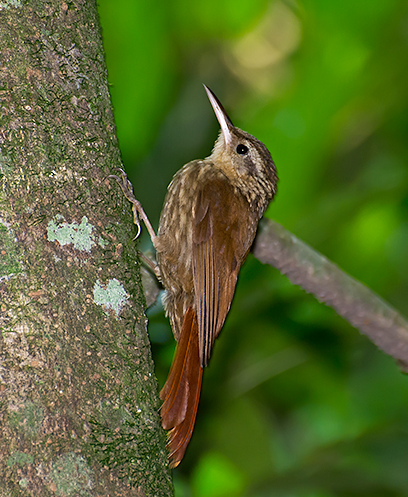
Adults of the nominate subspecies have a mostly dusky face with a wide creamy to yellowish-buff supercilium. The crown and nape are blackish-brown with small yellowish-buff to cinnamon spots.[1][2]
The back and wing coverts are olive-brown to reddish-brown. The flight feathers, rump, and tail are rufous-chestnut.[3][4]
The throat is plain creamy yellow, while the breast and belly are smoky brown with a scaly appearance created by dark-edged buff spots.[5][6]
The iris is dark brown, and the legs and feet are olive-gray to bluish gray.[7][8]
Juveniles have less pronounced spotting on their underparts than adults.[9]
The Lesser Woodcreeper measures 15 to 18.5 cm in length and weighs 15.5 to 25 g. The X. f. tenuirostris subspecies is larger than the nominate subspecies.[10][11][12]
Habitat
The species inhabits lowland rainforests and humid montane forests across much of its range. In inland areas, it occupies dry semi-deciduous forests and gallery forests.[13][14]
In the southern part of its range, the species occurs in forests dominated by Araucaria. It favors the interiors and edges of primary forests and mature secondary forests.[15][16]
The species mostly occurs below 1,200 m elevation but has been recorded as high as 1,500 m and possibly higher. It occurs in a variety of forest habitats.[17][18]
Diet
The Lesser Woodcreeper's diet consists predominantly, and possibly exclusively, of arthropods.[19]
Behaviour
The species forages alone and in mixed-species feeding flocks with approximately equal frequency. It also regularly follows mixed-species flocks.[20][21]
The species follows army ant swarms less frequently than it forages alone or in mixed-species flocks.[22]
The species forages mainly on tree trunks but also uses branches. Its foraging usually takes place from the understory to the middle levels of the forest, occasionally extending to the canopy.[23][24]
The species favors trees with rough bark, often covered with moss rather than lichen. It frequently searches for prey in dead leaf clusters and dead bromeliads.[25][26]
The species obtains most prey by gleaning and pecking while perched on trees.[27]
The species is believed to remain resident throughout its range throughout the year. Fluctuations in its occurrence in southern Brazil might indicate local movements.[28][29]
Reproduction and life cycle
The breeding season is thought to extend from September to December. The species nests in tree cavities.[30][31]
One described nest was accessed through a natural slit and lined with dried leaves and bark chips.[32]
The usual clutch contains two eggs, although three eggs are sometimes laid. Available evidence suggests that only the female incubates the eggs.[33][34]
Conservation
The Lesser Woodcreeper is classified as Least Concern by the IUCN. Its geographic range is large, but its population size is unknown and is believed to be decreasing.[35][36]
No immediate threats to the species have been identified. It is fairly common to common across most of its Brazilian range but less common in Rio Grande do Sul, Paraguay, and Argentina.[37][38]
Classification of the Lesser Woodcreeper
| Kingdom | Animalia |
|---|---|
| Phylum | Chordata |
| Subphylum | Vertebrata |
| Infraphylum | Gnathostomata |
| Parvphylum | Osteichthyes |
| Megaclass | Tetrapoda |
| Class | Aves (Bird) |
| Order | Passeriformes (Passerine) |
| Family | Furnariidae (Ovenbird) |
| Genus | Xiphorhynchus (Woodcreepers) |
| Species | Xiphorhynchus fuscus (Vieillot, 1818) |
Where the Lesser Woodcreeper is found
Checklists and occurrence records place Xiphorhynchus fuscus in 3 countries across South America. GBIF holds 35,507 georeferenced records of it.
Countries
Regions and cities with the most records
- São Paulo, Brazil 14,772
- Rio de Janeiro, Brazil 5,968
- Santa Catarina, Brazil 4,818
- Paraná, Brazil 2,164
- Misiones, Argentina 1,926
- Minas Gerais, Brazil 1,544
- Bahia, Brazil 1,513
- Ubatuba, Brazil 1,371
- Espírito Santo, Brazil 1,302
- Guapiara, Brazil 1,301
- Barra da Tijuca, Brazil 1,203
- Cordovil, Brazil 1,178
- Rocinha, Brazil 1,165
- Estácio, Brazil 1,158
- Leblon, Brazil 1,158
- Rio de Janeiro, Brazil 1,158
- Santa Teresa, Brazil 1,158
- Vidigal, Brazil 1,158
- Botafogo, Brazil 1,157
- Catete, Brazil 1,157
- Ipanema, Brazil 1,157
- Acari, Brazil 1,150
- Cachoeiras de Macacu, Brazil 1,069
- São Pedro, Brazil 963
- Teresópolis, Brazil 959
- Cubatão, Brazil 936
- Ribeirão Pires, Brazil 906
- Niterói, Brazil 904
- Bertioga, Brazil 889
- Vila Galvão, Brazil 883
- Schroeder, Brazil 881
- Rio Grande da Serra, Brazil 875
- Mairiporã, Brazil 871
- Itatiaia, Brazil 864
- Caieiras, Brazil 854
- Franco da Rocha, Brazil 852
Range as the checklists state it
South America
A number beside a place is its count of GBIF occurrence records. A place without a number comes from a checklist alone. Records show where a species has been observed or collected, which can include escapes and vagrants.
Common names
English
- Lesser Woodcreeper
Names in 22 other languages
- Catalan
- grimpatroncs menut
- Chinese
- 小䴕雀, 小爬木雀
- Croatian
- tankokljuna puzavica
- Czech
- klouzálek menší
- Danish
- Lille Trækryber
- Dutch
- Kleine Muisspecht
- Esperanto
- eta trunkogrimpulo
- Finnish
- valkokaulakipuaja
- French
- Grimpar brun
- German
- Blasskehl-Baumsteiger, Blasskehlbaumsteiger, Zwergbaumsteiger
- Italian
- Rampicatore minore
- Japanese
- ヒメウロコオニキバシリ
- Lithuanian
- mažasis kalavijasnapis kopikas
- Norwegian
- småtreløper
- Polish
- mieczonos mały
- Portuguese
- arapaçu-rajado, trepa-troncos-anão
- Russian
- Малый древолаз, Малый чешуйчатый древолаз
- Slovak
- klzáčik drevárik
- Spanish
- Chinchero enano, Trepatroncos enano
- Swedish
- mindre trädklättrare
- Turkish
- Küçük Tırmaşık
- Ukrainian
- кокоа малий
Synonyms
2 other scientific names have been used for this species and are now treated as synonyms of Xiphorhynchus fuscus.
- Dendrocopus fuscus Vieillot, 1818
- Lepidocolaptes fuscus (Vieillot, 1818)
Subspecies and varieties
- Xiphorhynchus fuscus fuscus subspecies
- Xiphorhynchus fuscus pintoi subspecies
- Xiphorhynchus fuscus tenuirostris subspecies
Related species
-
 Ivory-billed WoodcreeperXiphorhynchus flavigaster
-
 Cocoa WoodcreeperXiphorhynchus susurrans
-
 Buff-throated WoodcreeperXiphorhynchus guttatus
-
 Spotted WoodcreeperXiphorhynchus erythropygius
-
 Black-striped WoodcreeperXiphorhynchus lachrymosus
-
 Striped WoodcreeperXiphorhynchus obsoletus
-
 Elegant WoodcreeperXiphorhynchus elegans
-
 Olive-backed WoodcreeperXiphorhynchus triangularis
Compare
Questions and answers
What is the scientific name of the Lesser Woodcreeper?
The scientific name of the Lesser Woodcreeper is Xiphorhynchus fuscus. Written with its author, the full name is Xiphorhynchus fuscus (Vieillot, 1818).
Which family does the Lesser Woodcreeper belong to?
Xiphorhynchus fuscus belongs to the family Furnariidae, in the order Passeriformes and the class Aves.
Where is the Lesser Woodcreeper found?
Checklists and occurrence records place Xiphorhynchus fuscus in 3 countries: Brazil, Argentina and Paraguay.
What is the conservation status of the Lesser Woodcreeper?
The IUCN Red List category recorded for Xiphorhynchus fuscus is Least Concern (LC).
Sources
Passages the profile rests on
- Adults of the nominate subspecies have a mostly dusky face with a wide creamy to yellowish-buff supercilium. Source passage: “Adults of the nominate subspecies have a mostly dusky face with a wide creamy to yellowish buff supercilium and often a pale eyering.” — English Wikipedia
- The nominate subspecies has a blackish-brown crown and nape marked with small yellowish-buff to cinnamon spots. Source passage: “Their crown and nape are blackish brown with small yellowish buff to cinnamon spots on the crown.” — English Wikipedia
- The nominate subspecies has olive-brown to reddish-brown back and wing coverts. Source passage: “Their back and wing coverts are olive-brown to reddish brown.” — English Wikipedia
- Its flight feathers, rump, and tail are rufous-chestnut. Source passage: “Their flight feathers, rump, and tail are rufous-chestnut with darker outer webs and tips on the flight feathers.” — English Wikipedia
- Its throat is plain creamy yellow. Source passage: “Their throat is plain creamy yellow.” — English Wikipedia
- Its breast and belly are smoky brown with a scaly appearance created by dark-edged buff spots. Source passage: “Their breast and belly are smoky brown with a bold scaly appearance from dark-edged buff spots.” — English Wikipedia
- Its iris is dark brown. Source passage: “Their iris is dark brown” — English Wikipedia
- Its legs and feet are olive-gray to bluish gray. Source passage: “their legs and feet olive-gray to bluish gray.” — English Wikipedia
- Juveniles have less pronounced spotting on their underparts than adults. Source passage: “Juveniles have weaker spotting on their underparts but are otherwise like adults.” — English Wikipedia
- The Lesser Woodcreeper measures 15 to 18.5 cm in length. Source passage: “The species is 15 to 18.5 cm (5.9 to 7.3 in) long” — English Wikipedia
- The Lesser Woodcreeper weighs 15.5 to 25 g. Source passage: “weighs 15.5 to 25 g (0.55 to 0.88 oz).” — English Wikipedia
- The X. f. tenuirostris subspecies is larger than the nominate subspecies. Source passage: “Subspecies X. f. tenuirostris is larger than the nominate” — English Wikipedia
- The species inhabits lowland rainforests and humid montane forests across much of its range. Source passage: “In much of its range it occurs in lowland rainforest and humid montane forest.” — English Wikipedia
- In inland areas, the species occupies dry semi-deciduous forests and gallery forests. Source passage: “Inland it occurs in dryer semi-deciduous and gallery forests” — English Wikipedia
- In the southern part of its range, the species occurs in forests dominated by Araucaria. Source passage: “and in the south occurs in forest dominated by Araucaria.” — English Wikipedia
- The species favors the interiors and edges of primary forests and mature secondary forests. Source passage: “It favors the interior and edges of primary forest and mature secondary forest” — English Wikipedia
- The species mostly occurs below 1,200 m elevation but has been recorded as high as 1,500 m and possibly higher. Source passage: “It mostly occurs below 1,200 m (3,900 ft) of elevation but ranges as high as 1,500 m (4,900 ft) and possibly higher.” — English Wikipedia
- The species occurs in a variety of forest habitats. Source passage: “Found in a variety of forest habitats” — ebird.org
- The Lesser Woodcreeper's diet consists predominantly, and possibly exclusively, of arthropods. Source passage: “The lesser woodcreeper's diet is predominately, and possibly exclusively, arthropods.” — English Wikipedia
- The species forages both alone and in mixed-species feeding flocks with approximately equal frequency. Source passage: “It forages alone and as part of mixed-species feeding flocks about equally” — English Wikipedia
- The species regularly follows mixed-species flocks. Source passage: “where it regularly follows mixed-species flocks.” — ebird.org
- The species follows army ant swarms less frequently than it forages alone or in mixed-species flocks. Source passage: “and less frequently follows army ant swarms.” — English Wikipedia
- The species forages mainly on tree trunks but also uses branches. Source passage: “It forages mostly on tree trunks but also on branches” — English Wikipedia
- Its foraging usually takes place from the understory to the middle levels of the forest, occasionally extending to the canopy. Source passage: “usually from the understory to the forest's mid-level but sometimes all the way to the canopy.” — English Wikipedia
- The species favors trees with rough bark, often covered with moss rather than lichen. Source passage: “It favors trees with rough bark, often with moss rather than lichen cover” — English Wikipedia
- The species frequently searches for prey in dead leaf clusters and dead bromeliads. Source passage: “and does much of its foraging in dead leaf clusters and dead bromeliads.” — English Wikipedia
- The species obtains most prey by gleaning and pecking while perched on trees. Source passage: “It mostly takes prey by gleaning and pecking while on a tree” — English Wikipedia
- The species is believed to remain resident throughout its range throughout the year. Source passage: “The lesser woodcreeper is believed to be a year-round resident throughout its range.” — English Wikipedia
- Fluctuations in its occurrence in southern Brazil might indicate local movements. Source passage: “However, fluctuations in occurrence in southern Brazil might indicate some local movements.” — English Wikipedia
- The breeding season is thought to extend from September to December. Source passage: “The lesser woodcreeper's breeding season is thought to be September to December.” — English Wikipedia
- The species nests in tree cavities. Source passage: “It nests in tree cavities;” — English Wikipedia
- One described nest was accessed through a natural slit and lined with dried leaves and bark chips. Source passage: “the one well-described nest was through a natural slit and was lined with dried leaves and bark chips.” — English Wikipedia
- The usual clutch contains two eggs, although three eggs are sometimes laid. Source passage: “The clutch is usually two eggs and sometimes three.” — English Wikipedia
- Available evidence suggests that only the female incubates the eggs. Source passage: “though evidence suggests that only the female incubates.” — English Wikipedia
- The Lesser Woodcreeper is classified as Least Concern by the IUCN. Source passage: “Xiphorhynchus fuscus is listed as Least Concern.” — iucnredlist.org
- The species has a large geographic range, but its population size is unknown and is believed to be decreasing. Source passage: “It has a large range but its population size is not known and is believed to be decreasing.” — English Wikipedia
- No immediate threats to the species have been identified. Source passage: “No immediate threats have been identified.” — English Wikipedia
- The species is fairly common to common across most of its Brazilian range but less common in Rio Grande do Sul, Paraguay, and Argentina. Source passage: “It is considered fairly common to common in most of its Brazilian range but less so in Rio Grande do Sul, Paraguay, and Argentina.” — English Wikipedia
Data
- Catalogue of Life, 2026-10-16 XR cc by
- Global Biodiversity Information Facility CC BY 4.0
- Wikidata CC0
- GeoNames CC BY 4.0
- Wikimedia Commons per image; credit shown with each image
- Within the Catalogue of Life, this name comes from The Integrated Taxonomic Information System cc0
References
- Gill, Frank, & and Minturn Wright. (2006). Birds of the World: Recommended English Names.
This species in other databases
Page built on 28 November 2026. See how the catalog is made and all sources and licences.
Cite this page
ScientificNames.org. (2026). Xiphorhynchus fuscus (Lesser Woodcreeper). Retrieved November 28, 2026, from https://scientificnames.org/species/xiphorhynchus-fuscus
“Xiphorhynchus fuscus (Lesser Woodcreeper).” ScientificNames.org, 2026, scientificnames.org/species/xiphorhynchus-fuscus. Accessed 28 Nov. 2026.
ScientificNames.org. “Xiphorhynchus fuscus (Lesser Woodcreeper).” Accessed November 28, 2026. https://scientificnames.org/species/xiphorhynchus-fuscus.
@misc{scientificnames_xiphorhynchus_fuscus_lesser_woodcreeper,
  author = {{ScientificNames.org}},
  title = {Xiphorhynchus fuscus (Lesser Woodcreeper)},
  year = {2026},
  url = {https://scientificnames.org/species/xiphorhynchus-fuscus},
  note = {Accessed 2026-11-28}
}