Species · Birds
Cocoa Woodcreeper Xiphorhynchus susurrans
The scientific name of the Cocoa Woodcreeper is Xiphorhynchus susurrans. It is a species of bird in the family Furnariidae (ovenbird), order Passeriformes. The name dates from 1847.
- Scientific name
- Xiphorhynchus susurrans (Jardine, 1847)
- Common name
- Cocoa Woodcreeper
- Genus
- Xiphorhynchus
- Family
- Furnariidae (Ovenbird)
- Order
- Passeriformes
- Class
- Aves
- Red List category
- LC Least Concern
- Recorded in
- 8 countries
- Name status
- accepted in the Catalogue of Life

Overview
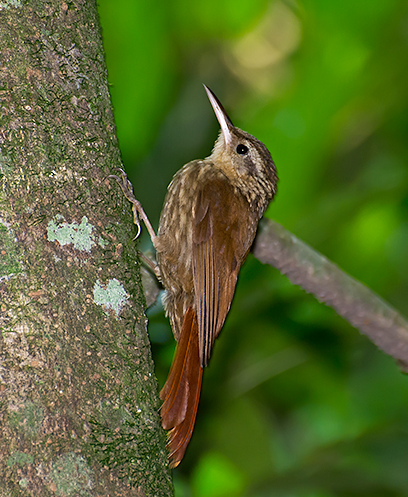
The Cocoa Woodcreeper (Xiphorhynchus susurrans) is a bird in the family Furnariidae, order Passeriformes, and class Aves. It occurs in Colombia, Costa Rica, Guatemala, Honduras, Nicaragua, Panama, Trinidad and Tobago, and Venezuela. It has a long, fairly heavy bill that curves slightly downward, and male and female birds have the same plumage.
Written 26 November 2026 from the sources listed below. Each statement was checked against the passage it cites; statements that could not be supported were removed.
Appearance
The Cocoa Woodcreeper measures 21–25.5 cm in length and weighs 43–58 g. Its bill is long, fairly heavy, and curves slightly downward.[1][2][3]
Male and female Cocoa Woodcreepers have the same plumage. Adult nominate-subspecies birds have a mostly dusky face with buff streaks and a whitish supercilium, while the crown and nape are dark brown to blackish with elongated buff spots.[4][5][6]
The nominate subspecies has olive-brown to brown upper back and wing coverts, with a rufous-chestnut lower back, rump, tail, and flight feathers. Its throat is whitish to pale buff with thin black scaling, and its breast, sides, and belly are reddish-brown, with redder undertail coverts.[7][8][9][10]
Juveniles are darker overall than adults and have shorter, blacker bills.[11]
Habitat
The Cocoa Woodcreeper primarily inhabits humid evergreen forest. It favors gallery forest, deciduous woodland, and the edges of primary and mature secondary forest.[12][13]
It occurs less frequently in young secondary forest, plantations, and open areas with scattered trees. It also inhabits mangroves along some coasts and arid scrub on Isla Margarita.[14][15][16]
The species generally occurs below 900 m elevation. In Colombia it reaches 1,600 m, and in Venezuela it occasionally occurs at 2,400 m.[17][18][19]
Diet
The Cocoa Woodcreeper feeds primarily on arthropods. It occasionally eats small vertebrates, including frogs and lizards.[20][21]
Behaviour
The Cocoa Woodcreeper usually forages alone but also joins mixed-species feeding flocks. It follows army ant swarms while foraging.[22][23]
When foraging with mixed-species flocks, it usually feeds in the middle levels of the forest. Away from army ant swarms, it climbs tree trunks, often in a spiral, and searches along branch undersides.[24][25]
The species obtains most prey by gleaning bark crevices and probing dead leaves, epiphytes, moss clumps, and knotholes. It sometimes pecks at rotting wood or flakes off bark while foraging.[26][27]
The Cocoa Woodcreeper remains in its range throughout the year. During the breeding season, it sings for extended periods at dawn and dusk.[28][29]
Reproduction and life cycle
The breeding season generally occurs between May and August. The Cocoa Woodcreeper primarily nests in natural cavities but sometimes uses human structures.[30][31]
The species adds bark fragments, wood chips, and softer plant material to its nest cavity. The documented clutch size is two eggs.[32][33]
The incubation period lasts 19–20 days, and nestlings take at least 17 days from hatching to fledging. The female appears to be the sole incubator and caregiver of nestlings.[34][35][36]
Conservation
The IUCN classifies the Cocoa Woodcreeper as Least Concern. Its estimated population is at least 500,000 mature individuals, and the mature population is believed to be decreasing.[37][38][39]
No immediate threats to the Cocoa Woodcreeper have been identified. The IUCN Red List most recently assessed the species in 2020.[40][41]
Similar species
The Cocoa Woodcreeper was formerly classified as part of the Buff-throated Woodcreeper. The two form a superspecies.[42][43]
Classification of the Cocoa Woodcreeper
| Kingdom | Animalia |
|---|---|
| Phylum | Chordata |
| Subphylum | Vertebrata |
| Infraphylum | Gnathostomata |
| Parvphylum | Osteichthyes |
| Megaclass | Tetrapoda |
| Class | Aves (Bird) |
| Order | Passeriformes (Passerine) |
| Family | Furnariidae (Ovenbird) |
| Genus | Xiphorhynchus (Woodcreepers) |
| Species | Xiphorhynchus susurrans (Jardine, 1847) |
Where the Cocoa Woodcreeper is found
Checklists and occurrence records place Xiphorhynchus susurrans in 8 countries across North America and South America. GBIF holds 136,264 georeferenced records of it.
Countries
- Colombia 19,211
- Costa Rica 60,994
- Guatemala 5
- Honduras 1,138
- Nicaragua 636
- Panama 41,756
- Trinidad and Tobago 4,872
- Venezuela 7,652
Regions and cities with the most records
- Puntarenas Province, Costa Rica 25,626
- Alcalde Díaz, Panama 21,623
- Chilibre, Panama 19,090
- Panamá, Panama 12,923
- Colón, Panama 12,294
- Heredia Province, Costa Rica 11,597
- Panama City, Panama 10,254
- Curundú, Panama 9,787
- Ancón, Panama 9,489
- San Miguelito, Panama 9,409
- Arraiján, Panama 9,379
- Limón Province, Costa Rica 7,506
- Alajuela Province, Costa Rica 7,428
- Veracruz, Panama 6,147
- Juan Díaz, Panama 5,799
- Coclé, Panama 4,919
- Turrialba, Costa Rica 4,642
- Cartago Province, Costa Rica 4,362
- Panamá Oeste Province, Panama 3,965
- San José, Costa Rica 3,662
- Caldas Department, Colombia 3,608
- Darién, Panama 3,348
- Antioquia, Colombia 3,258
- Chinchiná, Colombia 2,961
- Valle del Cauca Department, Colombia 2,812
- Villamaría, Colombia 2,754
- Manizales, Colombia 2,723
- Tocumen, Panama 2,720
- Neira, Colombia 2,695
- Magdalena Department, Colombia 2,571
- Paradise, Trinidad and Tobago 2,511
- Arima, Trinidad and Tobago 2,485
- Tunapuna, Trinidad and Tobago 2,466
- Tunapuna/Piarco, Trinidad and Tobago 2,303
- Baruta, Venezuela 2,102
- El Hatillo, Venezuela 2,102
Range as the checklists state it
Middle America
South America
Caribbean
A number beside a place is its count of GBIF occurrence records. A place without a number comes from a checklist alone. Records show where a species has been observed or collected, which can include escapes and vagrants.
Common names
English
- Cocoa Woodcreeper
Names in 24 other languages
- Catalan
- grimpatroncs del cacau
- Chinese
- 可可亞爬木雀, 可岛䴕雀
- Croatian
- maslinastotrba puzavica
- Czech
- klouzálek kakaový
- Danish
- Cocoatrækryber, Kakaotrækryber
- Dutch
- Cocoamuisspecht
- Esperanto
- kakaa trunkogrimpulo
- Finnish
- kaakaokipuaja
- French
- Grimpar cacao
- German
- Kakaobaumsteiger, Kleiner Fahlkehl-Baumsteiger
- Hungarian
- kakaó fahágó
- Italian
- Rampicatore cioccolato
- Japanese
- ココアオニキバシリ
- Lithuanian
- rusvasis kalavijasnapis kopikas
- Norwegian
- kakaotreløper
- Polish
- mieczonos namorzynowy
- Portuguese
- arapaçu-cacau, arapaçu-do-cacao, trepa-troncos-cacau
- Russian
- Мечеклювый древолаз
- Serbian
- Kakao puzavica
- Slovak
- klzáčik mravčí
- Spanish
- Trepador Gorgianteado, Trepatroncos Cacao
- Swedish
- kakaoträdklättrare
- Turkish
- Kakao Tırmaşığı
- Ukrainian
- кокоа північний
Synonyms
2 other scientific names have been used for this species and are now treated as synonyms of Xiphorhynchus susurrans.
- Dendrocolaptes susurrans Jardine, 1847
- Xiphorhynchus guttatus susurrans Jardine, W, 1847
Subspecies and varieties
- Xiphorhynchus susurrans confinis subspecies
- Xiphorhynchus susurrans costaricensis subspecies
- Xiphorhynchus susurrans jardinei subspecies
- Xiphorhynchus susurrans margaritae (Margarita Cocoa Woodcreeper) subspecies
- Xiphorhynchus susurrans marginatus subspecies
- Xiphorhynchus susurrans nana subspecies
- Xiphorhynchus susurrans rosenbergi subspecies
- Xiphorhynchus susurrans susurrans subspecies
Related species
-
 Ivory-billed WoodcreeperXiphorhynchus flavigaster
-
 Buff-throated WoodcreeperXiphorhynchus guttatus
-
 Spotted WoodcreeperXiphorhynchus erythropygius
-
 Black-striped WoodcreeperXiphorhynchus lachrymosus
-
 Lesser WoodcreeperXiphorhynchus fuscus
-
 Striped WoodcreeperXiphorhynchus obsoletus
-
 Elegant WoodcreeperXiphorhynchus elegans
-
 Olive-backed WoodcreeperXiphorhynchus triangularis
Compare
Questions and answers
What is the scientific name of the Cocoa Woodcreeper?
The scientific name of the Cocoa Woodcreeper is Xiphorhynchus susurrans. Written with its author, the full name is Xiphorhynchus susurrans (Jardine, 1847).
Which family does the Cocoa Woodcreeper belong to?
Xiphorhynchus susurrans belongs to the family Furnariidae, in the order Passeriformes and the class Aves.
Where is the Cocoa Woodcreeper found?
Checklists and occurrence records place Xiphorhynchus susurrans in 8 countries, including Costa Rica, Panama, Colombia, Venezuela, Trinidad and Tobago and Honduras.
What is the conservation status of the Cocoa Woodcreeper?
The IUCN Red List category recorded for Xiphorhynchus susurrans is Least Concern (LC).
Sources
Passages the profile rests on
- The Cocoa Woodcreeper measures 21–25.5 cm in length. Source passage: “The cocoa woodcreeper is 21 to 25.5 cm (8.3 to 10 in) long” — English Wikipedia
- The Cocoa Woodcreeper weighs 43–58 g. Source passage: “weighs 43 to 58 g (1.5 to 2.0 oz).” — English Wikipedia
- The Cocoa Woodcreeper has a long, fairly heavy bill that curves slightly downward. Source passage: “with a long, fairly heavy, slightly decurved bill.” — English Wikipedia
- Male and female Cocoa Woodcreepers have the same plumage. Source passage: “The sexes have the same plumage.” — English Wikipedia
- Adult nominate-subspecies birds have a mostly dusky face with buff streaks and a whitish supercilium. Source passage: “Adults of the nominate subspecies X. s. susurrans have a mostly dusky face with buff streaks and a whitish supercilium.” — English Wikipedia
- Adult nominate-subspecies birds have a dark brown to blackish crown and nape marked with elongated buff spots. Source passage: “Their crown and nape are dark brown to blackish with longish buff spots” — English Wikipedia
- The nominate subspecies has olive-brown to brown upper back and wing coverts. Source passage: “Their upper back and wing coverts are olive-brown to brown” — English Wikipedia
- The nominate subspecies has a rufous-chestnut lower back, rump, tail, and flight feathers. Source passage: “Their lower back, rump, tail, and flight feathers are rufous-chestnut” — English Wikipedia
- The nominate subspecies has a whitish to pale buff throat with thin black scaling. Source passage: “Their throat is whitish to pale buff with thin black scaling.” — English Wikipedia
- The nominate subspecies has reddish-brown breast, sides, and belly, with redder undertail coverts. Source passage: “Their breast, sides, and belly are reddish brown that becomes redder on the undertail coverts.” — English Wikipedia
- Juveniles are darker overall than adults and have shorter, blacker bills. Source passage: “Juveniles are overall darker than adults and have a shorter and blacker bill” — English Wikipedia
- The Cocoa Woodcreeper primarily inhabits humid evergreen forest. Source passage: “The cocoa woodcreeper mostly inhabits humid evergreen forest.” — English Wikipedia
- The species favors gallery forest, deciduous woodland, and edges of primary and mature secondary forest. Source passage: “It favors landscapes like gallery forest, deciduous woodland, and the edges of primary forest and mature secondary forest.” — English Wikipedia
- The species occurs less frequently in young secondary forest, plantations, and open areas with scattered trees. Source passage: “It occurs less in the interior of primary forest, in young secondary forest, in plantations, and in open areas with scattered trees.” — English Wikipedia
- The Cocoa Woodcreeper inhabits mangroves along some coasts. Source passage: “It occurs in magroves along some coasts” — English Wikipedia
- On Isla Margarita, the species inhabits arid scrub. Source passage: “and on Isla Margarita inhabits arid scrub.” — English Wikipedia
- The species generally occurs below 900 m elevation. Source passage: “In elevation it mostly is found below 900 m (3,000 ft)” — English Wikipedia
- In Colombia, the species reaches elevations of 1,600 m. Source passage: “1,600 m (5,200 ft) in Colombia” — English Wikipedia
- In Venezuela, the species occasionally occurs at elevations of 2,400 m. Source passage: “and occasionally 2,400 m (7,900 ft) in Venezuela.” — English Wikipedia
- The Cocoa Woodcreeper feeds primarily on arthropods. Source passage: “The cocoa woodcreeper's diet is mostly arthropods” — English Wikipedia
- The species occasionally eats small vertebrates, including frogs and lizards. Source passage: “but also occasionally includes small vertebrates such as frogs and lizards.” — English Wikipedia
- The Cocoa Woodcreeper usually forages alone but also joins mixed-species feeding flocks. Source passage: “It usually forages by itself but does join mixed-species feeding flocks” — English Wikipedia
- The species follows army ant swarms while foraging. Source passage: “and follows army ant swarms.” — English Wikipedia
- When foraging with mixed-species flocks, the Cocoa Woodcreeper usually feeds in the middle levels of the forest. Source passage: “With flocks it usually forages in the mid-level of the forest” — English Wikipedia
- Away from army ant swarms, the species climbs tree trunks, often in a spiral, and searches along branch undersides. Source passage: “Away from ants it hitches up trunks, often in a spiral, and along branches, often on their underside.” — English Wikipedia
- The species obtains most prey by gleaning bark crevices and probing dead leaves, epiphytes, moss clumps, and knotholes. Source passage: “Most prey is taken by gleaning from bark crevices and by probing dead leaves, epiphytes, moss clumps, and knotholes.” — English Wikipedia
- The Cocoa Woodcreeper sometimes pecks at rotting wood or flakes off bark while foraging. Source passage: “It sometimes pecks at rotting wood or flakes off bark.” — English Wikipedia
- The Cocoa Woodcreeper remains in its range throughout the year. Source passage: “The cocoa woodcreeper is a year-round resident throughout its range.” — English Wikipedia
- The Cocoa Woodcreeper sings for extended periods at dawn and dusk during the breeding season. Source passage: “during the breeding seasons it sings for long periods at dawn and dusk” — English Wikipedia
- The breeding season generally occurs between May and August. Source passage: “generally is within the northern spring and summer of May to August.” — English Wikipedia
- The Cocoa Woodcreeper primarily nests in natural cavities but sometimes uses human structures. Source passage: “It nests primarily in natural cavities but sometimes in human structures.” — English Wikipedia
- The species adds bark fragments, wood chips, and softer plant material to its nest cavity. Source passage: “It adds bits of bark, wood chips, and softer plant material to the cavity.” — English Wikipedia
- The documented clutch size of the Cocoa Woodcreeper is two eggs. Source passage: “show a clutch size is two eggs” — English Wikipedia
- The incubation period lasts 19–20 days. Source passage: “incubation period of 19 to 20 days.” — English Wikipedia
- Cocoa Woodcreeper nestlings take at least 17 days from hatching to fledging. Source passage: “The time to fledging is at least 17 days from hatch.” — English Wikipedia
- The female appears to be the sole incubator and caregiver of nestlings. Source passage: “It appears that only the female incubates eggs and cares for nestlings.” — English Wikipedia
- The IUCN classifies the Cocoa Woodcreeper as Least Concern. Source passage: “The IUCN has assessed the cocoa woodcreeper as being of Least Concern.” — English Wikipedia
- The Cocoa Woodcreeper has an estimated population of at least 500,000 mature individuals. Source passage: “an estimated population of at least 500,000 mature individuals.” — English Wikipedia
- The mature population of the Cocoa Woodcreeper is believed to be decreasing. Source passage: “The latter, however, is believed to be decreasing.” — English Wikipedia
- No immediate threats to the Cocoa Woodcreeper have been identified. Source passage: “No immediate threats have been identified.” — English Wikipedia
- The IUCN Red List most recently assessed the Cocoa Woodcreeper in 2020. Source passage: “Cocoa Woodcreeper Xiphorhynchus susurrans has most recently been assessed for The IUCN Red List of Threatened Species in 2020.” — iucnredlist.org
- The Cocoa Woodcreeper was formerly classified as part of the Buff-throated Woodcreeper. Source passage: “The cocoa woodcreeper was formerly included in the buff-throated woodcreeper (X. guttatus)” — English Wikipedia
- The Cocoa Woodcreeper and Buff-throated Woodcreeper form a superspecies. Source passage: “The two form a superspecies.” — English Wikipedia
Data
- Catalogue of Life, 2026-10-16 XR cc by
- Global Biodiversity Information Facility CC BY 4.0
- Wikidata CC0
- GeoNames CC BY 4.0
- Wikimedia Commons per image; credit shown with each image
- Within the Catalogue of Life, this name comes from The Integrated Taxonomic Information System cc0
References
- Gill, Frank, & and Minturn Wright. (2006). Birds of the World: Recommended English Names.
This species in other databases
Page built on 29 November 2026. See how the catalog is made and all sources and licences.
Cite this page
ScientificNames.org. (2026). Xiphorhynchus susurrans (Cocoa Woodcreeper). Retrieved November 29, 2026, from https://scientificnames.org/species/xiphorhynchus-susurrans
“Xiphorhynchus susurrans (Cocoa Woodcreeper).” ScientificNames.org, 2026, scientificnames.org/species/xiphorhynchus-susurrans. Accessed 29 Nov. 2026.
ScientificNames.org. “Xiphorhynchus susurrans (Cocoa Woodcreeper).” Accessed November 29, 2026. https://scientificnames.org/species/xiphorhynchus-susurrans.
@misc{scientificnames_xiphorhynchus_susurrans_cocoa_woodcreeper,
  author = {{ScientificNames.org}},
  title = {Xiphorhynchus susurrans (Cocoa Woodcreeper)},
  year = {2026},
  url = {https://scientificnames.org/species/xiphorhynchus-susurrans},
  note = {Accessed 2026-11-29}
}