Species · Birds
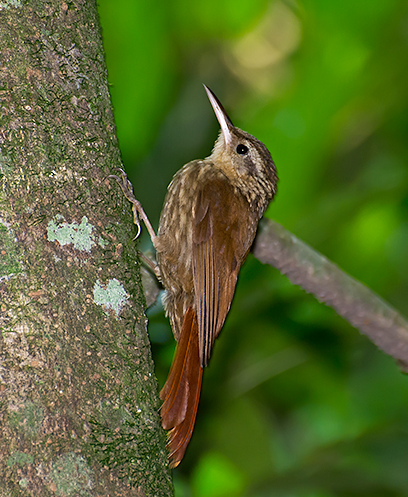
Buff-throated Woodcreeper Xiphorhynchus guttatus
The scientific name of the Buff-throated Woodcreeper is Xiphorhynchus guttatus. It is a species of bird in the family Furnariidae (ovenbird), order Passeriformes. The name dates from 1820.
- Scientific name
- Xiphorhynchus guttatus (M. H. C. Lichtenstein, 1820)
- Common name
- Buff-throated Woodcreeper
- Genus
- Xiphorhynchus
- Family
- Furnariidae (Ovenbird)
- Order
- Passeriformes
- Class
- Aves
- Red List category
- LC Least Concern
- Recorded in
- 10 countries
- Name status
- accepted in the Catalogue of Life

Overview
The Buff-throated Woodcreeper is a resident passerine bird in the family Furnariidae. It occurs in Bolivia, Brazil, Colombia, Ecuador, French Guiana, Guyana, Peru, Suriname, and Venezuela. It measures 22.5–29.5 cm in length, weighs 45–74 g, and is the largest species in its genus.
Written 26 November 2026 from the sources listed below. Each statement was checked against the passage it cites; statements that could not be supported were removed.
Appearance
The Buff-throated Woodcreeper has a heavy body and a long, heavy, decurved bill. Male and female individuals have the same plumage.[1][2]
The nominate subspecies has a deep-buff throat and reddish-brown breast, sides, and belly. Adults have dark brown irises, dark brownish-black bills, and blue, greenish-gray, or dark-gray legs and feet.[3][4]
Juveniles have shorter and blacker bills, more rufous bellies, and wider streaks with blacker edges than adults.[5]
Habitat
The species generally inhabits humid evergreen forest. It occurs along forest edges, in forest gaps, in older secondary forest, and inside primary forest.[6][7]
The nominate subspecies is restricted to humid tropical Atlantic forest. Populations in the Amazon Basin inhabit terra firme, floodplain forest, várzea, and igapó seasonally flooded forests.[8][9]
Most individuals occur between sea level and 800 m elevation. The subspecies X. g. polystictus occurs up to 1,200 m in Colombia and 1,250 m in the tepui region, while X. g. dorbignyanus occurs up to 1,100 m in Bolivia.[10][11][12]
Diet
The Buff-throated Woodcreeper feeds primarily on arthropods and occasionally consumes small vertebrates.[13]
Behaviour
The species usually forages alone and occasionally in pairs. It regularly joins mixed-species feeding flocks and follows army ant swarms while foraging.[14][15][16]
It generally forages from the middle levels of the forest to the subcanopy, but sometimes feeds at lower and higher levels. It searches for prey by hitching along trunks and branches and gleaning or pecking at their surfaces.[17][18]
The species also searches for prey on palm fronds, in dead leaf clusters, epiphytes, dead wood, and arboreal termite nests. When following army ants, it sometimes makes sallies from perches to capture prey from the ground, foliage, or air.[19][20]
Reproduction and life cycle
The breeding season varies geographically. Northern populations breed during the first half of the year, while southern populations tend to breed later.[21]
The species nests in natural cavities in dead trees or cavities excavated by woodpeckers. Clutches contain one to three eggs, usually two.[22][23]
Conservation
The Buff-throated Woodcreeper is listed as Least Concern on the IUCN Red List.[24][25]
The nominate subspecies is largely confined to scattered fragments of lowland Atlantic Forest and is considered potentially sensitive to continued forest loss.[26]
Classification of the Buff-throated Woodcreeper
| Kingdom | Animalia |
|---|---|
| Phylum | Chordata |
| Subphylum | Vertebrata |
| Infraphylum | Gnathostomata |
| Parvphylum | Osteichthyes |
| Megaclass | Tetrapoda |
| Class | Aves (Bird) |
| Order | Passeriformes (Passerine) |
| Family | Furnariidae (Ovenbird) |
| Genus | Xiphorhynchus (Woodcreepers) |
| Species | Xiphorhynchus guttatus (M. H. C. Lichtenstein, 1820) |
Where the Buff-throated Woodcreeper is found
Checklists and occurrence records place Xiphorhynchus guttatus in 10 countries across South America. GBIF holds 54,376 georeferenced records of it.
Countries
- Bolivia 3,276
- Brazil 18,373
- Colombia 5,128
- Ecuador 7,616
- French Guiana 628
- Guyana 1,641
- Panama 304
- Peru 15,425
- Suriname 962
- Venezuela 1,023
Regions and cities with the most records
- Madre de Dios, Peru 10,301
- Mato Grosso, Brazil 5,511
- Orellana Province, Ecuador 3,464
- Loreto, Peru 3,096
- Sucumbíos, Ecuador 2,509
- Pará, Brazil 2,467
- Puerto Maldonado, Peru 1,909
- Amazonas, Brazil 1,816
- Santa Cruz Department, Bolivia 1,470
- Goiás, Brazil 1,344
- Meta Department, Colombia 1,329
- Bahia, Brazil 1,222
- Tambopata, Peru 940
- Rondônia, Brazil 900
- Tocantins, Brazil 900
- Napo, Ecuador 858
- Amazonas Department, Colombia 755
- Upper Takutu-Upper Essequibo, Guyana 746
- Goiânia, Brazil 733
- Bolívar, Venezuela 713
- Beni Department, Bolivia 712
- Cuzco Department, Peru 678
- Vaupés, Colombia 676
- Acre, Brazil 675
- Potaro-Siparuni, Guyana 624
- Porto Seguro, Brazil 612
- Espírito Santo, Brazil 610
- Chapada dos Guimarães, Brazil 607
- San Martín Department, Peru 561
- Senador Canedo, Brazil 558
- Santa Cruz Cabrália, Brazil 531
- La Paz Department, Bolivia 529
- Mitú, Colombia 511
- Guainía Department, Colombia 507
- Santa Cruz de la Sierra, Bolivia 501
- Roraima, Brazil 494
5 more countries have a few records outside this range
These countries hold a few records of Xiphorhynchus guttatus but lie outside the range the checklists give for it. Such records are often zoo or garden specimens, museum material or vagrants, so the species is not counted as occurring there.
Range as the checklists state it
South America
A number beside a place is its count of GBIF occurrence records. A place without a number comes from a checklist alone. Records show where a species has been observed or collected, which can include escapes and vagrants.
Common names
English
- Buff-throated Woodcreeper
Names in 25 other languages
- Catalan
- grimpatroncs golagroc
- Chinese
- 黃喉爬木雀, 黄喉䴕雀
- Croatian
- prugastoprsa puzavica
- Czech
- klouzálek plavohrdlý
- Danish
- Gulstrubet Trækryber
- Dutch
- Geelkeelmuisspecht
- Esperanto
- okragorĝa trunkogrimpulo
- Finnish
- säämiskäkurkkukipuaja
- French
- Grimpar des cabosses
- German
- Fahlkehl-Baumsteiger, Fahlkehlbaumsteiger, Tropfenstirn-Baumsteiger, Tropfenstirnbaumsteiger
- Hungarian
- cseppfoltos fahágó
- Italian
- Rampicatore golacamoscio
- Japanese
- キノドオニキバシリ
- Lithuanian
- geltongurklis kalavijasnapis kopikas
- Norwegian
- kremstrupetreløper
- Polish
- mieczonos płowy
- Portuguese
- Arapaçu-de-garganta-camurça, arapaçu-de-garganta-amarela, trepa-troncos-de-garganta-bege
- Russian
- Желтогорлый мечеклювый древолаз, Светлогорлый древолаз
- Serbian
- Žutogrla puzavica
- Slovak
- klzáčik plavohrdlý
- Spanish
- Trepatroncos pegón
- Swedish
- beigestrupig trädklättrare
- Turkish
- Sarı Gerdanlı Tırmaşık
- Ukrainian
- кокоа жовтогорлий
- Welsh
- cropiwr gyddf-felyn
Synonyms
One other scientific name has been used for this species and is now treated as a synonym of Xiphorhynchus guttatus.
- Dendrocolaptes guttatus M. H. C. Lichtenstein, 1820
Subspecies and varieties
- Xiphorhynchus guttatus connectens subspecies
- Xiphorhynchus guttatus dorbignyanus subspecies
- Xiphorhynchus guttatus eytoni subspecies
- Xiphorhynchus guttatus gracilirostris subspecies
- Xiphorhynchus guttatus guttatoides (Lafresnaye's Woodcreeper) subspecies
- Xiphorhynchus guttatus guttatus subspecies
- Xiphorhynchus guttatus polystictus subspecies
- Xiphorhynchus guttatus vicinalis subspecies
Related species
-
 Ivory-billed WoodcreeperXiphorhynchus flavigaster
-
 Cocoa WoodcreeperXiphorhynchus susurrans
-
 Spotted WoodcreeperXiphorhynchus erythropygius
-
 Black-striped WoodcreeperXiphorhynchus lachrymosus
-
 Lesser WoodcreeperXiphorhynchus fuscus
-
 Striped WoodcreeperXiphorhynchus obsoletus
-
 Elegant WoodcreeperXiphorhynchus elegans
-
 Olive-backed WoodcreeperXiphorhynchus triangularis
Compare
Questions and answers
What is the scientific name of the Buff-throated Woodcreeper?
The scientific name of the Buff-throated Woodcreeper is Xiphorhynchus guttatus. Written with its author, the full name is Xiphorhynchus guttatus (M. H. C. Lichtenstein, 1820).
Which family does the Buff-throated Woodcreeper belong to?
Xiphorhynchus guttatus belongs to the family Furnariidae, in the order Passeriformes and the class Aves.
Where is the Buff-throated Woodcreeper found?
Checklists and occurrence records place Xiphorhynchus guttatus in 10 countries, including Brazil, Peru, Ecuador, Colombia, Bolivia and Guyana.
What is the conservation status of the Buff-throated Woodcreeper?
The IUCN Red List category recorded for Xiphorhynchus guttatus is Least Concern (LC).
How large is the Buff-throated Woodcreeper?
It measures 22.5–29.5 cm in length and weighs 45–74 g. It is the largest species in its genus.[27][28][29]
What does the Buff-throated Woodcreeper eat?
It feeds primarily on arthropods and occasionally consumes small vertebrates.[13]
Where does the Buff-throated Woodcreeper live?
It occurs in Bolivia, Brazil, Colombia, Ecuador, French Guiana, Guyana, Peru, Suriname, and Venezuela.[30]
Is the Buff-throated Woodcreeper migratory?
All subspecies are believed to remain year-round within their respective ranges.[31]
How many eggs does the Buff-throated Woodcreeper lay?
It lays clutches of one to three eggs, usually two.[23]
Sources
Passages the profile rests on
- The species has a heavy body and a long, heavy, decurved bill. Source passage: “with a heavy body and a long, heavy, decurved bill.” — English Wikipedia
- Male and female buff-throated woodcreepers have the same plumage. Source passage: “The sexes have the same plumage.” — English Wikipedia
- The nominate subspecies has a deep-buff throat and reddish-brown breast, sides, and belly. Source passage: “Their throat is deep buff with a dusky lower edge. Their breast, sides, and belly are reddish brown” — English Wikipedia
- Adult nominate individuals have dark brown irises, dark brownish-black bills, and blue, greenish-gray, or dark-gray legs and feet. Source passage: “Their iris is dark brown, their bill dark brownish black with a paler culmen and an even paler mandible, and their legs and feet blue, greenish gray, or dark gray.” — English Wikipedia
- Juveniles have shorter and blacker bills, more rufous bellies, and wider streaks with blacker edges than adults. Source passage: “Juveniles have a shorter and blacker bill than adults, a more rufous belly, and wider streaks with blacker edges above and below.” — English Wikipedia
- The species generally inhabits humid evergreen forest. Source passage: “The buff-throated woodcreeper generally inhabits humid evergreen forest” — English Wikipedia
- The species occurs along forest edges, in forest gaps, and in older secondary forest, as well as inside primary forest. Source passage: “All of the subspecies favor the edges of the forest, gaps within it, and older secondary forest, but they regularly occur in the interior of primary forest as well.” — English Wikipedia
- The nominate subspecies is restricted to humid tropical Atlantic forest. Source passage: “the nominate X. g. guttatus is restricted to the humid tropical Atlantic forest.” — English Wikipedia
- Populations in the Amazon Basin inhabit terra firme, floodplain forest, várzea, and igapó seasonally flooded forests. Source passage: “Populations in the Amazon Basin inhabit terra firme, floodplain forest, and both várzea and igapó types of seasonally flooded forest.” — English Wikipedia
- Most individuals occur between sea level and 800 m elevation. Source passage: “In elevation most individuals occur between sea level and 800 m (2,600 ft).” — English Wikipedia
- The subspecies X. g. polystictus occurs at elevations up to 1,200 m in Colombia and 1,250 m in the tepui region. Source passage: “X. g. polystictus reaches 1,200 m (3,900 ft) in Colombia and 1,250 m (4,100 ft) in the tepui region” — English Wikipedia
- The subspecies X. g. dorbignyanus occurs at elevations up to 1,100 m in Bolivia. Source passage: “X. g. dorbignyanus reaches 1,100 m (3,600 ft) in Bolivia.” — English Wikipedia
- The species feeds primarily on arthropods and occasionally consumes small vertebrates. Source passage: “The buff-throated woodcreeper's diet is mostly arthropods but also occasionally includes small vertebrates.” — English Wikipedia
- The species usually forages alone and occasionally in pairs. Source passage: “It usually forages singly and occasionally in pairs” — English Wikipedia
- The species regularly joins mixed-species feeding flocks. Source passage: “It regularly joins mixed-species feeding flocks” — English Wikipedia
- The species regularly follows army ant swarms while foraging. Source passage: “It also regularly follows army ant swarms.” — English Wikipedia
- The species generally forages from the middle levels of the forest to the subcanopy, but sometimes feeds at lower and higher levels. Source passage: “usually foraging from the forest's mid-level to the subcanopy but sometimes lower and higher.” — English Wikipedia
- The species searches for prey by hitching along trunks and branches and gleaning or pecking at their surfaces. Source passage: “It hitches up and along trunks and branches, gleaning and pecking for prey on those substrates” — English Wikipedia
- The species also searches for prey on palm fronds, in dead leaf clusters, epiphytes, dead wood, and arboreal termite nests. Source passage: “on palm fronds, and in dead leaf clusters, epiphytes, dead wood, and arboreal termite nests.” — English Wikipedia
- When following army ants, the species sometimes makes sallies from perches to capture prey from the ground, foliage, or air. Source passage: “when following ants makes sallies from a perch to glean from the ground and foliage or make mid-air captures.” — English Wikipedia
- The breeding season varies geographically, with northern populations breeding during the first half of the year and southern populations tending to breed later. Source passage: “Northern populations breed during the first half of the year while those further south tend to breed later.” — English Wikipedia
- The species nests in natural cavities in dead trees or cavities excavated by woodpeckers. Source passage: “The species nests in cavities in dead trees, either natural or made by woodpeckers.” — English Wikipedia
- The species lays clutches of one to three eggs, usually two. Source passage: “Their clutch is one to three eggs (usually two).” — English Wikipedia
- The species is assessed as Least Concern by the IUCN under the taxonomy followed by the source. Source passage: “both are assessed as being of Least Concern.” — English Wikipedia
- The IUCN Red List lists Xiphorhynchus guttatus as Least Concern. Source passage: “Xiphorhynchus guttatus is listed as Least Concern.” — iucnredlist.org
- The nominate subspecies is largely confined to scattered fragments of lowland Atlantic Forest and is considered potentially sensitive to continued forest loss. Source passage: “largely restricted to scattered fragments of lowland Atlantic Forest, and likely to be moderately to highly sensitive to continued loss of forest.” — English Wikipedia
- The buff-throated woodcreeper measures 22.5–29.5 cm in length. Source passage: “The buff-throated woodcreeper is 22.5 to 29.5 cm (8.9 to 12 in) long” — English Wikipedia
- The buff-throated woodcreeper weighs 45–74 g. Source passage: “weighs 45 to 74 g (1.6 to 2.6 oz).” — English Wikipedia
- The buff-throated woodcreeper is the largest species in its genus. Source passage: “It is the largest member of genus Xiphorhynchus” — English Wikipedia
- The species is recorded from Bolivia, Brazil, Colombia, Ecuador, French Guiana, Guyana, Peru, Suriname, and Venezuela. Source passage: “It is found in Bolivia, Brazil, Colombia, Ecuador, French Guiana, Guyana, Peru, Suriname, and Venezuela.” — English Wikipedia
- All subspecies are believed to remain year-round within their respective ranges. Source passage: “All subspecies of the buff-throated woodcreeper are believed to be year-round residents of their respective ranges.” — English Wikipedia
Data
- Catalogue of Life, 2026-10-16 XR cc by
- Global Biodiversity Information Facility CC BY 4.0
- Wikidata CC0
- GeoNames CC BY 4.0
- Wikimedia Commons per image; credit shown with each image
- Within the Catalogue of Life, this name comes from The Integrated Taxonomic Information System cc0
References
- Gill, Frank, & and Minturn Wright. (2006). Birds of the World: Recommended English Names.
This species in other databases
Page built on 29 November 2026. See how the catalog is made and all sources and licences.
Cite this page
ScientificNames.org. (2026). Xiphorhynchus guttatus (Buff-throated Woodcreeper). Retrieved November 29, 2026, from https://scientificnames.org/species/xiphorhynchus-guttatus
“Xiphorhynchus guttatus (Buff-throated Woodcreeper).” ScientificNames.org, 2026, scientificnames.org/species/xiphorhynchus-guttatus. Accessed 29 Nov. 2026.
ScientificNames.org. “Xiphorhynchus guttatus (Buff-throated Woodcreeper).” Accessed November 29, 2026. https://scientificnames.org/species/xiphorhynchus-guttatus.
@misc{scientificnames_xiphorhynchus_guttatus_buff_throated_woodcreeper,
  author = {{ScientificNames.org}},
  title = {Xiphorhynchus guttatus (Buff-throated Woodcreeper)},
  year = {2026},
  url = {https://scientificnames.org/species/xiphorhynchus-guttatus},
  note = {Accessed 2026-11-29}
}