Species · Birds
Black-striped Woodcreeper Xiphorhynchus lachrymosus
The scientific name of the Black-striped Woodcreeper is Xiphorhynchus lachrymosus. It is a species of bird in the family Furnariidae (ovenbird), order Passeriformes. The name dates from 1862.
- Scientific name
- Xiphorhynchus lachrymosus (Lawrence, 1862)
- Common name
- Black-striped Woodcreeper
- Genus
- Xiphorhynchus
- Family
- Furnariidae (Ovenbird)
- Order
- Passeriformes
- Class
- Aves
- Red List category
- LC Least Concern
- Recorded in
- 5 countries
- Name status
- accepted in the Catalogue of Life

Overview
The Black-striped Woodcreeper is a fairly large and distinctive woodcreeper. It occurs in Colombia, Costa Rica, Ecuador, Nicaragua, and Panama. Its body size and pale buff and black streaking distinguish it from other woodcreepers.
Written 26 November 2026 from the sources listed below. Each statement was checked against the passage it cites; statements that could not be supported were removed.
Appearance
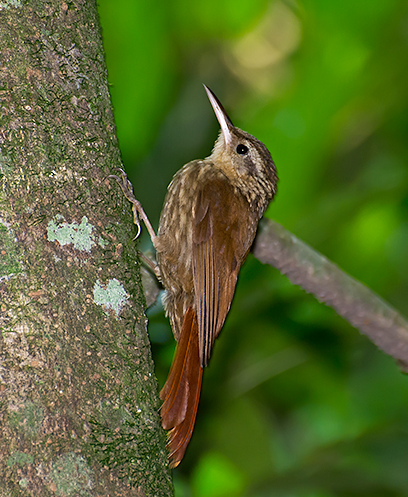
Adults measure 21.5–25 cm in length and weigh 51–66 g. The bill is relatively long and nearly straight, with a slightly drooping tip. Males and females have the same plumage.[1][2][3][4]
Adults of the nominate subspecies have a brownish-black face marked with buff streaks. The brownish-black crown and nape feathers have buffy teardrop spots and broad streaks, while the brownish-black back and scapular feathers have broad, deep buff streaks.[5][6][7]
The lower back, rump, and wings are dark cinnamon-rufous, and the tail is rufous-chestnut. The throat ranges from pale to deep buff and has a thin black lower edge. The breast and belly are pale buff, with a scaly pattern on the breast and streaks on the belly.[8][9][10][11]
The iris ranges from dark reddish brown to dark brown. The maxilla is dark brown to black, and the mandible ranges from silver-gray to bluish white. The legs and feet range from green to bluish gray or dark gray.[12][13][14][15]
Juveniles have a more muted plumage pattern than adults, heavier throat scaling, whiter underparts, and shorter bills.[16][17]
The subspecies X. l. eximius has more distinct black streaking on the breast, extending across the belly, and deeper rufous wings and tail than the nominate subspecies. The subspecies X. l. alarum has smaller buffy spots on its back than the nominate subspecies.[18][19][20]
Habitat
The Black-striped Woodcreeper primarily inhabits humid lowland forest. It favors evergreen forest but also occurs in mangroves in some areas.[21][22]
It favors the interior of tall mature forests but also occurs at forest edges and gaps. It also inhabits older secondary forests and occasionally tree plantations.[23][24]
The species usually occurs between sea level and 1,000 m elevation. It reaches elevations of 1,200 m in Costa Rica and 1,500 m in Colombia.[25][26]
Diet
The Black-striped Woodcreeper feeds primarily on arthropods and also eats small vertebrates such as lizards.[27]
It obtains most prey by probing bark crevices, vine tangles, dead leaf clusters, bromeliads, and epiphytes.[28]
Behaviour
The species is resident throughout its range throughout the year. It usually forages alone but sometimes feeds in pairs or family groups.[29][30]
It sometimes joins mixed-species feeding flocks, less frequently than other Xiphorhynchus woodcreepers. When accompanying these flocks, it usually forages in the forest canopy.[31][32]
The Black-striped Woodcreeper climbs tree trunks and branches in a spiral pattern and also moves along large limbs. It sometimes catches flying prey by making aerial sallies.[33][34]
The species regularly follows army ant swarms while foraging.[35]
Reproduction and life cycle
The species breeds between March and June in Costa Rica and between February and May in Colombia.[36][37]
It nests in cavities in trees or palms and lines the nesting cavity with wood and bark chips. The usual clutch contains two eggs, although three eggs are apparently sometimes laid.[38][39][40]
Conservation
The IUCN classifies the Black-striped Woodcreeper as Least Concern. It has an estimated population of at least 50,000 mature individuals, and this population is believed to be decreasing.[41][42][43]
No immediate threats to the species have been identified. It is considered uncommon to common across most of its range and locally common in some areas.[44][45]
The species was most recently assessed for the IUCN Red List in 2020.[46]
Similar species
The combination of body size and pale buff and black streaking distinguishes the Black-striped Woodcreeper from other woodcreepers.[1][11][47]
Classification of the Black-striped Woodcreeper
| Kingdom | Animalia |
|---|---|
| Phylum | Chordata |
| Subphylum | Vertebrata |
| Infraphylum | Gnathostomata |
| Parvphylum | Osteichthyes |
| Megaclass | Tetrapoda |
| Class | Aves (Bird) |
| Order | Passeriformes (Passerine) |
| Family | Furnariidae (Ovenbird) |
| Genus | Xiphorhynchus (Woodcreepers) |
| Species | Xiphorhynchus lachrymosus (Lawrence, 1862) |
Where the Black-striped Woodcreeper is found
Checklists and occurrence records place Xiphorhynchus lachrymosus in 5 countries across North America and South America. GBIF holds 17,669 georeferenced records of it.
Countries
Regions and cities with the most records
- Puntarenas Province, Costa Rica 4,648
- Alcalde Díaz, Panama 4,258
- Chilibre, Panama 4,135
- Colón, Panama 4,042
- Limón Province, Costa Rica 1,255
- Pichincha, Ecuador 1,249
- Heredia Province, Costa Rica 836
- Darién, Panama 809
- Panamá, Panama 676
- Valle del Cauca Department, Colombia 655
- Esmeraldas, Ecuador 604
- Buenaventura, Colombia 572
- Alajuela Province, Costa Rica 404
- San Miguelito, Panama 357
- Chocó, Colombia 349
- Limón, Costa Rica 289
- Boyacá, Colombia 281
- Tocumen, Panama 260
- Panama City, Panama 201
- Arraiján, Panama 200
- Ancón, Panama 197
- Curundú, Panama 197
- Panamá Oeste Province, Panama 179
- Antioquia, Colombia 174
- Juan Díaz, Panama 154
- Santander Department, Colombia 123
- San José, Costa Rica 106
- Nariño, Colombia 91
- Cauca Department, Colombia 79
- Manabí, Ecuador 70
- Buenaventura, Colombia 69
- Guápiles, Costa Rica 67
- Timbiquí, Colombia 66
- San Isidro, Costa Rica 63
- Veracruz, Panama 61
- Siquirres, Costa Rica 55
Range as the checklists state it
Middle America
South America
A number beside a place is its count of GBIF occurrence records. A place without a number comes from a checklist alone. Records show where a species has been observed or collected, which can include escapes and vagrants.
Common names
English
- Black-striped Woodcreeper
Names in 24 other languages
- Catalan
- grimpatroncs pintat
- Chinese
- 黑紋爬木雀, 黑纹䴕雀
- Croatian
- žutopruga puzavica
- Czech
- klouzálek perličkový
- Danish
- Sortstribet Trækryber
- Dutch
- Zwartgestreepte Muisspecht
- Esperanto
- nigrastria trunkogrimpulo
- Finnish
- mustaviirukipuaja
- French
- Grimpar maillé
- German
- Schwarzrücken-Baumsteiger, Tränenbaumsteiger
- Italian
- Rampicatore strienere, Rampichino striato di nero
- Japanese
- クロスジオニキバシリ
- Lithuanian
- margasis kalavijasnapis kopikas
- Norwegian
- perletreløper
- Polish
- mieczonos ciemny
- Portuguese
- arapaçu-sarapintado, trepa-troncos-lacrimoso
- Russian
- Жемчужноспинный древолаз, Пёстрый мечеклювый древолаз
- Serbian
- Puzavica sa crnim prugama
- Slovak
- klzáčik perlavý
- Spanish
- Trepador Pinto, Trepatroncos pinto, trepatroncos rayas negras
- Swedish
- svartstrimmig trädklättrare
- Turkish
- Siyah Çizgili Tırmaşık
- Ukrainian
- кокоа строкатоплечий
- Welsh
- cropiwr drudwennog
Synonyms
One other scientific name has been used for this species and is now treated as a synonym of Xiphorhynchus lachrymosus.
- Dendrornis lachrymosus Lawrence, 1862
Subspecies and varieties
- Xiphorhynchus lachrymosus alarum subspecies
- Xiphorhynchus lachrymosus eximius subspecies
- Xiphorhynchus lachrymosus lachrymosus subspecies
Related species
-
 Ivory-billed WoodcreeperXiphorhynchus flavigaster
-
 Cocoa WoodcreeperXiphorhynchus susurrans
-
 Buff-throated WoodcreeperXiphorhynchus guttatus
-
 Spotted WoodcreeperXiphorhynchus erythropygius
-
 Lesser WoodcreeperXiphorhynchus fuscus
-
 Striped WoodcreeperXiphorhynchus obsoletus
-
 Elegant WoodcreeperXiphorhynchus elegans
-
 Olive-backed WoodcreeperXiphorhynchus triangularis
Compare
Questions and answers
What is the scientific name of the Black-striped Woodcreeper?
The scientific name of the Black-striped Woodcreeper is Xiphorhynchus lachrymosus. Written with its author, the full name is Xiphorhynchus lachrymosus (Lawrence, 1862).
Which family does the Black-striped Woodcreeper belong to?
Xiphorhynchus lachrymosus belongs to the family Furnariidae, in the order Passeriformes and the class Aves.
Where is the Black-striped Woodcreeper found?
Checklists and occurrence records place Xiphorhynchus lachrymosus in 5 countries: Costa Rica, Panama, Colombia, Ecuador and Nicaragua.
What is the conservation status of the Black-striped Woodcreeper?
The IUCN Red List category recorded for Xiphorhynchus lachrymosus is Least Concern (LC).
Sources
Passages the profile rests on
- Adults measure 21.5–25 cm in length. Source passage: “The black-striped woodcreeper is 21.5 to 25 cm (8.5 to 9.8 in) long” — English Wikipedia
- Adults weigh 51–66 g. Source passage: “weighs 51 to 66 g (1.8 to 2.3 oz).” — English Wikipedia
- The species has a relatively long, nearly straight bill with a slightly drooping tip. Source passage: “with a longish, nearly straight, bill with a slight droop at the tip.” — English Wikipedia
- Males and females have the same plumage. Source passage: “The sexes have the same plumage.” — English Wikipedia
- Adults of the nominate subspecies have a brownish-black face marked with buff streaks. Source passage: “Adults of the nominate subspecies have a brownish black face with buff streaks and no distinct supercilium.” — English Wikipedia
- The nominate subspecies has brownish-black crown and nape feathers marked with buffy teardrop spots and broad streaks. Source passage: “Their crown and nape are brownish black with buffy teardrop spots and wide streaks.” — English Wikipedia
- The nominate subspecies has brownish-black back and scapular feathers with broad, deep buff streaks. Source passage: “Their back and scapulars are also brownish black with wider and deeper buff streaks.” — English Wikipedia
- The lower back, rump, and wings are dark cinnamon-rufous. Source passage: “Their lower back, rump, and wings are dark cinnamon-rufous” — English Wikipedia
- The tail is rufous-chestnut. Source passage: “Their tail is rufous-chestnut.” — English Wikipedia
- The throat ranges from pale to deep buff and has a thin black lower edge. Source passage: “Their throat is pale to deep buff with a thin black lower edge.” — English Wikipedia
- The breast and belly are pale buff, with a scaly pattern on the breast and streaks on the belly. Source passage: “Their breast and belly are pale buff with a scaly appearance on the former and streaks on the latter.” — English Wikipedia
- The iris ranges from dark reddish brown to dark brown. Source passage: “Their iris is dark reddish brown to dark brown” — English Wikipedia
- The maxilla is dark brown to black. Source passage: “their maxilla dark brown to black” — English Wikipedia
- The mandible ranges from silver-gray to bluish white. Source passage: “their mandible silver-gray to bluish white” — English Wikipedia
- The legs and feet range from green to bluish gray or dark gray. Source passage: “their legs and feet green to bluish gray or dark gray.” — English Wikipedia
- Juveniles have a more muted plumage pattern than adults. Source passage: “Juveniles are similar to adults with a more muted pattern” — English Wikipedia
- Juveniles have heavier throat scaling, whiter underparts, and shorter bills than adults. Source passage: “their throat has heavier scaling, their underparts are whiter, and their bill is shorter.” — English Wikipedia
- The subspecies X. l. eximius has more distinct black streaking on the breast, extending across the belly. Source passage: “Subspecies X. l. eximius has more distinct black streaking than the nominate on the breast and it extends through the belly.” — English Wikipedia
- The subspecies X. l. eximius has deeper rufous wings and tail than the nominate subspecies. Source passage: “their wings and tail are deeper rufous.” — English Wikipedia
- The subspecies X. l. alarum has smaller buffy spots on its back than the nominate subspecies. Source passage: “X. l. alarum has smaller buffy spots on the back than the nominate” — English Wikipedia
- The species primarily inhabits humid lowland forest. Source passage: “The black-striped woodcreeper mostly inhabits humid lowland forest.” — English Wikipedia
- The species favors evergreen forest but also occurs in mangroves in some areas. Source passage: “It favors evergreen forest but also entends into mangroves in some areas.” — English Wikipedia
- The species favors the interior of tall mature forests but also occurs at forest edges and gaps. Source passage: “It also favors the interior of tall mature forest but is regular at its edges and gaps” — English Wikipedia
- The species also inhabits older secondary forests and occasionally tree plantations. Source passage: “in older secondary forest, and occasionally in tree plantations.” — English Wikipedia
- The species usually occurs between sea level and 1,000 m elevation. Source passage: “In elevation it mostly ranges between sea level and 1,000 m (3,300 ft)” — English Wikipedia
- The species reaches elevations of 1,200 m in Costa Rica and 1,500 m in Colombia. Source passage: “but reaches 1,200 m (3,900 ft) in Costa Rica and 1,500 m (4,900 ft) in Colombia.” — English Wikipedia
- The species feeds primarily on arthropods and also eats small vertebrates such as lizards. Source passage: “The black-striped woodcreeper's diet is mostly arthropods but also includes small vertebrates such as lizards.” — English Wikipedia
- The species obtains most prey by probing bark crevices, vine tangles, dead leaf clusters, bromeliads, and epiphytes. Source passage: “Most prey is taken by probing bark crevices, vine tangles, dead leaf clusters, bromeliads, and epiphytes.” — English Wikipedia
- The species is resident throughout its range throughout the year. Source passage: “The black-striped woodcreeper is a year-round resident throughout its range.” — English Wikipedia
- The species usually forages alone but sometimes feeds in pairs or family groups. Source passage: “It usually forages singly, though sometimes in pairs or more rarely in family groups.” — English Wikipedia
- The species sometimes joins mixed-species feeding flocks less frequently than other Xiphorhynchus woodcreepers. Source passage: “It will join mixed-species feeding flocks but does so less than other Xiphorhynchus woodcreepers.” — English Wikipedia
- When accompanying feeding flocks, the species usually forages in the forest canopy. Source passage: “With flocks it usually feeds in the forest canopy” — English Wikipedia
- The species climbs tree trunks and branches in a spiral pattern and also moves along large limbs. Source passage: “It hitches up trunks and along branches, usually in a spiral but also creeping along large limbs.” — English Wikipedia
- The species sometimes catches flying prey by making aerial sallies. Source passage: “It also sometimes sallies for flying prey.” — English Wikipedia
- The species regularly follows army ant swarms while foraging. Source passage: “It regularly follows army ant swarms” — English Wikipedia
- The species breeds between March and June in Costa Rica. Source passage: “The black-striped woodcreeper breeds between March and June in Costa Rica” — English Wikipedia
- The species breeds between February and May in Colombia. Source passage: “and between February and May in Colombia.” — English Wikipedia
- The species nests in cavities in trees or palms. Source passage: “It nests in a tree or palm cavity” — English Wikipedia
- The species lines its nesting cavity with wood and bark chips. Source passage: “that it lines with wood and bark chips.” — English Wikipedia
- The usual clutch contains two eggs, although three eggs are apparently sometimes laid. Source passage: “The clutch size is usually two eggs though apparently sometimes three.” — English Wikipedia
- The IUCN classifies the species as Least Concern. Source passage: “The IUCN has assessed the black-striped woodcreeper as being of Least Concern.” — English Wikipedia
- The species has an estimated population of at least 50,000 mature individuals. Source passage: “an estimated population of at least 50,000 mature individuals” — English Wikipedia
- The estimated mature population is believed to be decreasing. Source passage: “though the latter is believed to be decreasing.” — English Wikipedia
- No immediate threats to the species have been identified. Source passage: “No immediate threats have been identified.” — English Wikipedia
- The species is considered uncommon to common across most of its range and locally common in some areas. Source passage: “It is considered uncommon to common in most of its range, and locally common.” — English Wikipedia
- The species was most recently assessed for the IUCN Red List in 2020. Source passage: “has most recently been assessed for The IUCN Red List of Threatened Species in 2020.” — iucnredlist.org
- The combination of body size and pale buff and black streaking distinguishes this species from other woodcreepers. Source passage: “The black-striped woodcreeper's combination of size and pattern of pale buff and black streaks is unique among woodcreepers.” — English Wikipedia
Data
- Catalogue of Life, 2026-10-16 XR cc by
- Global Biodiversity Information Facility CC BY 4.0
- Wikidata CC0
- GeoNames CC BY 4.0
- Wikimedia Commons per image; credit shown with each image
- Within the Catalogue of Life, this name comes from The Integrated Taxonomic Information System cc0
References
- Gill, Frank, & and Minturn Wright. (2006). Birds of the World: Recommended English Names.
This species in other databases
Page built on 29 November 2026. See how the catalog is made and all sources and licences.
Cite this page
ScientificNames.org. (2026). Xiphorhynchus lachrymosus (Black-striped Woodcreeper). Retrieved November 29, 2026, from https://scientificnames.org/species/xiphorhynchus-lachrymosus
“Xiphorhynchus lachrymosus (Black-striped Woodcreeper).” ScientificNames.org, 2026, scientificnames.org/species/xiphorhynchus-lachrymosus. Accessed 29 Nov. 2026.
ScientificNames.org. “Xiphorhynchus lachrymosus (Black-striped Woodcreeper).” Accessed November 29, 2026. https://scientificnames.org/species/xiphorhynchus-lachrymosus.
@misc{scientificnames_xiphorhynchus_lachrymosus_black_striped_woodcreeper,
  author = {{ScientificNames.org}},
  title = {Xiphorhynchus lachrymosus (Black-striped Woodcreeper)},
  year = {2026},
  url = {https://scientificnames.org/species/xiphorhynchus-lachrymosus},
  note = {Accessed 2026-11-29}
}