Species · Birds
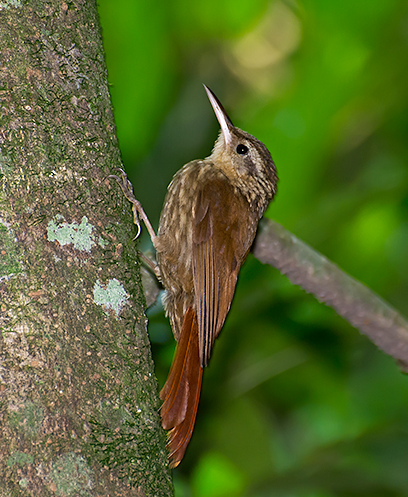
Striped Woodcreeper Xiphorhynchus obsoletus
The scientific name of the Striped Woodcreeper is Xiphorhynchus obsoletus. It is a species of bird in the family Furnariidae (ovenbird), order Passeriformes. The name dates from 1820.
- Scientific name
- Xiphorhynchus obsoletus (M. H. C. Lichtenstein, 1820)
- Common name
- Striped Woodcreeper
- Genus
- Xiphorhynchus
- Family
- Furnariidae (Ovenbird)
- Order
- Passeriformes
- Class
- Aves
- Red List category
- LC Least Concern
- Recorded in
- 9 countries
- Name status
- accepted in the Catalogue of Life

Overview
Xiphorhynchus obsoletus occurs in Bolivia, Brazil, Colombia, Ecuador, French Guiana, Guyana, Peru, Suriname and Venezuela. It has a slim, moderately long bill that curves slightly downward and plumage marked by pale streaks and spots.
Written 27 November 2026 from the sources listed below. Each statement was checked against the passage it cites; statements that could not be supported were removed.
Appearance
The Striped Woodcreeper is a medium-sized bird with a slim, moderately long bill that curves slightly downward. It measures between 18 and 20.5 cm in length. Males weigh between 27 and 37 g, and females between 24 and 36 g.[1][2][3][4]
Male and female Striped Woodcreepers have the same plumage. Adults of the nominate subspecies have creamy-buff and dark-brown facial streaks that become pronounced scales on the sides of the neck.[5][6]
The nominate subspecies has a blackish to dark olive-brown crown and nape marked with pale spots bordered by dusky edges. Its olive-brown back has dusky-edged whitish-buff streaks, while the rump, wings and tail range from cinnamon-rufous to rufous-chestnut.[7][8][9]
The nominate subspecies has a buffy-white throat that sometimes appears faintly scaly and grayish olive-brown underparts with buffy-white streaks edged in black. Its iris is brown to dark brown.[10][11][12]
Juveniles resemble adults but have less clearly defined dark edges on their spots and streaks.[13]
Similar species
The subspecies X. o. notatus is more rufescent than the nominate subspecies, with deeper buff to ochraceous throat coloration and finer streaks. X. o. palliatus is also more rufescent and has more deeply colored streaks.[14][15]
The subspecies X. o. caicarae is the smallest subspecies and has browner underparts and a shorter bill than the nominate subspecies.[16]
Habitat
The Striped Woodcreeper primarily inhabits mature evergreen forests. It favors forest landscapes near water, including várzea, igapó, swamp forest and river islands.[17][18]
It occurs less frequently in terra firme and secondary forests. In the southern part of its range, it inhabits gallery forests within the cerrado.[19][20]
The species is restricted to elevations below 500 m.[21]
Diet
The Striped Woodcreeper feeds mainly on insects and other arthropods, including spiders.[22]
Behaviour
The Striped Woodcreeper remains resident throughout its range throughout the year. It usually forages alone but sometimes feeds in pairs.[23][24]
The species forages at all forest levels up to the subcanopy. It climbs tree trunks and branches, including their undersides, while searching for prey, which it obtains by gleaning, probing and pecking.[25][26][27]
The Striped Woodcreeper captures a significant proportion of its prey in mid-air by making sallies from perches. It sometimes joins mixed-species feeding flocks but is not known to follow army ant swarms.[28][29]
The Striped Woodcreeper sings mainly at dawn and dusk, with additional singing intermittently during the day.[30]
Reproduction and life cycle
The breeding season of the Striped Woodcreeper is poorly defined and varies somewhat geographically. The species nests in cavities such as tree stumps and in arboreal termite nests.[31][32]
The Striped Woodcreeper lays clutches of two eggs.[33]
Conservation
The IUCN classifies the Striped Woodcreeper as Least Concern. It has a very large geographic range, but its population size is unknown and believed to be decreasing.[34][35]
No immediate threats have been identified for the species. It is considered uncommon to fairly common across much of its range, but rare and locally distributed at its range periphery.[36][37]
Classification of the Striped Woodcreeper
| Kingdom | Animalia |
|---|---|
| Phylum | Chordata |
| Subphylum | Vertebrata |
| Infraphylum | Gnathostomata |
| Parvphylum | Osteichthyes |
| Megaclass | Tetrapoda |
| Class | Aves (Bird) |
| Order | Passeriformes (Passerine) |
| Family | Furnariidae (Ovenbird) |
| Genus | Xiphorhynchus (Woodcreepers) |
| Species | Xiphorhynchus obsoletus (M. H. C. Lichtenstein, 1820) |
Where the Striped Woodcreeper is found
Checklists and occurrence records place Xiphorhynchus obsoletus in 9 countries across South America. GBIF holds 10,344 georeferenced records of it.
Countries
- Bolivia 144
- Brazil 3,692
- Colombia 2,237
- Ecuador 1,937
- French Guiana 81
- Guyana 343
- Peru 1,332
- Suriname 205
- Venezuela 373
Regions and cities with the most records
- Amazonas, Brazil 1,361
- Sucumbíos, Ecuador 1,055
- Loreto, Peru 821
- Mato Grosso, Brazil 818
- Orellana Province, Ecuador 771
- Guainía Department, Colombia 565
- Pará, Brazil 477
- Madre de Dios, Peru 432
- Meta Department, Colombia 371
- Novo Airão, Brazil 259
- Amazonas Department, Colombia 248
- Vaupés, Colombia 247
- Mitú, Colombia 233
- Upper Takutu-Upper Essequibo, Guyana 221
- Casanare Department, Colombia 214
- Vichada Department, Colombia 213
- Tocantins, Brazil 208
- Guaviare Department, Colombia 180
- Roraima, Brazil 169
- Lelydorp, Suriname 139
- Paramaribo, Suriname 139
- Commewijne District, Suriname 133
- Amazonas, Venezuela 94
- Rondônia, Brazil 93
- San José del Guaviare, Colombia 93
- Manaus, Brazil 83
- Amapá, Brazil 81
- Iranduba, Brazil 73
- Napo, Ecuador 73
- Atalaia do Norte, Brazil 71
- Careiro da Várzea, Brazil 68
- Ucayali, Peru 63
- Puerto Maldonado, Peru 60
- Beni Department, Bolivia 57
- Bolívar, Venezuela 57
- Caquetá, Colombia 56
Range as the checklists state it
South America
A number beside a place is its count of GBIF occurrence records. A place without a number comes from a checklist alone. Records show where a species has been observed or collected, which can include escapes and vagrants.
Common names
English
- Striped Woodcreeper
Names in 24 other languages
- Catalan
- grimpatroncs estriat
- Chinese
- 縱紋爬木雀, 纵纹䴕雀
- Croatian
- kestenjastokrila puzavica
- Czech
- klouzálek kapkohřbetý
- Danish
- Stribet Trækryber
- Dutch
- Gestreepte Muisspecht
- Esperanto
- stria trunkogrimpulo
- Finnish
- viirukipuaja
- French
- Grimpar strié
- German
- Streifenbaumsteiger
- Italian
- Rampicatore striato
- Japanese
- コケンハシオニキバシリ
- Lithuanian
- dryžasis kalavijasnapis kopikas
- Norwegian
- stripetreløper
- Polish
- mieczonos kropkowany
- Portuguese
- arapaçu-riscado, trepa-troncos-riscado
- Russian
- Полосатый мечеклювый древолаз, Пёстрый древолаз
- Serbian
- Prugasta puzavica
- Slovak
- klzáčik škvrnitý
- Spanish
- Trepatroncos loco
- Swedish
- strimmig trädklättrare
- Turkish
- Çizgili Tırmaşık
- Ukrainian
- кокоа смугастошиїй
- Welsh
- cropiwr rhibiniog
Synonyms
One other scientific name has been used for this species and is now treated as a synonym of Xiphorhynchus obsoletus.
- Dendrocolaptes obsoletus M. H. C. Lichtenstein, 1820
Subspecies and varieties
- Xiphorhynchus obsoletus caicarae subspecies
- Xiphorhynchus obsoletus notatus subspecies
- Xiphorhynchus obsoletus obsoletus subspecies
- Xiphorhynchus obsoletus palliatus subspecies
Related species
-
 Ivory-billed WoodcreeperXiphorhynchus flavigaster
-
 Cocoa WoodcreeperXiphorhynchus susurrans
-
 Buff-throated WoodcreeperXiphorhynchus guttatus
-
 Spotted WoodcreeperXiphorhynchus erythropygius
-
 Black-striped WoodcreeperXiphorhynchus lachrymosus
-
 Lesser WoodcreeperXiphorhynchus fuscus
-
 Elegant WoodcreeperXiphorhynchus elegans
-
 Olive-backed WoodcreeperXiphorhynchus triangularis
Compare
Questions and answers
What is the scientific name of the Striped Woodcreeper?
The scientific name of the Striped Woodcreeper is Xiphorhynchus obsoletus. Written with its author, the full name is Xiphorhynchus obsoletus (M. H. C. Lichtenstein, 1820).
Which family does the Striped Woodcreeper belong to?
Xiphorhynchus obsoletus belongs to the family Furnariidae, in the order Passeriformes and the class Aves.
Where is the Striped Woodcreeper found?
Checklists and occurrence records place Xiphorhynchus obsoletus in 9 countries, including Brazil, Colombia, Ecuador, Peru, Venezuela and Guyana.
What is the conservation status of the Striped Woodcreeper?
The IUCN Red List category recorded for Xiphorhynchus obsoletus is Least Concern (LC).
How large is the Striped Woodcreeper?
It measures between 18 and 20.5 cm in length. Males weigh between 27 and 37 g, and females between 24 and 36 g.[2][3][4]
Where does the Striped Woodcreeper occur?
It occurs in Bolivia, Brazil, Colombia, Ecuador, French Guiana, Guyana, Peru, Suriname and Venezuela.[38]
What habitats does the Striped Woodcreeper occupy?
It primarily inhabits mature evergreen forests, particularly forest landscapes near water, including várzea, igapó, swamp forest and river islands. It also occurs in terra firme and secondary forests, and in gallery forests within the cerrado in the southern part of its range.[17][18][19][20]
What does the Striped Woodcreeper eat?
It feeds mainly on insects and other arthropods, including spiders.[22]
How does the Striped Woodcreeper forage?
It climbs tree trunks and branches while gleaning, probing and pecking for prey. It also captures a significant proportion of its prey in mid-air by making sallies from perches.[26][27][29]
Sources
Passages the profile rests on
- The striped woodcreeper is a medium-sized bird with a slim, moderately long bill that curves slightly downward. Source passage: “The striped woodcreeper is medium-sized, with a slim, slightly decurved bill of moderate length.” — English Wikipedia
- The striped woodcreeper measures between 18 and 20.5 cm in length. Source passage: “The species is 18 to 20.5 cm (7.1 to 8.1 in) long.” — English Wikipedia
- Male striped woodcreepers weigh between 27 and 37 g. Source passage: “Males weigh 27 to 37 g (0.95 to 1.3 oz)” — English Wikipedia
- Female striped woodcreepers weigh between 24 and 36 g. Source passage: “females 24 to 36 g (0.85 to 1.3 oz).” — English Wikipedia
- Male and female striped woodcreepers have the same plumage. Source passage: “The sexes have the same plumage.” — English Wikipedia
- Adults of the nominate subspecies have creamy-buff and dark-brown facial streaks that become pronounced scales on the sides of the neck. Source passage: “Adults of the nominate subspecies X. o. obsoletus have a face with thin creamy buff and dark brown streaks that become bold scaling on the sides of the neck.” — English Wikipedia
- The nominate subspecies has a blackish to dark olive-brown crown and nape marked with pale spots bordered by dusky edges. Source passage: “Their crown and nape are blackish to dark olive-brown with pale spots that have dusky edges.” — English Wikipedia
- The nominate subspecies has an olive-brown back with dusky-edged whitish-buff streaks. Source passage: “Their back is olive-brown with dusky-edged whitish buff streaks.” — English Wikipedia
- The rump, wings and tail of the nominate subspecies range from cinnamon-rufous to rufous-chestnut. Source passage: “Their rump, wings, and tail are cinnamon-rufous to rufous-chestnut” — English Wikipedia
- The nominate subspecies has a buffy-white throat that sometimes appears faintly scaly. Source passage: “Their throat is buffy white, sometimes with a faint scaly appearance.” — English Wikipedia
- The nominate subspecies has grayish olive-brown underparts with buffy-white streaks edged in black. Source passage: “Their underparts are grayish olive-brown and sometimes have a rufescent cast; they have buffy-white streaks with black edges” — English Wikipedia
- The iris of the nominate subspecies is brown to dark brown. Source passage: “Their iris is brown to dark brown” — English Wikipedia
- Juveniles resemble adults but have less clearly defined dark edges on their spots and streaks. Source passage: “Juveniles are similar to adults but with less well defined dark edges to their spots and streaks.” — English Wikipedia
- The subspecies X. o. notatus is more rufescent than the nominate subspecies and has deeper buff to ochraceous throat coloration and finer streaks. Source passage: “Subspecies X. o. notatus is more rufescent than the nominate; its throat and streaks are a deeper buff to ochraceous and its streaks are finer.” — English Wikipedia
- The subspecies X. o. palliatus is more rufescent than the nominate subspecies and has more deeply colored streaks. Source passage: “X. o. palliatus is even more rufescent; its streaks are more deeply colored” — English Wikipedia
- The subspecies X. o. caicarae is the smallest subspecies and has browner underparts and a shorter bill than the nominate subspecies. Source passage: “X. o. caicarae is the smallest subspecies and has browner (less grayish) underparts and a shorter bill than the nominate.” — English Wikipedia
- The striped woodcreeper primarily inhabits mature evergreen forests. Source passage: “The striped woodcreeper is primarily a bird of mature evergreen forest” — English Wikipedia
- The species favors forest landscapes near water, including várzea, igapó, swamp forest and river islands. Source passage: “These include várzea, igapó, and swamp forest, and river islands.” — English Wikipedia
- The striped woodcreeper occurs less frequently in terra firme and secondary forests. Source passage: “It occurs less frequently in terra firme and secondary forest.” — English Wikipedia
- In the southern part of its range, the species inhabits gallery forests within the cerrado. Source passage: “In the southern part of its range it occurs in gallery forest within the cerrado.” — English Wikipedia
- The striped woodcreeper is restricted to elevations below 500 m. Source passage: “It is entirely a bird of the lowlands, being found only below 500 m (1,600 ft).” — English Wikipedia
- The striped woodcreeper feeds mainly on insects and other arthropods, including spiders. Source passage: “The striped woodcreeper's diet is mostly insects and other arthropods such as spiders.” — English Wikipedia
- The striped woodcreeper remains resident throughout its range throughout the year. Source passage: “The striped woodcreeper is a year-round resident throughout its range.” — English Wikipedia
- The species usually forages alone but sometimes feeds in pairs. Source passage: “It usually forages singly but sometimes in pairs” — English Wikipedia
- The striped woodcreeper forages at all forest levels up to the subcanopy. Source passage: “and at all levels of the forest up to the subcanopy.” — English Wikipedia
- The striped woodcreeper climbs tree trunks and branches, including their undersides, while searching for prey. Source passage: “It hitches up trunks and branches, sometimes on the underside of the latter” — English Wikipedia
- The species obtains prey by gleaning, probing and pecking. Source passage: “and gleans, probes, and pecks for prey.” — English Wikipedia
- The species sometimes joins mixed-species feeding flocks but is not known to follow army ant swarms. Source passage: “It sometimes joins mixed-species feeding flocks and is not known to follow army ant swarms.” — English Wikipedia
- The striped woodcreeper captures a significant proportion of its prey in mid-air by making sallies from perches. Source passage: “It also takes a significant part of its prey by mid-air capture during sallies from a perch.” — English Wikipedia
- The striped woodcreeper sings mainly at dawn and dusk, with additional singing intermittently during the day. Source passage: “The striped woodcreeper sings mostly at dawn and dusk, and also intermittently during the day.” — English Wikipedia
- The breeding season of the striped woodcreeper is poorly defined and varies somewhat geographically. Source passage: “The striped woodcreeper's breeding season is not well defined but appears to vary somewhat geographically.” — English Wikipedia
- The species nests in cavities such as tree stumps and in arboreal termite nests. Source passage: “It nests in cavities, such as in a stump, and also in nests of arboreal termites.” — English Wikipedia
- The striped woodcreeper lays clutches of two eggs. Source passage: “The clutch size is two eggs.” — English Wikipedia
- The IUCN classifies the striped woodcreeper as Least Concern. Source passage: “The IUCN has assessed the striped woodcreeper as being of Least Concern.” — English Wikipedia
- The striped woodcreeper has a very large geographic range, but its population size is unknown and believed to be decreasing. Source passage: “It has a very large range but its population size is not known and is believed to be decreasing.” — English Wikipedia
- No immediate threats have been identified for the striped woodcreeper. Source passage: “No immediate threats have been identified.” — English Wikipedia
- The species is considered uncommon to fairly common across much of its range, but rare and locally distributed at its range periphery. Source passage: “It is considered uncommon to fairly common in much of its range but only rare and local at its periphery.” — English Wikipedia
- The striped woodcreeper occurs in Bolivia, Brazil, Colombia, Ecuador, French Guiana, Guyana, Peru, Suriname and Venezuela. Source passage: “It is found in Bolivia, Brazil, Colombia, Ecuador, French Guiana, Guyana, Peru, Suriname, and Venezuela.” — English Wikipedia
Data
- Catalogue of Life, 2026-10-16 XR cc by
- Global Biodiversity Information Facility CC BY 4.0
- Wikidata CC0
- GeoNames CC BY 4.0
- Wikimedia Commons per image; credit shown with each image
- Within the Catalogue of Life, this name comes from The Integrated Taxonomic Information System cc0
References
- Gill, Frank, & and Minturn Wright. (2006). Birds of the World: Recommended English Names.
This species in other databases
Page built on 27 November 2026. See how the catalog is made and all sources and licences.
Cite this page
ScientificNames.org. (2026). Xiphorhynchus obsoletus (Striped Woodcreeper). Retrieved November 27, 2026, from https://scientificnames.org/species/xiphorhynchus-obsoletus
“Xiphorhynchus obsoletus (Striped Woodcreeper).” ScientificNames.org, 2026, scientificnames.org/species/xiphorhynchus-obsoletus. Accessed 27 Nov. 2026.
ScientificNames.org. “Xiphorhynchus obsoletus (Striped Woodcreeper).” Accessed November 27, 2026. https://scientificnames.org/species/xiphorhynchus-obsoletus.
@misc{scientificnames_xiphorhynchus_obsoletus_striped_woodcreeper,
  author = {{ScientificNames.org}},
  title = {Xiphorhynchus obsoletus (Striped Woodcreeper)},
  year = {2026},
  url = {https://scientificnames.org/species/xiphorhynchus-obsoletus},
  note = {Accessed 2026-11-27}
}