Species · Fishes
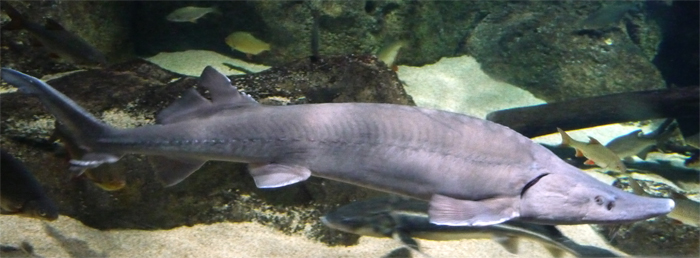
Siberian Sturgeon Acipenser baerii
The scientific name of the Siberian Sturgeon is Acipenser baerii. It is a species of fish in the family Acipenseridae (sturgeon), order Acipenseriformes. The name dates from 1869.
- Scientific name
- Acipenser baerii Brandt, 1869
- Common name
- Siberian Sturgeon
- Genus
- Acipenser
- Family
- Acipenseridae (Sturgeon)
- Order
- Acipenseriformes
- Class
- Chondrostei
- Red List category
- CR Critically Endangered
- Environment
- brackish, freshwater
- Recorded in
- 19 countries
- Name status
- accepted in the Catalogue of Life
Overview
Acipenser baerii occurs in the Ob, Yenisei, Lena and Kolyma river systems and inhabits Lake Baikal. It can grow to approximately two metres in length and has been reported to live as long as 65 years.
Written 26 November 2026 from the sources listed below. Each statement was checked against the passage it cites; statements that could not be supported were removed.
Habitat
The Siberian Sturgeon occurs in major Siberian river basins draining northward into the Kara, Laptev and East Siberian Seas. Its distribution includes the Ob, Yenisei, Lena and Kolyma river systems.[1][2]
The species has also occurred in Kazakhstan and China in the Irtysh River. Wild populations are extirpated in China.[3][4]
The Siberian Sturgeon inhabits Lake Baikal, particularly its northern end.[5]
Diet
The Siberian Sturgeon feeds on benthic organisms, including crustaceans and chironomid larvae. It also consumes insects in its natural habitat.[6][7]
Behaviour
The Ob River population migrates to the river mouth during winter because of seasonal oxygen deficiency.[8]
Reproduction and life cycle
Male Siberian Sturgeon reach sexual maturity between 11 and 24 years of age, while females reach sexual maturity between 20 and 28 years. The species is late to reach sexual maturity.[9][10][11]
The species spawns in main river channels with strong currents over stone or gravel substrates.[12]
Conservation
The natural population of Siberian Sturgeon is undergoing a steep decline. The species is classified as endangered by the IUCN according to the Oregon State University profile.[13][14]
Habitat loss, habitat degradation and poaching have contributed to declines in the species' natural range. Blocking natural migration routes with dams, pollution and poaching are identified as causes of population decline.[15][16]
Dams have made up to 40% of the Siberian Sturgeon's spawning habitat inaccessible. Pollution has negatively affected reproductive gonad development in some populations.[17][18]
Uses
The Siberian Sturgeon is farmed for meat and caviar production. It is considered suitable for aquaculture producing caviar and meat.[19][20]
France is the main producer of Siberian Sturgeon caviar. Russia and China are the largest producers of Siberian Sturgeon meat.[21][22]
Classification of the Siberian Sturgeon
| Kingdom | Animalia |
|---|---|
| Phylum | Chordata |
| Subphylum | Vertebrata |
| Infraphylum | Gnathostomata |
| Parvphylum | Osteichthyes |
| Gigaclass | Actinopterygii |
| Superclass | Actinopteri |
| Class | Chondrostei |
| Order | Acipenseriformes |
| Family | Acipenseridae (Sturgeon) |
| Genus | Acipenser (Sturgeons) |
| Species | Acipenser baerii Brandt, 1869 |
Where the Siberian Sturgeon is found
Checklists and occurrence records place Acipenser baerii in 19 countries. GBIF holds 541 georeferenced records of it.
Countries
- Austria 10
- Belgium 60
- China 32
- Czechia 10
- Denmark 16
- Finland 10
- France 31
- Germany 26
- Iran 5
- Italy 3
- Kazakhstan 15
- Poland 4
- Romania 7
- Russia 132
- South Korea 3
- Sweden 4
- The Netherlands 152
- Turkey 16
- Uzbekistan 5
Regions and cities with the most records
- Valkenswaard, The Netherlands 32
- Cranendonck, The Netherlands 31
- Bergeijk, The Netherlands 30
- Gelderland, The Netherlands 30
- Neerpelt, Belgium 30
- Lommel, Belgium 29
- Peer, Belgium 29
- Weert, The Netherlands 29
- Ekeren, Belgium 26
- Heist-op-den-Berg, Belgium 25
- Herentals, Belgium 25
- Lille, Belgium 24
- Duffel, Belgium 23
- Lier, Belgium 23
- Nijlen, Belgium 23
- Putte, Belgium 23
- Sint-Katelijne-Waver, Belgium 23
- Antwerp, Belgium 22
- Berchem, Belgium 22
- Borgerhout, Belgium 22
- Brasschaat, Belgium 22
- Deurne, Belgium 22
- Edegem, Belgium 22
- Kontich, Belgium 22
- Merksem, Belgium 22
- Mortsel, Belgium 22
- Ranst, Belgium 22
- Schilde, Belgium 22
- Schoten, Belgium 22
- Wilrijk, Belgium 22
- Gorinchem, The Netherlands 20
- Limburg, The Netherlands 17
- Kayseri, Turkey 16
- Flevoland, The Netherlands 12
- Utrecht, The Netherlands 9
- Alzenau in Unterfranken, Germany 8
3 more countries have a few records outside this range
These countries hold a few records of Acipenser baerii but lie outside the range the checklists give for it. Such records are often zoo or garden specimens, museum material or vagrants, so the species is not counted as occurring there.
A number beside a place is its count of GBIF occurrence records. A place without a number comes from a checklist alone. Records show where a species has been observed or collected, which can include escapes and vagrants.
Common names
English
- Siberian Sturgeon
Names in 20 other languages
- Catalan
- Esturió siberià
- Chinese
- 西伯利亚鲟
- Czech
- jeseter sibiřský
- Danish
- Sibirisk stør
- Dutch
- Siberische steur
- Finnish
- siperiansampi
- French
- Esturgeon sibérien, esturgeon de Sibérie
- German
- Sibirischer Stör
- Greek
- Οξύρρυγχος Σιβηρίας
- Hungarian
- Szibériai tok
- Italian
- storione Siberiano
- Lithuanian
- Sibirinis eršketas
- Polish
- jesiotr Syberyjski
- Russian
- западносибирский, обский, сибирский осетр
- Slovenian
- Sibirski jeseter
- Spanish
- esturión Siberiano
- Swedish
- sibirisk stör
- Thai
- ปลาสเตอร์เจียนไซบีเรีย
- Turkish
- Sibirya mersin balığı
- Ukrainian
- Осетер сибірський, Сибірський осетер
Synonyms
16 other scientific names have been used for this species and are now treated as synonyms of Acipenser baerii.
- Acipenser (Huso) baerii Brandt, 1869
- Acipenser (Sterletus) baerii Brandt, 1869
- Acipenser baeri Brandt, 1869
- Acipenser baeri baicalensis Nikolskii, 1896
- Acipenser baeri chatys Dryagin, 1948
- Acipenser baeri stenorrhynchus Nikolskii, 1896
- Acipenser baerii baerii Brandt, 1869
- Acipenser baerii baicalensis Nikolskii, 1896
- Acipenser baerii baikalensis Nikolskii, 1896
- Acipenser baerii stenorrhynchus Nikolskii, 1896
- Acipenser baieri Brandt, 1869
- Acipenser stenorrhynchus Nikolskii, 1896
- Acipenser stenorrhynchus baicalensis Nikolskii, 1896
- Acipenser stenorrhynchus var. baicalensis Nikolskii, 1896
- Huso baerii (Brandt, 1869)
- Sterletus baerii (Brandt, 1869)
Subspecies and varieties
- Acipenser baeri infra subspecies
Related species
-
 Lake SturgeonAcipenser fulvescens
-
 White SturgeonAcipenser transmontanus
-
 Dabry's SturgeonAcipenser dabryanus
-
 Atlantic SturgeonAcipenser oxyrinchus
-
 Russian SturgeonAcipenser gueldenstaedtii
-
 Chinese SturgeonAcipenser sinensis
-
 SterletAcipenser ruthenus
-
 European Sea SturgeonAcipenser sturio
Compare
Questions and answers
What is the scientific name of the Siberian Sturgeon?
The scientific name of the Siberian Sturgeon is Acipenser baerii. Written with its author, the full name is Acipenser baerii Brandt, 1869.
Which family does the Siberian Sturgeon belong to?
Acipenser baerii belongs to the family Acipenseridae, in the order Acipenseriformes and the class Chondrostei.
Where is the Siberian Sturgeon found?
Checklists and occurrence records place Acipenser baerii in 19 countries, including The Netherlands, Russia, Belgium, China, France and Germany.
What is the conservation status of the Siberian Sturgeon?
The IUCN Red List category recorded for Acipenser baerii is Critically Endangered (CR).
How big do Siberian sturgeon get?
The Siberian Sturgeon usually weighs approximately 65 kg. Its maximum recorded weight is 210 kg, and it can grow to approximately two metres in length.[23][24][25]
Sources
Passages the profile rests on
- The Siberian sturgeon occurs in the major Siberian river basins draining northward into the Kara, Laptev and East Siberian Seas. Source passage: “all of the major Siberian river basins that drain northward into the Kara, Laptev and East Siberian Seas” — English Wikipedia
- Its distribution includes the Ob, Yenisei, Lena and Kolyma river systems. Source passage: “including the Ob, Yenisei (which drains Lake Baikal via the Angara River) Lena, and Kolyma Rivers.” — English Wikipedia
- The species has also occurred in Kazakhstan and China in the Irtysh River. Source passage: “It was also found in Kazakhstan and China in the Irtysh River” — English Wikipedia
- Wild populations of the species are extirpated in China. Source passage: “wild populations are extirpated in China.” — English Wikipedia
- The Siberian sturgeon inhabits Lake Baikal, particularly its northern end. Source passage: “a lake population found primarily in the northern end of Lake Baikal” — English Wikipedia
- The Siberian sturgeon feeds on benthic organisms, including crustaceans and chironomid larvae. Source passage: “feeds on a variety of benthic organisms, such as crustaceans and chironomid larvae.” — English Wikipedia
- The species consumes insects in its natural habitat. Source passage: “This species consumes insects in its natural habitat” — pmc.ncbi.nlm.nih.gov
- The Ob River population migrates to the river mouth during winter because of seasonal oxygen deficiency. Source passage: “This population migrates to the mouth of the Ob during the winter due to seasonal oxygen deficiency” — English Wikipedia
- Male Siberian sturgeon reach sexual maturity between 11 and 24 years of age. Source passage: “males at 11–24 years” — English Wikipedia
- Female Siberian sturgeon reach sexual maturity between 20 and 28 years of age. Source passage: “females at 20–28 years” — English Wikipedia
- The Siberian sturgeon is late to reach sexual maturity. Source passage: “late to reach sexual maturity” — English Wikipedia
- The species spawns in main river channels with strong currents over stone or gravel substrates. Source passage: “They spawn in strong current main stem river channels over stone or gravel substrates.” — English Wikipedia
- The natural population of Siberian sturgeon is undergoing a steep decline. Source passage: “The natural population is in a steep decline” — fwcs.oregonstate.edu
- The species is classified as endangered by the IUCN according to the Oregon State University profile. Source passage: “it is considered as endangered by IUCN.” — fwcs.oregonstate.edu
- Habitat loss, habitat degradation and poaching have contributed to declines in the species' natural range. Source passage: “decline in its natural range due to habitat loss, degradation, and poaching.” — English Wikipedia
- Blocking natural migration routes with dams, pollution and poaching are identified as causes of population decline. Source passage: “The decline is the result of blocking the natural migration routes by dams, pollution, and through poaching.” — fwcs.oregonstate.edu
- Dams have made up to 40% of the Siberian sturgeon's spawning habitat inaccessible. Source passage: “Up to 40% of the Siberian sturgeon spawning habitat has been made inaccessible by damming.” — English Wikipedia
- Pollution has negatively affected reproductive gonad development in some populations. Source passage: “High levels of pollution in certain places have led to significant negative impacts on the reproductive development of gonads.” — English Wikipedia
- The Siberian sturgeon is farmed for meat and caviar production. Source passage: “increasingly farmed both for meat and to produce caviar from its roe.” — English Wikipedia
- Siberian sturgeon is considered suitable for aquaculture producing caviar and meat. Source passage: “making it one of the most suitable Acipenser species for caviar and meat production.” — pmc.ncbi.nlm.nih.gov
- France is the main producer of Siberian sturgeon caviar. Source passage: “The main producer of Siberian sturgeon caviar is France” — English Wikipedia
- Russia and China are the largest producers of Siberian sturgeon meat. Source passage: “the largest meat producers are Russia and China.” — English Wikipedia
- The species usually weighs approximately 65 kg. Source passage: “Siberian sturgeon usually weigh about 65 kg” — English Wikipedia
- The maximum recorded weight of the Siberian sturgeon is 210 kg. Source passage: “The maximum recorded weight was 210 kg.” — English Wikipedia
- The Siberian sturgeon can grow to approximately two metres in length. Source passage: “can grow up to two meters long” — fwcs.oregonstate.edu
Data
- Catalogue of Life, 2026-10-16 XR cc by
- Global Biodiversity Information Facility CC BY 4.0
- Wikidata CC0
- GeoNames CC BY 4.0
- Wikimedia Commons per image; credit shown with each image
- Within the Catalogue of Life, this name comes from World Register of Marine Species cc by
References
- Brandt, J. F. (1869). Einige Worte über die europäisch-asiatischen Störarten (Sturionides). Mélanges Biologiques, v. 7: 110–116. [Also in Bull. Acad. Sci. St. Petersburg (sér. 3) v. 14:171–176 (1870).]. where the name was published
This species in other databases
Page built on 26 November 2026. See how the catalog is made and all sources and licences.
Cite this page
ScientificNames.org. (2026). Acipenser baerii (Siberian Sturgeon). Retrieved November 26, 2026, from https://scientificnames.org/species/acipenser-baerii
“Acipenser baerii (Siberian Sturgeon).” ScientificNames.org, 2026, scientificnames.org/species/acipenser-baerii. Accessed 26 Nov. 2026.
ScientificNames.org. “Acipenser baerii (Siberian Sturgeon).” Accessed November 26, 2026. https://scientificnames.org/species/acipenser-baerii.
@misc{scientificnames_acipenser_baerii_siberian_sturgeon,
  author = {{ScientificNames.org}},
  title = {Acipenser baerii (Siberian Sturgeon)},
  year = {2026},
  url = {https://scientificnames.org/species/acipenser-baerii},
  note = {Accessed 2026-11-26}
}