Species · Fishes
Sterlet Acipenser ruthenus
The scientific name of the Sterlet is Acipenser ruthenus. It is a species of fish in the family Acipenseridae (sturgeon), order Acipenseriformes. The name dates from 1758.
- Scientific name
- Acipenser ruthenus Linnaeus, 1758
- Common name
- Sterlet
- Genus
- Acipenser
- Family
- Acipenseridae (Sturgeon)
- Order
- Acipenseriformes
- Class
- Chondrostei
- Red List category
- EN Endangered
- Environment
- brackish, freshwater
- Recorded in
- 15 countries
- Name status
- accepted in the Catalogue of Life

Overview
Acipenser ruthenus inhabits large rivers flowing into the Black Sea, Azov Sea, and Caspian Sea, as well as large rivers in Siberia. It is distinguished from other European sturgeons by its numerous whitish lateral scutes, fringed barbels, and elongated, narrow snout.
Written 26 November 2026 from the sources listed below. Each statement was checked against the passage it cites; statements that could not be supported were removed.
Appearance
The Sterlet has variable coloration, typically with a yellowish underside. It can be distinguished from other European sturgeons by its numerous whitish lateral scutes, fringed barbels, and elongated, narrow snout.[1][2]
Habitat
The Sterlet inhabits large rivers flowing into the Black Sea, Azov Sea, and Caspian Sea. It also inhabits large rivers in Siberia.[3][4]
Diet
Benthic organisms constitute the Sterlet's main food source. It commonly consumes crustaceans, worms, and insect larvae.[5][6]
Behaviour
Anadromous Sterlet populations that migrated between freshwater and saltwater have been extirpated.[7]
Reproduction and life cycle
Male Sterlets reach sexual maturity between 3 and 7 years of age, while females reach sexual maturity between 4 and 12 years.[8][9]
Spawning takes place from mid-April to early June. Females can lay between 15,000 and 44,000 eggs, with a preferred water temperature for egg laying of 12–17 °C.[10][11][12]
Conservation
The Sterlet has declined throughout its native range because of overfishing, pollution, and dam construction. It is considered endangered by the IUCN and is subject to continuing declines in mature individuals.[13][14][15]
The species is also subject to continuing declines in the area, extent, or quality of its habitat. Conservation sites have been identified across part of its range.[16][17]
Restocking projects are ongoing. Introduced populations outside the native range have generally failed to become self-sustaining.[18][19]
The Sterlet is included in international legislation and is subject to international management or trade controls. It has also been the subject of education and awareness programmes.[20][21][22]
Uses
Commercial uses of the Sterlet include its flesh, caviar, and isinglass. Its flesh is highly esteemed in Russia.[23][24]
Most international trade in Sterlets currently involves aquaculture-raised individuals.[25]
Classification of the Sterlet
| Kingdom | Animalia |
|---|---|
| Phylum | Chordata |
| Subphylum | Vertebrata |
| Infraphylum | Gnathostomata |
| Parvphylum | Osteichthyes |
| Gigaclass | Actinopterygii |
| Superclass | Actinopteri |
| Class | Chondrostei |
| Order | Acipenseriformes |
| Family | Acipenseridae (Sturgeon) |
| Genus | Acipenser (Sturgeons) |
| Species | Acipenser ruthenus Linnaeus, 1758 |
Where the Sterlet is found
Checklists and occurrence records place Acipenser ruthenus in 15 countries. GBIF holds 1,040 georeferenced records of it.
Countries
- Austria 32
- Belgium 119
- Bosnia and Herzegovina 11
- Croatia 4
- Czechia 9
- Denmark 5
- France 96
- Germany 52
- Hungary 11
- Romania 24
- Russia 325
- Serbia 55
- Slovakia 93
- The Netherlands 5
- Ukraine 199
Regions and cities with the most records
- Perm Krai, Russia 82
- Esztergom, Hungary 78
- Odesa, Ukraine 73
- Chaykovskiy, Russia 70
- Komárom-Esztergom, Hungary 56
- Pays de la Loire, France 50
- Walcourt, Belgium 49
- Angers, France 40
- Kirov Oblast, Russia 40
- Grand Est, France 39
- Bischheim, France 38
- Illkirch-Graffenstaden, France 38
- Kehl, Germany 38
- Lingolsheim, France 38
- Schiltigheim, France 38
- Strasbourg, France 38
- Nitra Region, Slovakia 37
- Astrakhan Oblast, Russia 27
- Chernivtsi, Ukraine 20
- Tulcea County, Romania 20
- Chaudfontaine, Belgium 17
- Flémalle-Haute, Belgium 17
- Fléron, Belgium 17
- Grivegnée, Belgium 17
- Herstal, Belgium 17
- Liège, Belgium 17
- Saint-Nicolas, Belgium 17
- Seraing, Belgium 17
- Soumagne, Belgium 17
- Bashkortostan Republic, Russia 16
- Chernihiv Oblast, Ukraine 15
- Komárno, Slovakia 15
- Komárom, Hungary 15
- Sumy, Ukraine 15
- Tata, Hungary 15
- Tatabánya, Hungary 15
3 more countries have a few records outside this range
These countries hold a few records of Acipenser ruthenus but lie outside the range the checklists give for it. Such records are often zoo or garden specimens, museum material or vagrants, so the species is not counted as occurring there.
A number beside a place is its count of GBIF occurrence records. A place without a number comes from a checklist alone. Records show where a species has been observed or collected, which can include escapes and vagrants.
Common names
English
- Sterlet
- Sterlet Sturgeon
Names in 34 other languages
- Azerbaijani
- Çökə
- Belarusian
- Сцерлядзь
- Bulgarian
- chiga, chigа, Чига
- Chinese
- 小体鲟
- Czech
- jeseter malý
- Danish
- sterlet
- Dutch
- sterlet
- Esperanto
- Sterledo
- Finnish
- sterletti
- French
- esturgeon de Sibérie, sterlet
- German
- Sterlet, Sterlett
- Hebrew
- חדקן גמדי, שטירל
- Hungarian
- Kecsege
- Italian
- storione sterleto
- Lithuanian
- sterlė
- Norwegian Bokmål
- sterlett
- Norwegian Nynorsk
- sterlett
- Polish
- czeczuga, sterlet
- Romanian
- cegă
- Russian
- Осетр стерлядь, стерлядь
- Serbian
- Дугоноса кечига
- Slovenian
- kečiga
- Spanish
- esterlete, esturión de Siberia
- Swedish
- sterlett
- Turkish
- ciga baligi, ciga balığı, cuka, Çuka baligi, çoka balığı, çuka
- Ukrainian
- Осетер стерлядь, Стерлядь, Стерлядь прісноводна
- Vietnamese
- Cá tầm nhỏ
- bak
- Уҡбалыҡ
- chv
- Шĕке пулă
- ido
- Sterleto
- mhr
- Сӱгӧ
- mrj
- Стерлӓк
- rue
- Кечеге
- tat
- Чөгә
Synonyms
40 other scientific names have been used for this species and are now treated as synonyms of Acipenser ruthenus.
- Acipenser (Huso) ruthenus Linnaeus, 1758
- Acipenser (Sterletus) ruthenus Linnaeus, 1758
- Acipenser dubius Heckel, 1836
- Acipenser dubius Brusina, 1902
- Acipenser gmelini Fitzinger, 1836
- Acipenser jeniscensis Herzenstein, 1895
- Acipenser jenisensis Herzenstein, 1895
- Acipenser kamensis Lovetsky, 1834
- Acipenser kankreni Duméril, 1870
- Acipenser koster Gmelin, 1789
- Acipenser kostera Fitzinger, 1832
- Acipenser lovetzkyi Duméril, 1870
- Acipenser marsiglii Brandt, 1833
- Acipenser ruthenicus Brusina, 1902
- Acipenser ruthensis Linnaeus, 1758
- Acipenser ruthenus alba Antipa, 1909
- Acipenser ruthenus albinea Brusina, 1902
- Acipenser ruthenus birostrata Brusina, 1902
- Acipenser ruthenus brevirostris Antipa, 1909
- Acipenser ruthenus erytraea Antipa, 1909
- Acipenser ruthenus grisescens Brandt, 1853
- Acipenser ruthenus leucotica Brandt, 1853
- Acipenser ruthenus obtusirostris Brusina, 1902
- Acipenser ruthenus rutzskyi Johansen, 1946
- Acipenser ruthenus ruzskyi Johansen, 1946
- Acipenser ruthenus septemcarinata Brusina, 1902
- Acipenser ruthenus var. alba Antipa, 1909
- Acipenser ruthenus var. albinea Brusina, 1902
- Acipenser ruthenus var. birostrata Brusina, 1902
- Acipenser ruthenus var. brevirostris Antipa, 1909
- Acipenser ruthenus var. erytraea Antipa, 1909
- Acipenser ruthenus var. grisescens Brandt, 1853
- Acipenser ruthenus var. leucotica Brandt, 1853
- Acipenser ruthenus var. obtusirostra Brusina, 1902
- Acipenser ruthenus var. septemcarinata Brusina, 1902
- Acipenser sterlet Brusina, 1902
- Sterledus ruthenus (Linnaeus, 1758)
- Sterledus ruthenus sibiricus Dybowski, 1874
- Sterledus ruthenus var. sibiricus Dybowski, 1874
- Acipenser pygmaeus Pallas, 1814 ambiguous synonym
Related species
-
 Lake SturgeonAcipenser fulvescens
-
 White SturgeonAcipenser transmontanus
-
 Dabry's SturgeonAcipenser dabryanus
-
 Atlantic SturgeonAcipenser oxyrinchus
-
 Russian SturgeonAcipenser gueldenstaedtii
-
 Chinese SturgeonAcipenser sinensis
-
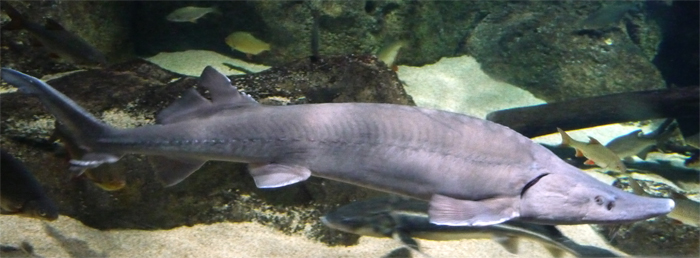 Siberian SturgeonAcipenser baerii
-
 European Sea SturgeonAcipenser sturio
Compare
Questions and answers
What is the scientific name of the Sterlet?
The scientific name of the Sterlet is Acipenser ruthenus. Written with its author, the full name is Acipenser ruthenus Linnaeus, 1758.
Which family does the Sterlet belong to?
Acipenser ruthenus belongs to the family Acipenseridae, in the order Acipenseriformes and the class Chondrostei.
Where is the Sterlet found?
Checklists and occurrence records place Acipenser ruthenus in 15 countries, including Russia, Ukraine, Belgium, France, Slovakia and Serbia.
What is the conservation status of the Sterlet?
The IUCN Red List category recorded for Acipenser ruthenus is Endangered (EN).
What other names does the Sterlet have?
Acipenser ruthenus is also known in English as Sterlet Sturgeon.
Sources
Passages the profile rests on
- The sterlet has variable coloration, typically with a yellowish underside. Source passage: “It is quite variable in coloration, but usually has a yellowish ventral side.” — English Wikipedia
- The sterlet can be distinguished from other European sturgeons by its numerous whitish lateral scutes, fringed barbels, and elongated, narrow snout. Source passage: “It can be distinguished from other European species of sturgeons by the presence of a great number of whitish lateral scutes, fringed barbels, and an elongated and narrow snout” — English Wikipedia
- The sterlet inhabits large rivers flowing into the Black Sea, Azov Sea, and Caspian Sea. Source passage: “native to large rivers that flow into the Black Sea, Azov Sea, and Caspian Sea” — English Wikipedia
- The sterlet also inhabits large rivers in Siberia. Source passage: “as well as rivers in Siberia as far east as Yenisei.” — English Wikipedia
- Benthic organisms constitute the sterlet's main food source. Source passage: “The sterlet's main source of food is benthic organisms” — English Wikipedia
- The sterlet commonly consumes crustaceans, worms, and insect larvae. Source passage: “they commonly feed on crustaceans, worms, and insect larvae.” — English Wikipedia
- Anadromous sterlet populations that migrated between freshwater and saltwater have been extirpated. Source passage: “Populations migrating between fresh and salt water (anadromous) have been extirpated.” — English Wikipedia
- Male sterlets reach sexual maturity between 3 and 7 years of age. Source passage: “Males reach sexual maturity at 3–7 years old” — English Wikipedia
- Female sterlets reach sexual maturity between 4 and 12 years of age. Source passage: “females at 4–12 years old.” — English Wikipedia
- Sterlet spawning takes place from mid-April to early June. Source passage: “Spawning occurs from the middle of April to the beginning of June.” — English Wikipedia
- Female sterlets can lay between 15,000 and 44,000 eggs. Source passage: “Females may lay from 15,000 to 44,000 eggs” — English Wikipedia
- The preferred water temperature for sterlet egg laying is 12–17 °C. Source passage: “at water temperatures preferably 12–17 °C (54–63 °F).” — English Wikipedia
- The sterlet has declined throughout its native range because of overfishing, pollution, and dam construction. Source passage: “Due to overfishing (for its flesh, caviar, and isinglass), pollution, and dams, the sterlet has declined throughout its native range” — English Wikipedia
- The sterlet is considered endangered by the IUCN. Source passage: “is considered endangered by the IUCN.” — English Wikipedia
- The sterlet is subject to continuing declines in mature individuals. Source passage: “Continuing decline of mature individuals” — iucnredlist.org
- The sterlet is subject to continuing declines in the area, extent, or quality of its habitat. Source passage: “Continuing decline in area, extent and/or quality of habitat” — iucnredlist.org
- Conservation sites have been identified across part of the sterlet's range. Source passage: “Conservation sites identified : Yes, over part of range” — iucnredlist.org
- Restocking projects for the sterlet are ongoing. Source passage: “Restocking projects are ongoing” — English Wikipedia
- Introduced sterlet populations outside the native range have generally failed to become self-sustaining. Source passage: “it has been introduced to some regions outside its native range, but the latter have generally not become self-sustaining.” — English Wikipedia
- The sterlet is included in international legislation. Source passage: “Included in international legislation : Yes” — iucnredlist.org
- The sterlet is subject to international management or trade controls. Source passage: “Subject to any international management / trade controls : Yes” — iucnredlist.org
- The sterlet has been the subject of education and awareness programmes. Source passage: “Subject to recent education and awareness programmes : Yes” — iucnredlist.org
- Sterlet flesh, caviar, and isinglass are commercial uses associated with the species. Source passage: “for its flesh, caviar, and isinglass” — English Wikipedia
- The sterlet's flesh is highly esteemed in Russia. Source passage: “In Russia, it is held in high esteem on account of its flesh” — English Wikipedia
- Most international trade in sterlets currently involves aquaculture-raised individuals. Source passage: “Today, the majority of the international trade involves sterlets from aquaculture.” — English Wikipedia
- The sterlet is the last of five native sturgeon species inhabiting the Middle and Upper Danube River. Source passage: “The sterlet (Acipenser ruthenus in Linnaeus' classification) is the last of the five native sturgeon species inhabiting the Middle and Upper Danube River.” — English Wikipedia
- The sterlet can reach a maximum recorded weight of 16 kg. Source passage: “The sterlet may reach 16 kg in weight” — English Wikipedia
- The sterlet can reach 100 to 125 cm in length, although it rarely exceeds 90 cm. Source passage: “100 to 125 cm in length, rarely exceeding a length of 90 cm.” — English Wikipedia
Data
- Catalogue of Life, 2026-10-16 XR cc by
- Global Biodiversity Information Facility CC BY 4.0
- Wikidata CC0
- GeoNames CC BY 4.0
- Wikimedia Commons per image; credit shown with each image
- Within the Catalogue of Life, this name comes from World Register of Marine Species cc by
References
- Linnaeus, C. (1758). Systema Naturae per regna tria naturae, secundum classes, ordines, genera, species, cum characteribus, differentiis, synonymis, locis. Tomus I. Editio decima, reformata. Laurentii Salvii. Holmiae [Stockholm]. [iii] + 824 pp. https://doi.org/10.5962/bhl.title.542 Link where the name was published
This species in other databases
Page built on 28 November 2026. See how the catalog is made and all sources and licences.
Cite this page
ScientificNames.org. (2026). Acipenser ruthenus (Sterlet). Retrieved November 28, 2026, from https://scientificnames.org/species/acipenser-ruthenus
“Acipenser ruthenus (Sterlet).” ScientificNames.org, 2026, scientificnames.org/species/acipenser-ruthenus. Accessed 28 Nov. 2026.
ScientificNames.org. “Acipenser ruthenus (Sterlet).” Accessed November 28, 2026. https://scientificnames.org/species/acipenser-ruthenus.
@misc{scientificnames_acipenser_ruthenus_sterlet,
  author = {{ScientificNames.org}},
  title = {Acipenser ruthenus (Sterlet)},
  year = {2026},
  url = {https://scientificnames.org/species/acipenser-ruthenus},
  note = {Accessed 2026-11-28}
}