Species · Fishes
Lake Sturgeon Acipenser fulvescens
The scientific name of the Lake Sturgeon is Acipenser fulvescens. It is a species of fish in the family Acipenseridae (sturgeon), order Acipenseriformes. The name dates from 1817.
- Scientific name
- Acipenser fulvescens Rafinesque, 1817
- Common name
- Lake Sturgeon
- Genus
- Acipenser
- Family
- Acipenseridae (Sturgeon)
- Order
- Acipenseriformes
- Class
- Chondrostei
- Red List category
- EN Endangered
- Environment
- brackish, freshwater
- Recorded in
- 2 countries
- Name status
- accepted in the Catalogue of Life

Overview
Lake Sturgeon (Acipenser fulvescens Rafinesque, 1817) is a cartilaginous, potamodromous fish in the family Acipenseridae, order Acipenseriformes, and class Chondrostei. Its native range extends from Hudson Bay to the Mississippi River basin, and its Canadian range extends from Alberta to Quebec. It has five rows of bony scutes, four barbels beneath the rostrum, large pectoral fins, and a heterocercal tail.
Written 26 November 2026 from the sources listed below. Each statement was checked against the passage it cites; statements that could not be supported were removed.
Appearance
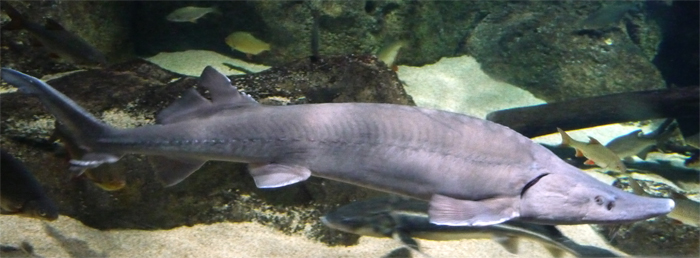
Lake Sturgeon has five rows of bony scutes, four barbels beneath the rostrum, large pectoral fins, and a heterocercal tail. The species can exceed 7 feet (2.1 m) in length and weigh well over 250 pounds.[1][2][3]
Habitat
The species spawns on clean gravel shoals and stream rapids.[4]
Diet
Lake Sturgeon primarily feeds on benthic macroinvertebrates, including mayflies, chironomids, and stoneflies. In the Saskatchewan River, crayfish account for approximately 49.1% of its diet.[5][6]
The species also consumes small fish, mussels, and other crustaceans opportunistically. Its diet varies with fish size, age, geographic location, and locally available food resources.[7][8]
Behaviour
Lake Sturgeon migrates long distances for spawning, food, and seasonal environmental conditions. It often returns to its natal streams to reproduce.[9][10]
Newly hatched larvae are negatively phototactic and remain among large cobble and rocks. Approximately two weeks after hatching, they drift downstream, commonly at night.[11][12]
Juveniles can remain in their natal streams for several years.[13]
Reproduction and life cycle
Males generally reach reproductive maturity at 15–20 years of age, while females generally mature at 20–25 years. The species has polygamous reproductive behaviour.[14][15][16]
Males typically spawn every two to seven years, while females typically spawn every four to nine years. Spawning generally occurs between April and June, at a preferred water temperature of 55–64 °F (13–18 °C).[17][18][19][20]
Females produce approximately 4,000–7,000 eggs per pound of body weight. Eggs generally hatch within 8–14 days, and newly hatched larvae are approximately 10 mm long.[21][22][23]
Conservation
Overfishing has contributed to Lake Sturgeon's classification as Endangered by the IUCN. All Canadian populations are listed by COSEWIC, and the Saskatchewan River population was classified as endangered by COSEWIC in 2006.[24][25][26]
Hydroelectric dams, water pollution, and caviar harvesting have contributed to population reductions. Habitat restoration, harvest restrictions, and stocking programs have contributed to the recovery of some populations.[27][28]
Uses
Lake Sturgeon is commercially valued for its meat, caviar, and isinglass. Indigenous peoples traditionally used its meat, eggs, isinglass, and bones for ceremonial and traditional purposes.[29][30]
European settlers used the species' isinglass as a clarifying agent in beer and wine.[31]
Classification of the Lake Sturgeon
| Kingdom | Animalia |
|---|---|
| Phylum | Chordata |
| Subphylum | Vertebrata |
| Infraphylum | Gnathostomata |
| Parvphylum | Osteichthyes |
| Gigaclass | Actinopterygii |
| Superclass | Actinopteri |
| Class | Chondrostei |
| Order | Acipenseriformes |
| Family | Acipenseridae (Sturgeon) |
| Genus | Acipenser (Sturgeons) |
| Species | Acipenser fulvescens Rafinesque, 1817 |
Where the Lake Sturgeon is found
Checklists and occurrence records place Acipenser fulvescens in 2 countries. GBIF holds 586,783 georeferenced records of it.
Countries
Regions and cities with the most records
- Québec, Canada 430,724
- Lévis, Canada 430,720
- L'Ancienne-Lorette, Canada 419,187
- Neufchâtel-Est–Lebourgneuf, Canada 412,219
- Quebec, Canada 40,386
- Saint-Augustin-de-Desmaures, Canada 39,172
- Sainte-Catherine, Canada 27,287
- Trois-Rivières, Canada 27,253
- Sorel-Tracy, Canada 16,884
- L'Assomption, Canada 10,619
- Varennes, Canada 9,516
- Repentigny, Canada 9,508
- Joliette, Canada 5,626
- Mascouche, Canada 3,469
- Le Plateau-Mont-Royal, Canada 2,271
- Rosemont–La Petite-Patrie, Canada 2,270
- Villeray–Saint-Michel–Parc-Extension, Canada 2,222
- Dorval, Canada 2,063
- Châteauguay, Canada 2,059
- Beaconsfield, Canada 2,056
- Pointe-Claire, Canada 2,056
- Kirkland, Canada 2,053
- L'Île-Bizard–Sainte-Geneviève, Canada 2,052
- Pierrefonds, Canada 2,052
- Montréal, Canada 1,908
- Ville-Marie, Canada 1,907
- Mont-Royal, Canada 1,906
- Westmount, Canada 1,897
- Laval, Canada 1,896
- Le Sud-Ouest, Canada 1,882
- Côte-Saint-Luc, Canada 1,880
- La Prairie, Canada 1,879
- Cartierville, Canada 1,874
- Laval-des-Rapides, Canada 1,873
- Candiac, Canada 1,657
- Sainte-Catherine, Canada 1,657
1 more country has a few records outside this range
These countries hold a few records of Acipenser fulvescens but lie outside the range the checklists give for it. Such records are often zoo or garden specimens, museum material or vagrants, so the species is not counted as occurring there.
A number beside a place is its count of GBIF occurrence records. A place without a number comes from a checklist alone. Records show where a species has been observed or collected, which can include escapes and vagrants.
Common names
English
- Lake Sturgeon
- Rock Sturgeon
Names in 8 other languages
- Finnish
- Järvisampi
- French
- esturgeon jaune
- German
- See-Stör
- Italian
- Storione di lago
- Polish
- Jesiotr jeziorny
- Spanish
- Esturión Lacustre
- Turkish
- Göl mersin baligi
- Ukrainian
- Озерний осетер
Synonyms
5 other scientific names have been used for this species and are now treated as synonyms of Acipenser fulvescens.
- Accipenser fulvescens Rafinesque, 1817
- Acipenser (Huso) fulvescens Rafinesque, 1817
- Acipenser (Sterletus) fulvescens Rafinesque, 1817
- Acipenser rubicundus Lesueur, 1818
- Huso fulvescens (Rafinesque, 1817)
Related species
-
 White SturgeonAcipenser transmontanus
-
 Dabry's SturgeonAcipenser dabryanus
-
 Atlantic SturgeonAcipenser oxyrinchus
-
 Russian SturgeonAcipenser gueldenstaedtii
-
 Chinese SturgeonAcipenser sinensis
-
 SterletAcipenser ruthenus
-
 Siberian SturgeonAcipenser baerii
-
 European Sea SturgeonAcipenser sturio
Compare
Questions and answers
What is the scientific name of the Lake Sturgeon?
The scientific name of the Lake Sturgeon is Acipenser fulvescens. Written with its author, the full name is Acipenser fulvescens Rafinesque, 1817.
Which family does the Lake Sturgeon belong to?
Acipenser fulvescens belongs to the family Acipenseridae, in the order Acipenseriformes and the class Chondrostei.
Where is the Lake Sturgeon found?
Checklists and occurrence records place Acipenser fulvescens in 2 countries: Canada and United States.
What is the conservation status of the Lake Sturgeon?
The IUCN Red List category recorded for Acipenser fulvescens is Endangered (EN).
What other names does the Lake Sturgeon have?
Acipenser fulvescens is also known in English as Rock Sturgeon.
Can lake sturgeon live 400 years?
A lifespan of up to 150 years has been estimated for Lake Sturgeon. Validated otolith ages have documented individuals reaching 68 years.[32][33]
How heavy is a 5 ft sturgeon?
Lake Sturgeon can exceed 7 feet (2.1 m) in length and weigh well over 250 pounds. No weight is specified for a 5 ft individual.[2][3]
How rare are lake sturgeon?
Overfishing has contributed to the species' classification as Endangered by the IUCN. All Canadian populations are listed by COSEWIC.[24][25]
What is the diet of a sturgeon?
Lake Sturgeon primarily feeds on benthic macroinvertebrates, including mayflies, chironomids, and stoneflies. It also consumes small fish, mussels, and other crustaceans opportunistically.[6][7]
What does the lake sturgeon eat?
Lake Sturgeon primarily feeds on benthic macroinvertebrates, including mayflies, chironomids, and stoneflies. It also eats small fish, mussels, and other crustaceans opportunistically. In the Saskatchewan River, crayfish account for approximately 49.1% of its diet.[5][6][7]
Sources
Passages the profile rests on
- The species has five rows of bony scutes, four barbels beneath the rostrum, large pectoral fins, and a heterocercal tail. Source passage: “lake sturgeon have five rows of bony scutes, four barbels on the ventral side of the rostrum anterior of the protrusible mouth, large pectoral fins, and a heterocercal tail.” — English Wikipedia
- The species can exceed 7 feet (2.1 m) in length. Source passage: “grow up to over 7 feet long” — English Wikipedia
- The species can weigh well over 250 pounds. Source passage: “weigh well over 250 pounds.” — English Wikipedia
- The species spawns on clean gravel shoals and stream rapids. Source passage: “They spawn on clean, gravel shoals and stream rapids” — English Wikipedia
- In the Saskatchewan River, crayfish account for approximately 49.1% of the species' diet. Source passage: “Their diet was dominated by crayfish (49.1± 6.4%)” — pmc.ncbi.nlm.nih.gov
- The species primarily feeds on benthic macroinvertebrates, including mayflies, chironomids, and stoneflies. Source passage: “Primarily feeding on benthic macroinvertebrates, such as mayflies, chrionimids, stoneflies” — English Wikipedia
- The species also consumes small fish, mussels, and other crustaceans opportunistically. Source passage: “lake sturgeon will also opportunistically eat small fish, mussels, and other crustaceans.” — English Wikipedia
- The species' diet varies with fish size, age, geographic location, and locally available food resources. Source passage: “the diet of lake sturgeon varies depending on the size and age of the fish, and the geographic location and available food resources within the system they inhabitat.” — English Wikipedia
- The species migrates long distances for spawning, food, and seasonal environmental conditions. Source passage: “Lake sturgeon are known to migrate long distances for spawning, in search of food, or in response to seasonal environmental conditions.” — English Wikipedia
- The species often returns to its natal streams to reproduce. Source passage: “often returning to their natal streams for reproduction.” — English Wikipedia
- Newly hatched larvae are negatively phototactic and remain among large cobble and rocks. Source passage: “Larvae are negatively phototactic, and remain in the interstitial places of large cobble and rocks.” — English Wikipedia
- Larvae drift downstream approximately two weeks after hatching and commonly drift at night. Source passage: “About two weeks after hatching, larvae drift downstream with the current, and are known to drift at night to avoid predation.” — English Wikipedia
- Juveniles can remain in their natal streams for several years. Source passage: “As juveniles, they can remain in their natal streams for several years” — English Wikipedia
- Males generally reach reproductive maturity at 15–20 years of age. Source passage: “Male lake sturgeon do not reach reproductive maturity until 15-20 years old” — English Wikipedia
- Females generally reach reproductive maturity at 20–25 years of age. Source passage: “females take up to 20-25 years.” — English Wikipedia
- The species has polygamous reproductive behaviour. Source passage: “Lake sturgeon are polygamous, maximizing genetic diversity.” — English Wikipedia
- Females typically spawn every four to nine years. Source passage: “females spawn every 4 to 9 years.” — English Wikipedia
- Males typically spawn every two to seven years. Source passage: “Males spawn every 2 to 7 years” — English Wikipedia
- Spawning generally occurs between April and June. Source passage: “usually from April to June.” — English Wikipedia
- The preferred spawning water temperature is 55–64 °F (13–18 °C). Source passage: “They prefer to spawn in temperatures between 55 and 64 °F (13 and 18 °C).” — English Wikipedia
- Females produce approximately 4,000–7,000 eggs per pound of body weight. Source passage: “Female lake sturgeon lay 4,000 to 7,000 eggs per pound of fish.” — English Wikipedia
- Eggs generally hatch within 8–14 days. Source passage: “Eggs typically hatch after 8 to 14 days.” — English Wikipedia
- Newly hatched larvae are approximately 10 mm long. Source passage: “At hatching, the larvae are barely discernible and are about 10 mm long.” — English Wikipedia
- Overfishing has contributed to the species' classification as Endangered by the IUCN. Source passage: “overfishing has contributed to its current IUCN classification as an Endangered species.” — English Wikipedia
- All Canadian populations of the species are listed by COSEWIC. Source passage: “All Canadian lake sturgeon (Acipenser fulvescens) populations are listed under the Committee on the Status of Endangered Wildlife in Canada (COSEWIC)” — pmc.ncbi.nlm.nih.gov
- The Saskatchewan River population was classified as endangered by COSEWIC in 2006. Source passage: “In 2006, the Committee on the Status of Endangered Wildlife in Canada (COSEWIC) listed the Saskatchewan River populations, along with four other populations, as endangered” — pmc.ncbi.nlm.nih.gov
- Hydroelectric dams, water pollution, and caviar harvesting have contributed to population reductions. Source passage: “Anthropogenic impacts, such as blocked migratory routes by hydroelectric dams, water pollution, and extensive caviar harvesting in the late 1800’s and early 1900’s, have resulted in significant reductions of lake sturgeon populations” — pmc.ncbi.nlm.nih.gov
- Habitat restoration, harvest restrictions, and stocking programs have contributed to the recovery of some populations. Source passage: “Many populations of lake sturgeon have recovered through harvest restrictions, habitat restoration, and stocking program intiatives.” — English Wikipedia
- The species is commercially valued for its meat, caviar, and isinglass. Source passage: “This sturgeon is a valuable gourmet food fish, as well as a source of specialty products including caviar and isinglass.” — English Wikipedia
- Indigenous peoples traditionally used the species' meat, eggs, isinglass, and bones for ceremonial and traditional purposes. Source passage: “Native Americans utilized every part of the lake sturgeon, including the meat, eggs, isinglass, and bones for traditional and ceremonial purposes.” — English Wikipedia
- European settlers used the species' isinglass as a clarifying agent in beer and wine. Source passage: “European settlers utilized the meat, eggs, and isinglass, as a beer and wine clarifier.” — English Wikipedia
- Validated otolith ages have documented individuals reaching 68 years. Source passage: “Validated ages from otoliths have shown individuals up to 68 years old” — English Wikipedia
- A lifespan of up to 150 years has been estimated for the species. Source passage: “individuals reaching up to 150 years old is assumed and estimated from a fin ray from the 1950s.” — English Wikipedia
Data
- Catalogue of Life, 2026-10-16 XR cc by
- Global Biodiversity Information Facility CC BY 4.0
- Wikidata CC0
- GeoNames CC BY 4.0
- Wikimedia Commons per image; credit shown with each image
- Within the Catalogue of Life, this name comes from World Register of Marine Species cc by
References
- Rafinesque, C. S. (1817). Additions to the observations on the sturgeons of North America. American Monthly Magazine and Critical Review, v. 1: 288. where the name was published
This species in other databases
Page built on 27 November 2026. See how the catalog is made and all sources and licences.
Cite this page
ScientificNames.org. (2026). Acipenser fulvescens (Lake Sturgeon). Retrieved November 27, 2026, from https://scientificnames.org/species/acipenser-fulvescens
“Acipenser fulvescens (Lake Sturgeon).” ScientificNames.org, 2026, scientificnames.org/species/acipenser-fulvescens. Accessed 27 Nov. 2026.
ScientificNames.org. “Acipenser fulvescens (Lake Sturgeon).” Accessed November 27, 2026. https://scientificnames.org/species/acipenser-fulvescens.
@misc{scientificnames_acipenser_fulvescens_lake_sturgeon,
  author = {{ScientificNames.org}},
  title = {Acipenser fulvescens (Lake Sturgeon)},
  year = {2026},
  url = {https://scientificnames.org/species/acipenser-fulvescens},
  note = {Accessed 2026-11-27}
}