Species · Fishes
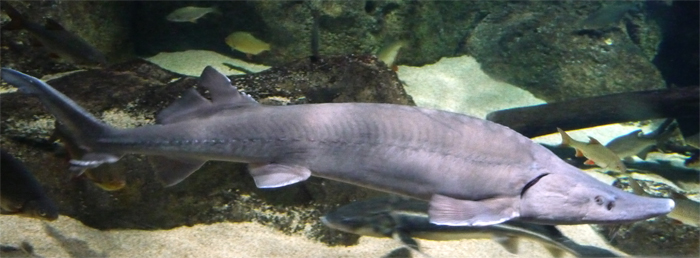
Russian Sturgeon Acipenser gueldenstaedtii
The scientific name of the Russian Sturgeon is Acipenser gueldenstaedtii. It is a species of fish in the family Acipenseridae (sturgeon), order Acipenseriformes. The name dates from 1833.
- Scientific name
- Acipenser gueldenstaedtii Brandt & Ratzeburg, 1833
- Common name
- Russian Sturgeon
- Genus
- Acipenser
- Family
- Acipenseridae (Sturgeon)
- Order
- Acipenseriformes
- Class
- Chondrostei
- Red List category
- CR Critically Endangered
- Environment
- brackish, freshwater, marine
- Recorded in
- 18 countries
- Name status
- accepted in the Catalogue of Life

Overview
The species has a very low minimum population doubling rate, requiring more than 14 years for its population to double. Its vulnerability score is 87 out of 100.
Written 26 November 2026 from the sources listed below. Each statement was checked against the passage it cites; statements that could not be supported were removed.
Conservation
The Russian Sturgeon has a very low minimum population doubling rate, requiring more than 14 years for its population to double.[1]
The species has a very high vulnerability score of 87 out of 100.[2]
Behaviour
Laboratory experiments using Russian Sturgeon from the Volga River were conducted to develop a conceptual model of early behaviour.[3]
Classification of the Russian Sturgeon
| Kingdom | Animalia |
|---|---|
| Phylum | Chordata |
| Subphylum | Vertebrata |
| Infraphylum | Gnathostomata |
| Parvphylum | Osteichthyes |
| Gigaclass | Actinopterygii |
| Superclass | Actinopteri |
| Class | Chondrostei |
| Order | Acipenseriformes |
| Family | Acipenseridae (Sturgeon) |
| Genus | Acipenser (Sturgeons) |
| Species | Acipenser gueldenstaedtii Brandt & Ratzeburg, 1833 |
Where the Russian Sturgeon is found
Checklists and occurrence records place Acipenser gueldenstaedtii in 18 countries. GBIF holds 551 georeferenced records of it.
Countries
- Austria 6
- Belgium 64
- China 9
- Czechia 9
- Denmark 22
- Finland 10
- Georgia 10
- Germany 15
- Hungary 4
- Iran 25
- Kazakhstan 15
- Romania 12
- Russia 58
- Serbia 9
- Sweden 13
- The Netherlands 149
- Turkey 18
- Ukraine 103
Regions and cities with the most records
- Astrakhan Oblast, Russia 31
- Heist-op-den-Berg, Belgium 28
- Herentals, Belgium 28
- Lille, Belgium 27
- Duffel, Belgium 25
- Mortsel, Belgium 25
- Wilrijk, Belgium 25
- Antwerp, Belgium 24
- Berchem, Belgium 24
- Borgerhout, Belgium 24
- Deurne, Belgium 24
- Edegem, Belgium 24
- Kontich, Belgium 24
- Lier, Belgium 24
- Merksem, Belgium 24
- Sint-Katelijne-Waver, Belgium 24
- Brasschaat, Belgium 23
- Ekeren, Belgium 23
- Nijlen, Belgium 23
- Ranst, Belgium 23
- Schoten, Belgium 23
- Gelderland, The Netherlands 22
- Putte, Belgium 21
- Schilde, Belgium 21
- Neerpelt, Belgium 19
- Lommel, Belgium 18
- Peer, Belgium 15
- Kherson, Ukraine 12
- Balen, Belgium 11
- Groningen, The Netherlands 10
- Kasterlee, Belgium 10
- Limburg, The Netherlands 10
- Utrecht, The Netherlands 10
- Aarschot, Belgium 9
- Diest, Belgium 9
- Flevoland, The Netherlands 9
1 more country has a few records outside this range
These countries hold a few records of Acipenser gueldenstaedtii but lie outside the range the checklists give for it. Such records are often zoo or garden specimens, museum material or vagrants, so the species is not counted as occurring there.
A number beside a place is its count of GBIF occurrence records. A place without a number comes from a checklist alone. Records show where a species has been observed or collected, which can include escapes and vagrants.
Common names
English
- Russian Sturgeon
- Danube Sturgeon
- Danube Sturgeon (=Osetr)
- Osetr
Names in 22 other languages
- Belarusian
- Асетр рускі
- Bulgarian
- Ruska esetra, Ruskа esetrа, pуска есетра, Руска есетра
- Czech
- Jeseter ruský
- Danish
- diamantstør
- Dutch
- Donausteur, diamantsteur
- Estonian
- Vene tuur
- Finnish
- venäjänsampi
- French
- esturgeon du Danube
- German
- Donau-Stör, Ossietra-Stör, Russischer Stör, Waxdick
- Greek
- Οξύρυγχος Δούναβη
- Hebrew
- חדקן רוסי
- Hungarian
- Vágó tok
- Italian
- storione danubiano, storione russo
- Lithuanian
- rusiškasis eršketas
- Polish
- jesiotr rosyjski
- Romanian
- nisetru
- Russian
- Осетр русский, Русский осетр, русский осётр
- Slovenian
- koster
- Spanish
- esturion del Danubio, esturión del Danubio
- Swedish
- rysk stör
- Turkish
- karaca, karaca baligi, karaca balığı, rus mersin baligi
- Ukrainian
- Осетер російський, Осетер руський, Осетр російський
Synonyms
30 other scientific names have been used for this species and are now treated as synonyms of Acipenser gueldenstaedtii.
- Acipenser (Huso) gueldenstaedtii Brandt & Ratzeburg, 1833
- Acipenser (Sterletus) gueldenstaedtii Brandt & Ratzeburg, 1833
- Acipenser aculeatus Lovetsky, 1834
- Acipenser gueldenstadti Brandt & Ratzeburg, 1833
- Acipenser gueldenstadtii Brandt & Ratzeburg, 1833
- Acipenser gueldenstaedti Brandt & Ratzeberg, 1833
- Acipenser gueldenstaedti acutirostris Antipa, 1909
- Acipenser gueldenstaedti golis Antipa, 1909
- Acipenser gueldenstaedti longirostris Antipa, 1909
- Acipenser gueldenstaedti scaber Antipa, 1909
- Acipenser gueldenstaedti tanaica Marty, 1940
- Acipenser gueldenstaedti var. tanaica Marti, 1940
- Acipenser gueldenstaedtii gueldenstaedtii Brandt & Ratzeburg, 1833
- Acipenser gueldenstaedtii scobar Antipa, 1909
- Acipenser guldenstadti Brandt & Ratzeberg, 1833
- Acipenser guldenstaedti Brandt & Ratzeberg, 1833
- Acipenser güldenstaedti Brandt & Ratzeberg, 1833
- Acipenser güldenstädti Brandt & Ratzeberg, 1833
- Acipenser güldenstõdti
- Acipenser macrophthalmus Brusina, 1902
- Acipenser macrophthalmus Heckel, 1836
- Acipenser medius Heckel, 1836
- Acipenser medius Brusina, 1902
- Acipenser persicus colchicus Arthyukin & Zarkua, 1986
- Acipenser tuecka Heckel, 1836
- Acipenser tücka Brusina, 1902
- Huso gueldenstaedtii (Brandt & Ratzeburg, 1833)
- Acipenser brevirostris Heckel, 1836 ambiguous synonym
- Acipenser brevirostris Brusina, 1902 ambiguous synonym
- Acipenser pygmaeus Reisinger, 1830 ambiguous synonym
Related species
-
 Lake SturgeonAcipenser fulvescens
-
 White SturgeonAcipenser transmontanus
-
 Dabry's SturgeonAcipenser dabryanus
-
 Atlantic SturgeonAcipenser oxyrinchus
-
 Chinese SturgeonAcipenser sinensis
-
 SterletAcipenser ruthenus
-
 Siberian SturgeonAcipenser baerii
-
 European Sea SturgeonAcipenser sturio
Compare
Questions and answers
What is the scientific name of the Russian Sturgeon?
The scientific name of the Russian Sturgeon is Acipenser gueldenstaedtii. Written with its author, the full name is Acipenser gueldenstaedtii Brandt & Ratzeburg, 1833.
Which family does the Russian Sturgeon belong to?
Acipenser gueldenstaedtii belongs to the family Acipenseridae, in the order Acipenseriformes and the class Chondrostei.
Where is the Russian Sturgeon found?
Checklists and occurrence records place Acipenser gueldenstaedtii in 18 countries, including The Netherlands, Ukraine, Belgium, Russia, Iran and Denmark.
What is the conservation status of the Russian Sturgeon?
The IUCN Red List category recorded for Acipenser gueldenstaedtii is Critically Endangered (CR).
What other names does the Russian Sturgeon have?
Acipenser gueldenstaedtii is also known in English as Danube Sturgeon, Danube Sturgeon (=Osetr) and Osetr.
Sources
Passages the profile rests on
- The species has a very low minimum population doubling rate, requiring more than 14 years for its population to double. Source passage: “Very Low, minimum population doubling time more than 14 years” — fishbase.se
- The species has a very high vulnerability score of 87 out of 100. Source passage: “Very high vulnerability (87 of 100).” — fishbase.se
- Laboratory experiments were conducted using Russian sturgeon from the Volga River to develop a conceptual model of early behaviour. Source passage: “We conducted laboratory experiments with Volga River Russian sturgeon, Acipenser gueldenstaedtii, to develop a conceptual model of early behavior.” — usgs.gov
Data
- Catalogue of Life, 2026-10-16 XR cc by
- Global Biodiversity Information Facility CC BY 4.0
- Wikidata CC0
- GeoNames CC BY 4.0
- Wikimedia Commons per image; credit shown with each image
- Within the Catalogue of Life, this name comes from World Register of Marine Species cc by
References
- Brandt, J. F., & Ratzeburg, J. T. C. (1833). Medizinische Zoologie, oder getreue Darstellung und Beschreibung der Thiere, die in der Arzneimittellehre in Betracht kommen, in systematischer Folge herausgegeben. A. Hirschwald, Berlin., v. 2: i–iv + 1–364, Pls. 1–36 + 1. [Vol. 1 in 1829.]. where the name was published
This species in other databases
Page built on 29 November 2026. See how the catalog is made and all sources and licences.
Cite this page
ScientificNames.org. (2026). Acipenser gueldenstaedtii (Russian Sturgeon). Retrieved November 29, 2026, from https://scientificnames.org/species/acipenser-gueldenstaedtii
“Acipenser gueldenstaedtii (Russian Sturgeon).” ScientificNames.org, 2026, scientificnames.org/species/acipenser-gueldenstaedtii. Accessed 29 Nov. 2026.
ScientificNames.org. “Acipenser gueldenstaedtii (Russian Sturgeon).” Accessed November 29, 2026. https://scientificnames.org/species/acipenser-gueldenstaedtii.
@misc{scientificnames_acipenser_gueldenstaedtii_russian_sturgeon,
  author = {{ScientificNames.org}},
  title = {Acipenser gueldenstaedtii (Russian Sturgeon)},
  year = {2026},
  url = {https://scientificnames.org/species/acipenser-gueldenstaedtii},
  note = {Accessed 2026-11-29}
}