Species · Fishes
White Sturgeon Acipenser transmontanus
The scientific name of the White Sturgeon is Acipenser transmontanus. It is a species of fish in the family Acipenseridae (sturgeon), order Acipenseriformes. The name dates from 1836.
- Scientific name
- Acipenser transmontanus Richardson, 1836
- Common name
- White Sturgeon
- Genus
- Acipenser
- Family
- Acipenseridae (Sturgeon)
- Order
- Acipenseriformes
- Class
- Chondrostei
- Red List category
- VU Vulnerable
- Environment
- brackish, freshwater, marine
- Recorded in
- 2 countries
- Name status
- accepted in the Catalogue of Life

Overview
Acipenser transmontanus occurs along the Pacific coast of North America from the Aleutian Islands in Alaska to Baja California. It has an elongated, cylindrical body, five longitudinal rows of scutes, and a downward-directed mouth without teeth.
Written 26 November 2026 from the sources listed below. Each statement was checked against the passage it cites; statements that could not be supported were removed.
Appearance
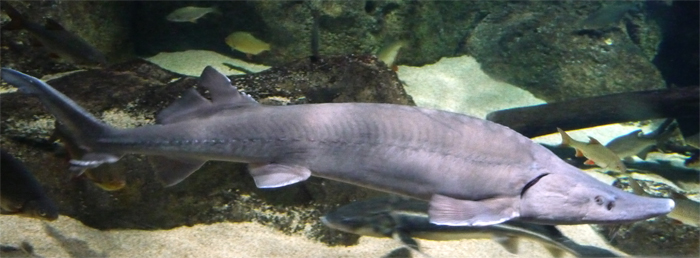
White Sturgeon has an elongated, cylindrical body without scales and five longitudinal rows of scutes. Its dorsal surface is light gray and its ventral surface is white.[1][2][3]
Its mouth is directed downward and lacks teeth. It has a short, broad snout with four barbels positioned closer to its tip than to its mouth.[4][5]
Habitat
White Sturgeon inhabits streams, rivers, estuaries, and marine waters. Adults have been recorded at depths of 30 metres.[6][7]
Adult White Sturgeon generally spend most of their time in nearshore marine waters, although most individuals are thought to spend the majority of their time in freshwater.[8][9]
Diet
White Sturgeon are opportunistic bottom feeders that use their barbels to detect food.[10]
Juveniles feed on clams, mussels, crayfish, worms, and fish eggs. Larger individuals prey on smelt, anchovies, lamprey, shad, and salmon.[11][12]
Behaviour
White Sturgeon can move between freshwater and saltwater without requiring this movement to complete their life cycle. Individuals can remain entirely in freshwater when access to the sea is unavailable.[13][14]
White Sturgeon can migrate far inland through large rivers to reach spawning areas. Some landlocked populations also undertake migrations.[15][16]
Kootenai River White Sturgeon have been observed moving upstream between 16 and 114 river kilometres during spring. Individuals remaining sedentary during summer have been found in the deepest river pools.[17][18]
Reproduction and life cycle
White Sturgeon reproduce by releasing eggs and sperm into fast-flowing water. Spawning generally occurs by May or June after adults enter large rivers in early spring.[19][20]
White Sturgeon typically reach sexual maturity between 15 and 25 years of age. In the Lower Columbia River, they typically mature at approximately 6 feet in length.[21][22]
Female White Sturgeon are estimated to spawn every four to six years, while males are estimated to spawn every two to three years. Male sturgeons generally reproduce for 10 to 20 years, while females reproduce for 15 to 25 years.[23][24][25]
Landlocked White Sturgeon have been observed spawning during peak river flows.[26]
Conservation
Dam construction has created landlocked populations and destroyed spawning grounds. Populations in Pacific Northwest river systems are isolated, with migration restricted by dam-created pools and lakes.[27][28]
The Kootenai River population has experienced a decline since the 1960s and a complete absence of breeding juvenile recruitment since 1974. It received endangered status in 1994.[29][30][31]
Warmer water temperatures may reduce spawning success or increase disease risk and mortality. Declining spring and summer streamflows reduce spawning habitat and annual recruitment.[32][33]
Reduced prey availability in estuarine environments has been associated with impaired growth in young White Sturgeon. The species is classified as a Species of Greatest Conservation Need under Washington's State Wildlife Action Plan.[34][35]
Recreational harvest of White Sturgeon is prohibited in Willapa Bay, Grays Harbor, Puget Sound, and other coastal areas of Washington.[36]
Uses
White Sturgeon are valued as game fish because of their large size and flesh quality. Their roe is used to produce caviar.[37][38]
Classification of the White Sturgeon
| Kingdom | Animalia |
|---|---|
| Phylum | Chordata |
| Subphylum | Vertebrata |
| Infraphylum | Gnathostomata |
| Parvphylum | Osteichthyes |
| Gigaclass | Actinopterygii |
| Superclass | Actinopteri |
| Class | Chondrostei |
| Order | Acipenseriformes |
| Family | Acipenseridae (Sturgeon) |
| Genus | Acipenser (Sturgeons) |
| Species | Acipenser transmontanus Richardson, 1836 |
Where the White Sturgeon is found
Checklists and occurrence records place Acipenser transmontanus in 2 countries. GBIF holds 207,885 georeferenced records of it.
Countries
Regions and cities with the most records
- Coquitlam, Canada 176,078
- Port Coquitlam, Canada 176,078
- Port Moody, Canada 176,004
- Fleetwood, Canada 168,192
- Pitt Meadows, Canada 165,821
- Maple Ridge, Canada 151,043
- Surrey, Canada 141,641
- British Columbia, Canada 140,795
- Strawberry Hill, Canada 138,061
- New Westminster, Canada 132,717
- Burnaby, Canada 132,712
- Langley, Canada 112,170
- Victoria-Fraserview, Canada 82,521
- Riley Park, Canada 82,491
- North Vancouver, Canada 57,651
- Delta, Canada 50,553
- Richmond, Canada 50,553
- Vancouver, Canada 50,043
- White Rock, Canada 12,618
- West Vancouver, Canada 6,932
- Oakley, United States 3,833
- Antioch, United States 3,831
- Pittsburg, United States 3,357
- Bay Point, United States 2,080
- Martinez, United States 1,932
- Concord, United States 1,902
- Pleasant Hill, United States 1,900
- Brentwood, United States 1,482
- Abbotsford, Canada 1,401
- Mission, Canada 1,400
- Walnut Creek, United States 1,152
- California, United States 791
- Benicia, United States 177
- Idaho, United States 131
- Oregon, United States 123
- Pinole, United States 101
1 more country has a few records outside this range
These countries hold a few records of Acipenser transmontanus but lie outside the range the checklists give for it. Such records are often zoo or garden specimens, museum material or vagrants, so the species is not counted as occurring there.
A number beside a place is its count of GBIF occurrence records. A place without a number comes from a checklist alone. Records show where a species has been observed or collected, which can include escapes and vagrants.
Common names
English
- White Sturgeon
Names in 8 other languages
- Dutch
- Pacific steur, witte steur
- French
- esturgeon blanc
- German
- Sacramentostör, weißer Stör
- Italian
- storione bianco
- Lithuanian
- baltasis eršketas
- Slovenian
- beli jeseter
- Spanish
- esturión blanco
- Swedish
- vit stör
Synonyms
3 other scientific names have been used for this species and are now treated as synonyms of Acipenser transmontanus.
- Acipenser (Sinosturio) transmontanus Richardson, 1836
- Acipenser aleutensis Fitzinger, 1836
- Sinosturio transmontanus (Richardson, 1836)
Related species
-
 Lake SturgeonAcipenser fulvescens
-
 Dabry's SturgeonAcipenser dabryanus
-
 Atlantic SturgeonAcipenser oxyrinchus
-
 Russian SturgeonAcipenser gueldenstaedtii
-
 Chinese SturgeonAcipenser sinensis
-
 SterletAcipenser ruthenus
-
 Siberian SturgeonAcipenser baerii
-
 European Sea SturgeonAcipenser sturio
Compare
Questions and answers
What is the scientific name of the White Sturgeon?
The scientific name of the White Sturgeon is Acipenser transmontanus. Written with its author, the full name is Acipenser transmontanus Richardson, 1836.
Which family does the White Sturgeon belong to?
Acipenser transmontanus belongs to the family Acipenseridae, in the order Acipenseriformes and the class Chondrostei.
Where is the White Sturgeon found?
Checklists and occurrence records place Acipenser transmontanus in 2 countries: Canada and United States.
What is the conservation status of the White Sturgeon?
The IUCN Red List category recorded for Acipenser transmontanus is Vulnerable (VU).
Why is sturgeon illegal to fish?
Recreational harvest of White Sturgeon is prohibited in Willapa Bay, Grays Harbor, Puget Sound, and other coastal areas of Washington. The Kootenai River population received endangered status in 1994.[29][36]
What's the biggest white sturgeon ever recorded?
The largest recorded White Sturgeon described weighed 682 kilograms and was caught in Idaho's Snake River in 1898.[39]
What do white sturgeon eat?
Juveniles eat clams, mussels, crayfish, worms, and fish eggs. Larger White Sturgeon prey on smelt, anchovies, lamprey, shad, and salmon.[11][12]
What habitat do sturgeon live in?
White Sturgeon inhabit streams, rivers, estuaries, and marine waters.[6]
Sources
Passages the profile rests on
- The species has an elongated, cylindrical body. Source passage: “Its body is elongate and cylindrical” — animaldiversity.org
- The species lacks scales and has five longitudinal rows of scutes. Source passage: “It has no scales but five rows of "scutes" along the body.” — animaldiversity.org
- The dorsal surface is light gray and the ventral surface is white. Source passage: “Dorsal color is light gray while the ventral surface is white.” — animaldiversity.org
- The species has a downward-directed ventral mouth and lacks teeth. Source passage: “The mouth is ventral, moderate in size and directed downward. The white sturgeon has no teeth” — animaldiversity.org
- The white sturgeon has a short, broad snout with four barbels positioned closer to its tip than to its mouth. Source passage: “This fish is recognized by its short broad snout with four barbels closer to the tip of the snout than the mouth.” — animaldiversity.org
- The species inhabits streams, rivers, estuaries, and marine waters. Source passage: “Historically, white sturgeon spent their life in several habitats; streams, rivers, estuaries, and marine waters.” — animaldiversity.org
- Adult white sturgeon have been recorded at depths of 30 metres. Source passage: “but they have been found in depths of 30 meters.” — animaldiversity.org
- Adult white sturgeon generally spend most of their time in nearshore marine waters. Source passage: “Adults spend most of their time in sea near the shore” — animaldiversity.org
- Most white sturgeon are thought to spend the majority of their time in freshwater. Source passage: “A majority of white sturgeon are thought to spend most of their time within the freshwater environment” — wdfw.wa.gov
- White sturgeon are opportunistic bottom feeders that use their barbels to detect food. Source passage: “White Sturgeon have been described as opportunistic feeders, feeding on the bottom with their long snouts and using their barbels to detect food.” — animaldiversity.org
- Juvenile white sturgeon feed on clams, mussels, crayfish, worms, and fish eggs. Source passage: “When small they feed on clams, mussels, crayfish, worms, and fish eggs.” — animaldiversity.org
- Larger white sturgeon prey on smelt, anchovies, lamprey, shad, and salmon. Source passage: “At a larger size, they prey on fish such as smelt, anchovies, lamprey, shad and salmon.” — animaldiversity.org
- White sturgeon can remain entirely in freshwater when access to the sea is unavailable. Source passage: “They are anadromous fish but may spend much or all of their lives in fresh water if they cannot reach the sea” — animaldiversity.org
- White sturgeon can move between freshwater and saltwater without requiring this movement to complete their life cycle. Source passage: “White Sturgeon are amphidromous, meaning they can travel between freshwater and saltwater but it’s not a requirement to complete their life cycle.” — wdfw.wa.gov
- White sturgeon can migrate far inland through large rivers to reach spawning areas. Source passage: “It migrates far inland in large rivers to spawn.” — animaldiversity.org
- Some landlocked white sturgeon populations also undertake migrations. Source passage: “Landlocked fish also migrate.” — animaldiversity.org
- Kootenai River white sturgeon have been observed moving upstream between 16 and 114 river kilometres during spring. Source passage: “the fish were observed to have moved upriver 16 to 114 river kilometers” — animaldiversity.org
- White sturgeon remaining sedentary during summer have been found inhabiting the deepest river pools. Source passage: “The fish that were sedentary during the summer inhabited the deepest holes of the river” — animaldiversity.org
- White sturgeon reproduce by releasing eggs and sperm into fast-flowing water. Source passage: “White sturgeon are broadcast spawners because they release their eggs and sperm in fast water.” — animaldiversity.org
- White sturgeon spawning generally occurs by May or June after adults enter large rivers in early spring. Source passage: “Adults move into large rivers in early spring and spawn by May or June.” — animaldiversity.org
- White sturgeon typically reach sexual maturity between 15 and 25 years of age. Source passage: “typically don't reach sexual maturity until 15–25 years old.” — wdfw.wa.gov
- In the Lower Columbia River, white sturgeon typically mature at approximately 6 feet in length. Source passage: “white sturgeon typically reach sexual maturity when they grow to approximately 6 feet in length” — wdfw.wa.gov
- Male sturgeons generally reproduce for 10 to 20 years, while females reproduce for 15 to 25 years. Source passage: “the males reproduce for 10 to 20 years and females for 15 to 25 years.” — animaldiversity.org
- Female white sturgeon are estimated to spawn every four to six years. Source passage: “Females are estimated to spawn every 4-6 years” — wdfw.wa.gov
- Male white sturgeon are estimated to spawn every two to three years. Source passage: “males are estimated to spawn every 2-3 years.” — wdfw.wa.gov
- Landlocked white sturgeon have been observed spawning during peak river flows. Source passage: “Landlocked sturgeons have been observed to spawn during periods of peak river flow” — animaldiversity.org
- Dam construction has created landlocked populations and destroyed spawning grounds. Source passage: “The building of dams along the rivers has impacted the populations of white sturgeons by creating landlocked populations and destroying spawning grounds.” — animaldiversity.org
- Populations in Pacific Northwest river systems are isolated, with migration restricted by dam-created pools and lakes. Source passage: “these populations are isolated and their migration is limited within the series of pools and lakes that make up these new dammed rivers” — animaldiversity.org
- The Kootenai River population received endangered status in 1994. Source passage: “In 1994, the population of White Sturgeon located in the Kootenai river was granted endangered status.” — animaldiversity.org
- The Kootenai River population has experienced a decline since the 1960s. Source passage: “The population has been declining since the 1960's” — animaldiversity.org
- The Kootenai River population has experienced a complete absence of breeding juvenile recruitment since 1974. Source passage: “there has been a complete lack of recruitment of breeding juveniles in the population since 1974.” — animaldiversity.org
- Warmer water temperatures may reduce spawning success or increase disease risk and mortality in white sturgeon. Source passage: “increasing temperatures may reduce spawning success and/or increase disease risk and mortality.” — wdfw.wa.gov
- Declining spring and summer streamflows reduce spawning habitat and annual recruitment. Source passage: “declining spring and summer streamflows, which reduce spawning habitat and annual recruitment” — wdfw.wa.gov
- Reduced prey availability in estuarine environments has been associated with impaired growth in young white sturgeon. Source passage: “reduced prey availability has been linked with undermined sturgeon growth.” — wdfw.wa.gov
- White sturgeon are classified as a Species of Greatest Conservation Need under Washington's State Wildlife Action Plan. Source passage: “the species is identified as a Species of Greatest Conservation Need under Washington’s State Wildlife Action Plan.” — wdfw.wa.gov
- Recreational harvest of white sturgeon is prohibited in Willapa Bay, Grays Harbor, Puget Sound, and other coastal areas of Washington. Source passage: “Currently there is no recreational harvest of white sturgeon allowed in the Willapa Bay, Grays Harbor, or Puget Sound waterways or other coastal areas.” — wdfw.wa.gov
- White sturgeon are valued as game fish because of their large size and flesh quality. Source passage: “The size combined with the "characteristic quality of its flesh" makes it a valuable game fish” — animaldiversity.org
- White sturgeon roe is used to produce caviar. Source passage: “Its roe can be used for caviar” — animaldiversity.org
- The largest recorded white sturgeon described in the document weighed 682 kilograms and was caught in Idaho's Snake River in 1898. Source passage: “The largest white sturgeon was taken from the Snake River in Idaho in 1898 and it weighed 682 kilograms” — animaldiversity.org
Data
- Catalogue of Life, 2026-10-16 XR cc by
- Global Biodiversity Information Facility CC BY 4.0
- Wikidata CC0
- GeoNames CC BY 4.0
- Wikimedia Commons per image; credit shown with each image
- Within the Catalogue of Life, this name comes from World Register of Marine Species cc by
References
- Richardson, J. (1836). The Fish. In: Fauna Boreali-Americana; or the zoology of the northern parts of British America: containing descriptions of the objects of natural history collected on the late northern land expeditions, under the command of Sir John Franklin, R.N. J. Bentley, London, Part 3: i–xv + 1–327, Pls. 74–97. [Reference was incorrectly given as 1837; correct date is 1836 (WNE June 12, 2015).]. where the name was published
This species in other databases
Page built on 26 November 2026. See how the catalog is made and all sources and licences.
Cite this page
ScientificNames.org. (2026). Acipenser transmontanus (White Sturgeon). Retrieved November 26, 2026, from https://scientificnames.org/species/acipenser-transmontanus
“Acipenser transmontanus (White Sturgeon).” ScientificNames.org, 2026, scientificnames.org/species/acipenser-transmontanus. Accessed 26 Nov. 2026.
ScientificNames.org. “Acipenser transmontanus (White Sturgeon).” Accessed November 26, 2026. https://scientificnames.org/species/acipenser-transmontanus.
@misc{scientificnames_acipenser_transmontanus_white_sturgeon,
  author = {{ScientificNames.org}},
  title = {Acipenser transmontanus (White Sturgeon)},
  year = {2026},
  url = {https://scientificnames.org/species/acipenser-transmontanus},
  note = {Accessed 2026-11-26}
}