Species · Fishes
Atlantic Sturgeon Acipenser oxyrinchus
The scientific name of the Atlantic Sturgeon is Acipenser oxyrinchus. It is a species of fish in the family Acipenseridae (sturgeon), order Acipenseriformes. The name dates from 1815.
- Scientific name
- Acipenser oxyrinchus Mitchill, 1815
- Common name
- Atlantic Sturgeon
- Genus
- Acipenser
- Family
- Acipenseridae (Sturgeon)
- Order
- Acipenseriformes
- Class
- Chondrostei
- Red List category
- VU Vulnerable
- Environment
- brackish, freshwater, marine
- Recorded in
- 2 countries
- Name status
- accepted in the Catalogue of Life

Overview
Acipenser oxyrinchus inhabits coastal and estuarine waters along the eastern coast of North America from southern Canada to northern Florida. It is distinguished by five rows of bony plates called scutes, four barbels beside its mouth and a relatively long, flattened snout.
Written 26 November 2026 from the sources listed below. Each statement was checked against the passage it cites; statements that could not be supported were removed.
Appearance
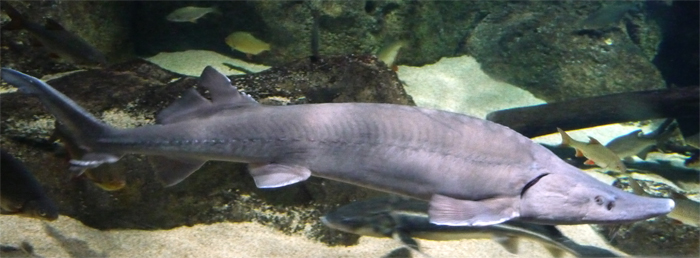
The Atlantic Sturgeon has five rows of bony plates called scutes along its body and four barbels beside its mouth. Its body is robust, with a relatively long, flattened snout that is longer than those of other sturgeons.[1][2][3][4]
Its dorsal coloration ranges from bluish-black to olive green, while its underside is white. Its tail has an asymmetrically larger upper lobe.[5][6]
Atlantic sturgeon typically grow to 1.8–2.4 m in length and typically weigh no more than 140 kg. The species can reach approximately 4.6 m in length and exceed 360 kg in weight.[7][8][9]
Habitat
The species uses coastal brackish waters and large river systems for spawning. In Virginia, spawning habitat includes rocky river bottoms with relatively little silt and debris.[10][11]
Juvenile Atlantic sturgeon prefer river temperatures in the upper 60 degrees Fahrenheit.[12]
Diet
Atlantic sturgeon feed on crustaceans, worms and molluscs. They also feed opportunistically on insects, shrimp and other fish.[13][14]
Their barbels help locate food on the bottom. Their toothless mouths function like vacuums to capture worms, small fish and other small bottom-dwelling animals.[15][16]
American sand lance was the primary food item identified in Atlantic sturgeon from the Saco River.[17]
Behaviour
Juveniles can remain in freshwater for up to six years before moving into brackish waters or the ocean. Atlantic sturgeon live alone or in small groups.[18][19]
Reproduction and life cycle
Atlantic sturgeon reach sexual maturity between five and 34 years of age, depending on population. Females reproduce every two to five years, while males reproduce every one to five years.[20][21][22]
Female Atlantic sturgeon can produce between 400,000 and two million eggs, depending on their size. The eggs are adhesive and attach to river substrate during incubation.[23][24]
Atlantic sturgeon spawning migrations in Virginia occur in spring or fall.[25]
Conservation
The Atlantic Sturgeon was listed under the United States Endangered Species Act in February 2012. Four United States distinct population segments were listed as endangered, while the Gulf of Maine segment was listed as threatened.[26][27]
Overfishing, water pollution and dams have contributed to the decline of Atlantic sturgeon populations. The species is also susceptible to mortality from accidental capture in fisheries operating in its natal estuaries.[28][29]
The Virginia fishing ban for sturgeon was introduced in 1974. A fishery management plan for sturgeon was formalized by the Atlantic States Marine Fisheries Commission in 1990.[30][31]
Baltic Atlantic sturgeon recovery efforts began in 1996 using American donor populations.[32]
Uses
Atlantic sturgeon eggs have historically been harvested to produce caviar. The species was also historically harvested for meat, leather materials and isinglass.[33][34]
Similar species
Shortnose sturgeon are smaller-bodied than Atlantic sturgeon.[35]
Classification of the Atlantic Sturgeon
| Kingdom | Animalia |
|---|---|
| Phylum | Chordata |
| Subphylum | Vertebrata |
| Infraphylum | Gnathostomata |
| Parvphylum | Osteichthyes |
| Gigaclass | Actinopterygii |
| Superclass | Actinopteri |
| Class | Chondrostei |
| Order | Acipenseriformes |
| Family | Acipenseridae (Sturgeon) |
| Genus | Acipenser (Sturgeons) |
| Species | Acipenser oxyrinchus Mitchill, 1815 |
Where the Atlantic Sturgeon is found
Checklists and occurrence records place Acipenser oxyrinchus in 2 countries. GBIF holds 74,039 georeferenced records of it.
Countries
Regions and cities with the most records
- Québec, Canada 57,005
- Lévis, Canada 56,969
- Neufchâtel-Est–Lebourgneuf, Canada 53,183
- L'Ancienne-Lorette, Canada 53,121
- Saint-Augustin-de-Desmaures, Canada 1,974
- Quebec, Canada 1,390
- Sorel-Tracy, Canada 360
- Varennes, Canada 240
- Repentigny, Canada 238
- Joliette, Canada 212
- Mascouche, Canada 206
- Boucherville, Canada 192
- Rivière-du-Loup, Canada 169
- Le Plateau-Mont-Royal, Canada 168
- Longueuil, Canada 168
- Mercier–Hochelaga-Maisonneuve, Canada 168
- Montréal-Nord, Canada 168
- Rivière-des-Prairies–Pointe-aux-Trembles, Canada 168
- Rosemont–La Petite-Patrie, Canada 168
- Saint-Michel, Canada 168
- Saint-Vincent-de-Paul, Canada 168
- Sainte-Julie, Canada 168
- Val-des-Arbres, Canada 168
- Villeray–Saint-Michel–Parc-Extension, Canada 168
- Terrebonne, Canada 166
- Saint-Bruno-de-Montarville, Canada 164
- Laflèche, Canada 148
- Greenfield Park, Canada 130
- Laval, Canada 130
- Mont-Royal, Canada 130
- Montréal, Canada 130
- Saint-Basile-le-Grand, Canada 130
- Ville-Marie, Canada 130
- L'Assomption, Canada 128
- Westmount, Canada 124
- Brossard, Canada 110
9 more countries have a few records outside this range
These countries hold a few records of Acipenser oxyrinchus but lie outside the range the checklists give for it. Such records are often zoo or garden specimens, museum material or vagrants, so the species is not counted as occurring there.
A number beside a place is its count of GBIF occurrence records. A place without a number comes from a checklist alone. Records show where a species has been observed or collected, which can include escapes and vagrants.
Common names
English
- Atlantic Sturgeon
- Gulf Sturgeon
- Paddlefishes
Names in 18 other languages
- Arabic
- حفش أطلسي, حفش خليجي
- Czech
- jeseter ostrorypý
- Danish
- Vestatlantisk stør
- Dutch
- Atlantische steur
- Finnish
- atlantinsampi, sinisampi
- French
- Esturgeon noir d'Amérique, esturgeon noir
- German
- Atlantischer Stör, Baltischer Stör, Ostseestör
- Italian
- storione Atlantico
- Latvian
- store
- Lithuanian
- Aštriašnipis eršketas, aštriašnypis eršketas
- Norwegian Bokmål
- atlanterhavstør
- Polish
- jesiotr atlantycki, jesiotr ostronosy
- Portuguese
- Esturjão-atlântico
- Russian
- остроносый осётр
- Spanish
- esturión del Atlántico
- Swedish
- Atlantisk stör, amerikansk stör, atlantstör, stör
- Turkish
- Atlantik mersin balığı
- Ukrainian
- Атлантичний осетер, Осетер атлантичний
Synonyms
17 other scientific names have been used for this species and are now treated as synonyms of Acipenser oxyrinchus.
- Accipenser ruthenus major Schöpf, 1788
- Acipenser (Acipenser) oxyrinchus Mitchill, 1815
- Acipenser bairdii Duméril, 1870
- Acipenser girardi Duméril, 1870
- Acipenser hallowellii Duméril, 1870
- Acipenser holbrookii Duméril, 1870
- Acipenser kennicottii Duméril, 1870
- Acipenser lecontei Duméril, 1867
- Acipenser lichtensteinii Bloch & Schneider, 1801
- Acipenser macrorhinus Duméril, 1870
- Acipenser mitchillii Duméril, 1870
- Acipenser oxyrhynchus Mitchill, 1814
- Acipenser oxyrhynchus oxyrhynchus Mitchill, 1815
- Acipenser oxyrinchus oxyrinchus Mitchill, 1815
- Acipenser ruthenus major Schöpf, 1788
- Acipenser storeri Duméril, 1870
- Sturio accipenser Strøm, 1784
Related species
-
 Lake SturgeonAcipenser fulvescens
-
 White SturgeonAcipenser transmontanus
-
 Dabry's SturgeonAcipenser dabryanus
-
 Russian SturgeonAcipenser gueldenstaedtii
-
 Chinese SturgeonAcipenser sinensis
-
 SterletAcipenser ruthenus
-
 Siberian SturgeonAcipenser baerii
-
 European Sea SturgeonAcipenser sturio
Compare
Questions and answers
What is the scientific name of the Atlantic Sturgeon?
The scientific name of the Atlantic Sturgeon is Acipenser oxyrinchus. Written with its author, the full name is Acipenser oxyrinchus Mitchill, 1815.
Which family does the Atlantic Sturgeon belong to?
Acipenser oxyrinchus belongs to the family Acipenseridae, in the order Acipenseriformes and the class Chondrostei.
Where is the Atlantic Sturgeon found?
Checklists and occurrence records place Acipenser oxyrinchus in 2 countries: Canada and United States.
What is the conservation status of the Atlantic Sturgeon?
The IUCN Red List category recorded for Acipenser oxyrinchus is Vulnerable (VU).
What other names does the Atlantic Sturgeon have?
Acipenser oxyrinchus is also known in English as Gulf Sturgeon and Paddlefishes.
Why is sturgeon illegal to fish?
Overfishing, water pollution and dams have contributed to the decline of Atlantic sturgeon populations. Accidental capture in fisheries operating in their natal estuaries is also a source of mortality. The species was listed under the United States Endangered Species Act in February 2012.[26][28][29]
What do Atlantic sturgeon eat?
Atlantic sturgeon feed on crustaceans, worms, molluscs, insects, shrimp and other fish. They use their barbels to locate food on the bottom and their toothless mouths to capture small bottom-dwelling animals.[13][15][16][14]
Sources
Passages the profile rests on
- The Atlantic sturgeon has five rows of bony plates called scutes along its body. Source passage: “the Atlantic sturgeon has five rows of bony plates known as scutes.” — English Wikipedia
- The Atlantic sturgeon has four barbels beside its mouth. Source passage: “It has a longer snout than other sturgeons and has four barbels at the side of its mouth.” — English Wikipedia
- The Atlantic sturgeon has a longer snout than other sturgeons. Source passage: “It has a longer snout than other sturgeons” — English Wikipedia
- The Atlantic sturgeon has a robust body and a relatively long, flattened snout. Source passage: “Robust body profile with a relatively long, flattened snout” — dwr.virginia.gov
- Its dorsal coloration ranges from bluish-black to olive green, while its underside is white. Source passage: “Its coloration ranges from bluish-black and olive green on its back to white on its underside.” — English Wikipedia
- Its tail has an asymmetrically larger upper lobe. Source passage: “In addition, the tail is like a shark’s where one side, or lobe, is larger than the other.” — fws.gov
- Atlantic sturgeon typically grow to 1.8–2.4 m in length. Source passage: “they typically grow to be 6–8 ft (1.8–2.4 m)” — English Wikipedia
- Atlantic sturgeon typically weigh no more than 140 kg. Source passage: “and no more than 300 lb (140 kg).” — English Wikipedia
- The species can reach approximately 4.6 m in length and exceed 360 kg in weight. Source passage: “15 ft (4.6 m) in length and over 800 lb (360 kg) in weight.” — English Wikipedia
- The species uses coastal brackish waters and large river systems for spawning. Source passage: “and also coastal brackish waters. They enter large river systems to spawn.” — fws.gov
- Atlantic sturgeon spawning habitat in Virginia includes rocky river bottoms with relatively little silt and debris. Source passage: “it seeks out the same rocky river bottoms from which it was born, in areas that are relatively clean of silt and other debris.” — dwr.virginia.gov
- Juvenile Atlantic sturgeon prefer river temperatures in the upper 60 degrees Fahrenheit. Source passage: “Juvenile Atlantic Sturgeon have been found to prefer river temperatures in the upper 60 degrees Fahrenheit.” — dwr.virginia.gov
- Atlantic sturgeon feed on crustaceans, worms and molluscs. Source passage: “Sturgeons are most generally known for feeding on crustaceans, worms, and molluscs.” — English Wikipedia
- Atlantic sturgeon feed opportunistically on insects, crustaceans, shrimp, molluscs and other fish. Source passage: “opportunistically feeds upon insects, crustaceans, shrimp, mollusks, and other fish inhabiting the substrates.” — dwr.virginia.gov
- Atlantic sturgeon use their barbels to locate food on the bottom. Source passage: “As bottom-feeders, they use their barbels to find food” — fws.gov
- Their toothless mouths function like vacuums to capture worms, small fish and other small bottom-dwelling animals. Source passage: “their toothless mouth acts like a vacuum, capturing worms, small fish and other small animals living on the bottom.” — fws.gov
- American sand lance was the primary food item identified in Atlantic sturgeon from the Saco River. Source passage: “Stomach content analysis revealed that American sand lance (Ammodytes americanus) was the primary food item in the diet of Atlantic sturgeon in the Saco River.” — dune.une.edu
- Atlantic sturgeon live alone or in small groups. Source passage: “They spend most of their adult life in the ocean migrating into coastal estuaries and rivers to spawn in spring and fall. They can occur in small groups or alone.” — fws.gov
- Juveniles can remain in freshwater for up to six years before moving into brackish waters or the ocean. Source passage: “Juveniles can spend up to 6 years in freshwater of large rivers” — fws.gov
- Females reproduce every two to five years. Source passage: “females spawning every 2 to 5 years.” — fws.gov
- Males reproduce every one to five years. Source passage: “males spawning every 1 to 5 years” — fws.gov
- Atlantic sturgeon reach sexual maturity between five and 34 years of age, depending on population. Source passage: “Southern populations grow more quickly and can reach sexual maturity at age 5 to 19, while in northern rivers the age at maturity could be 34 years.” — fws.gov
- Female Atlantic sturgeon can produce between 400,000 and two million eggs, depending on their size. Source passage: “Female Atlantic sturgeon can lay between 400 thousand and 2 million eggs, depending on the size of the female.” — fws.gov
- Atlantic sturgeon eggs are adhesive and attach to river substrate during incubation. Source passage: “their adhesive eggs (up to 2 million of them) are able to stick to the substrate” — dwr.virginia.gov
- Atlantic sturgeon spawning migrations in Virginia occur in spring or fall. Source passage: “two distinct spawning migrations have been identified – with Atlantic Sturgeon ascending the larger Chesapeake Bay tributaries in either the spring or fall.” — dwr.virginia.gov
- The species was listed under the United States Endangered Species Act in February 2012. Source passage: “In February 2012, the Atlantic sturgeon was listed by the National Oceanic and Atmospheric Administration Fisheries Service under the Endangered Species Act (ESA).” — English Wikipedia
- Four United States distinct population segments were listed as endangered, while the Gulf of Maine segment was listed as threatened. Source passage: “Four distinct population segments (DPSs) were listed as endangered (New York Bight, Chesapeake Bay, Carolina, and South Atlantic) while one DPS was listed as threatened (Gulf of Maine).” — English Wikipedia
- Overfishing, water pollution and dams have contributed to the decline of Atlantic sturgeon populations. Source passage: “but has since declined due to overfishing, water pollution, and habitat impediments such as dams.” — English Wikipedia
- The species is susceptible to mortality from accidental capture in fisheries operating in its natal estuaries. Source passage: “They are particularly susceptible to bycatch mortality due to the many fisheries that exist within their natal estuaries.” — English Wikipedia
- The Virginia fishing ban for sturgeon was introduced in 1974. Source passage: “Virginia banned fishing for sturgeon in 1974 after decades of declining catches.” — dwr.virginia.gov
- A fishery management plan for sturgeon was formalized by the Atlantic States Marine Fisheries Commission in 1990. Source passage: “The Atlantic States Marine Fisheries Commission formalized a Fishery Management Plan for sturgeon in 1990” — dwr.virginia.gov
- Baltic Atlantic sturgeon recovery efforts began in 1996 using American donor populations. Source passage: “Since 1996 Baltic sturgeon recovery has been attempted, with American donor populations used due to genetic similarities.” — English Wikipedia
- Atlantic sturgeon eggs have historically been harvested to produce caviar. Source passage: “the primary reason for catching sturgeon was the high-quality caviar that could be made cheaply from its eggs” — English Wikipedia
- Atlantic sturgeon were historically harvested for meat, leather materials and isinglass. Source passage: “Other fisheries along the Atlantic coast harvested them for use as food, a leather material used in clothing and bookbinding, and isinglass” — English Wikipedia
- Shortnose sturgeon are smaller-bodied than Atlantic sturgeon. Source passage: “Shortnose sturgeon (Acipenser brevirostrum) are smaller bodied than Atlantic sturgeon” — fws.gov
Data
- Catalogue of Life, 2026-10-16 XR cc by
- Global Biodiversity Information Facility CC BY 4.0
- Wikidata CC0
- GeoNames CC BY 4.0
- Wikimedia Commons per image; credit shown with each image
- Within the Catalogue of Life, this name comes from World Register of Marine Species cc by
References
- Mitchill, S. L. (1815). The fishes of New-York, described and arranged. Transactions of the Literary and Philosophical Society of New-York, v. 1 (art. 5) (for 1814): 355–492, Pls. 1–6. where the name was published
This species in other databases
- Catalogue of Life 9C6W
- Wikidata Q756969
- iNaturalist 93187
- WoRMS urn:lsid:marinespecies.org:taxname:151802
- ITIS 553269
Page built on 27 November 2026. See how the catalog is made and all sources and licences.
Cite this page
ScientificNames.org. (2026). Acipenser oxyrinchus (Atlantic Sturgeon). Retrieved November 27, 2026, from https://scientificnames.org/species/acipenser-oxyrinchus
“Acipenser oxyrinchus (Atlantic Sturgeon).” ScientificNames.org, 2026, scientificnames.org/species/acipenser-oxyrinchus. Accessed 27 Nov. 2026.
ScientificNames.org. “Acipenser oxyrinchus (Atlantic Sturgeon).” Accessed November 27, 2026. https://scientificnames.org/species/acipenser-oxyrinchus.
@misc{scientificnames_acipenser_oxyrinchus_atlantic_sturgeon,
  author = {{ScientificNames.org}},
  title = {Acipenser oxyrinchus (Atlantic Sturgeon)},
  year = {2026},
  url = {https://scientificnames.org/species/acipenser-oxyrinchus},
  note = {Accessed 2026-11-27}
}