Species · Flowering plants
Formosan Alder Alnus formosana
The scientific name of the Formosan Alder is Alnus formosana. It is a species of flowering plant in the family Betulaceae (birch family), order Fagales.
- Scientific name
- Alnus formosana (Burkill) Makino
- Common name
- Formosan Alder
- Genus
- Alnus
- Family
- Betulaceae (Birch Family)
- Order
- Fagales
- Class
- Magnoliopsida
- Red List category
- LC Least Concern
- Recorded in
- 5 countries
- Name status
- accepted in the Catalogue of Life

Overview
Formosan Alder (Alnus formosana) is a deciduous, fast-growing tree in the family Betulaceae and order Fagales. It is endemic to Taiwan and grows from near sea level to elevations of 2,900 metres. It is a shade-intolerant, nitrogen-fixing pioneer species.
Written 26 November 2026 from the sources listed below. Each statement was checked against the passage it cites; statements that could not be supported were removed.
Appearance
Formosan Alder has dark gray-brown bark. Its leaves are elliptic, oblong-lanceolate, or rarely ovate-oblong, with irregularly minutely serrated margins and acuminate or acute apices.[1][2][3]
The underside of its leaves is hairy in the axils of lateral veins, while the upper surface is almost hairless. Its leaf petioles measure 1.2–2.2 cm in length, and the midrib has six or seven lateral veins on each side.[4][5][6]
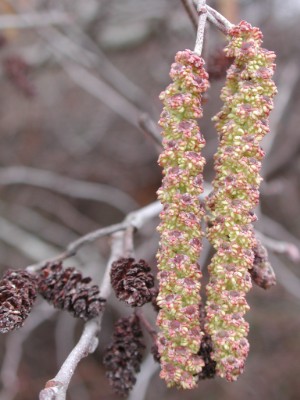
Its female inflorescences are ellipsoid and measure 1–2.5 cm long.[7]
Formosan Alder can reach 20 metres in height, with a trunk diameter of up to 40 centimetres.[8][9]
Habitat
Formosan Alder commonly grows on riverbanks and in other open habitats. It occurs from near sea level to elevations of 2,900 metres.[10][11][12]
It commonly inhabits disturbed environments as a pioneer species. It grows in eroded or denuded areas, sometimes forming pure stands.[13][14]
Behaviour
Formosan Alder is a shade-intolerant pioneer tree. It is fast-growing and adaptable.[15][16]
It is a nitrogen-fixing species.[17]
Reproduction and life cycle
Formosan Alder flowers between May and June. Its fruiting period extends from July through September.[18][19]
Conservation
Formosan Alder is considered particularly suitable for reforestation.[20]
Uses
Formosan Alder is used to improve soil. It is also planted in gardens and used as a windbreak.[21][22]
Its trunks are used in paper pulping and for cultivating snow fungus and shiitake.[23][24]
The Atayal people use Formosan Alder as a cover crop after clearing new agricultural fields. The Saisiyat people use it in the Pas-ta'ai ritual.[25][26]
Classification of the Formosan Alder
| Kingdom | Plantae |
|---|---|
| Subkingdom | Pteridobiotina |
| Phylum | Tracheophyta |
| Class | Magnoliopsida |
| Order | Fagales |
| Family | Betulaceae (Birch Family) |
| Subfamily | Betuloideae |
| Genus | Alnus (Alder) |
| Species | Alnus formosana (Burkill) Makino |
Where the Formosan Alder is found
Checklists and occurrence records place Alnus formosana in 5 countries across Asia. GBIF holds 1,263 georeferenced records of it.
Countries
Regions and cities with the most records
- Taiwan, Taiwan 790
- Lugu, Taiwan 41
- Zhushan, Taiwan 39
- Shulin, Taiwan 33
- Sanxia, Taiwan 32
- Yingge, Taiwan 32
- Banqiao, Taiwan 27
- Taipei, Taiwan 25
- Bade, Taiwan 24
- Daxi, Taiwan 24
- Linnei, Taiwan 24
- Neihu, Taiwan 24
- New Taipei City, Taiwan 23
- Okinawa, Japan 20
- Zhudong, Taiwan 19
- Tsuha, Japan 16
- Puli, Taiwan 15
- Xizhi, Taiwan 15
- Xizhou, Taiwan 13
- Danshui, Taiwan 11
- Hsinchu, Taiwan 11
- Taipei, Taiwan 9
- Keelung, Taiwan 8
- Miaoli, Taiwan 8
- Toufen, Taiwan 8
- Zhubei, Taiwan 8
- Aihara, Japan 7
- Akiruno, Japan 7
- Akishima, Japan 7
- Fussa, Japan 7
- Hachiōji, Japan 7
- Hakonegasaki, Japan 7
- Hamura, Japan 7
- Hino, Japan 7
- Itsukaichi, Japan 7
- Iwai, Japan 7
3 more countries have a few records outside this range
These countries hold a few records of Alnus formosana but lie outside the range the checklists give for it. Such records are often zoo or garden specimens, museum material or vagrants, so the species is not counted as occurring there.
Range as the checklists state it
Taiwan
A number beside a place is its count of GBIF occurrence records. A place without a number comes from a checklist alone. Records show where a species has been observed or collected, which can include escapes and vagrants.
Common names
English
- Formosan Alder
Names in 3 other languages
- Chinese
- tai wan qi mu, 台湾桤木, 台灣赤楊, 臺灣赤楊
- Japanese
- タイワンハンノキ
- Turkish
- Formoza kızılağacı
Synonyms
4 other scientific names have been used for this species and are now treated as synonyms of Alnus formosana.
- Alnus japonica var. formosana (Burkill) Callier
- Alnus maritima var. formosana Burkill
- Alnus japonica Siebold & Zucc. ambiguous synonym
- Alnus maritima var. japonica Regel ambiguous synonym
Related species
-
 Common AlderAlnus glutinosa
-
 Gray AlderAlnus incana
-
 Red AlderAlnus rubra
-
 Green AlderAlnus alnobetula
-
 Italian AlderAlnus cordata
-
 California AlderAlnus rhombifolia
-
 Common AlderAlnus serrulata
-
 Nepalese AlderAlnus nepalensis
Compare
Questions and answers
What is the scientific name of the Formosan Alder?
The scientific name of the Formosan Alder is Alnus formosana. Written with its author, the full name is Alnus formosana (Burkill) Makino.
Which family does the Formosan Alder belong to?
Alnus formosana belongs to the family Betulaceae, in the order Fagales and the class Magnoliopsida.
Where is the Formosan Alder found?
Checklists and occurrence records place Alnus formosana in 5 countries: Taiwan, Japan, China, Philippines and Hong Kong.
What is the conservation status of the Formosan Alder?
The IUCN Red List category recorded for Alnus formosana is Least Concern (LC).
What is special about alder trees?
Formosan Alder is a fast-growing, adaptable, nitrogen-fixing, shade-intolerant pioneer tree. It is considered particularly suitable for reforestation.[15][20][16][17]
Sources
Passages the profile rests on
- Alnus formosana has dark gray-brown bark. Source passage: “with dark gray-brown bark.” — English Wikipedia
- Its leaves are elliptic, oblong-lanceolate, or rarely ovate-oblong. Source passage: “leaves elliptic or oblong-lanceolate, rarely ovate-oblong” — English Wikipedia
- Its leaves have irregularly minutely serrated margins and acuminate or acute apices. Source passage: “irregularly minutely serrated margin, acuminate or acute apex” — English Wikipedia
- The underside of its leaves is hairy in the axils of lateral veins, while the upper surface is almost hairless. Source passage: “hairy in the axils of lateral veins beneath, almost hairless above” — English Wikipedia
- Its leaf petioles measure 1.2–2.2 cm in length. Source passage: “The petiole is 1.2-2.2 cm, slender” — English Wikipedia
- Its leaf midrib has six or seven lateral veins on each side. Source passage: “lateral veins 6 or 7 on each side of the midrib.” — English Wikipedia
- Its female inflorescences are ellipsoid and measure 1–2.5 cm long. Source passage: “one female inflorescence, or 2-4 in a cluster, ellipsoid, 1-2.5 cm” — English Wikipedia
- Alnus formosana can reach 20 metres in height. Source passage: “up to 20 metres (66 ft) in height” — English Wikipedia
- Its trunk can reach 40 centimetres in diameter. Source passage: “40 centimetres (16 in) in trunk diameter.” — English Wikipedia
- Alnus formosana commonly grows on riverbanks. Source passage: “a common species growing on riverbanks” — English Wikipedia
- It occurs from near sea level to elevations of 2,900 metres. Source passage: “from near sea level to 2,900 metres (9,500 ft).” — English Wikipedia
- It grows along riverbanks and in other open habitats. Source passage: “grows along river banks and in other open habitats” — bioresources.cnr.ncsu.edu
- It commonly inhabits disturbed environments as a pioneer species. Source passage: “commonly found in disturbed habitats as a pioneer species.” — English Wikipedia
- It grows in eroded or denuded areas, sometimes forming pure stands. Source passage: “where it grows fast and often forms pure stands in eroded or denuded areas.” — bioresources.cnr.ncsu.edu
- Alnus formosana is a shade-intolerant pioneer tree. Source passage: “It is also a shade-intolerant pioneer tree species” — bioresources.cnr.ncsu.edu
- Alnus formosana is a fast-growing and adaptable tree species native to Taiwan. Source passage: “a fast-growing, adaptable, pioneer native tree species in Taiwan” — bioresources.cnr.ncsu.edu
- Alnus formosana is a nitrogen-fixing species. Source passage: “Formosan alder is a nitrogen fixing species” — bioresources.cnr.ncsu.edu
- Alnus formosana flowers between May and June. Source passage: “Alnus formosana flowers between May–June” — English Wikipedia
- Its fruiting period extends from July through September. Source passage: “fruiting between July–September.” — English Wikipedia
- Alnus formosana is considered particularly suitable for reforestation. Source passage: “it is particularly suitable for reforestation.” — bioresources.cnr.ncsu.edu
- Alnus formosana is used to improve soil. Source passage: “This tree is used for soil improvement.” — English Wikipedia
- It is planted in gardens and used as a windbreak. Source passage: “It also finds use in gardens and as a windbreak.” — English Wikipedia
- Its trunks are used in paper pulping. Source passage: “The tree trunks is also used in paper pulping” — English Wikipedia
- Its trunks are used for cultivating snow fungus and shiitake. Source passage: “cultivating snow fungus and shiitake.” — English Wikipedia
- The Atayal people use Alnus formosana as a cover crop after clearing new agricultural fields. Source passage: “The Atayal people uses A. formosana as a cover crop after clearing a new field” — English Wikipedia
- The Saisiyat people use Alnus formosana in the Pas-ta'ai ritual. Source passage: “It is also used in the Pas-ta'ai ritual of the Saisiyat people.” — English Wikipedia
- Alnus formosana is endemic to Taiwan. Source passage: “is a species of alder endemic to Taiwan.” — English Wikipedia
Data
- Catalogue of Life, 2026-10-16 XR cc by
- Global Biodiversity Information Facility CC BY 4.0
- Wikidata CC0
- GeoNames CC BY 4.0
- Wikimedia Commons per image; credit shown with each image
- Within the Catalogue of Life, this name comes from Synonymic Checklists of the Vascular Plants of the World cc by
References
- Makino. (1912). Bot. Mag. (Tokyo) 26(312): 390 (1912). where the name was published
This species in other databases
Page built on 28 November 2026. See how the catalog is made and all sources and licences.
Cite this page
ScientificNames.org. (2026). Alnus formosana (Formosan Alder). Retrieved November 28, 2026, from https://scientificnames.org/species/alnus-formosana
“Alnus formosana (Formosan Alder).” ScientificNames.org, 2026, scientificnames.org/species/alnus-formosana. Accessed 28 Nov. 2026.
ScientificNames.org. “Alnus formosana (Formosan Alder).” Accessed November 28, 2026. https://scientificnames.org/species/alnus-formosana.
@misc{scientificnames_alnus_formosana_formosan_alder,
  author = {{ScientificNames.org}},
  title = {Alnus formosana (Formosan Alder)},
  year = {2026},
  url = {https://scientificnames.org/species/alnus-formosana},
  note = {Accessed 2026-11-28}
}