Species · Flowering plants
Manchurian Alder Alnus hirsuta
The scientific name of the Manchurian Alder is Alnus hirsuta. It is a species of flowering plant in the family Betulaceae (birch family), order Fagales.
- Scientific name
- Alnus hirsuta (Spach) Rupr.
- Common name
- Manchurian Alder
- Genus
- Alnus
- Family
- Betulaceae (Birch Family)
- Order
- Fagales
- Class
- Magnoliopsida
- Red List category
- LC Least Concern
- Recorded in
- 6 countries
- Name status
- accepted in the Catalogue of Life

Overview
Alnus hirsuta is native to Japan, Korea, northern China, the Russian Far East and eastern Siberia. It has grey bark, usually a single straight trunk and leaves with coarsely double-toothed margins.
Written 26 November 2026 from the sources listed below. Each statement was checked against the passage it cites; statements that could not be supported were removed.
Appearance
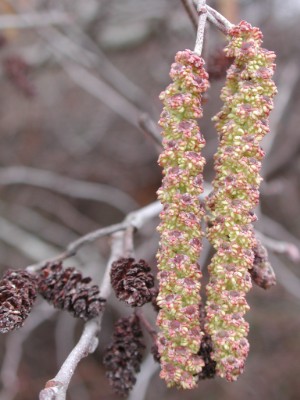
Manchurian alder is a tree with grey bark and usually a single, straight trunk. Its leaves are green on their upper surfaces and grey-green on their lower surfaces, with coarsely double-toothed margins.[1][2][3]
The tree grows to approximately 20–25 metres tall. Its leaves measure 3–11 cm in length and 2.5–9 cm in width.[4][5][6]
Habitat
Manchurian alder is native to Japan, Korea, northern China, the Russian Far East and eastern Siberia.[7][8][9][10][11]
Similar species
Manchurian alder is closely related to Alnus incana, commonly called grey alder, and has sometimes been classified as a subspecies of that species.[12][13]
Manchurian alder hybridises freely with Alnus incana when the two species are brought together in cultivation. It differs from grey alder by having larger leaves and larger seed catkins.[14][15]
Classification of the Manchurian Alder
| Kingdom | Plantae |
|---|---|
| Subkingdom | Pteridobiotina |
| Phylum | Tracheophyta |
| Class | Magnoliopsida |
| Order | Fagales |
| Family | Betulaceae (Birch Family) |
| Subfamily | Betuloideae |
| Genus | Alnus (Alder) |
| Species | Alnus hirsuta (Spach) Rupr. |
Where the Manchurian Alder is found
Checklists and occurrence records place Alnus hirsuta in 6 countries across Asia. GBIF holds 8,911 georeferenced records of it.
Countries
Regions and cities with the most records
- Nagano, Japan 702
- Hokkaido, Japan 630
- Primorye, Russia 452
- Kamchatka, Russia 442
- Suzaka, Japan 415
- Sakaki, Japan 391
- Tōmi, Japan 384
- Ueda, Japan 383
- Gyeonggi-do, South Korea 318
- Gangwon-do, South Korea 311
- Gyeongsangbuk-do, South Korea 300
- Gyeongsangnam-do, South Korea 265
- Kanagawa, Japan 239
- Chungcheongnam-do, South Korea 187
- Seongnam-si, South Korea 184
- Sakhalin Oblast, Russia 164
- Sagamihara, Japan 157
- Hanam, South Korea 151
- Jilin, China 149
- Minawa, Japan 149
- Gwangju, South Korea 139
- Kanaishima, Japan 138
- Petropavlovsk-Kamchatsky, Russia 135
- Gunpo, South Korea 134
- Uiwang, South Korea 134
- Aihara, Japan 131
- Suwon, South Korea 131
- Hadano, Japan 128
- Minamiashigara, Japan 128
- Guri-si, South Korea 120
- Jeollabuk-do, South Korea 120
- Zama, Japan 120
- Machida, Japan 114
- Atsugi, Japan 112
- Sakha, Russia 111
- Khabarovsk, Russia 109
7 more countries have a few records outside this range
These countries hold a few records of Alnus hirsuta but lie outside the range the checklists give for it. Such records are often zoo or garden specimens, museum material or vagrants, so the species is not counted as occurring there.
Range as the checklists state it
Siberia (NW-Siberia, SW-Siberia, Buryatia, Chita, S-Yakutia, N-Yakutia); Russian Far East (Upper Amur, Primorye, Sakhalin, Kamchatka, Okhotsk, Magadan, Chukotka); China (Heilongjiang, Jilin, Liaoning, Nei Mongol, Shandong); North Korea; South Korea (incl. Cheju Isl.); Japan
A number beside a place is its count of GBIF occurrence records. A place without a number comes from a checklist alone. Records show where a species has been observed or collected, which can include escapes and vagrants.
Common names
English
- Manchurian Alder
- Siberian Alder
Names in 10 other languages
- Chinese
- liao dong qi mu, lioa dong qi mu, 遼東榿木
- Estonian
- lammlepp
- Finnish
- kamtsatkanleppä
- German
- Färber-Erle
- Japanese
- ke-yama-han-no-ki, タニガワハンノキ, ヤマハンノキ(広義)
- Korean
- Mul-o-ri-na-mu, 물오리나무
- Norwegian Bokmål
- sibirgråor
- Polish
- Olsza szorstka
- Russian
- Ольха волосистая, Ольха пушистая
- Slovak
- jelša srstnatá
Synonyms
35 other scientific names have been used for this species and are now treated as synonyms of Alnus hirsuta.
- Alnus hirsuta f. inokumae (Murai & Kusaka) H.Ohba
- Alnus hirsuta f. macrophylla Callier
- Alnus hirsuta f. sibirica (Spach) H.Ohba
- Alnus hirsuta var. hirsuta
- Alnus hirsuta var. microphylla (Nakai) Tatew.
- Alnus hirsuta var. sibirica (Spach) C.K.Schneid.
- Alnus hirsuta var. tinctoria (Sarg.) Kudô, nom. inval.
- Alnus incana f. hirsuta Regel
- Alnus incana subsp. hirsuta (Spach) Á.Löve & D.Löve
- Alnus incana subsp. tchangbokii Chin S.Chang & H.Kim
- Alnus incana var. glauca (F.Michx.) Loudon
- Alnus incana var. hirsuta Spach
- Alnus incana var. sibirica Spach
- Alnus incana var. tinctoria (Sarg.) H.J.P.Winkl.
- Alnus inokumae Murai & Kusaka
- Alnus sibirica Fisch. ex Turcz.
- Alnus sibirica (Spach) Turcz. ex Kom.
- Alnus sibirica f. acutiloba Koidz.
- Alnus sibirica f. glabra (Callier) Koidz.
- Alnus sibirica f. hirsutoides Koidz.
- Alnus sibirica f. obtusiloba Koidz.
- Alnus sibirica var. hirsuta (Spach) Koidz.
- Alnus sibirica var. oxyloba C.K.Schneid.
- Alnus sibirica var. paucinervis C.K.Schneid.
- Alnus sibirica var. tinctoria (Sarg.) Koidz.
- Alnus tinctoria Sarg.
- Alnus tinctoria f. acutiloba (Koidz.) H.Hara
- Alnus tinctoria f. hirsutoides (Koidz.) H.Hara
- Alnus tinctoria var. glabra Callier
- Alnus tinctoria var. mandschurica Callier
- Alnus tinctoria var. microphylla Nakai
- Alnus tinctoria var. obtusiloba Callier
- Alnus tinctoria var. velutina H.Hara
- Alnus incana var. glauca Regel ambiguous synonym
- Alnus viridis var. sibirica (Spach) Regel ambiguous synonym
Related species
-
 Common AlderAlnus glutinosa
-
 Gray AlderAlnus incana
-
 Red AlderAlnus rubra
-
 Green AlderAlnus alnobetula
-
 Italian AlderAlnus cordata
-
 California AlderAlnus rhombifolia
-
 Common AlderAlnus serrulata
-
 Nepalese AlderAlnus nepalensis
Compare
Questions and answers
What is the scientific name of the Manchurian Alder?
The scientific name of the Manchurian Alder is Alnus hirsuta. Written with its author, the full name is Alnus hirsuta (Spach) Rupr..
Which family does the Manchurian Alder belong to?
Alnus hirsuta belongs to the family Betulaceae, in the order Fagales and the class Magnoliopsida.
Where is the Manchurian Alder found?
Checklists and occurrence records place Alnus hirsuta in 6 countries: Japan, South Korea, Russia, China, North Korea and Turkey.
What is the conservation status of the Manchurian Alder?
The IUCN Red List category recorded for Alnus hirsuta is Least Concern (LC).
What other names does the Manchurian Alder have?
Alnus hirsuta is also known in English as Siberian Alder.
Sources
Passages the profile rests on
- Alnus hirsuta is a tree with grey bark and usually a single, straight trunk. Source passage: “usually with a single, straight trunk, with grey bark.” — English Wikipedia
- The leaves are green on their upper surfaces and grey-green on their lower surfaces. Source passage: “The leaves are green above, grey-green below” — English Wikipedia
- The leaves have coarsely double-toothed margins. Source passage: “with coarsely double-toothed margins” — English Wikipedia
- Alnus hirsuta grows to approximately 20–25 metres tall. Source passage: “It is a tree growing to 20–25 metres (66–82 ft) tall” — English Wikipedia
- Its leaves measure 3–11 cm in length. Source passage: “3–11 cm (1.2–4.3 in) long” — English Wikipedia
- Its leaves measure 2.5–9 cm in width. Source passage: “2.5–9 cm (1.0–3.5 in) broad.” — English Wikipedia
- Alnus hirsuta is native to Japan. Source passage: “A tree native to Japan, Korea, northern China, the Russian Far east, and eastern Siberia.” — English Wikipedia
- Alnus hirsuta is native to Korea. Source passage: “A tree native to Japan, Korea, northern China, the Russian Far east, and eastern Siberia.” — English Wikipedia
- Alnus hirsuta is native to northern China. Source passage: “A tree native to Japan, Korea, northern China, the Russian Far east, and eastern Siberia.” — English Wikipedia
- Alnus hirsuta is native to the Russian Far East. Source passage: “A tree native to Japan, Korea, northern China, the Russian Far east, and eastern Siberia.” — English Wikipedia
- Alnus hirsuta is native to eastern Siberia. Source passage: “A tree native to Japan, Korea, northern China, the Russian Far east, and eastern Siberia.” — English Wikipedia
- Alnus hirsuta is closely related to Alnus incana, commonly called grey alder. Source passage: “It is closely related to grey alder Alnus incana” — English Wikipedia
- Alnus hirsuta has sometimes been classified as a subspecies of Alnus incana. Source passage: “has sometimes been treated as a subspecies of it Alnus incana subsp. hirsuta (Spach) Á.Löve & D.Löve” — English Wikipedia
- Alnus hirsuta hybridises freely with Alnus incana when the two species are brought together in cultivation. Source passage: “it hybridises freely with it when brought together in cultivation.” — English Wikipedia
- Alnus hirsuta differs from grey alder by having larger leaves and larger seed catkins. Source passage: “It differs from grey alder in larger leaves and larger seed catkins.” — English Wikipedia
Data
- Catalogue of Life, 2026-10-16 XR cc by
- Global Biodiversity Information Facility CC BY 4.0
- Wikidata CC0
- GeoNames CC BY 4.0
- Wikimedia Commons per image; credit shown with each image
- Within the Catalogue of Life, this name comes from Synonymic Checklists of the Vascular Plants of the World cc by
References
- Rupr. (1857). Bull. Cl. Phys.-Math. Acad. Imp. Sci. St.-Pétersbourg 15: 376 (1857). where the name was published
This species in other databases
Page built on 28 November 2026. See how the catalog is made and all sources and licences.
Cite this page
ScientificNames.org. (2026). Alnus hirsuta (Manchurian Alder). Retrieved November 28, 2026, from https://scientificnames.org/species/alnus-hirsuta
“Alnus hirsuta (Manchurian Alder).” ScientificNames.org, 2026, scientificnames.org/species/alnus-hirsuta. Accessed 28 Nov. 2026.
ScientificNames.org. “Alnus hirsuta (Manchurian Alder).” Accessed November 28, 2026. https://scientificnames.org/species/alnus-hirsuta.
@misc{scientificnames_alnus_hirsuta_manchurian_alder,
  author = {{ScientificNames.org}},
  title = {Alnus hirsuta (Manchurian Alder)},
  year = {2026},
  url = {https://scientificnames.org/species/alnus-hirsuta},
  note = {Accessed 2026-11-28}
}