Species · Flowering plants
Caucasian Alder Alnus subcordata
The scientific name of the Caucasian Alder is Alnus subcordata. It is a species of flowering plant in the family Betulaceae (birch family), order Fagales.
- Scientific name
- Alnus subcordata C.A.Mey.
- Common name
- Caucasian Alder
- Genus
- Alnus
- Family
- Betulaceae (Birch Family)
- Order
- Fagales
- Class
- Magnoliopsida
- Red List category
- LC Least Concern
- Recorded in
- 3 countries
- Name status
- accepted in the Catalogue of Life

Overview
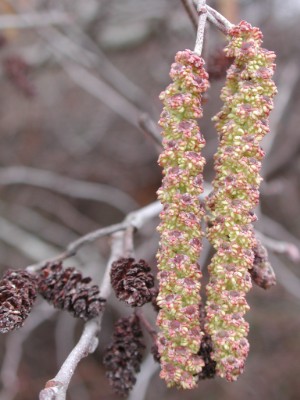
Caucasian Alder is a deciduous tree with glossy green, heart-shaped leaves. It predominantly grows in river valleys in the Hyrcanian woodlands of the Caspian Mountains in northern Iran and southeastern Azerbaijan, at elevations from sea level to 2,000 metres. It produces flowers in catkins that develop into woody, cone-like fruits containing small winged seeds.
Written 26 November 2026 from the sources listed below. Each statement was checked against the passage it cites; statements that could not be supported were removed.
Appearance
Caucasian Alder is a deciduous tree with glossy green, heart-shaped leaves measuring 5–15 cm in length. It grows to a height of 15–25 m.[1][2][3]
The species produces flowers arranged in catkins. Male catkins measure 8–15 cm long, while female catkins are smaller.[4]
Habitat
Caucasian Alder predominantly grows in river valleys in its natural habitat. It occurs at elevations ranging from sea level to 2,000 metres.[5][6]
The species is prevalent in the Hyrcanian woodlands of the Caspian Mountains in northern Iran and southeastern Azerbaijan. It is also described as native to the Caucasus Mountains.[7][8]
Reproduction and life cycle
The female catkins mature into woody, cone-like fruits measuring 2–3 cm long. These fruits contain numerous small winged seeds.[9][10]
Similar species
Caucasian Alder is closely related to the Italian alder (Alnus cordata) and Alnus orientalis.[11]
Two varieties have been recorded: Alnus subcordata var. subcordata and Alnus subcordata var. villosa.[12]
Uses
Caucasian Alder has commercial value through its widespread use in the timber and furniture industries.[13]
Its wood has a calorific value of approximately 4.7 cal/g, while its bark has a calorific value of approximately 4.5 cal/g.[14][15]
Classification of the Caucasian Alder
| Kingdom | Plantae |
|---|---|
| Subkingdom | Pteridobiotina |
| Phylum | Tracheophyta |
| Class | Magnoliopsida |
| Order | Fagales |
| Family | Betulaceae (Birch Family) |
| Subfamily | Betuloideae |
| Genus | Alnus (Alder) |
| Species | Alnus subcordata C.A.Mey. |
Where the Caucasian Alder is found
Checklists and occurrence records place Alnus subcordata in 3 countries across Asia. GBIF holds 103 georeferenced records of it.
Countries
Regions and cities with the most records
- Lənkəran, Azerbaijan 15
- Lankaran, Azerbaijan 13
- Māzandarān, Iran 8
- Gilan Province, Iran 5
- Nowshahr, Iran 4
6 more countries have a few records outside this range
These countries hold a few records of Alnus subcordata but lie outside the range the checklists give for it. Such records are often zoo or garden specimens, museum material or vagrants, so the species is not counted as occurring there.
Range as the checklists state it
Azerbaijan (Talysh); Iran (N-Iran, Iranian Aserbaijan)
A number beside a place is its count of GBIF occurrence records. A place without a number comes from a checklist alone. Records show where a species has been observed or collected, which can include escapes and vagrants.
Common names
English
- Caucasian Alder
Names in 10 other languages
- Azerbaijani
- Qafqaz qızılağacı
- Dutch
- Kaukasische els
- Estonian
- kaukaasia lepp
- German
- Kaukasische Erle
- Lithuanian
- Kaukazinis alksnis
- Polish
- olsza kaukaska
- Russian
- Ольха почтисердцевидная, Ольха сердцелистная
- Slovak
- jelša lipolistá
- Swedish
- storbladig al
- Turkish
- Kafkas kızılağacı
Synonyms
5 other scientific names have been used for this species and are now treated as synonyms of Alnus subcordata.
- Alnus cordata var. tschmela Sommier & Levier
- Alnus cordifolia var. subcordata (C.A.Mey.) Regel
- Alnus cordifolia var. villosa Regel
- Alnus subcordata var. villosa (Regel) H.J.P.Winkl.
- Alnus tiliifolia K.Koch
Related species
-
 Common AlderAlnus glutinosa
-
 Gray AlderAlnus incana
-
 Red AlderAlnus rubra
-
 Green AlderAlnus alnobetula
-
 Italian AlderAlnus cordata
-
 California AlderAlnus rhombifolia
-
 Common AlderAlnus serrulata
-
 Nepalese AlderAlnus nepalensis
Compare
Questions and answers
What is the scientific name of the Caucasian Alder?
The scientific name of the Caucasian Alder is Alnus subcordata. Written with its author, the full name is Alnus subcordata C.A.Mey..
Which family does the Caucasian Alder belong to?
Alnus subcordata belongs to the family Betulaceae, in the order Fagales and the class Magnoliopsida.
Where is the Caucasian Alder found?
Checklists and occurrence records place Alnus subcordata in 3 countries: Azerbaijan, Iran and Turkey.
What is the conservation status of the Caucasian Alder?
The IUCN Red List category recorded for Alnus subcordata is Least Concern (LC).
Sources
Passages the profile rests on
- Alnus subcordata is a deciduous tree with glossy green, heart-shaped leaves. Source passage: “It is a deciduous tree growing to 15–25 m tall, with similar glossy green cordate leaves 5–15 cm long.” — English Wikipedia
- Alnus subcordata grows to a height of 15–25 m. Source passage: “It is a deciduous tree growing to 15–25 m tall” — English Wikipedia
- Its leaves measure 5–15 cm in length. Source passage: “glossy green cordate leaves 5–15 cm long.” — English Wikipedia
- The species produces flowers arranged in catkins, with male catkins measuring 8–15 cm long and female catkins being smaller. Source passage: “The flowers are catkins, the male catkins very slender, 8–15 cm long, the female catkins small” — English Wikipedia
- Alnus subcordata predominantly grows in river valleys in its natural habitat. Source passage: “This tree exhibits rapid growth in its natural habitat, predominantly river valleys.” — English Wikipedia
- The species grows at elevations ranging from sea level to 2,000 metres. Source passage: “It thrives across altitudes from sea level up to 2000 meters.” — English Wikipedia
- Alnus subcordata is prevalent in the Hyrcanian woodlands of the Caspian Mountains in northern Iran and southeastern Azerbaijan. Source passage: “prevalent in the Hyrcanian woodlands situated in the Caspian Mountains of northern Iran and southeast Azerbaijan.” — English Wikipedia
- Alnus subcordata is described as native to the Caucasus Mountains. Source passage: “Alnus subcordata is native to the Caucasus Mountains” — botanic.cam.ac.uk
- The female catkins mature into woody, cone-like fruits measuring 2–3 cm long. Source passage: “the female catkins small, maturing into a woody cone-like fruit 2–3 cm long” — English Wikipedia
- The fruits contain numerous small winged seeds. Source passage: “containing numerous small winged seeds.” — English Wikipedia
- Alnus subcordata is closely related to the Italian alder (Alnus cordata) and Alnus orientalis. Source passage: “It is closely related to the Italian alder (A. cordata) and Alnus orientalis.” — English Wikipedia
- Two varieties of Alnus subcordata have been recorded: Alnus subcordata var. subcordata and Alnus subcordata var. villosa. Source passage: “Alnus subcordata var. subcordata C.A. Mey. Alnus subcordata var. villosa (Regel) H.J.P.Winkl” — English Wikipedia
- Alnus subcordata has commercial value through its widespread use in the timber and furniture industries. Source passage: “It is a commercially valuable species with "widespread application in timber and furniture industries".” — English Wikipedia
- The wood of Alnus subcordata has a calorific value of approximately 4.7 cal/g. Source passage: “It has a calorific value of about 4,7 cal/g for wood” — English Wikipedia
- The bark of Alnus subcordata has a calorific value of approximately 4.5 cal/g. Source passage: “and 4,5 cal/g for bark.” — English Wikipedia
Data
- Catalogue of Life, 2026-10-16 XR cc by
- Global Biodiversity Information Facility CC BY 4.0
- Wikidata CC0
- GeoNames CC BY 4.0
- Wikimedia Commons per image; credit shown with each image
- Within the Catalogue of Life, this name comes from Synonymic Checklists of the Vascular Plants of the World cc by
References
- C.A.Mey. Verz. Pfl. Casp. Meer. [C.A. von Meyer] 43 (1831). where the name was published
This species in other databases
- Catalogue of Life 65WTW
- Wikidata Q2666298
- iNaturalist 791913
- World Flora Online wfo-0000947978
- GRIN 404169
Page built on 27 November 2026. See how the catalog is made and all sources and licences.
Cite this page
ScientificNames.org. (2026). Alnus subcordata (Caucasian Alder). Retrieved November 27, 2026, from https://scientificnames.org/species/alnus-subcordata
“Alnus subcordata (Caucasian Alder).” ScientificNames.org, 2026, scientificnames.org/species/alnus-subcordata. Accessed 27 Nov. 2026.
ScientificNames.org. “Alnus subcordata (Caucasian Alder).” Accessed November 27, 2026. https://scientificnames.org/species/alnus-subcordata.
@misc{scientificnames_alnus_subcordata_caucasian_alder,
  author = {{ScientificNames.org}},
  title = {Alnus subcordata (Caucasian Alder)},
  year = {2026},
  url = {https://scientificnames.org/species/alnus-subcordata},
  note = {Accessed 2026-11-27}
}