Species · Reptiles
Northeastern Hill Krait Bungarus bungaroides
The scientific name of the Northeastern Hill Krait is Bungarus bungaroides. It is a species of reptile in the family Elapidae (cobras), order Squamata. The name dates from 1839.
- Scientific name
- Bungarus bungaroides (Cantor, 1839)
- Common name
- Northeastern Hill Krait
- Genus
- Bungarus
- Family
- Elapidae (Cobras)
- Order
- Squamata
- Class
- Reptilia
- Red List category
- LC Least Concern
- Recorded in
- 6 countries
- Name status
- accepted in the Catalogue of Life

Overview
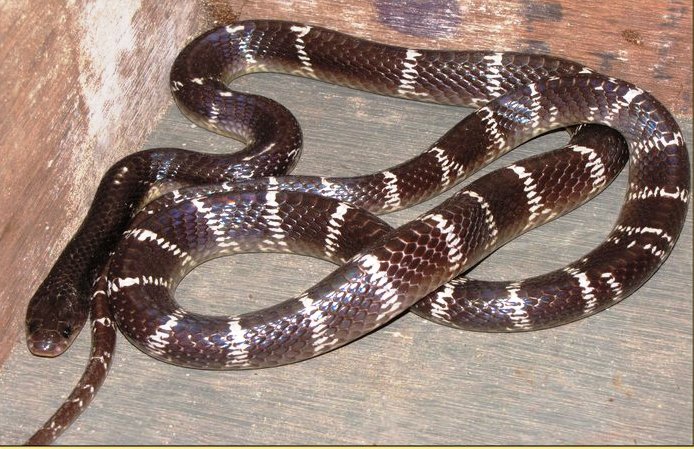
The Northeastern Hill Krait is a venomous elapid snake in the genus Bungarus. It is recorded from Myanmar, India, Nepal, Vietnam and Tibet, at elevations around 2,040 metres. It has a smooth black dorsum with narrow white to pale yellowish lines or crossbars that widen across the belly.
Written 26 November 2026 from the sources listed below. Each statement was checked against the passage it cites; statements that could not be supported were removed.
Appearance
The Northeastern Hill Krait has a smooth, black dorsum marked with narrow white to pale yellowish lines or crossbars. These crossbars widen across the belly to form distinct transverse bars.[1][2]
The head is slightly distinct from the neck, with a flat upper surface and a blunt snout. The species has 15 longitudinal rows of dorsal scales at midbody.[3][4]
The mid-dorsal scales are slightly enlarged anteriorly and distinctly enlarged posteriorly. The subcaudal scutes are usually divided anteriorly, although some may occasionally be single, and are always divided near the tail tip.[5][6]
Habitat
The Northeastern Hill Krait occurs at elevations around 2,040 metres.[7]
It is recorded from Myanmar, India, Nepal, Vietnam and Tibet. Within India, its recorded locations include Assam, Manipur, Cachar and Sikkim.[8][9]
The type locality is Cherra Punjee in the Khasi Hills of Meghalaya, India.[10]
Classification of the Northeastern Hill Krait
| Kingdom | Animalia |
|---|---|
| Phylum | Chordata |
| Subphylum | Vertebrata |
| Infraphylum | Gnathostomata |
| Parvphylum | Osteichthyes |
| Megaclass | Tetrapoda |
| Class | Reptilia (Reptile) |
| Order | Squamata (Snakes) |
| Suborder | Serpentes (Snakes) |
| Infraorder | Alethinophidia |
| Family | Elapidae (Cobras) |
| Genus | Bungarus (Deathpickers) |
| Species | Bungarus bungaroides (Cantor, 1839) |
Where the Northeastern Hill Krait is found
Checklists and occurrence records place Bungarus bungaroides in 6 countries across Asia. GBIF holds 28 georeferenced records of it.
Countries
Regions and cities with the most records
Range as the checklists state it
Myanmar (= Burma), India (Meghalaya, Assam, Arunachal Pradesh, Assam [Cachar], Sikkim, Meghalaya, Nagaland), Nepal, Bhutan, Vietnam (HR 33: 323), elevation 2040 m (Boulenger 1896:371), China (Xizang)
A number beside a place is its count of GBIF occurrence records. A place without a number comes from a checklist alone. Records show where a species has been observed or collected, which can include escapes and vagrants.
Common names
English
- Northeastern Hill Krait
- Himalayan Krait
Names in 5 other languages
- Chinese
- 喜山環蛇, 环蛇
- Italian
- Bungaro collinare nord-orientale, Krait collinare nord-orientale
- Nepali
- Karet sarpa
- Russian
- Крайт Кантора
- Vietnamese
- Rắn cạp nia đồi Đông Bắc
Synonyms
2 other scientific names have been used for this species and are now treated as synonyms of Bungarus bungaroides.
- Elaps bungaroides Cantor, 1839
- Xenurelaps bungaroides Günther, 1864: 345
Related species
-
 Common KraitBungarus caeruleus
-
 Banded KraitBungarus fasciatus
-
 Many-banded KraitBungarus multicinctus
-
 Malayan KraitBungarus candidus
-
 Red-headed KraitBungarus flaviceps
-
 Sind KraitBungarus sindanus
-
 Greater Black KraitBungarus niger
-
 Ceylon KraitBungarus ceylonicus
Compare
Questions and answers
What is the scientific name of the Northeastern Hill Krait?
The scientific name of the Northeastern Hill Krait is Bungarus bungaroides. Written with its author, the full name is Bungarus bungaroides (Cantor, 1839).
Which family does the Northeastern Hill Krait belong to?
Bungarus bungaroides belongs to the family Elapidae, in the order Squamata and the class Reptilia.
Where is the Northeastern Hill Krait found?
Checklists and occurrence records place Bungarus bungaroides in 6 countries: India, Myanmar, China, Bhutan, Nepal and Vietnam.
What is the conservation status of the Northeastern Hill Krait?
The IUCN Red List category recorded for Bungarus bungaroides is Least Concern (LC).
What other names does the Northeastern Hill Krait have?
Bungarus bungaroides is also known in English as Himalayan Krait.
Are Bungarus venomous?
The Northeastern Hill Krait is a venomous elapid snake.[11]
Sources
Passages the profile rests on
- The species has a smooth, black dorsum marked with narrow white to pale yellowish lines or crossbars. Source passage: “Dorsum – smooth, black with a series of very narrow white to pale yellowish lines or crossbars” — English Wikipedia
- The light crossbars widen across the belly to form distinct transverse bars. Source passage: “on the belly, the light crossbars widen to form distinct transverse bars” — English Wikipedia
- The head is slightly distinct from the neck, with a flat upper surface and a blunt snout. Source passage: “head slightly distinct from the neck. Top of the head is flat. Snout is blunt.” — English Wikipedia
- The species has 15 longitudinal rows of dorsal scales at midbody. Source passage: “Dorsal scales in 15 longitudinal rows at midbody.” — English Wikipedia
- The mid-dorsal scales are slightly enlarged anteriorly and distinctly enlarged posteriorly. Source passage: “Mid-dorsal scales are slightly enlarged anteriorly, but distinctly enlarged posteriorly.” — English Wikipedia
- The subcaudal scutes are usually divided anteriorly, although some may occasionally be single, and they are always divided near the tail tip. Source passage: “Subcaudal scutes ordinarily divided anteriorly, but occasionally some scutes may be single, but always divided near the tip” — English Wikipedia
- The species occurs at elevations around 2,040 metres. Source passage: “at elevations around 2040 m” — English Wikipedia
- The species is recorded from Myanmar, India, Nepal, Vietnam and Tibet. Source passage: “This species is found in Myanmar, India (Assam, Manipur, Cachar, Sikkim), Nepal, and Vietnam at elevations around 2040 m as well as in Tibet.” — English Wikipedia
- Within India, the species is recorded from Assam, Manipur, Cachar and Sikkim. Source passage: “India (Assam, Manipur, Cachar, Sikkim)” — English Wikipedia
- The type locality is Cherra Punjee in the Khasi Hills of Meghalaya, India. Source passage: “Cherra Punjee, Khasi Hills, Meghalaya, India” — English Wikipedia
- The species is described as a venomous elapid snake. Source passage: “is a venomous species of elapid snake.” — English Wikipedia
Data
- Catalogue of Life, 2026-10-16 XR cc by
- Global Biodiversity Information Facility CC BY 4.0
- Wikidata CC0
- GeoNames CC BY 4.0
- Wikimedia Commons per image; credit shown with each image
- Within the Catalogue of Life, this name comes from The Reptile Database cc by
References
- Cantor, T. E. (1839). Spicilegium serpentium indicorum [part 1]. Proc. Zool. Soc. London 1839: 31-34.
- Boulenger, George A. (1890). The Fauna of British India, Including Ceylon and Burma. Reptilia and Batrachia. Taylor & Francis, London, Xviii, 541 Pp.
- Boulenger, G. A. (1896). Catalogue of the snakes in the British Museum, Vol. 3. London (Taylor & Francis), Xiv + 727 Pp.
- Wall, F. (1908). A popular treatise of the common Indian snakes. Part VIII. J. Bombay Nat. Hist. Soc. 18: 711-735.
- Wall, F. (1908). The poisonous terrestrial snakes of our British Indian dominions and how to recognise them, 2nd ed. Bombay, Bombay Natural History Society, 68 Pp.
- Smith, M. A. (1943). The Fauna of British India, Ceylon and Burma, Including the Whole of the Indo-Chinese Sub-Region. Reptilia and Amphibia. 3 (Serpentes). Taylor and Francis, London. 583 Pp.
- Golay, P. (1985). Checklist and keys to the terrestrial proteroglyphs of the world (Serpentes: Elapidae - Hydrophiidae). Elapsoidea, Geneva.
- Dowling, H.G., & Jenner, J.V. (1988). Snakes of Burma: checklist of reported species and bibliography. Smithsonian Herp. Inf. Serv. (76): 19 Pp.
- Slowinski J, B. (1994). A phylogenetic analysis of Bungarus (Elapidae) based on morphological characters. Journal of Herpetology 28 (4): 440-446.
- Shah, K. B. (1998). Checklist of the herpetofauna of Nepal with english and vernacular names. NAHSON Bull., Nat. Hist. Soc. Nepal, Kathmandu 8 (1-4): 26-30.
- Shah, K. B. (1999). New records and distribution of some herpetofauna of Nepal. J. Nat. Hist. Mus., Kathmandu 18: 99-111.
- Khan, M. S. (2002). Die Schlangen Pakistans [English edition as “A Guide to the snakes of Pakistan”]. Edition Chimaira (Frankfurt Am Main), 265 Pp. [Review in HR 34: 400, Russ J Herp 12: 79].
- Leviton, Alan E.; Guinevere O.U. Wogan; Michelle S. Koo; George R. Zug; Rhonda S. Lucas and Jens V. Vindum. (2003). The Dangerously Venomous Snakes of Myanmar Illustrated Checklist with Keys. Proc. Cal. Acad. Sci. 54 (24): 407–462.
- Orlov, N. L., S. A. Ryabov, N. Van Sang and N. Q. Truong. (2003). New records and data on the poorly known snakes of Vietnam. Russ. J. Herpetol. 10: 217-240.
- Tillack, F., & Kucharzewski, C. (2004). Buchbesprechung: Khan: Die Schlangen Pakistans. Reptilia (Münster) 9 (45): 92-96.
- Ao, J. M., David, P., Bordoloi, S., & Ohler, A. (2004). Notes on a collection of snakes from Nagaland, Northeast India, with 19 new records for this state. Russian Journal of Herpetology 11 (2): 155 – 162.
- Sharma, R. C. (2004). Handbook Indian Snakes. AKHIL BOOKS, New Delhi, 292 Pp.
- RAO Ding-qi, & ZHAO Er-mi. (2004). Bungarus bungaroides, A Record New to China (Xizang AR) with a Note on Trimeresurus tibetanus. Sichuan Journal of Zoology 23 (3).
- Kuch, U.; Kizirian, D.; Nguyen, Q.T.; Lawson, R.; Donnelly, M.A. & Mebs, D. (2005). A new species of krait (Squamata: Elapidae) from the Red River System of Nothern Vietnam. Copeia 2005 (4): 818-833.
- Zhao, E. M. (2006). The snakes of China [in Chinese]. Hefei, China, Anhui Sience & Technology Publ. House, Vol. I, 372 Pp., Vol. II (Color Plates), 280 Pp.
- Das, I. (2012). A Naturalist’s Guide to the Snakes of South-East Asia: Malaysia, Singapore, Thailand, Myanmar, Borneo, Sumatra, Java and Bali. Oxford J, Ohn Beaufoy Publishing.
- Lenz, & Norbert. (2012). Von Schmetterlingen und Donnerdrachen - Natur und Kultur in Bhutan. Karlsruher Naturhefte 4, Naturkundemuseum Karlsruhe, 124 Pp.
- Bhupathy, S., Ramesh Kumar, S., Paramanandham, J., Thirumalainathan, P. and Pranjit Kumar Sarma. (2013). Conservation of reptiles in Nagaland, India. In: K. K. Singh et Al. (Editors), Bioresources and Traditional Knowledge of Northeast India, Mizo Post-Graduate Science Society, Pp. 181-186.
- Kästle, W., Rai, K., & Schleich, H. H. (2013). FIELD GUIDE to Amphibians and Reptiles of Nepal. ARCO-Nepal E.V., 625 Pp.
- Sharma, S.K., Pandey, D.P., Shah, K.B., Tillack, E, Chappuis, E, Thapa, C. L., AiroI, E. & Kuch, U. (2013). Venomous snakes of Nepal: a photographic guide. B.P. Kolrala Institute of Health Sciences, Dharan, 85 Pp.
This species in other databases
Page built on 27 November 2026. See how the catalog is made and all sources and licences.
Cite this page
ScientificNames.org. (2026). Bungarus bungaroides (Northeastern Hill Krait). Retrieved November 27, 2026, from https://scientificnames.org/species/bungarus-bungaroides
“Bungarus bungaroides (Northeastern Hill Krait).” ScientificNames.org, 2026, scientificnames.org/species/bungarus-bungaroides. Accessed 27 Nov. 2026.
ScientificNames.org. “Bungarus bungaroides (Northeastern Hill Krait).” Accessed November 27, 2026. https://scientificnames.org/species/bungarus-bungaroides.
@misc{scientificnames_bungarus_bungaroides_northeastern_hill_krait,
  author = {{ScientificNames.org}},
  title = {Bungarus bungaroides (Northeastern Hill Krait)},
  year = {2026},
  url = {https://scientificnames.org/species/bungarus-bungaroides},
  note = {Accessed 2026-11-27}
}