Species · Reptiles
Lesser Black Krait Bungarus lividus
The scientific name of the Lesser Black Krait is Bungarus lividus. It is a species of reptile in the family Elapidae (cobras), order Squamata. The name dates from 1839.
- Scientific name
- Bungarus lividus Cantor, 1839
- Common name
- Lesser Black Krait
- Genus
- Bungarus
- Family
- Elapidae (Cobras)
- Order
- Squamata
- Class
- Reptilia
- Red List category
- LC Least Concern
- Recorded in
- 4 countries
- Name status
- accepted in the Catalogue of Life

Overview
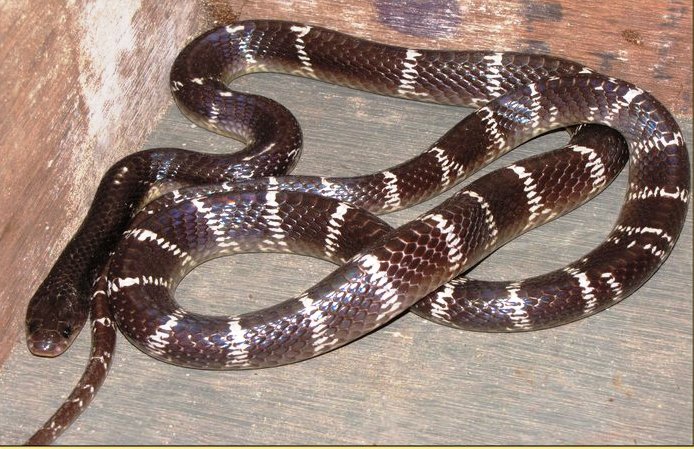
Bungarus lividus occurs in India, Bangladesh, and Nepal. It has a smooth black to bluish-black dorsal body, a white upper lip, and white ventral scales with grey edges.
Written 26 November 2026 from the sources listed below. Each statement was checked against the passage it cites; statements that could not be supported were removed.
Appearance
The Lesser Black Krait has a smooth black to bluish-black dorsal body. Its upper lip is white, and its ventral scales are white with grey edges.[1][2][3]
It has small black eyes with round pupils, positioned closer to the snout. The species has 15 dorsal scale rows, and its vertebral scales are only slightly larger than the scales in the other dorsal rows.[4][5][6][7]
The anal and subcaudal scales are undivided. It has seven supralabial scales, with the third and fourth touching the eye, and seven infralabial scales, with the third touching the anterior genial.[8][9][10]
Habitat
The Lesser Black Krait occurs in India, Bangladesh, and Nepal. Its recorded Indian distribution includes North Bengal and Northeast India.[11][12]
The type locality is Assam, India. Juvenile specimens have been recorded from Alipurduar in West Bengal, India.[13][14]
Diet
The Lesser Black Krait primarily feeds on other snakes.[15]
Classification of the Lesser Black Krait
| Kingdom | Animalia |
|---|---|
| Phylum | Chordata |
| Subphylum | Vertebrata |
| Infraphylum | Gnathostomata |
| Parvphylum | Osteichthyes |
| Megaclass | Tetrapoda |
| Class | Reptilia (Reptile) |
| Order | Squamata (Snakes) |
| Suborder | Serpentes (Snakes) |
| Infraorder | Alethinophidia |
| Family | Elapidae (Cobras) |
| Genus | Bungarus (Deathpickers) |
| Species | Bungarus lividus Cantor, 1839 |
Where the Lesser Black Krait is found
Checklists and occurrence records place Bungarus lividus in 4 countries across Asia. GBIF holds 28 georeferenced records of it.
Countries
Regions and cities with the most records
- West Bengal, India 11
- Jalpāiguri, India 8
- Maināguri, India 8
- Bagdogra, India 3
- Assam, India 1
- Arunachal Pradesh, India
- Meghalaya, India
Range as the checklists state it
India (Meghalaya, Assam, Arunachal Pradesh, Nagaland etc), Bangladesh, Nepal, Bhutan
A number beside a place is its count of GBIF occurrence records. A place without a number comes from a checklist alone. Records show where a species has been observed or collected, which can include escapes and vagrants.
Common names
English
- Lesser Black Krait
Names in 6 other languages
- Bengali
- Choto Kal Keutey
- Chinese
- 乌环蛇, 烏環蛇
- Italian
- Bungaro nero minore, Krait nero minore
- Nepali
- Kalo karet
- Russian
- Свинцовый крайт
- Vietnamese
- Rắn cạp nia đen nhỏ
Related species
-
 Common KraitBungarus caeruleus
-
 Banded KraitBungarus fasciatus
-
 Many-banded KraitBungarus multicinctus
-
 Malayan KraitBungarus candidus
-
 Red-headed KraitBungarus flaviceps
-
 Sind KraitBungarus sindanus
-
 Greater Black KraitBungarus niger
-
 Ceylon KraitBungarus ceylonicus
Compare
Questions and answers
What is the scientific name of the Lesser Black Krait?
The scientific name of the Lesser Black Krait is Bungarus lividus. Written with its author, the full name is Bungarus lividus Cantor, 1839.
Which family does the Lesser Black Krait belong to?
Bungarus lividus belongs to the family Elapidae, in the order Squamata and the class Reptilia.
Where is the Lesser Black Krait found?
Checklists and occurrence records place Bungarus lividus in 4 countries: India, Nepal, Bangladesh and Bhutan.
What is the conservation status of the Lesser Black Krait?
The IUCN Red List category recorded for Bungarus lividus is Least Concern (LC).
What do krait snakes eat?
The Lesser Black Krait primarily feeds on other snakes.[15]
Sources
Passages the profile rests on
- The species has a smooth black to bluish-black dorsal body. Source passage: “The body (dorsum) is smooth and black to bluish-black in colour.” — English Wikipedia
- The upper lip of the species is white. Source passage: “The upper lip is white.” — English Wikipedia
- The ventral scales are white with grey edges. Source passage: “The ventrals are white with grey edges.” — English Wikipedia
- The species has small black eyes with round pupils. Source passage: “The eyes are small, black with round pupils.” — English Wikipedia
- Its eyes are positioned closer to the snout. Source passage: “Eyes are positioned more towards the snout.” — English Wikipedia
- The species has 15 dorsal scale rows. Source passage: “The scales are arranged in 15 dorsal rows (15:15:15).” — English Wikipedia
- Its vertebral scales are only slightly larger than the scales in the other dorsal rows. Source passage: “The mid-dorsal (vertebral) scales are only slightly enlarged than the other rows.” — English Wikipedia
- The anal and subcaudal scales are undivided. Source passage: “Anal and subcaudal scales are undivided.” — English Wikipedia
- The species has seven supralabial scales, with the third and fourth touching the eye. Source passage: “7 supralabials (3rd and 4th touches eye)” — English Wikipedia
- The species has seven infralabial scales, with the third touching the anterior genial. Source passage: “7 infralabials (3rd touches anterior genial)” — English Wikipedia
- The species occurs in India, Bangladesh, and Nepal. Source passage: “The lesser black krait (Bungarus lividus) is a species of venomous elapid snake found in India, Bangladesh, and Nepal.” — English Wikipedia
- Its recorded Indian distribution includes North Bengal and Northeast India. Source passage: “India(North Bengal, Northeast India), Bangladesh, Nepal” — English Wikipedia
- The type locality of the species is Assam, India. Source passage: “Type locality: Assam, India” — English Wikipedia
- Juvenile specimens have been recorded from Alipurduar in West Bengal, India. Source passage: “from Alipurduar, West Bengal” — academia.edu
- The species primarily feeds on other snakes. Source passage: “The krait is primarily ophiophagous, meaning it preys on other snakes.” — English Wikipedia
Data
- Catalogue of Life, 2026-10-16 XR cc by
- Global Biodiversity Information Facility CC BY 4.0
- Wikidata CC0
- GeoNames CC BY 4.0
- Wikimedia Commons per image; credit shown with each image
- Within the Catalogue of Life, this name comes from The Reptile Database cc by
References
- Cantor, T. E. (1839). Spicilegium serpentium indicorum [part 1]. Proc. Zool. Soc. London 1839: 31-34.
- Boulenger, George A. (1890). The Fauna of British India, Including Ceylon and Burma. Reptilia and Batrachia. Taylor & Francis, London, Xviii, 541 Pp.
- Boulenger, G. A. (1896). Catalogue of the snakes in the British Museum, Vol. 3. London (Taylor & Francis), Xiv + 727 Pp.
- Wall, F. (1906). The poisonous snakes of India and how to recognize them, Part I. J. Bombay Nat. Hist. Soc. 17: 51-72 [Correction on P. 995].
- Wall, F. (1908). A popular treatise of the common Indian snakes. Part VIII. J. Bombay Nat. Hist. Soc. 18: 711-735.
- Wall, F. (1908). The poisonous terrestrial snakes of our British Indian dominions and how to recognise them, 2nd ed. Bombay, Bombay Natural History Society, 68 Pp.
- Smith, M. A. (1943). The Fauna of British India, Ceylon and Burma, Including the Whole of the Indo-Chinese Sub-Region. Reptilia and Amphibia. 3 (Serpentes). Taylor and Francis, London. 583 Pp.
- Slowinski J, B. (1994). A phylogenetic analysis of Bungarus (Elapidae) based on morphological characters. Journal of Herpetology 28 (4): 440-446.
- Shah, K. B. (1998). Checklist of the herpetofauna of Nepal with english and vernacular names. NAHSON Bull., Nat. Hist. Soc. Nepal, Kathmandu 8 (1-4): 26-30.
- Sharma, R. C. (2004). Handbook Indian Snakes. AKHIL BOOKS, New Delhi, 292 Pp.
- Lenz, & Norbert. (2012). Von Schmetterlingen und Donnerdrachen - Natur und Kultur in Bhutan. Karlsruher Naturhefte 4, Naturkundemuseum Karlsruhe, 124 Pp.
- Bhupathy, S., Ramesh Kumar, S., Paramanandham, J., Thirumalainathan, P. and Pranjit Kumar Sarma. (2013). Conservation of reptiles in Nagaland, India. In: K. K. Singh et Al. (Editors), Bioresources and Traditional Knowledge of Northeast India, Mizo Post-Graduate Science Society, Pp. 181-186.
- Kästle, W., Rai, K., & Schleich, H. H. (2013). FIELD GUIDE to Amphibians and Reptiles of Nepal. ARCO-Nepal E.V., 625 Pp.
- Sharma, S.K., Pandey, D.P., Shah, K.B., Tillack, E, Chappuis, E, Thapa, C. L., AiroI, E. & Kuch, U. (2013). Venomous snakes of Nepal: a photographic guide. B.P. Kolrala Institute of Health Sciences, Dharan, 85 Pp.
- Purkayastha, J. (2013). An Amateur’s Guide to Reptiles of Assam. EBH Publishers (India).
- Wallach, Van; Kenneth L. Williams, Jeff Boundy. (2014). Snakes of the World: A Catalogue of Living and Extinct Species. [type catalogue]. Taylor and Francis, CRC Press, 1237 Pp.
- Bhattarai, Santosh; Chiranjibi P. Pokheral, Baburam Lamichhane,, and Naresh Subedi. (2017). Herpetofauna of a Ramsar Site: Beeshazar and Associated Lakes, Chitwan National Park, Nepal. IRCF Reptiles & Amphibians 24 (1): 17-29.
- Ahsan, M.F. & M.M. Rahman. (2017). Status, distribution and threats of kraits (Squamata: Elapidae: Bungarus) in Bangladesh. Journal of Threatened Taxa 9 (3): 9903–9910.
- Pandey, & Deb Prasad. (2018). New records of snakes from Chitwan National Park and vicinity, Central Nepal. Herpetology Notes 11: 679-696.
- Tshewang, S. & L. Letro. (2018). The herpetofauna of Jigme Singye Wangchuck National Park in central Bhutan: status, distribution and new records. Journal of Threatened Taxa 10(11): 12489–12498;
- Das, & Abhijit. (2018). Notes on Snakes of the Genus Bungarus 2 (Serpentes: Elapidae) from Northeast India. In: C. Sivaperuman, K. Venkataraman (Eds.), Indian Hotspots, Springer, Pp:
- Bhattarai S, Pokheral CP, Lamichhane BR, Regmi UR, Ram AK, Subedi N. (2018). Amphibians and reptiles of Parsa National Park, Nepal. Amphibian & Reptile Conservation 12(1): 35–48 (E155).
- Ray, & Prajjwal and Shyamaprasad Pandey. (2020). A leucistic Lesser Black Krait, Bungarus lividus (Squamata: Elapidae), from West Bengal, India. IRCF Reptiles & Amphibians 27 (1): 103–104.
- Bhattarai S., Gurung A., Lamichhane BR., Regmi R., Dhungana M., Kumpakha B. and Subedi N. (2020). Amphibians and Reptiles of Chure Range, Nepal. President Chure Terai-Madhesh Conservation Development Board and National Trust for Nature Conservation, Khumaltar, Lalitpur, Nepal.
- Purkayastha, JAYADITYA; SOMLEE GUPTA, RUPANKAR BHATTACHARJEE & SANATH BOHRA. (2020). Self-inflicted bites by two venomous snake species: Medo’s pit viper Trimeresurus medoensis and lesser black krait Bungarus lividus. Herpetological Bulletin 154:
This species in other databases
Page built on 26 November 2026. See how the catalog is made and all sources and licences.
Cite this page
ScientificNames.org. (2026). Bungarus lividus (Lesser Black Krait). Retrieved November 26, 2026, from https://scientificnames.org/species/bungarus-lividus
“Bungarus lividus (Lesser Black Krait).” ScientificNames.org, 2026, scientificnames.org/species/bungarus-lividus. Accessed 26 Nov. 2026.
ScientificNames.org. “Bungarus lividus (Lesser Black Krait).” Accessed November 26, 2026. https://scientificnames.org/species/bungarus-lividus.
@misc{scientificnames_bungarus_lividus_lesser_black_krait,
  author = {{ScientificNames.org}},
  title = {Bungarus lividus (Lesser Black Krait)},
  year = {2026},
  url = {https://scientificnames.org/species/bungarus-lividus},
  note = {Accessed 2026-11-26}
}