Species · Reptiles
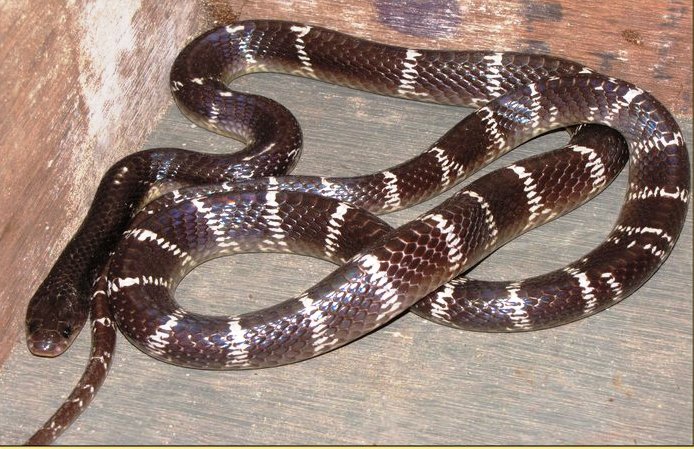
Sind Krait Bungarus walli
The scientific name of the Sind Krait is Bungarus walli. It is a species of reptile in the family Elapidae (cobras), order Squamata. The name dates from 1907.
- Scientific name
- Bungarus walli Wall, 1907
- Common name
- Sind Krait
- Genus
- Bungarus
- Family
- Elapidae (Cobras)
- Order
- Squamata
- Class
- Reptilia
- Red List category
- LC Least Concern
- Recorded in
- 4 countries
- Name status
- accepted in the Catalogue of Life
Overview
Bungarus walli, the Wall's krait, is a species of krait, a venomous elapid snake found in northern India, Bangladesh, Nepal, and Bhutan. It has previously been treated as a subspecies of Bungarus sindanus (also known as the Sind krait), but is now considered a valid species.
Classification of the Sind Krait
| Kingdom | Animalia |
|---|---|
| Phylum | Chordata |
| Subphylum | Vertebrata |
| Infraphylum | Gnathostomata |
| Parvphylum | Osteichthyes |
| Megaclass | Tetrapoda |
| Class | Reptilia (Reptile) |
| Order | Squamata (Snakes) |
| Suborder | Serpentes (Snakes) |
| Infraorder | Alethinophidia |
| Family | Elapidae (Cobras) |
| Genus | Bungarus (Deathpickers) |
| Species | Bungarus walli Wall, 1907 |
Where the Sind Krait is found
Checklists and occurrence records place Bungarus walli in 4 countries across Asia. GBIF holds 22 georeferenced records of it.
Countries
Regions and cities with the most records
- Uttar Pradesh, India 7
- Alīpur Duār, India 6
- Ayodhya, India 6
- Fyzābād, India 6
- Koch Bihār, India 6
- West Bengal, India 6
- Mymensingh Division, Bangladesh 3
Range as the checklists state it
C/S India (Uttar Pradesh, Assam), Nepal, Bangladesh, Bhutan
A number beside a place is its count of GBIF occurrence records. A place without a number comes from a checklist alone. Records show where a species has been observed or collected, which can include escapes and vagrants.
Common names
English
- Sind Krait
Synonyms
One other scientific name has been used for this species and is now treated as a synonym of Bungarus walli.
- Bungarus sindanus walli Wall, 1907
Related species
-
 Common KraitBungarus caeruleus
-
 Banded KraitBungarus fasciatus
-
 Many-banded KraitBungarus multicinctus
-
 Blue KraitBungarus candidus
-
 Red-headed KraitBungarus flaviceps
-
 Sind KraitBungarus sindanus
-
 Greater Black KraitBungarus niger
-
 Ceylon KraitBungarus ceylonicus
Compare
Questions and answers
What is the scientific name of the Sind Krait?
The scientific name of the Sind Krait is Bungarus walli. Written with its author, the full name is Bungarus walli Wall, 1907.
Which family does the Sind Krait belong to?
Bungarus walli belongs to the family Elapidae, in the order Squamata and the class Reptilia.
Where is the Sind Krait found?
Checklists and occurrence records place Bungarus walli in 4 countries: India, Bangladesh, Bhutan and Nepal.
What is the conservation status of the Sind Krait?
The IUCN Red List category recorded for Bungarus walli is Least Concern (LC).
Sources
Data
- Catalogue of Life, 2026-10-16 XR cc by
- Global Biodiversity Information Facility CC BY 4.0
- Wikidata CC0
- English Wikipedia CC BY-SA 4.0
- GeoNames CC BY 4.0
- Within the Catalogue of Life, this name comes from The Reptile Database cc by
References
- Boulenger, G. A. (1897). A new krait from Sind (Bungarus sindanus). J. Bombay Nat. Hist. Soc. 11: 73-74.
- Wall, F. (1906). The poisonous snakes of India and how to recognize them, Part I. J. Bombay Nat. Hist. Soc. 17: 51-72 [Correction on P. 995].
- Wall, F. (1907). A new krait from Oudh (Bungarus walli). J. Bombay Nat. Hist. Soc. 17: 608-611.
- Wall, F. (1907). Notes on Snakes collected in Fyzabad. J. Bombay Nat. Hist. Soc. 18: 101-129.
- Wall, F. (1908). A popular treatise of the common Indian snakes. Part VIII. J. Bombay Nat. Hist. Soc. 18: 711-735.
- Cholmondeley, E. C. (1908). Kraits in Indore. J. Bombay Nat. Hist. Soc. 18: 921-924.
- Wall, F. (1908). The poisonous terrestrial snakes of our British Indian dominions and how to recognise them, 2nd ed. Bombay, Bombay Natural History Society, 68 Pp.
- Wall, F. (1909). Remarks on some little known Indian Ophidia. Records of the Indian Museum 3 (2): 145-150.
- Wall, F. (1911). Remarks on a snake collection in the Quetta museum. J. Bombay Nat. Hist. Soc. 20: 1033-1042.
- Wall, F. (1913). On the Common (Bungarus caeruleus) and Sind Kraits (Bungarus sindanus). J. Bombay Nat. Hist. Soc. 22: 401.
- Pitman, C. R. S. (1913). Kraits in the Dera Ismail Khan District. J. Bombay Nat. Hist. Soc. 22: 636.
- Smith, M. A. (1943). The Fauna of British India, Ceylon and Burma, Including the Whole of the Indo-Chinese Sub-Region. Reptilia and Amphibia. 3 (Serpentes). Taylor and Francis, London. 583 Pp.
- Kral, B. (1969). Notes on the herpetofauna of certain provinces of Afghanistan. Zoologiske Listy 18, 55-66.
- Khan, M. S. (1985). Taxonomic notes on Bungarus caeruleus (Schneider) and Bungarus sindanus Boulenger. The Snake 17: 71-78.
- Khan, M. S. (1986). A noteworthy collection of Amphibians and reptiles from North- Western Punjab, Pakistan. The Snake 18: 118-125.
- Das, I., & Chaturvedi, N. (1998). Catalogue of the herpetological types in the collection of the Bombay Natural History Society. Hamadryad 23 (2): 150-156.
- Vyas, & Raju. (1998). Unusual marking pattern in krait Bungarus sindanus. Cobra 32: 34-35.
- Whitaker, & Romulus and Ashok Captain. (2004). Snakes of India. Draco Books, 500 Pp., Reprinted 2007.
- Kuch, & Ulrich. (2004). Bungarus sindanus Boulenger, 1897, an addition to the venomous snake fauna of Afghanistan. Herpetozoa 16 (3/4):171-173.
- Sharma, R. C. (2004). Handbook Indian Snakes. AKHIL BOOKS, New Delhi, 292 Pp.
- Roemer, K., & Mahyar-Roemer, M. (2006). Haltung, Nachzucht und Toxin des Indischen Kraits, Bungarus caeruleus (SCHNEIDER 1801). Elaphe 14 (1): 26-32.
- Lenz, & Norbert. (2012). Von Schmetterlingen und Donnerdrachen - Natur und Kultur in Bhutan. Karlsruher Naturhefte 4, Naturkundemuseum Karlsruhe, 124 Pp.
- Kästle, W., Rai, K., & Schleich, H. H. (2013). FIELD GUIDE to Amphibians and Reptiles of Nepal. ARCO-Nepal E.V., 625 Pp.
- Sharma, S.K., Pandey, D.P., Shah, K.B., Tillack, E, Chappuis, E, Thapa, C. L., AiroI, E. & Kuch, U. (2013). Venomous snakes of Nepal: a photographic guide. B.P. Kolrala Institute of Health Sciences, Dharan, 85 Pp.
- Wallach, Van; Kenneth L. Williams, Jeff Boundy. (2014). Snakes of the World: A Catalogue of Living and Extinct Species. [type catalogue]. Taylor and Francis, CRC Press, 1237 Pp.
This species in other databases
Page built on 25 November 2026. See how the catalog is made and all sources and licences.
Cite this page
ScientificNames.org. (2026). Bungarus walli (Sind Krait). Retrieved November 25, 2026, from https://scientificnames.org/species/bungarus-walli
“Bungarus walli (Sind Krait).” ScientificNames.org, 2026, scientificnames.org/species/bungarus-walli. Accessed 25 Nov. 2026.
ScientificNames.org. “Bungarus walli (Sind Krait).” Accessed November 25, 2026. https://scientificnames.org/species/bungarus-walli.
@misc{scientificnames_bungarus_walli_sind_krait,
  author = {{ScientificNames.org}},
  title = {Bungarus walli (Sind Krait)},
  year = {2026},
  url = {https://scientificnames.org/species/bungarus-walli},
  note = {Accessed 2026-11-25}
}