Species · Reptiles
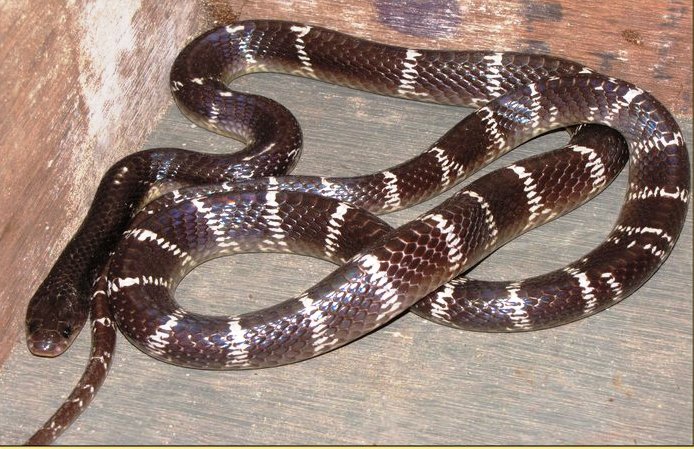
Many-banded Krait Bungarus wanghaotingi
The scientific name of the Many-banded Krait is Bungarus wanghaotingi. It is a species of reptile in the family Elapidae (cobras), order Squamata. The name dates from 1928.
- Scientific name
- Bungarus wanghaotingi Pope, 1928
- Common name
- Many-banded Krait
- Genus
- Bungarus
- Family
- Elapidae (Cobras)
- Order
- Squamata
- Class
- Reptilia
- Red List category
- LC Least Concern
- Recorded in
- 6 countries
- Name status
- accepted in the Catalogue of Life
Overview
Wikidata describes Bungarus wanghaotingi as “species of reptile”.
Classification of the Many-banded Krait
| Kingdom | Animalia |
|---|---|
| Phylum | Chordata |
| Subphylum | Vertebrata |
| Infraphylum | Gnathostomata |
| Parvphylum | Osteichthyes |
| Megaclass | Tetrapoda |
| Class | Reptilia (Reptile) |
| Order | Squamata (Snakes) |
| Suborder | Serpentes (Snakes) |
| Infraorder | Alethinophidia |
| Family | Elapidae (Cobras) |
| Genus | Bungarus (Deathpickers) |
| Species | Bungarus wanghaotingi Pope, 1928 |
Where the Many-banded Krait is found
Checklists and occurrence records place Bungarus wanghaotingi in 6 countries across Asia. GBIF holds 96 georeferenced records of it.
Countries
Regions and cities with the most records
- Yunnan, China 35
- Nan, Thailand 6
- Nam Định, Vietnam 3
- Nga Sơn, Vietnam 3
- Ninh Binh, Vietnam 3
- Yunjinghong, China 3
- Fujian, China
Range as the checklists state it
China (Hong Kong, Fujian), Laos, Vietnam, Myanmar
Southern Asia
A number beside a place is its count of GBIF occurrence records. A place without a number comes from a checklist alone. Records show where a species has been observed or collected, which can include escapes and vagrants.
Common names
English
- Many-banded Krait
- Wanghaoting's Krait
- Wang’s Krait
Names in 2 other languages
- Chinese
- 云南环蛇, 云南银环蛇, 银环蛇, 雨傘節雲南亞種
- German
- Vielgebänderter Krait
Synonyms
One other scientific name has been used for this species and is now treated as a synonym of Bungarus wanghaotingi.
- Bungarus multicinctus wanghaotingi Pope, 1928
Related species
-
 Common KraitBungarus caeruleus
-
 Banded KraitBungarus fasciatus
-
 Many-banded KraitBungarus multicinctus
-
 Blue KraitBungarus candidus
-
 Red-headed KraitBungarus flaviceps
-
 Sind KraitBungarus sindanus
-
 Greater Black KraitBungarus niger
-
 Ceylon KraitBungarus ceylonicus
Compare
Questions and answers
What is the scientific name of the Many-banded Krait?
The scientific name of the Many-banded Krait is Bungarus wanghaotingi. Written with its author, the full name is Bungarus wanghaotingi Pope, 1928.
Which family does the Many-banded Krait belong to?
Bungarus wanghaotingi belongs to the family Elapidae, in the order Squamata and the class Reptilia.
Where is the Many-banded Krait found?
Checklists and occurrence records place Bungarus wanghaotingi in 6 countries: China, Vietnam, Hong Kong, Thailand, Laos and Myanmar.
What is the conservation status of the Many-banded Krait?
The IUCN Red List category recorded for Bungarus wanghaotingi is Least Concern (LC).
What other names does the Many-banded Krait have?
Bungarus wanghaotingi is also known in English as Wanghaoting's Krait and Wang’s Krait.
Sources
Data
- Catalogue of Life, 2026-10-16 XR cc by
- Global Biodiversity Information Facility CC BY 4.0
- Wikidata CC0
- GeoNames CC BY 4.0
- Within the Catalogue of Life, this name comes from The Reptile Database cc by
References
- Some Plethodontid Salamanders from North Carolina and Kentucky with the description of a new race of Leurognathus. (1928). American Museum Novitates, 306, 1–19. https://bionames.org/references/81f32d1d4e664e7a3d65bc6728d07d43 Link where the name was published
- Pope, C. H. (1928). Four new snakes and a new lizard from South China. American Museum Novitates 325: 1-4.
- Smith, M. A. (1943). The Fauna of British India, Ceylon and Burma, Including the Whole of the Indo-Chinese Sub-Region. Reptilia and Amphibia. 3 (Serpentes). Taylor and Francis, London. 583 Pp.
- Glass, Bryan P. (1946). A collection of reptiles from Hunan and Anhwei provinces, China. Copeia 1946 (4): 249-252.
- Dowling, H.G., & Jenner, J.V. (1988). Snakes of Burma: checklist of reported species and bibliography. Smithsonian Herp. Inf. Serv. (76): 19 Pp.
- Kuch, U., & Schneyer, W. (1992). Erfahrungen bei der Terrarienhaltung von vier Arten nahrungsspezialisierter Giftnattern der Gattung Bungarus DAUDIN 1803 Teil II Bungarus multicinctus BLYTH 1861. Sauria 14 (1): 25-32.
- Zhao, E., & Adler, K. (1993). Herpetology of China. SSAR, Oxford/Ohio, 1-522.
- Chan-ard,T.; Grossmann,W.; Gumprecht,A. & Schulz,K. D. (1999). Amphibians and reptiles of peninsular Malaysia and Thailand - an illustrated checklist [bilingual English and German]. Bushmaster Publications, Würselen, Gemany, 240 Pp. [Book Review in Russ. J Herp. 7: 87].
- Lazell, J. D. (2002). The herpetofauna of Shek Kwu Chau, South Chinese Sea, with descriptions of two new colubrid snakes. Mem. Hong Kong Nat. Hist. Soc. 25: 82 Pp.
- Ziegler, T. (2002). Die Amphibien und Reptilien eines Tieflandfeuchtwald-Schutzgebietes in Vietnam. Natur Und Tier Verlag (Münster), 342 Pp.
- Orlov, N.; Ananjeva, A.; Ryabov, S. & Rao, D.-Q. (2003). Die Giftschlangen Südchinas. Reptilia (Münster) 8 (44): 30-36.
- Leviton, Alan E.; Guinevere O.U. Wogan; Michelle S. Koo; George R. Zug; Rhonda S. Lucas and Jens V. Vindum. (2003). The Dangerously Venomous Snakes of Myanmar Illustrated Checklist with Keys. Proc. Cal. Acad. Sci. 54 (24): 407–462.
- Orlov, N.; Ananjeva, A.; Ryabov, S. & Rao, D.-Q. (2003). Venomous snakes in Southern China. Reptilia (GB) (31): 22-29.
- Sokolov, A. Y. (2005). ON THE MORPHOFUNCTIONAL PECULIARITIES OF THE JAW APPARATUS OF OPHIOPHAGOUS ELAPID SNAKES AND ON THE SOME STAGES IN EVOLUTION OF ELAPIDAE. Herpetologia Petropolitana [SEH Meeting 2003], Ananjeva N.&O.Tsinenko (Eds.): 171 – 173.
- Zhao, E. M. (2006). The snakes of China [in Chinese]. Hefei, China, Anhui Sience & Technology Publ. House, Vol. I, 372 Pp., Vol. II (Color Plates), 280 Pp.
- Switak, Karl H. (2006). Adventures in Green Python Country. Natur Und Tier Verlag (Münster), 364 Pp.
- Roemer, K., & Mahyar-Roemer, M. (2006). Haltung, Nachzucht und Toxin des Indischen Kraits, Bungarus caeruleus (SCHNEIDER 1801). Elaphe 14 (1): 26-32.
- Nguyen, S.V., Ho, C.T. and Nguyen, T.Q. (2009). Herpetofauna of Vietnam. Chimaira, Frankfurt, 768 Pp.
- Jiang Y, Li Y, Lee W, Xu X, Zhang Y, Zhao R, Zhang Y, & Wang W. (2011). Venom gland transcriptomes of two Elapid snakes (Bungarus multicinctus and Naja atra) and evolution of toxin genes. BMC Genomics 2011, 12:1.
- Das, I. (2012). A Naturalist’s Guide to the Snakes of South-East Asia: Malaysia, Singapore, Thailand, Myanmar, Borneo, Sumatra, Java and Bali. Oxford J, Ohn Beaufoy Publishing.
- Laita, & Mark. (2013). Serpentine. Abrams and PQ Blackwell, Auckland, New Zealand, 200 Unnumbered Pages.
- Wallach, Van; Kenneth L. Williams, Jeff Boundy. (2014). Snakes of the World: A Catalogue of Living and Extinct Species. [type catalogue]. Taylor and Francis, CRC Press, 1237 Pp.
- Lillywhite, Harvey B. (2014). How Snakes Work: Structure, Function and Behavior of the World’s Snakes. Oxford University Press, New York, 256 Pp.
- O’Shea, M. (2018). The Book of Snakes. Ivy Press / Quarto Publishing, London,.
- Nguyen, Truong Quang; Tan Van Nguyen, Cuong The Pham, An Vinh Ong & Thomas Ziegler. (2018). New records of snakes (Squamata: Serpentes) from Hoa Binh Province, northwestern Vietnam. Bonn Zoological Bulletin 67 (1): 15–24.
This species in other databases
Page built on 26 November 2026. See how the catalog is made and all sources and licences.
Cite this page
ScientificNames.org. (2026). Bungarus wanghaotingi (Many-banded Krait). Retrieved November 26, 2026, from https://scientificnames.org/species/bungarus-wanghaotingi
“Bungarus wanghaotingi (Many-banded Krait).” ScientificNames.org, 2026, scientificnames.org/species/bungarus-wanghaotingi. Accessed 26 Nov. 2026.
ScientificNames.org. “Bungarus wanghaotingi (Many-banded Krait).” Accessed November 26, 2026. https://scientificnames.org/species/bungarus-wanghaotingi.
@misc{scientificnames_bungarus_wanghaotingi_many_banded_krait,
  author = {{ScientificNames.org}},
  title = {Bungarus wanghaotingi (Many-banded Krait)},
  year = {2026},
  url = {https://scientificnames.org/species/bungarus-wanghaotingi},
  note = {Accessed 2026-11-26}
}