Species · Spiders and other arachnids
Cheiracanthium falcatum
Cheiracanthium falcatum has no English name on record in the checklists used here. It is a species of arachnid in the family Cheiracanthiidae (long-legged sac spiders), order Araneae. The name dates from 2006.
- Scientific name
- Cheiracanthium falcatum Chen, Huang, Chen & Wang, 2006
- Genus
- Cheiracanthium
- Family
- Cheiracanthiidae (Long-legged Sac Spiders)
- Order
- Araneae
- Class
- Arachnida
- Recorded in
- 1 country
- Name status
- accepted in the Catalogue of Life
Overview
The species is endemic to Taiwan and widely distributed at elevations between 200 and 800 metres. It is distinguished from Cheiracanthium ningmingense by the male's thicker tibial apophysis.
Written 27 November 2026 from the sources listed below. Each statement was checked against the passage it cites; statements that could not be supported were removed.
Appearance
The species has a yellowish-brown coloration and a long, slender body. Its maxillae and chelicerae are brown, and it lacks a thoracic furrow.[1][2][3][4]
Females have a posterior depression on the epigyne. Their copulatory ducts form three spiral coils that descend toward the spermatheca.[5][6]
Males possess a finger-like tibial apophysis and a long, sickle-shaped cymbial spur on their pedipalps.[7][8]
Habitat
The species is endemic to Taiwan and widely distributed at elevations between 200 and 800 metres.[9][10]
Similar species
Cheiracanthium ningmingense most closely resembles Cheiracanthium falcatum. Males of Cheiracanthium falcatum can be distinguished by their thicker tibial apophysis.[11][12]
Classification of Cheiracanthium falcatum
| Kingdom | Animalia |
|---|---|
| Phylum | Arthropoda |
| Subphylum | Chelicerata |
| Class | Arachnida (Arachnid) |
| Order | Araneae (Spider) |
| Family | Cheiracanthiidae (Long-legged Sac Spiders) |
| Genus | Cheiracanthium (Longlegged Sac Spiders) |
| Species | Cheiracanthium falcatum Chen, Huang, Chen & Wang, 2006 |
Where Cheiracanthium falcatum is found
Checklists and occurrence records place Cheiracanthium falcatum in 1 country across Asia.
Countries
Range as the checklists state it
Taiwan
A number beside a place is its count of GBIF occurrence records. A place without a number comes from a checklist alone. Records show where a species has been observed or collected, which can include escapes and vagrants.
Common names
Names in 1 other language
- Chinese
- 鐮形紅螯蛛
Related species
-
 Agrarian Sac SpiderCheiracanthium inclusum
-
 Northern Yellow Sac SpiderCheiracanthium mildei
-
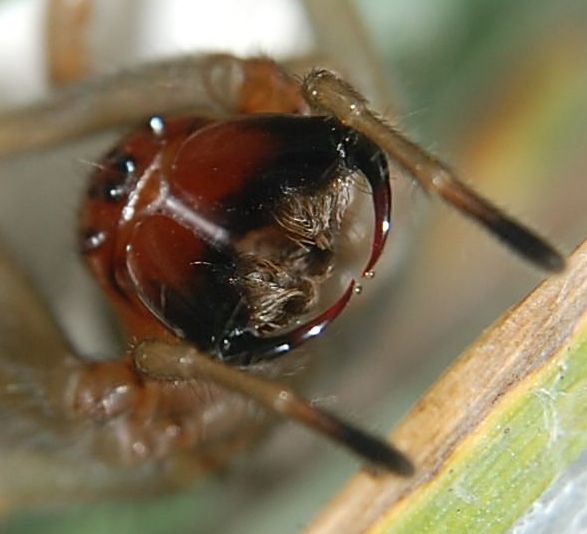 European Yellow Sac SpiderCheiracanthium punctorium
-
 Common House Sac SpiderCheiracanthium furculatum
-
 Two-Clawed Hunting SpiderCheiracanthium erraticum
-
 Cheiracanthium taiwanicum
- Cheiracanthium annulipes
- African Long-legged Sac SpiderCheiracanthium africanum
Compare
Questions and answers
Where is Cheiracanthium falcatum found?
The species is endemic to Taiwan and widely distributed at elevations between 200 and 800 metres.[9][10]
Which species most closely resembles Cheiracanthium falcatum?
Cheiracanthium ningmingense most closely resembles Cheiracanthium falcatum.[11]
How can male Cheiracanthium falcatum be distinguished from Cheiracanthium ningmingense?
Male Cheiracanthium falcatum has a thicker tibial apophysis.[12]
Sources
Passages the profile rests on
- The species has a yellowish-brown coloration. Source passage: “C. falcatum are yellowish brown in color” — English Wikipedia
- Its body is long and slender. Source passage: “with a long, slender body” — English Wikipedia
- Its maxillae and chelicerae are brown. Source passage: “brown maxilla and chelicerae.” — English Wikipedia
- The species lacks a thoracic furrow. Source passage: “They lack a thoracic furrow.” — English Wikipedia
- Females have a posterior depression on the epigyne. Source passage: “a posterior epigyneal depression” — English Wikipedia
- The female copulatory ducts form three spiral coils that descend toward the spermatheca. Source passage: “copulatory duct coils in three spirals leading downward to the spermatheca in the female vulva” — English Wikipedia
- Males possess a finger-like tibial apophysis on their pedipalps. Source passage: “a finger-like tibial apophysis” — English Wikipedia
- Males possess a long, sickle-shaped cymbial spur on their pedipalps. Source passage: “long sickle-shaped cymbial spur in the pedipalps of males.” — English Wikipedia
- The species is endemic to Taiwan. Source passage: “C. falcatum are endemic to Taiwan” — English Wikipedia
- The species is widely distributed at elevations between 200 and 800 metres. Source passage: “widely distributed at elevations between 200m and 800m.” — English Wikipedia
- Cheiracanthium ningmingense is the species that most closely resembles Cheiracanthium falcatum. Source passage: “They most resemble C. ningmingense” — English Wikipedia
- Male Cheiracanthium falcatum can be distinguished from Cheiracanthium ningmingense by having a thicker tibial apophysis. Source passage: “but may be distinguished by their thicker tibial apophysis in the male palpus.” — English Wikipedia
Data
- Catalogue of Life, 2026-10-16 XR cc by
- Wikidata CC0
- GeoNames CC BY 4.0
- Within the Catalogue of Life, this name comes from The World Spider Catalog cc by
References
- Chen, S. H., Huang, W. J., Chen, S. C. & Wang, Y. (2006). Two new species and one newly recorded species of the genus Cheiracanthium (Araneae: Miturgidae) from Taiwan. BioFormosa 41: 9-18. where the name was published
This species in other databases
Page built on 27 November 2026. See how the catalog is made and all sources and licences.
Cite this page
ScientificNames.org. (2026). Cheiracanthium falcatum. Retrieved November 27, 2026, from https://scientificnames.org/species/cheiracanthium-falcatum
“Cheiracanthium falcatum.” ScientificNames.org, 2026, scientificnames.org/species/cheiracanthium-falcatum. Accessed 27 Nov. 2026.
ScientificNames.org. “Cheiracanthium falcatum.” Accessed November 27, 2026. https://scientificnames.org/species/cheiracanthium-falcatum.
@misc{scientificnames_cheiracanthium_falcatum,
  author = {{ScientificNames.org}},
  title = {Cheiracanthium falcatum},
  year = {2026},
  url = {https://scientificnames.org/species/cheiracanthium-falcatum},
  note = {Accessed 2026-11-27}
}